(By Quratulain Mahnoor)
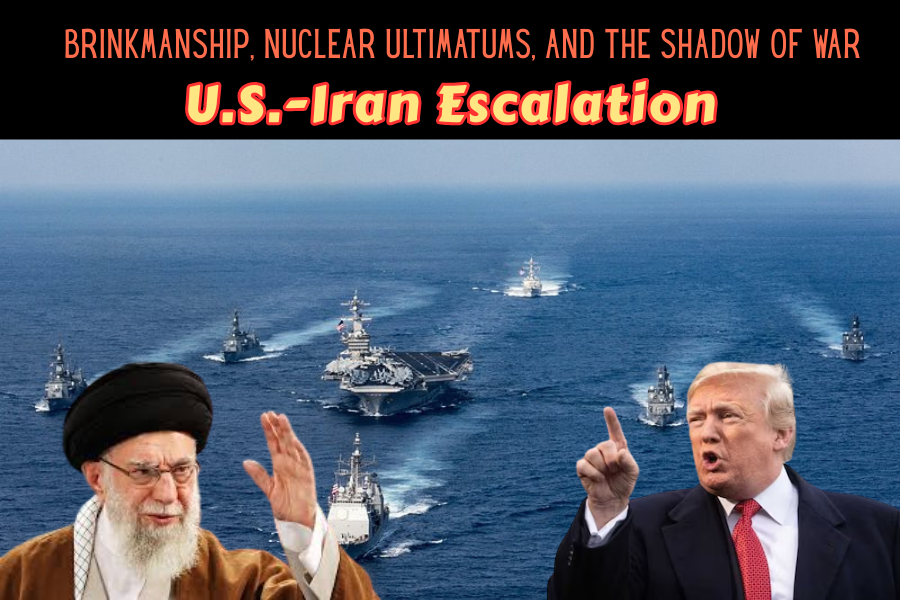
As tensions in the Middle East reach a fever pitch in late January 2026, U.S. President Donald Trump has issued stark warnings to Iran: negotiate a nuclear deal swiftly or face consequences far more severe than previous actions. In a Truth Social post on January 28, Trump declared, “Hopefully Iran will quickly ‘Come to the Table’ and negotiate a fair and equitable deal – NO NUCLEAR WEAPONS – one that is good for all parties. Time is running out, it is truly of the essence!” He referenced a “massive armada” heading toward the region and cautioned that the “next attack will be far worse” than the June 2025 strikes known as Operation Midnight Hammer, which targeted Iranian nuclear facilities.
This rhetoric coincides with a significant U.S. military buildup in the Gulf, Iran’s vows of immediate and powerful retaliation, and the European Union’s January 29 decision to designate Iran’s Islamic Revolutionary Guard Corps (IRGC) as a terrorist organization. The situation blends coercive diplomacy—maximum pressure to extract concessions—with the genuine danger of miscalculation, potentially spiraling into limited precision strikes, a broader regional conflict involving proxies and allies, or—though less likely in the short term—a grudging return to indirect negotiations.
Background: From JCPOA Collapse to Renewed Brinkmanship
The current crisis did not emerge in a vacuum. It stems directly from the U.S. withdrawal from the 2015 Joint Comprehensive Plan of Action (JCPOA) in May 2018 during Trump’s first term. That decision, driven by concerns over the deal’s “sunset clauses,” ballistic missile provisions, and Iran’s regional activities, led to the reimposition of sweeping “maximum pressure” sanctions targeting Iran’s oil exports, banking sector, and key industries. Tehran responded by gradually breaching JCPOA limits: enriching uranium to higher levels (now approaching weapons-grade thresholds), expanding centrifuge cascades, and restricting IAEA access.
The June 2025 U.S.-Israeli strikes—launched amid escalating exchanges with Israel—hit key nuclear sites at Natanz, Fordow, and Arak. Trump claimed these operations “devastated” Iran’s program, but open-source assessments indicate partial reconstitution: surviving underground facilities, dispersed stockpiles, and accelerated covert work have kept the breakout timeline alarmingly short (estimates range from weeks to months for enough fissile material for one bomb).
Compounding this, late 2025 and early 2026 witnessed massive nationwide protests in Iran—the most severe since 1979. Sparked by economic collapse (hyperinflation, rial devaluation exceeding 90% in recent years, energy shortages, and widespread corruption), the unrest exploded after security forces killed protesters in several cities. The regime’s crackdown was brutal: live ammunition, mass arrests, and internet blackouts concealed the scale. Casualty estimates vary widely—official Iranian figures cite around 3,000–3,100 deaths (including security forces), while human rights groups and UN sources report 5,000–36,500 killed, with massacres concentrated on January 8–9, 2026. This internal fragility has made the regime more vulnerable but also more defiant, viewing external pressure as an existential threat designed to exploit domestic unrest.
Trump’s current demands reportedly go beyond past positions: a permanent end to all uranium enrichment on Iranian soil, destruction of existing stockpiles and advanced centrifuges, severe limits on ballistic missiles, and verifiable curbs on support for proxy militias (Hezbollah, Houthis, Iraqi groups, Syrian forces). Tehran sees these as regime-change demands in disguise—non-starters that would dismantle core pillars of its security doctrine.
The Military Dimension: U.S. Buildup and Iranian Counter-Posture
The U.S. has executed one of its most rapid and visible reinforcements in the region since the 2025 strikes. Key elements include:
- The USS Abraham Lincoln carrier strike group (CVN-72), which transited from the South China Sea/Philippine waters and arrived in the Gulf of Oman/Middle East by late January 2026. It carries Carrier Air Wing Nine: F-35C stealth fighters (VMFA-314), F/A-18E/F Super Hornets, EA-18G Growlers for electronic attack, E-2D Hawkeyes for airborne early warning, and support helicopters—adding thousands of personnel and overwhelming strike capacity.
- Surface escorts: At least three guided-missile destroyers (e.g., Arleigh Burke-class with Tomahawk missiles and Aegis defenses), bringing total warships in theater to 10+.
- Air Force assets: Approximately 35 F-15E Strike Eagles deployed to Muwaffaq Salti Air Base in Jordan (from the 494th Expeditionary Fighter Squadron at RAF Lakenheath), KC-135/KC-46 tanker surges to Al Udeid (Qatar), Patriot and THAAD missile-defense batteries repositioned across Gulf states, MQ-9 Reaper drones, P-8A Poseidon maritime patrol aircraft, and reconnaissance platforms.
- CENTCOM-led multi-day air readiness exercises to demonstrate interoperability and rapid-response capability.
This posture serves multiple purposes: deterrence against Iranian preemption, signaling resolve to both Tehran and regional allies, and creating credible options for operations ranging from limited strikes (e.g., B-2 or F-35C precision hits on nuclear reconstitution sites, missile depots, or IRGC command nodes) to more expansive campaigns targeting leadership or proxy infrastructure to exploit internal divisions.
Iran’s response emphasizes asymmetric warfare. Senior officials, including Foreign Minister Abbas Araghchi, have stated forces are “with their fingers on the trigger,” prepared for “immediate and powerful” retaliation. Capabilities include:
- Medium-range ballistic missiles (e.g., Fateh-110, Shahab-3 variants) capable of saturating U.S. bases like Al Udeid, Bahrain, or UAE facilities.
- Drone swarms (recent acquisitions pushing strategic drone numbers over 1,000), sea mines, fast-attack boats for swarming tactics in the Strait of Hormuz.
- Proxy activation: Hezbollah in Lebanon, Houthis in Yemen (already disrupting Red Sea shipping), and Iraqi militias targeting U.S. forces.
While U.S. forces enjoy qualitative superiority in air and naval domains, Iran’s “anti-access/area-denial” (A2/AD) strategy could inflict significant costs—oil price spikes above $150/barrel, disrupted global shipping, and escalation drawing in Israel or Gulf states.
Diplomatic and Multilateral Layers: Pressure Points and Leverage
The EU’s January 29, 2026, terrorist designation of the IRGC—following years of hesitation—marks a major shift. Spearheaded by Italy and now supported by France and Spain, it imposes asset freezes, travel bans, and financial restrictions on a entity central to Iran’s military, economic, and political power. EU High Representative Kaja Kallas stated, “Repression cannot go unanswered,” aligning the bloc closer to U.S., Canadian, and Australian positions amid outrage over the protest massacres.
Broader international context shows fragmentation: Arab Gulf states hedge (quietly welcoming pressure on Iran but fearing war’s fallout), Israel urges decisive action against nuclear threats, and mediation attempts (via Oman, Qatar, or Ankara) have stalled. Trump’s unilateral “America First” approach strains transatlantic ties but exploits Iran’s isolation and domestic weakness.
Iran insists on talks “on equal footing” without coercion. Araghchi has reiterated willingness for a “mutually beneficial, fair and equitable nuclear deal” preserving peaceful nuclear rights while guaranteeing no weapons—but only absent threats or maximalist demands. Back channels remain open, hinting at potential off-ramps.
Scenarios and Risks: What Could Happen Next?
Several plausible paths forward, ranked by probability:
- Best case (low probability, ~15–20%): Domestic fragility forces Tehran to offer partial concessions (e.g., enrichment caps, IAEA access) via indirect talks (Oman/Qatar), trading for phased sanctions relief and averting strikes.
- Most likely near-term (~50–60%): Prolonged brinkmanship culminates in limited U.S. strikes—precision operations against reconstituted nuclear/missile sites or IRGC targets—to degrade capabilities, signal resolve, and embolden remaining protesters without triggering full war.
- Worst case (~20–30%): Miscalculation spirals—Iranian retaliation (Hormuz closure, proxy barrages) draws U.S./Israeli responses, regional escalation, oil shocks, and civilian casualties. Full regime change via air power alone is improbable, echoing Iraq 2003 or Libya 2011 pitfalls: high costs, power vacuums, and long-term instability.
Escalation bolsters Trump’s domestic image as a strong leader but risks U.S. casualties, economic blowback (inflation from energy prices), and alliance fatigue. Iran’s pride and survival instincts could provoke defiance, even if rationally disadvantageous.
Conclusion: Lessons in Statecraft and the Path Forward
This standoff starkly tests the limits of coercive diplomacy versus negotiated compromise. Trump’s revival of “peace through strength”—echoing Reagan’s pressure on the Soviets or Nixon’s madman theory—aims to exploit Iran’s vulnerabilities for concessions. Yet history warns that brinkmanship in the Middle East often backfires: misjudged red lines, proxy entanglements, and unintended escalation have repeatedly destabilized the region.
De-escalation requires quiet assurances—perhaps via trusted intermediaries—that talks can address mutual concerns without humiliation. Any viable deal must balance non-proliferation imperatives with Iran’s security needs and economic relief. Absent creative diplomacy, the region risks another destructive cycle with profound global consequences: energy market chaos, nuclear proliferation incentives for others, and strained U.S. credibility.
Monitor key indicators in the coming days: additional force deployments, proxy movements, protest flare-ups, or subtle diplomatic outreach. In the art of statecraft, credible threats can pry open negotiating doors—but only if both parties ultimately perceive greater value in peace than in the abyss of war. The next moves will determine whether this moment becomes a breakthrough or a breakdown.