(By Khalid Masood)
Introduction: A Tale of Two Headlines
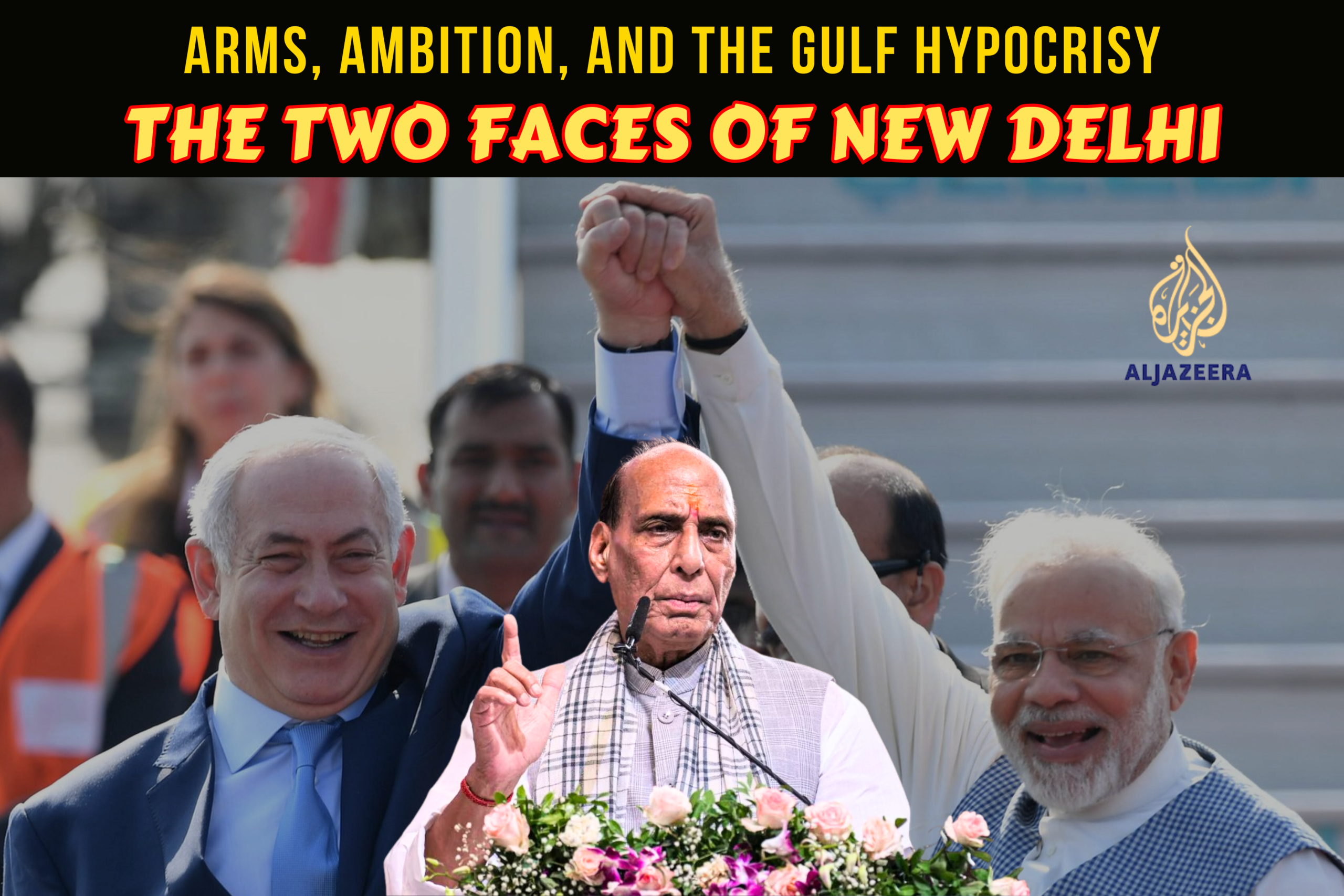
On 23 May 2026, Indian Defence Minister Rajnath Singh stood before an audience in Shirdi, Maharashtra, and delivered a vision of India’s future that was as grandiose as it was revealing. Inaugurating an ammunition production facility, Singh declared that within 25 to 30 years, India would emerge as the world’s largest arms exporter—a military-industrial titan whose weapons would shape global security dynamics. “No power can now stop it from being the biggest exporter,” he boasted, adding that India had transformed from a “weapons importer” into a rising arms superpower.
Yet even as Singh’s words echoed through the Maharashtra auditorium, another story was breaking—one that exposed the uncomfortable reality behind New Delhi’s polished rhetoric. On the very same day, Qatar’s Al Jazeera published a meticulous investigative report that laid bare India’s role in arming one of the world’s most controversial militaries. Between October 2023 and October 2025, the investigation revealed, India had become Israel’s second-largest arms supplier after the United States, providing nearly 26 percent of the Jewish state’s military imports during a period of devastating conflict in Gaza.
The juxtaposition was staggering. While Indian leaders spoke of indigenous manufacturing and strategic autonomy, Indian-made weapons were flowing into a war zone that had drawn global condemnation. And while Indian diplomats continued to court Gulf nations and the broader Islamic world with promises of partnership and mutual respect, Indian military hardware was being deployed in a conflict that had inflamed Muslim sentiment across the globe. The contradiction was not merely embarrassing—it was emblematic of a deeper hypocrisy that has come to define India’s foreign policy posture.
The Gulf Gambit: Smiling for the Cameras, Selling for the War
India’s engagement with the Gulf and wider Islamic world has long been framed as a partnership built on trust, energy security, and shared economic interests. New Delhi has meticulously cultivated an image of itself as a reliable ally to Muslim-majority nations—from Saudi Arabia and the UAE to Qatar and Oman—presenting India as a stable democratic power in an increasingly volatile region. Indian leaders have spoken warmly of “historic ties” and “civilizational connections,” securing billions in energy investments and remittance flows that sustain India’s economy.
But the Al Jazeera investigation tears away this diplomatic veil. The report documented that between October 2023 and October 2025, Israel imported approximately $886 million worth of military equipment from 51 countries. India’s share of this arsenal was staggering: roughly one-quarter of all Israeli military imports during this period originated from Indian suppliers. This was not a token trade relationship; it was a strategic lifeline provided by New Delhi to Tel Aviv at the height of the Gaza conflict—a war that claimed tens of thousands of Palestinian lives and triggered unprecedented outrage across the Islamic world.
The evidence on the ground was even more damning. As residents of Gaza’s Nuseirat refugee camp picked through the rubble of a UN school shelter after an Israeli airstrike on 6 June 2024 that killed at least 33 people, they found fragments of rockets with unmistakable markings: “Made in India.”
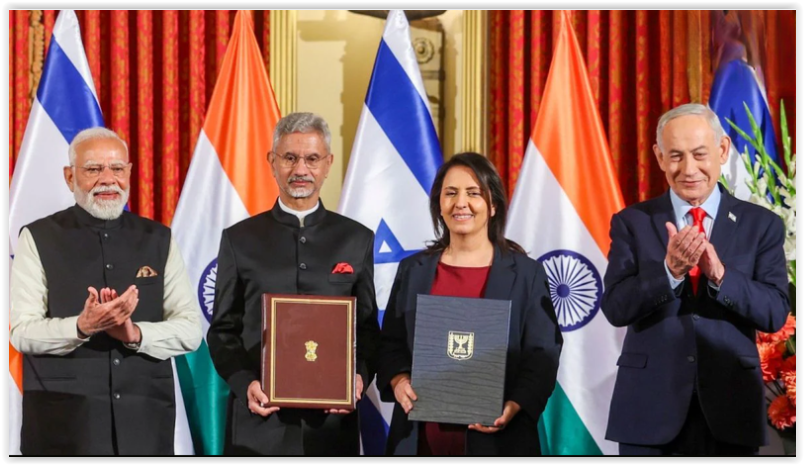
This is the essence of New Delhi’s Gulf hypocrisy: the ability to maintain two entirely separate narratives simultaneously. To the Islamic world, India presents itself as a neutral, even sympathetic, partner—a rising power that understands the concerns of Muslim nations. To Israel, India is a dependable arms supplier, willing to sustain its military campaigns regardless of the human cost. The duplicity is not subtle; it is systemic.
Strategic Practice vs. Diplomatic Messaging: The Hypocrisy Index
The contradiction identified by observers is not merely a diplomatic misstep—it is a structural feature of India’s foreign policy architecture. New Delhi has mastered the art of saying one thing to the Muslim world while doing precisely the opposite where Israel is concerned. Indian officials speak of “shared values” and “anti-colonial solidarity” when addressing Arab audiences, yet their strategic practice reveals a cold, calculated alignment with a military power actively engaged in the occupation and bombardment of Palestinian territories.
As Middle East expert Omair Anas observed: “The ruling Bharatiya Janata Party’s pro-Israeli gestures are no secret to Arab diplomats. They knew that a BJP-led government in New Delhi would start a new chapter of relations with Israel beyond the traditional ‘balancing act.‘”
This gap between messaging and practice has not gone unnoticed in the Gulf. While official government-to-government relations remain cordial—driven by the hard realities of energy imports and labour remittances—there is a growing awareness among strategic elites in the Islamic world that India’s friendship comes with invisible conditions. New Delhi wants Gulf oil, Gulf investment, and Gulf diplomatic support, but it is unwilling to pay the political price of distancing itself from Israel’s military adventures. Instead, India has attempted to have it both ways: extracting maximum benefit from its Islamic partnerships while providing material support to a state that many of those same partners consider an existential threat to Palestinian—and by extension, Muslim—dignity.
The Al Jazeera report is particularly damaging because it quantifies India’s complicity. This was not a clandestine operation hidden from public view; it was a sustained, large-scale transfer of military equipment that accounted for a quarter of Israel’s import needs. The scale of the trade suggests not opportunism but strategic commitment—a deliberate choice by New Delhi to prioritise its defence relationship with Israel over its stated solidarity with the Muslim world.

The Corporate Architects of Complicity
India’s arms trade with Israel is not merely a government-to-government affair. It is underpinned by a web of corporate partnerships that bind India’s business oligarchs to Israel’s military-industrial complex.
Chief among them is the Adani Group, led by Gautam Adani—India’s second-richest man and a figure whose proximity to Prime Minister Narendra Modi has enabled him to secure favourable deals both at home and abroad. In 2016, Adani formed a joint venture with Israel’s Elbit Systems to manufacture Hermes 900 drones domestically, establishing a production facility in Hyderabad. Elbit Systems is widely known for its complicity in war crimes against Palestinians, with its surveillance systems employed along walls and checkpoints in occupied Palestine. By February 2024, the Adani-Elbit facility had reportedly produced over 20 Hermes 900 drones for Israel.
Other Indian companies have jumped onto the bandwagon. Premier Explosives, the state-owned Munitions India, Bharat Forge, and Tata have all been implicated in supplying weapons, components, or infrastructure support to Israel’s war machine. As author Azad Essa noted: “Adani’s joint ventures with Israeli arms manufacturers are not just about economic opportunity, but play a central role in consolidating India’s military-industrial complex with Israel.”
Table 1: India’s Defence Exports Trajectory — From Importer to Genocide Enabler
| Fiscal Year | Defence Exports (in US Million Dollars) | Key Milestones |
|---|---|---|
| 2013-14 | $114.3M | Baseline year; India primarily an arms importer |
| 2016-17 | $223.9M | Opening of defence sector under Modi government |
| 2018-19 | $1,500.0M | 700% jump in two years |
| 2022-23 | $1,951.2M | Exports to 85 nations; 10-fold increase from 2016-17 |
| 2023-24 | $2,540.1M | 32.5% YoY growth |
| 2024-25 | $2,846.0M | All-time high; 34x increase over decade |
| 2025-26 | $4,520.5M | Record year; 62.66% growth over previous year |
Source: Ministry of Defence, Government of India; Press Trust of India
The trajectory is unmistakable: India’s defence export ambitions have exploded under the Modi government. But the dark underbelly of this “success story” is that a significant portion of this growth is fuelled by complicity in genocide. While Rajnath Singh dreams of India becoming the world’s largest arms exporter, his government is busy ensuring that Indian weapons find their way into the hands of an occupying force systematically destroying Palestinian lives.
Table 2: India’s Gulf Hypocrisy — Narrative vs. Reality
| Dimension | India’s Public Narrative to Gulf/Islamic World | India’s Actual Practice with Israel |
|---|---|---|
| Diplomatic Posture | “Historic ties,” “shared values,” “civilizational connections” with Muslim nations | Deep strategic alliance; 34% of Israel’s arms exports go to India (2020-24) |
| Palestine Position | Officially supports “two-state solution” with East Jerusalem as Palestinian capital | Abstained from UN ceasefire resolution (April 2024) that called for arms embargo on Israel |
| Arms Trade | Claims “self-reliance” and “Atmanirbhar Bharat” rhetoric | Supplied ~26% of Israel’s military imports during Oct 2023 – Oct 2025; Indian-made rockets found in Gaza rubble |
| Domestic Response to Gaza | Claims democratic values and freedom of expression | Pro-Palestinian activists beaten, detained, labelled “anti-nationals”; social media posts supporting Palestine lead to arrests |
| Supreme Court | Claims independent judiciary | Dismissed petition to halt arms exports to Israel, citing lack of jurisdiction |
| Trade Unions | Ignored or suppressed | Water Transport Workers Federation (3,500+ workers) refused to load/unload arms to Israel; CITU condemned genocide complicity |
| Key Companies Involved | — | Adani-Elbit (Hermes 900 drones), Premier Explosives, Munitions India (state-owned), Tata, Bharat Forge |
| Timeline of Complicity | — | Sustained supply throughout Gaza genocide (Oct 2023 – Oct 2025); over 20 Hermes 900 drones produced for Israel by Feb 2024 |
Source: Al Jazeera Investigation (May 2026); New Internationalist (Jan 2025); 360info/Qantara (2024)
The Ideological Engine: Hindutva and Zionism — Brothers in Arms
The India-Israel arms relationship is not merely transactional; it is ideological. As political commentator Apoorvanand observed: “Hindutva, as a Hindu supremacist ideology, envisions the creation of a Hindu nation and draws inspiration from Zionism. Both ideologies are rooted in the belief of a distinct and superior group entitled to their homeland.” He added: “Hindutva supporters admire Zionism because they see it as a successful model of subjugating and controlling a Muslim population.“
This ideological affinity explains why India’s ruling establishment has been so brazen in its support for Israel. Hashtags like #IndiaStandsWithIsrael and #ISupportIsrael have trended on Indian social media, with many expressing admiration for Israel’s actions in Gaza. This support is often intertwined with anti-Muslim rhetoric and hatred for Palestinians, which in turn helps in garnering acceptability for arms trading.
The domestic crackdown on dissent has been equally revealing. Since 7 October 2023, protests in India have erupted in support of both Palestine and Israel. However, the authorities have reacted very differently to these demonstrations. Pro-Palestinian activists have faced severe crackdowns, while pro-Israel rallies have proceeded without interference. As Sant Kumar, a PhD scholar at Delhi’s Jamia Millia Islamia University, stated: “The core demand is an arms embargo on Israel and an end to India’s arms exports, which fuel the genocide in Gaza. Our volunteers are beaten, detained, and labelled anti-nationals and terror sympathizers simply for standing up for Palestine.“
Even India’s judiciary has failed the test of conscience. When a group of concerned citizens—including judges, diplomats, writers, and economists—approached the Supreme Court to cancel licences for arms exports to Israel, the court dismissed the petition, claiming such matters were beyond judicial purview. Social activist Harsh Mander’s response was scathing: “The court may lack jurisdiction over Israel, but it has the authority to revoke export licences that contribute to crimes against humanity.”
The workers, at least, showed moral clarity. The Water Transport Workers Federation (WTWF), representing over 3,500 workers at 11 of India’s major ports, announced it would refuse to load or unload arms cargoes bound for Israel. Their general secretary, T Narendra Rao, declared: “We decided to boycott any ship carrying arms to Israel. We will not co-operate with that.”
Similarly, Tapan Sen, General Secretary of the Centre of Indian Trade Unions (CITU), stated: “We will not get our hands dirty in this genocide. We call upon the Indian state to halt all arms trade with Israel that is being used against children.”
Operation Sindoor and the Militarization of Indian Rhetoric
The context of Rajnath Singh’s Shirdi speech adds another layer of concern to this already troubling picture. The Defence Minister’s remarks did not occur in a vacuum. They came in the aftermath of “Operation Sindoor”—the aerial confrontation between India and Pakistan in May 2025 that pushed South Asia to the brink of wider war. Rather than adopting a posture of de-escalation, Indian officials have repeatedly asserted that the operation remains “active,” signalling a continued appetite for military confrontation.
This militarized strategic posture is reinforced by the increasingly belligerent rhetoric emanating from sections of India’s political and security establishment. In October 2025, the Indian Army Chief reportedly threatened to “wipe Pakistan off the map,” cautioning that India would not tolerate threats to its existence.
Such language, directed at a nuclear-armed neighbour, reveals a dangerous comfort with escalation—a willingness to treat South Asia’s precarious nuclear balance with casual disregard.
When viewed alongside the arms-to-Israel revelation, this rhetoric paints a portrait of an India that is not merely ambitious but aggressively militarized. New Delhi’s vision of becoming the world’s largest arms exporter is not a neutral economic objective; it is an extension of a strategic culture that views military force as the primary currency of international influence. And if India is willing to arm Israel during an active genocide—while simultaneously claiming friendship with the Muslim world—there is little reason to believe it will exercise restraint in its own neighbourhood.
The Cost of Credibility
India’s Gulf hypocrisy carries a price that New Delhi appears unwilling to acknowledge. Trust, once eroded, is not easily rebuilt. The Islamic world may continue to engage with India for pragmatic reasons—energy needs, trade volumes, and the logic of realpolitik do not disappear overnight—but the illusion of shared values has been shattered. Muslim-majority nations are increasingly sophisticated in their assessment of global powers, and they are capable of distinguishing between genuine partnership and extractive opportunism.
Moreover, India’s conduct undermines its own long-term strategic interests. A nation that aspires to global leadership cannot indefinitely sustain a foreign policy built on contradictory foundations. The attempt to simultaneously arm Israel and befriend the Muslim world is not sustainable diplomacy; it is a tightrope walk over a deepening chasm. As Omair Anas warned: “Selling ammunition to Israel during a war showcases arms exports as a political statement.”
Eventually, New Delhi will be forced to choose—and the longer it delays that choice, the more costly the reckoning will be.
Conclusion: A Reckoning Deferred
Rajnath Singh’s boast in Shirdi was revealing not merely for its ambition, but for its arrogance. The claim that “no force in the world” could prevent India’s rise as an arms superpower carried an implicit message: India would pursue its military-industrial objectives regardless of the moral or diplomatic consequences. When read alongside the Al Jazeera investigation, the statement acquires a darker hue. India does not merely want to sell weapons; it wants to sell them without accountability—to profit from conflict while maintaining the fiction of neutrality.
The Gulf and the wider Islamic world now face an unenviable task: navigating a relationship with a power that offers economic opportunity but practices strategic betrayal. For Pakistan and other regional stakeholders, the lesson is equally clear. An India that arms Israel while smiling at Muslims, that threatens nuclear neighbours while preaching stability, and that dreams of global military dominance while ignoring the responsibilities that accompany power—is not a partner to be trusted, but a challenge to be managed.
New Delhi’s hypocrisy is no longer a matter of speculation. It is documented, quantified, and increasingly undeniable. The only question remaining is how long the Islamic world—and the broader international community—will continue to pretend otherwise.