(By Khalid Masood)
INTRODUCTION: THE PERFECT STORM
The Iran nuclear question has entered its most volatile phase in over a decade. Despite multiple rounds of indirect negotiations throughout early 2026, US and Iranian officials remained locked in a strategic stalemate. The February–April diplomatic cycles, initially hosted in Muscat and Geneva, failed to yield a breakthrough. Yet, a historic shift occurred in April 2026, when Washington and Tehran agreed to direct face-to-face talks in Islamabad, Pakistan. Facilitated by Islamabad’s leadership, the marathon 21-hour session marked the first direct diplomatic engagement between the two nations since 2015. Although it concluded without a formal agreement, it demonstrated a willingness to bypass traditional Western intermediaries and explore alternative diplomatic pathways.
The June 2025 military exchanges between Israel and Iran, widely termed the “Twelve-Day War”, proved a harsh geopolitical reality: kinetic operations can degrade physical infrastructure, but they cannot erase technical knowledge or strategic intent. Iran’s nuclear breakout time remains estimated at one to three months, with some assessments warning it could compress to under a week. Yet, weaponisation would still require six to eighteen months of fissile material processing, device design, and delivery integration. The International Atomic Energy Agency (IAEA) cannot verify whether Tehran has suspended all enrichment-related activities, leaving policymakers to navigate a widening intelligence vacuum.
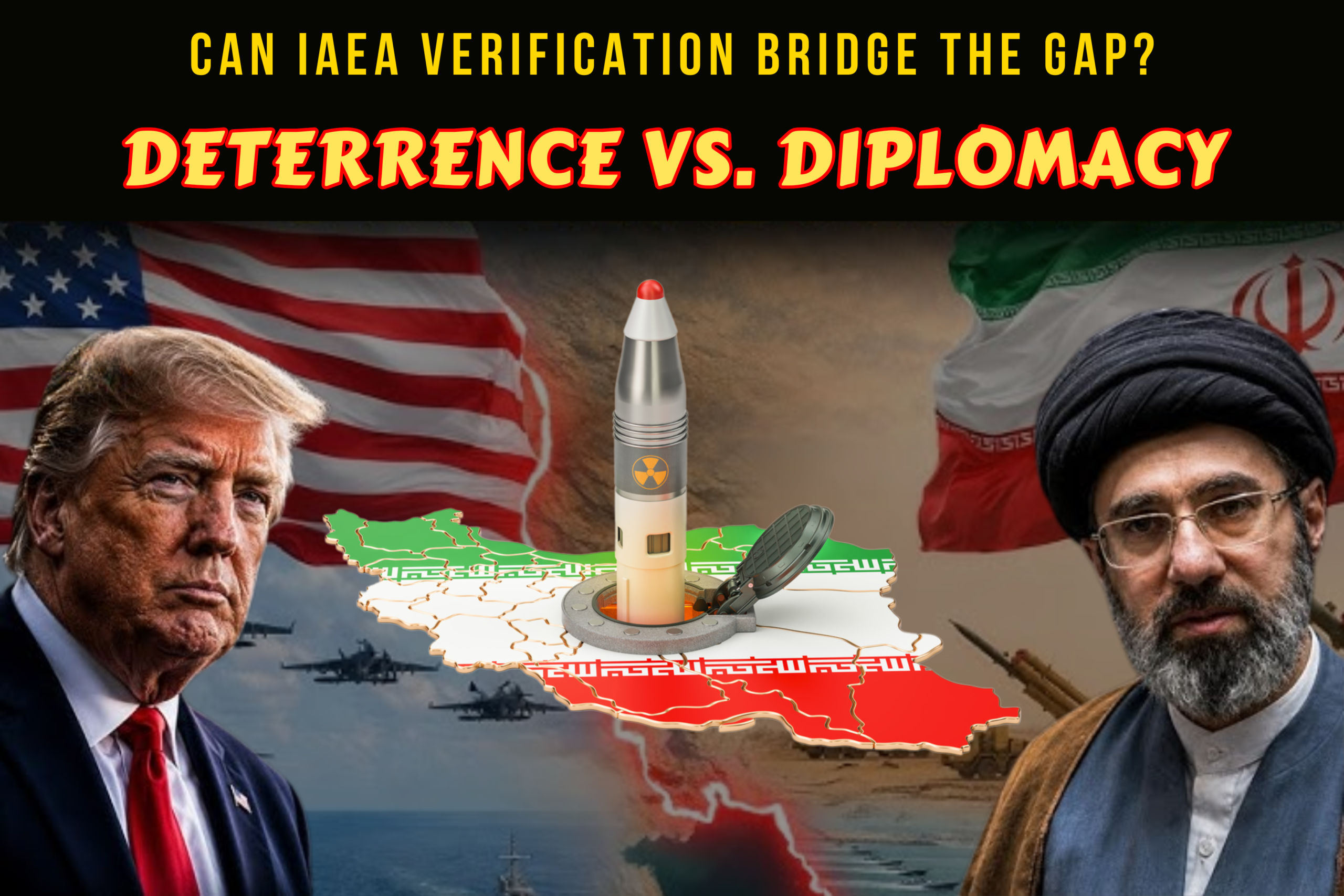
At the heart of this impasse lies a deceptively simple question: can robust, mutually acceptable verification mechanisms reconcile competing demands for absolute security and uncompromised sovereignty? Military deterrence has proven insufficient to reset the diplomatic clock, whilst diplomatic frameworks lack the trust necessary for implementation. What remains is a fragile bridge being constructed by neutral mediators, most notably Pakistan, whose diplomatic persistence has kept channels open when traditional backchannels collapsed. This article examines the technical, political, and geostrategic dimensions of the verification challenge, assessing whether transparency can serve as the bridge between deterrence and diplomacy in 2026 and beyond.
THE CURRENT STATE OF IRAN’S NUCLEAR PROGRAMME
Iran’s nuclear infrastructure exists in a state of deliberate ambiguity. Prior to the June 2025 strikes, Tehran was enriching uranium to 60 per cent purity at multiple sites. Iranian officials maintain that enrichment levels up to 60 per cent serve legitimate civilian and scientific purposes, including advanced medical isotope production and materials research. While Western non-proliferation analysts note that such concentrations have limited commercial utility, Tehran argues that the technical threshold is dictated by domestic scientific requirements rather than weapons intent. Post-strike assessments indicate that whilst surface facilities at Natanz and peripheral research centres sustained damage, the deeply fortified Fordow enrichment plant and underground conversion facilities near Isfahan remained largely intact. Satellite imagery and intelligence intercepts suggest that significant quantities of highly enriched uranium cylinders were relocated to secure, undisclosed locations ahead of the strikes.
Estimates of Iran’s unaccounted HEU stockpile range between 440 and 540 kilograms. At 60 per cent enrichment, this material is sufficient, following further isotopic separation, to produce multiple nuclear weapon cores. The IAEA, however, lacks continuous monitoring access to four of Iran’s declared enrichment sites as of early 2026. Without inspector presence, real-time camera feeds, and environmental sampling, the Agency’s ability to verify baseline inventories has been severely compromised.
The debate over Iran’s breakout timeline reflects deeper uncertainties about its technical readiness. Whilst fissile material production remains the most time-consuming phase of weaponisation, Iran has already mastered centrifuge operation, uranium conversion, and metallurgical processing. Weaponisation activities would require additional infrastructure and testing. US intelligence assessments consistently note that whilst Iran’s physical infrastructure has been disrupted, its scientific and engineering base remains intact. The timeline for a functional nuclear weapon, therefore, is less a question of capability and more a question of political decision.
DETERRENCE STRATEGIES: THE MILITARY APPROACH
Deterrence in the Iranian context operates on multiple levels: regional, great-power, and domestic. Israel’s security doctrine has long relied on the principle of qualitative military edge and the implicit threat of disproportionate retaliation, often framed through the lens of the “Samson Option”. The June 2025 strikes were a calibrated demonstration of this doctrine: targeted, limited in scope, and designed to degrade rather than eliminate. Israeli red lines were clear: end all enrichment, dismantle critical facilities, and remove HEU stockpiles. Yet, the operational aftermath revealed a fundamental limitation of kinetic deterrence against a dispersed, knowledge-intensive programme.
The United States has pursued a complementary posture, combining forward naval deployments in the Persian Gulf and Caribbean with targeted sanctions enforcement and diplomatic pressure. In February 2026, US military assets were repositioned to deter escalation, whilst Washington issued explicit warnings regarding infrastructure retaliation should Iran attempt to close or weaponise the Strait of Hormuz. The underlying logic remains traditional: deny Iran the capability to cross the nuclear threshold, impose unacceptable costs for aggression, and preserve regional stability.
Yet deterrence has failed to produce strategic clarity for three interrelated reasons. First, Iran’s missile programme continues to expand, with Tehran openly pursuing an arsenal designed for target saturation and anti-access/area denial capabilities. Tehran frames this expansion as a sovereign defensive imperative, citing historical precedents of external military intervention and the need to deter regime-change scenarios. Iranian defence doctrine explicitly positions ballistic capabilities as a non-negotiable pillar of national security, independent of nuclear negotiations. Second, Tehran has widened its retaliation calculus beyond Israel, explicitly threatening regional US assets and allied infrastructure. Third, and most critically, military action severed the continuity of IAEA monitoring. The very strikes intended to degrade Iran’s nuclear capability created an information blackout, forcing intelligence agencies to rely on fragmented satellite data and signals intercepts. In the nuclear domain, uncertainty breeds worst-case assumptions, which in turn fuel escalation cycles. Deterrence, paradoxically, has undermined the verification architecture it seeks to protect.
DIPLOMATIC TRACK: THE NEGOTIATION MAZE
Diplomacy has proceeded through a fragmented, multi-track process, with Pakistan emerging as the most consistent facilitator. Indirect talks began in Oman in April 2025, followed by rounds in Muscat (February 6, 2026), at Oman’s embassy in Switzerland (February 17), and in Geneva (February 26). A brief two-week ceasefire in April 2026, brokered by Islamabad, provided a temporary diplomatic window that directly enabled the historic direct talks in Pakistan. The marathon session, lasting 21 hours, focused on ceasefire implementation, humanitarian access, and preliminary nuclear verification frameworks. Whilst no final agreement emerged, the talks established a precedent for direct engagement and produced a joint commitment to continue dialogue through neutral intermediaries. The venue choice signalled Tehran’s willingness to engage in a Muslim-majority, non-Western setting, potentially broadening the diplomatic toolkit for future rounds.
Washington’s position is anchored in what it terms an “indefinite deal”: the complete and verifiable dismantlement of Iran’s enrichment infrastructure, the shutdown of Fordow, Natanz, and Isfahan facilities, and the transfer of all enriched uranium stockpiles out of Iranian territory. Sanctions relief would be conditional, incremental, and tied to verified milestones.
Tehran’s stance is equally uncompromising on core principles. Iranian officials consistently reject any permanent restrictions on enrichment, framing it as a sovereign right under the Nuclear Non-Proliferation Treaty (NPT). Missile limitations and regional proxy activities are explicitly excluded from nuclear negotiations. Instead, Iran demands guaranteed, legally binding mechanisms for sanctions relief, with clear sequencing that prioritises economic normalisation before irreversible nuclear concessions.
The sanctions relief dispute remains the most immediate stumbling block. US negotiators favour a phased, verification-linked approach, whilst Iranian counterparts demand upfront guarantees to avoid repeating what they view as the JCPOA’s structural vulnerability. This sequencing dilemma is not merely technical; it is fundamentally political. Without a mechanism to insulate agreements from domestic political shifts, neither side can commit to irreversible steps.
THE VERIFICATION CHALLENGE: BRIDGING THE TRUST DEFICIT
Verification is the technical backbone of nuclear diplomacy, but in the Iran context, it has become a geopolitical flashpoint. The IAEA’s current limitations are stark: no continuous access to enrichment facilities, incomplete environmental sampling, and restricted inspector presence. The Agency’s monitoring regime, once the most intrusive in history under the JCPOA, has been reduced to fragmented access and delayed reporting. As of January 2026, IAEA inspectors had only verified four of six remaining declared sites. The knowledge gap is widening.
Technical verification presents its own complexities. HEU stockpile accounting requires precise, non-destructive assay technology, gamma spectroscopy, and cylinder content verification. These processes are time-intensive and vulnerable to disruption. Enrichment level monitoring demands continuous surveillance of centrifuge cascades, feed and withdrawal streams, and waste streams. The JCPOA’s verification architecture succeeded in creating transparency, but it also created complexity: allowing complex nuclear activities to continue required an equally complex monitoring regime. When that regime collapsed, so did the baseline.
Crucially, verification cannot answer strategic questions. It can detect undeclared material at declared sites, but it cannot map hidden facilities. It can track fissile material movements, but it cannot reveal weapons design work or dual-use technology transfers. Most importantly, verification measures compliance, not intent. Iran’s civilian nuclear programme and its military-adjacent infrastructure often share supply chains, personnel, and technical knowledge. Confidence-building measures remain the only viable pathway to restore verification continuity. Pakistan’s mediation has repeatedly emphasised the need for a technical, non-punitive inspection framework that satisfies security requirements whilst respecting sovereign boundaries.
REGIONAL & INTERNATIONAL DIMENSIONS
The Iran nuclear standoff does not exist in a vacuum. It is embedded in a broader regional security architecture shaped by Gulf mediation, European alignment, and great-power competition. Oman has long served as a traditional intermediary, yet Pakistan’s proactive diplomacy in 2026 has redefined mediation dynamics in the Middle East and South Asia. Islamabad’s leadership, leveraging its historical ties with Tehran and strategic partnerships with Washington, has consistently urged de-escalation, emphasising that a broader regional security framework must accompany any nuclear agreement.
The European Three (France, Germany, UK) maintain a cautious alignment with US red lines whilst emphasising diplomatic preservation. EU statements consistently call for Iran to end its enrichment programme and curb ballistic missile development, but European capitals remain wary of further military escalation. Russia and China have pursued a coordinated strategic posture. The January 2026 trilateral agreement between Tehran, Moscow, and Beijing formalised a diplomatic and economic alignment that explicitly opposes unilateral sanctions. Whilst China opposes nuclear weapons development and supports diplomatic resolution, it has consistently criticised maximum pressure policies. Both powers have been briefed by Tehran on negotiation progress.
The Strait of Hormuz remains the most immediate geo-economic flashpoint. Roughly one-fifth of global oil consumption transits the strait daily, and Iran has been developing a “toll-and-control regime” to assert strategic leverage. Pakistani diplomatic efforts have consistently advocated for decoupling maritime security arrangements from nuclear disputes, recognising that trade route stability is a prerequisite for broader regional diplomacy.
KEY STICKING POINTS: WHY DEALS FAIL
The failure of past agreements and the stagnation of current negotiations stem from four interrelated structural problems. First is the “indefinite deal” dilemma. The US demands a permanent end to enrichment, whilst Iran insists on sovereign rights under the NPT. Second is the sequencing dispute. Washington insists on nuclear steps first, then sanctions relief. Tehran demands guaranteed economic normalisation before irreversible concessions. Third is scope creep. US and Israeli negotiators increasingly seek to incorporate ballistic missile limitations and regional proxy activities into nuclear talks. Tehran restricts negotiations to the nuclear file. Fourth is the “bomb or not” ambiguity. US intelligence assessments indicate that Iran has not resumed high-level enrichment as of March 2026, yet 60 per cent enrichment serves limited practical civilian purpose. The ambiguity itself is a strategic asset for Tehran, providing deterrence without crossing the threshold that would trigger immediate military retaliation.
SCENARIOS & PATHWAYS FORWARD
The trajectory of the Iran nuclear standoff will likely follow one of three broad pathways.
The Comprehensive Verification Regime (Best Case)
This scenario requires a modified Additional Protocol with continuous, real-time monitoring at all declared sites. HEU stockpiles would be transferred to a third country under IAEA seal, with phased sanctions relief tied to verified milestones. Implementation would demand US congressional backing, Iranian acceptance of intrusive inspections beyond JCPOA standards, and sustained Pakistani mediation to maintain regional trust.
The Interim Confidence-Building Agreement (Middle Case)
A more likely near-term outcome involves limited enrichment (5 per cent or less) for civilian purposes only, the return of IAEA inspectors to all declared facilities, and partial sanctions relief in humanitarian sectors. A six- to twelve-month negotiating window would be established, with separate tracks for Strait of Hormuz security. Pakistan’s ceasefire diplomacy provides the structural template for this phased approach.
Verification Collapse & Escalation (Worst Case)
Should IAEA access remain blocked, Iran could resume 60 per cent+ enrichment underground at Fordow. US or Israeli military strikes would likely follow, triggering Iranian retaliation against regional assets, potential Strait of Hormuz closure, and a broader regional conflict. The NPT regime would suffer severe credibility damage.
Wild Cards
Internal Iranian political shifts, breakthroughs in remote verification technology, or an oil price shock that forces economic concessions could rapidly alter the trajectory. Nuclear diplomacy is rarely linear; it is shaped by crisis, contingency, and political windows that open without warning.
ANALYSIS: CAN VERIFICATION BRIDGE THE GAP?
Verification is not a substitute for trust, but it can serve as its functional equivalent in high-stakes diplomacy.
What Verification Can Achieve
Verification provides early warning of breakout attempts, creating transparency that builds confidence incrementally. It establishes baselines for compliance, enables phased reciprocal concessions, and preserves diplomatic off-ramps during crises. In the Iran context, a restored monitoring regime would compress breakout timelines from months to days, allowing policymakers to respond before irreversible steps are taken.
What Verification Cannot Solve
Verification cannot repair the fundamental trust deficit created by the 2018 JCPOA withdrawal. It cannot resolve Iran’s dual-use infrastructure dilemma. It cannot replace political will. Technical measures require political frameworks to function, and political frameworks require domestic consensus to endure. Regional security dilemmas extend far beyond the nuclear file.
The “Knowledge Gap” Paradox
The June 2025 military strikes intended to degrade Iran’s nuclear capability created an information blackout. The IAEA cannot verify what it cannot see, and uncertainty drives worst-case assumptions on all sides. Breaking this cycle requires decoupling verification from punishment. Inspection regimes must be framed as technical safeguards, not political weapons.
Lessons from History
The JCPOA demonstrated that intrusive verification is possible, but politically unsustainable without domestic consensus. Libya’s 2003 voluntary disarmament taught Tehran that unilateral concessions can lead to regime vulnerability. North Korea’s verification failures highlight the limits of technical measures without enforcement mechanisms. South Africa’s successful disarmament required political transformation. The lesson is consistent: verification succeeds when it is embedded in a broader political settlement, not when it is imposed as a standalone condition.
CONCLUSION: THE VERIFICATION IMPERATIVE
The Iran nuclear standoff in 2026 is not merely a technical dispute over centrifuges and enrichment levels. It is a strategic competition over security architecture, regional influence, and the future of non-proliferation norms. Military deterrence has proven incapable of eliminating nuclear knowledge or altering strategic intent. Diplomatic frameworks remain stalled by sequencing disputes and a trust deficit that transcends bilateral relations. What remains is verification: imperfect, politically contested, but structurally indispensable.
Pakistan’s role in this landscape has been transformative. By facilitating ceasefire extensions, hosting direct US-Iran talks, and advocating for technical over punitive inspection frameworks, Islamabad has demonstrated how neutral mediation can sustain diplomatic momentum when traditional channels fracture. The knowledge gap created by military strikes has made verification more urgent, not less relevant. Off-ramps are available, but they require political courage to activate. The question is no longer whether verification can bridge the gap between deterrence and diplomacy. The question is whether leaders will walk across it.
For negotiators, the imperative is clear: separate the verification protocol from the political agreement. Make it technical, not punitive. For the IAEA, the challenge is to develop innovative remote monitoring technologies whilst preserving inspector independence. For regional actors, the priority is to support Pakistani and Omani-mediated confidence-building measures that decouple maritime security from nuclear disputes. For great powers, the responsibility is to align diplomatic pressure with credible incentives.
Time is not neutral. Every month without IAEA access increases breakout risk, erodes institutional credibility, and narrows the diplomatic window. The alternative to verification-based diplomacy is perpetual crisis management. The verification imperative is not a technical footnote. It is the foundation of strategic stability.