(By Ayesha Mahnoor)
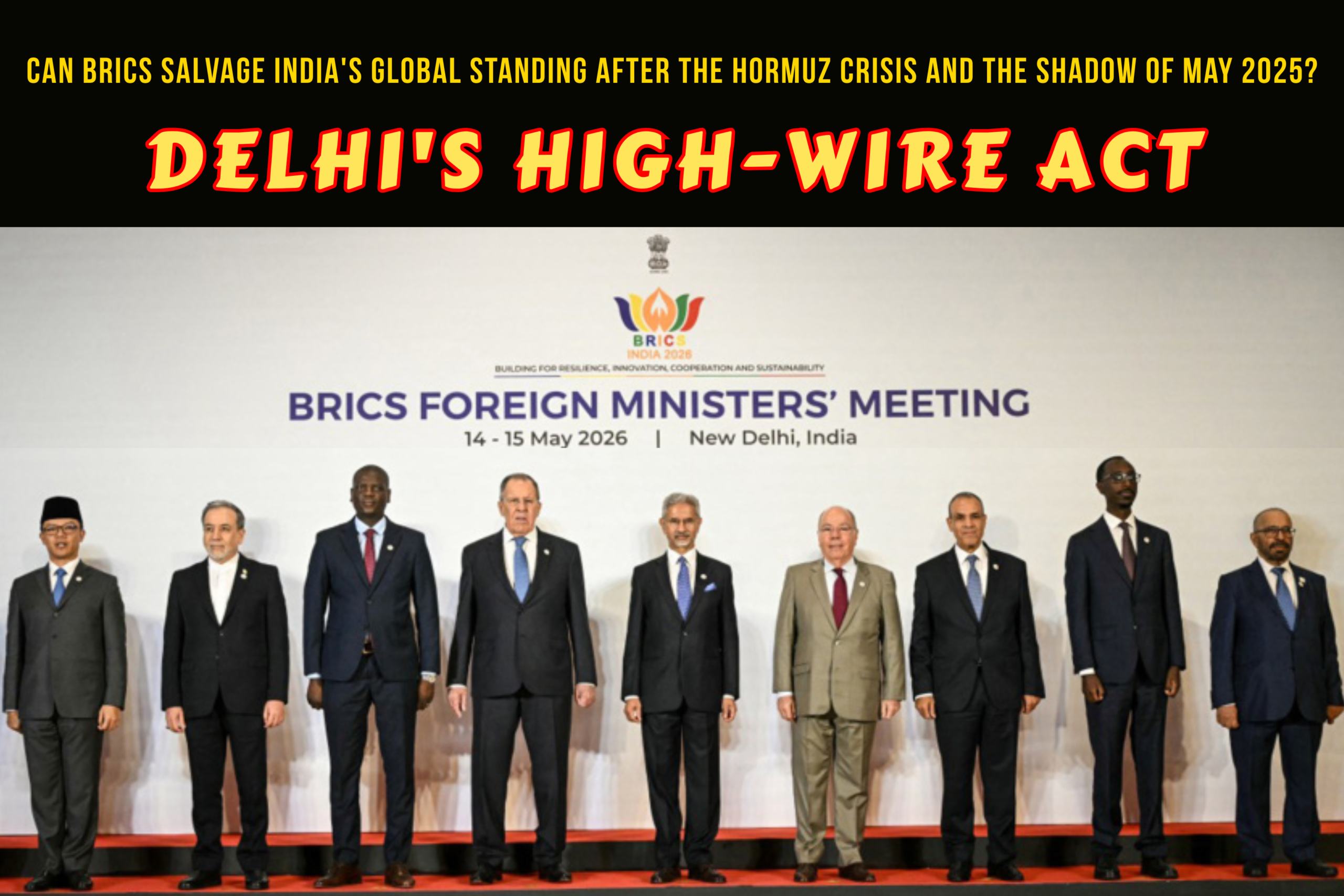
BRICS India Hormuz crisis diplomacy reaches a critical inflection point as the bloc’s Foreign Ministers convene in New Delhi on 14 May 2026. With the US-Iran ceasefire fraying and the Strait of Hormuz semi-blockaded, the summit offers Iran a platform for sanctions relief, gives Russia and China a stage to reaffirm their patronage, and presents host India with its most important diplomatic test since the ambiguous conclusion of Operation Sindoor in May 2025.
Table of Contents
<
- The Opening Frame: Delhi, 14 May 2026
- Iran’s Shopping List at BRICS 2026
- The Russia-China-Iran Triangle
- India’s Reckoning After Operation Sindoor
- The Chair’s Test: Five Positions India Must Hold
- Conclusion: Stabiliser or Spectator?
I. The Opening Frame: Delhi, 14 May 2026
At Bharat Mandapam in New Delhi, the chandeliers illuminate a gathering that the world’s television cameras have largely bypassed. While headlines chase superpower spectacle elsewhere, the foreign ministers of BRICS are locked in a session that may determine whether the bloc remains a talking shop or becomes a genuine crisis-management apparatus. Iranian Foreign Minister Abbas Araqchi sits across from Russia’s Sergei Lavrov. China’s Ambassador Xu Feihong is present in place of Wang Yi. The United Arab Emirates, a BRICS member now caught in Tehran’s crosshairs, holds its own seat at the table. And India—host, chair, and a nation still nursing the strategic bruises of a four-day war fought twelve months ago—holds the gavel.
The timing is not merely inconvenient; it is diabolical. The US-Iran ceasefire, brokered under duress, is on what Donald Trump himself called “life support.” The Strait of Hormuz, through which one-fifth of global oil once flowed, is now a semi-blockaded chokepoint. Iranian Revolutionary Guard speedboats prowl waters where American and British warships maintain a tense vigil. Throughput has collapsed from twenty million barrels per day to less than four million. And Iran, far from retreating, has begun charging transit tolls and demanding full US recognition of its sovereignty over the strait, the unfreezing of $6 billion in frozen assets, and war reparations.
Into this furnace walks BRICS. The bloc’s mandate, as India’s External Affairs Minister Subrahmanyam Jaishankar framed it in his opening remarks, is to play a “constructive and stabilising role” amid “considerable flux in international relations.” The question is whether BRICS can stabilise anything at all—or whether this meeting will merely expose the limits of non-Western solidarity when one of its own members is the crisis.
II. Iran’s Shopping List at BRICS 2026
Abbas Araqchi did not come to Delhi for photo opportunities. Iran’s objectives are specific, urgent, and grounded in the reality that Tehran is simultaneously under military pressure from the United States and diplomatic pressure from its own economic collapse.
From Bilateral Crisis to Multilateral Grievance
First, Iran seeks to transform the Hormuz crisis from a bilateral confrontation with Washington into a multilateral grievance shared by the entire Global South. Brazil, South Africa, India, and China are all facing fuel inflation and supply disruption. Iran’s strategy is elegant: frame itself not as the disruptor, but as the power defending equitable maritime access against American naval hegemony. If BRICS can be persuaded to issue even a carefully worded statement on freedom of navigation that implicitly challenges the US blockade, Tehran will have achieved a significant diplomatic coup.
Sanctions Relief Through BRICS Institutions
Second, Iran needs sanctions relief, and it knows BRICS offers the institutional architecture to bypass the Western financial system. The New Development Bank, local-currency trade settlement mechanisms, and the proposed BRICS Pay system represent Tehran’s best hope for economic survival outside SWIFT. Iran has already signalled its willingness to dilute its highly enriched uranium stockpile and ship the remainder to a third country—reportedly Russia—as part of a nuclear compromise. At BRICS, Tehran wants this concession packaged as a reasonable, Global South-backed proposal, making any future American rejection appear intransigent to the developing world.
A Unified Anti-Escalation Doctrine
Third, Iran wants formal BRICS opposition to any US-led military escalation. With Russia and China both holding veto power at the UN Security Council, Tehran seeks to institutionalise the solidarity that already exists. Just days before this meeting, Moscow and Beijing vetoed a US-backed Security Council resolution on Hormuz. Iran now wants that veto power backed by a unified BRICS diplomatic doctrine, not merely ad hoc great-power manoeuvring.
Araqchi made his position brutally clear: “The West’s false sense of superiority and immunity must be shattered by all of us,” he declared, adding that “US bullying is not unfamiliar to anyone here.” He urged the bloc to unequivocally condemn Washington and Tel Aviv, framing Iran as the frontline defender of an emerging order “increasingly shaped by developing nations rather than Western powers.”
III. The Russia-China-Iran Triangle
The chemistry among Tehran, Moscow, and Beijing is the gravitational centre of this meeting, and it is more complicated than simple anti-American solidarity.
Russia’s Guarantees: Nuclear and Economic
Sergei Lavrov’s physical presence in Delhi while China’s foreign minister remains in Beijing is itself a signal. Russia is carrying the diplomatic load for Iran inside BRICS. Moscow can offer Tehran something concrete: a destination for Iran’s highly enriched uranium, effectively acting as the guarantor of Iran’s nuclear compromise. Russia can also propose deeper energy market integration, pooling sanctioned Russian and Iranian crude into a BRICS-facing trading mechanism that bypasses Western markets entirely. What Russia cannot offer—and will not—is military intervention against American forces. The Kremlin wants Hormuz contained, not expanded into a wider war that could force direct confrontation with Washington.
Lavrov also brought reassurances for his hosts. “I can guarantee that India’s interests as they apply to Russian supplies will not suffer,” he told Jaishankar ahead of the meeting. “We will do everything to ensure that this unfair and…” The sentence trailed off into the language of sanctions and secondary pressure, but the message was plain: Moscow values its Delhi bridgehead.
China’s Economic Lifeline
China’s assurances are economic rather than military. Beijing is Iran’s largest oil buyer, and that lifeline will continue regardless of American pressure. More importantly, China is the biggest loser from Hormuz’s closure; twenty per cent of its oil imports transited the strait before the crisis. Beijing can assure Tehran of continued purchases and long-term supply agreements formalised through BRICS channels. In exchange, China wants guaranteed passage for its tankers—a selective access Iran is already granting to China, Turkey, Pakistan, and India. But China’s “stabilising role,” to use Jaishankar’s phrase, is defined strictly in Beijing’s interest: no regime change in Tehran, no wider war, and no American military victory that would strengthen US dominance in the Gulf.
The limit of this triangle is clear. Russia and China will shield Iran diplomatically and economically. They will not fight for Iran militarily. Tehran understands this, but in Delhi, the goal is to lock in those diplomatic and economic guarantees so firmly that Washington calculates the cost of escalation as prohibitively high.
IV. India’s Reckoning After Operation Sindoor
To understand why this meeting matters so intensely for New Delhi, one must look back to May 2025. Operation Sindoor, India’s military response to the Pahalgam terror attack, lasted four days and ended not with Indian victory but with an American-brokered ceasefire announced by Donald Trump, not Narendra Modi. The symbolism stung. For a nation that aspires to strategic autonomy, having its war terminated by a third-party telephone call was a humiliation dressed in diplomatic language.
The Diplomatic Damage of May 2025
The damage ran deeper. No significant power unambiguously backed India’s actions. Quad partners Australia and Japan were conspicuously absent from the diplomatic fray. Pakistan, despite being the aggressor in India’s narrative, shot down several Indian aircraft—including, French-made Rafales—and prevented international condemnation of Islamabad. The Financial Times noted that the ceasefire gave Pakistan the “diplomatic upper hand.” Chinese-supplied aircraft and air defence systems performed well against India, and Beijing’s stance was predictably neutral-to-hostile. India had demonstrated military reach, but it had failed to convert that reach into strategic legitimacy.
The post-Sindoor period exposed a hard truth: India’s Western partnerships, however robust in peacetime, offered limited cover in crisis. The US intervened to stop the fighting, not to vindicate Indian objectives. BRICS, for all its flaws, represents an arena where India is not a junior partner. The chairmanship is not a consolation prize. It is a test.
V. The Chair’s Test: Five Positions India Must Hold Simultaneously
Jaishankar’s challenge in Delhi is to convert India’s procedural advantage as host into genuine strategic influence. This requires managing contradictions that would break a lesser diplomat.
The UAE-Iran Fault Line
Iran and the UAE are both BRICS members, yet Tehran has publicly accused Abu Dhabi of being an “active partner” in the US-Israel war effort. Araqchi warned that “those colluding with Israel to sow division will be held to account.” Keeping both nations in the same room and producing a unified communiqué would be a genuine achievement—proof that India can manage fault lines the West cannot.
Energy Diplomacy and the Hormuz Leverage
Energy diplomacy offers another opening. India is one of the few countries Iran has granted selective Hormuz passage to. This gives New Delhi leverage with both Tehran and Washington. If India can position itself as the conduit keeping Iranian oil flowing to Asian markets without triggering American retaliation, it demonstrates a form of great-power utility that goes beyond military symbolism.
From Operation Sindoor to Operation Multipolar
But the hardest test is narrative. India must pivot from “Operation Sindoor”—a military operation with ambiguous outcomes—to “Operation Multipolar,” a diplomatic initiative that redefines India’s role in the Global South. The BRICS chairmanship provides the stage, but the script is unwritten. As The Diplomat has observed, India must “measure up to China” to achieve regional dominance. This meeting is that measuring tape.
Jaishankar has already sketched the thematic pillars: “Technological advancements are reshaping the global landscape. It can be leveraged for good governance and inclusive growth. Peace and security…” He added that BRICS can assist nations facing challenges of “energy supplies, food, fertiliser, and health security.” The subtext is unmistakable: India wants the bloc to address the material pain that Hormuz is inflicting on ordinary economies, not merely the geopolitical grievances of its members.
The Impossible Chair: BRICS India Hormuz Crisis Diplomacy in Five Dimensions
| Position | Audience | The Contradiction | Risk of Collapse |
|---|---|---|---|
| Hormuz Mediator | Iran + UAE | Tehran accuses Abu Dhabi of being “an aggressor” and “active partner” in US-Israel war; both are BRICS members in the same room | A walkout by either party renders India’s convening power hollow |
| Energy Broker | Russia + China | Moscow wants sanctioned-oil pooling; Beijing wants exclusive tanker passage | India needs both for its own fuel security yet cannot favour either |
| Defence Partner | Russia | Lavrov guarantees Russian supplies “will not suffer” despite Western pressure | Washington watches every India-Russia embrace and tightens CAATSA threats |
| Quad Anchor | US, Japan, Australia | No Quad partner backed India unambiguously during Operation Sindoor | The credibility gap in the Western camp widens with each BRICS embrace |
| Global South Voice | Brazil, South Africa, Ethiopia | These nations want cheap fuel, not great-power games | If Hormuz stays shut, they blame the BRICS bloc, not Washington |
VI. Conclusion: Stabiliser or Spectator?
By the time the Delhi meeting concludes, the verdict on India’s diplomatic recovery will begin to form. If BRICS produces a substantive statement on Hormuz—one that acknowledges the crisis, affirms the bloc’s economic stake in stable energy flows, and offers a non-Western framework for de-escalation—then India will have demonstrated that it can lead a multilateral coalition through live fire. If the meeting yields only boilerplate about cooperation and shared values, the perception of post-2025 strategic drift will harden.
Iran will leave Delhi with Russian nuclear guarantees and Chinese economic commitments, but probably without the full BRICS military-diplomatic umbrella it craves. Russia and China will have reaffirmed their status as Iran’s patrons without being dragged into Tehran’s confrontation with Washington. And India will face the loneliest calculation of all: whether to use its chairmanship to forge a genuine Global South consensus, or to remain a Western-aligned outlier in a non-Western club.
The Hormuz crisis will outlast this BRICS meeting. So will the memory of May 2025. But for a few days in Delhi, India has the chance to prove that it can be more than a participant in other powers’ wars—that it can be the architect of the peace that follows. The gavel is in Jaishankar’s hand. Whether he can strike it with authority remains the open question of the hour.