(By Khalid Masood)
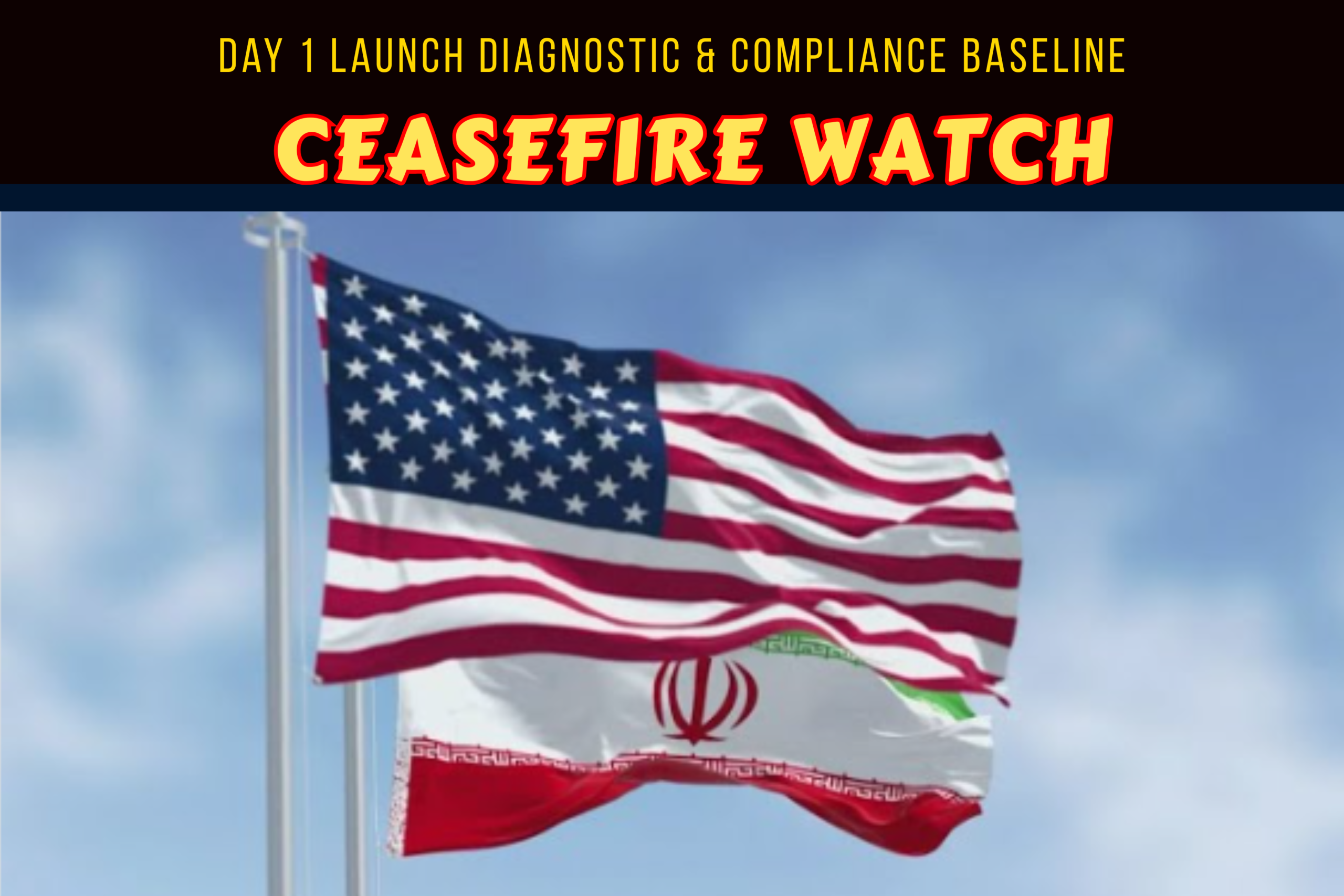
As the US-Iran ceasefire takes effect today, April 8, the opening 24 hours will establish critical precedents for verification, communication, and operational compliance. Diplomatic channels report initial confirmation of the pause framework, including the activation of mediator-backed hotlines and a provisional halt to direct kinetic strikes. However, early signals remain unverified, proxy posturing continues in contested theaters, and market pricing reflects cautious uncertainty rather than confirmed de-escalation. This Day 1 diagnostic establishes baseline indicators, verification protocols, and priority monitoring vectors to track as the 10-day pause enters its most fragile phase.
Initial Compliance Signals & Verification Priorities
In the first hours of implementation, several operational markers should align with ceasefire parameters, though independent confirmation remains pending:
Military Activity
Official statements from the US Department of Defence, Israeli defence authorities, and Iranian military channels indicate a suspension of direct strike operations. Verification should focus on zero-launch confirmation, air defence alert frequency, and satellite-validated force posture shifts. A sustained 24-hour absence of cross-border launches will serve as the first meaningful compliance baseline.
Maritime Flow
The Joint Maritime Information Center (JMIC) and commercial AIS trackers are expected to report initial commercial transits under Iran’s newly implemented vetting protocol. Baseline success will be measured by transparent routing, absence of forced interdictions, and insurer willingness to adjust war risk premiums. Even limited transit normalization will signal functional de-escalation, provided processing delays remain administrative rather than coercive.
Diplomatic & Humanitarian Infrastructure
Mediator governments (Pakistan, Turkey, Qatar, Oman) confirm dedicated communication channels are active. The International Atomic Energy Agency (IAEA) has indicated continued monitoring access at key nuclear facilities, while the ICRC reports preliminary coordination for medical supply corridors. Full operationalization of humanitarian access and deconfliction protocols will likely require 48–72 hours as security clearances and logistical routing are finalized.
Ambiguity Vectors & Early Risk Indicators
Compliance in active conflict zones is rarely binary. Several vectors require careful attribution before they can be classified as violations or routine postures:
Proxy & Militia Activity
Iranian-aligned groups in Iraq, Lebanon, and Yemen may continue reconnaissance flights, logistical movements, or defensive repositioning. These actions are likely to be framed as “non-offensive readiness,” complicating clear attribution and testing the ceasefire’s scope definitions.
Cyber & Intelligence Operations
Non-kinetic pressure channels—including network scanning, signals intelligence collection, and electronic warfare probing—are expected to persist below the ceasefire’s kinetic threshold. While technically compliant, these activities can degrade trust, trigger misinterpretation, and create friction in verification channels.
Maritime Processing Delays
Initial transits may face extended vetting periods at Iranian checkpoint zones. Differentiating between standard administrative processing and coercive delay will require timestamped AIS data, neutral maritime authority verification, and clear dispute resolution mechanisms.
Narrative Warfare
State-aligned outlets and social media networks are expected to circulate unverified claims of “covert repositioning” or “unreported incidents.” Cross-referencing with satellite imagery, OSINT tracking, and official deconfliction logs will be essential to filter noise from signal and prevent escalation based on unverified claims.
✅ Day 1 Priority Checklist & 📊 Days 1–3 Monitoring Dashboard
✅ Day 1 Priority Checklist
- Verify first Hormuz AIS transit reports (JMIC/MarineTraffic)
- Monitor IDF/DoD/Iranian FM statements on strike activity
- Track Brent crude pricing and marine war risk premiums
- Watch for joint mediator statement on hotline activation
- Flag any unattributed social media strike/interdiction claims
📊 Days 1–3 Monitoring Dashboard
| Indicator | Baseline Expectation | Deviation Threshold | Tracking Source |
|---|---|---|---|
| Direct Kinetic Activity | Zero verified strikes/launches | Any confirmed cross-border exchange | DoD/IDF/Iranian FM, ISW |
| Hormuz Transit Volume | ≥15–20 vessels/day under vetting | ≤5 vessels/day or new detentions | JMIC, MarineTraffic |
| Proxy Attribution Clarity | ≤1 ambiguous incident reported | ≥3 coordinated actions with state signatures | OSINT, regional intel |
| Diplomatic Communication | Joint mediator endorsement of pause terms | Competing narratives or public deadline resets | Foreign ministries, UN |
| Market Confidence | War risk premiums stabilize or decline <15% | Premiums spike >30% + Brent volatility >5% | Lloyd’s List, ICE/NYMEX |
Threshold breaches do not automatically indicate collapse, but they should trigger immediate verification protocols and backchannel consultations before public escalation narratives harden.
Early Red Flags & Communication Protocols
Three factors warrant close monitoring as the ceasefire transitions from announcement to implementation:
- Hardliner Rhetoric Escalation
Public statements emphasizing the “temporary” and “conditional” nature of the pause are standard crisis management tools, but sustained narrative pressure reduces political cover for extension if minor violations occur. Leadership framing in the next 48 hours will signal whether domestic audiences are being prepared for compromise or confrontation. - Verification Lag
Ambiguous incidents in the first 48 hours may not trigger immediate joint clarifications. While hotlines are reportedly active, delayed public attribution increases misinterpretation risk. Establishing clear attribution standards before incidents compound is critical to preventing escalation spirals. - Proxy Command Ambiguity
Decentralized militia structures may test boundaries under the guise of “local defence.” If proxy actions are not explicitly covered under the ceasefire scope, attribution disputes will multiply. Clarifying command-and-control boundaries early will determine whether the pause holds or fractures along non-state fault lines.
Methodology of Research
This brief adheres to a strict source-hierarchy and cross-verification standard:
- Primary Verification: Official military/diplomatic statements, IAEA monitoring reports, JMIC/AIS maritime data, UN/ICRC field updates
- Secondary Corroboration: Satellite imagery analysis, reputable OSINT networks, wire service cross-references (Reuters, AP, AFP)
- Excluded Data: Unattributed social media claims, single-source casualty/strike reports, anonymous leaks without documentation
- Uncertainty Acknowledgment: All compliance assessments are conditional. Fog-of-war limitations, restricted media access, and competing state narratives require explicit attribution and cautious interpretation. Updates will follow at Day 3 and Day 7 based on verified data.
Closing Assessment
Day 1 of the ceasefire is not a verdict but a baseline. The opening 24–48 hours will test whether diplomatic commitments translate into operational reality, whether verification mechanisms function under pressure, and whether communication channels can absorb initial ambiguity without fracture. For now, the framework holds—but compliance remains provisional, markets remain priced for risk, and proxy dynamics require disciplined attribution. The next three days will reveal whether this pause consolidates into structured de-escalation or begins to fray at the edges. Verified data, transparent methodology, and measured policy responses will determine which path materializes.