(By Ayesha Mahnoor)
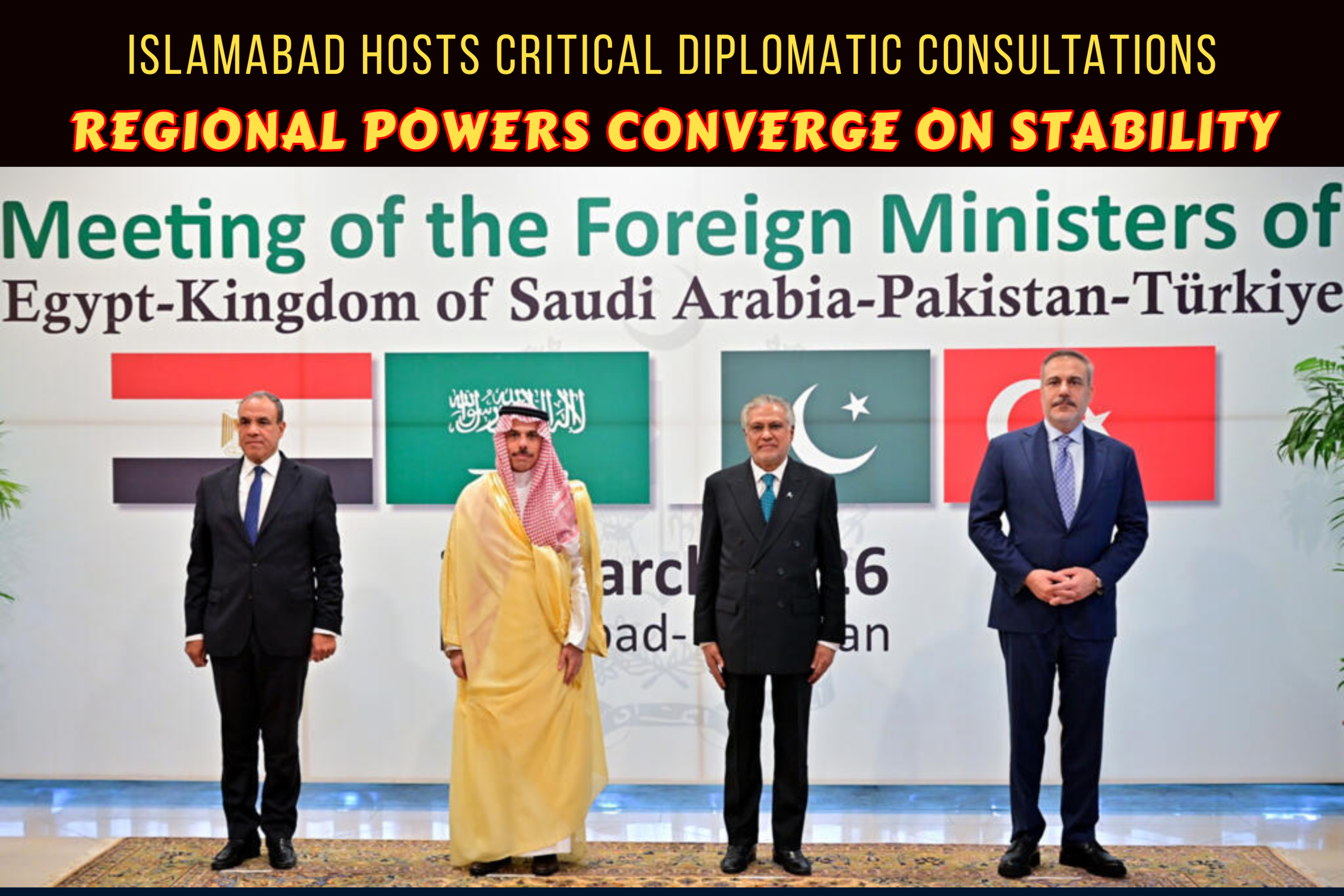
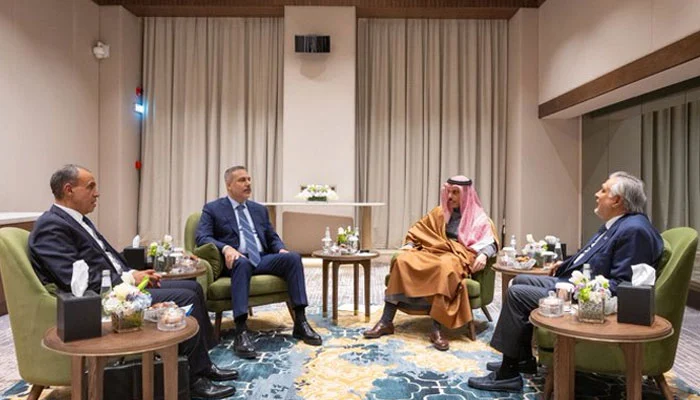
In a quiet but consequential development, Islamabad has emerged as an unlikely but increasingly vital node in the complex architecture of Middle Eastern diplomacy. Today, the Pakistani capital hosted a high-level gathering of foreign ministers from Saudi Arabia, Türkiye, and Egypt—alongside their Pakistani counterpart—for closed-door consultations that signal a subtle but significant shift in how regional powers are approaching crisis management, conflict mediation, and strategic alignment.
While official communiqués remain carefully worded and details sparingly released, the mere convergence of these diplomatic heavyweights in Pakistan warrants close attention. This article examines the context, the stakes, the process, and the potential implications of these talks—not just for South Asia, but for the broader Indo-Pacific and Middle Eastern security landscape.
Part I: The Setting – Why Islamabad, Why Now?
A History of Mediation Ambitions
Pakistan’s foreign policy has long oscillated between strategic caution and aspirational mediation. From its role in facilitating U.S.-Taliban talks in Doha to its quiet diplomacy during the India-Pakistan crises, Islamabad has periodically positioned itself as a “bridge” state. However, economic pressures, domestic political volatility, and regional rivalries have often constrained its ability to sustain such roles.
Today’s consultations represent a recalibration. With the Middle East experiencing renewed volatility—from the Gaza war’s aftermath to Red Sea shipping disruptions, from Iran-Israel shadow conflicts to Gulf realignments—regional actors are seeking new forums for dialogue. Pakistan offers several advantages:
- Geographic Neutrality: Unlike Gulf capitals, Islamabad is not directly entangled in Arab-Persian rivalries.
- Diplomatic Relationships: Pakistan maintains working ties with Tehran, Riyadh, Ankara, and Cairo, even as these capitals navigate their own tensions.
- Strategic Patience: Pakistani diplomacy often emphasizes process over proclamation—a valuable asset in protracted negotiations.
The Trilateral Plus Framework
The gathering builds upon the Pakistan-Türkiye-Saudi Arabia trilateral mechanism, formally revived in recent years with focus on defence, investment, and energy. The inclusion of Egypt—a key Arab power with its own mediation credentials in Gaza—elevates the format to a “trilateral plus” model. This is not a formal alliance, but rather a flexible consultative platform, allowing participants to coordinate without binding commitments.
Part II: The Agenda – What’s Really Being Discussed?
While no official agenda has been published, credible diplomatic sources and pattern analysis suggest four interlocking themes:
1. Regional De-escalation and Conflict Containment
The immediate catalyst for the meeting is the risk of regional escalation. Key concerns include:
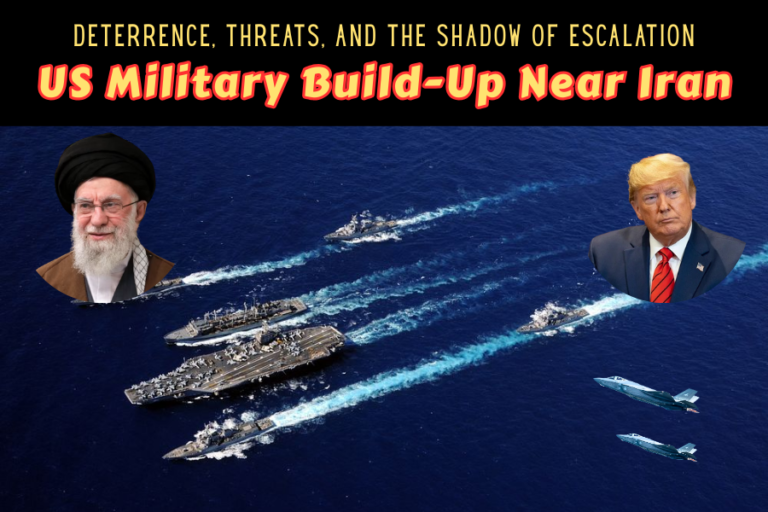
- Iran-Israel Tensions: Following recent strikes and counter-strikes, there is urgency to prevent miscalculation.
- Red Sea Security: Houthi attacks on shipping lanes affect global trade and Gulf economies; a coordinated response is needed.
- Afghanistan and Counter-Terrorism: With the Taliban’s return, regional powers share concerns about militant spill-over, though approaches differ.
Pakistan’s Foreign Office has emphasized “dialogue over confrontation” in recent statements—a phrase that resonates with all participants, even if their tactical preferences vary.
2. The Palestine Question: Beyond Rhetoric
The Gaza war remains a unifying moral cause for the Muslim world, but policy divergence persists. Saudi Arabia is navigating normalization talks with Israel; Türkiye has taken a sharply confrontational stance; Egypt mediates ceasefire talks while managing its own security concerns; Pakistan maintains a principled pro-Palestine position while avoiding direct entanglement.
The Islamabad consultations likely aimed to:
- Harmonize messaging on humanitarian access and reconstruction.
- Explore mechanisms for coordinated aid delivery.
- Discuss long-term political pathways without pre-empting sovereign decisions.
3. Economic Statecraft and Energy Security
Diplomacy in the 21st century is inseparable from economics. Pakistan, facing balance-of-payment pressures, seeks investment, energy partnerships, and remittance flows from Gulf allies. In return, it offers:
- A market of 240 million people.
- Strategic location for trade corridors (including potential CPEC-Gulf linkages).
- A large, skilled diaspora in Gulf states.
Discussions reportedly touched on:
- Energy Cooperation: LNG supplies, potential electricity grids, and renewable energy projects.
- Investment Frameworks: Special economic zones, mining partnerships, and digital infrastructure.
- Labor Mobility: Streamlining visa processes for Pakistani workers in Gulf states.
4. Strategic Autonomy in a Multipolar World
A subtler but critical theme: how do middle powers navigate great power competition? The U.S.-China rivalry, Russia’s role in West Asia, and the EU’s energy dependencies create a complex backdrop. Pakistan, Saudi Arabia, Türkiye, and Egypt all seek to avoid over-alignment while extracting maximum benefit from multiple partnerships.
The Islamabad talks may have explored:
- Coordination in multilateral forums (UN, OIC, G20).
- Balancing security cooperation with economic diversification.
- Managing relationships with external powers without becoming proxy arenas.
Part III: The Process – How Diplomatic Consultations Actually Work
For outsiders, high-level meetings can appear as photo-ops followed by vague statements. In reality, the value often lies in the process—the less visible groundwork that enables future breakthroughs.
The Pre-Meeting Phase
- Sherpa Diplomacy: Senior officials and ambassadors spend weeks drafting talking points, identifying red lines, and testing potential compromises.
- Backchannel Messaging: Informal contacts allow for frank exchanges without public posturing.
- Scenario Planning: Teams prepare for multiple outcomes, from joint statements to simple “agreement to disagree.”
The Meeting Itself
- Plenary Sessions: Formal statements set the public tone.
- Restricted Sessions: Only principals and key advisors discuss sensitive issues.
- Technical Breakouts: Experts on trade, security, or energy work on actionable details.
- Social Diplomacy: Meals and informal chats often yield more progress than formal negotiations.
The Post-Meeting Phase
- Joint Statement Drafting: Every word is negotiated; ambiguity is sometimes intentional.
- Follow-Up Mechanisms: Working groups, hotlines, or future meeting dates are established.
- Public Messaging: Officials brief media selectively to shape narratives without compromising sensitive details.
In Islamabad’s case, the absence of an immediate, detailed joint statement does not indicate failure. It may reflect the complexity of the issues—or a deliberate choice to keep options open.
Part IV: Expert Perspectives – What Analysts Are Saying
“Pakistan’s diplomatic value lies not in its power, but in its positioning. It is one of the few states that can talk to Tehran and Riyadh, to Ankara and Cairo, to Beijing and Washington—without being seen as wholly aligned with any single camp.”
— Dr. Ayesha Siddiqa, Independent Defence Analyst, Islamabad
“The real test of these consultations will be whether they produce sustained engagement, not just one-off meetings. Regional diplomacy requires patience and institutional memory—both of which are in short supply.”
— Dr. Kemal Kirişci, Senior Fellow, Brookings Institution
“Economic incentives are the glue that can hold diplomatic initiatives together. If Pakistan can offer tangible investment opportunities, it gains leverage; if not, its mediation role remains symbolic.”
— Timothy Ash, Emerging Markets Strategist
Part V: Challenges and Constraints
No diplomatic initiative is without obstacles. Key challenges facing the Islamabad process include:
- Divergent National Interests: Saudi Arabia’s Vision 2030 priorities differ from Türkiye’s regional ambitions; Egypt’s domestic pressures shape its foreign policy; Pakistan’s economic needs may not align with partners’ investment timelines.
- External Interference: Great powers may view regional coordination with suspicion, fearing exclusion or counter-alignment.
- Domestic Politics: Public opinion in each country—on issues like Palestine, Iran, or economic reform—can constrain leaders’ flexibility.
- Implementation Gap: Agreements are easier to sign than to execute; bureaucratic inertia, corruption, or changing leadership can derail follow-through.
Part VI: Looking Ahead – Scenarios and Signposts
What might emerge from these consultations? Three plausible scenarios:
Scenario 1: Incremental Progress (Most Likely)
- A modest joint statement emphasizing “shared concerns” and “continued dialogue.”
- Establishment of technical working groups on trade or counter-terrorism.
- No major breakthroughs, but a foundation for future engagement.
Scenario 2: Mediation Momentum (Possible, but Conditional)
- Pakistan offers to host further talks on a specific flashpoint (e.g., Iran-Gulf security).
- Participants agree to backchannel facilitation on a discrete issue.
- Success depends on buy-in from external actors (e.g., U.S., Iran, Israel).
Scenario 3: Strategic Realignment (Less Likely, but High Impact)
- A more formalized consultative mechanism emerges, with regular summits and joint initiatives.
- Economic agreements are announced, signaling deeper integration.
- This would require significant political will and a conducive regional environment.
Signposts to Watch:
- Official joint statement (wording, tone, specific commitments).
- Follow-up meetings at the ambassadorial or expert level.
- Announcements of bilateral deals on the sidelines (e.g., Pakistan-Saudi investment MoUs).
- Reactions from external powers (U.S., China, EU statements).
Conclusion: Diplomacy as a Long Game
In an era of instant news and reactive policymaking, the Islamabad consultations remind us that diplomacy is often a slow, iterative process. The value of today’s meeting may not be evident in tomorrow’s headlines—but in the relationships built, the misunderstandings clarified, and the options kept open.
For Pakistan, hosting such talks is both an opportunity and a test. It can enhance the country’s strategic relevance, attract investment, and contribute to regional stability. But it also demands consistency, credibility, and capacity—qualities that must be nurtured over time.
As one senior Pakistani diplomat reportedly remarked during the preparations: “We are not trying to solve every problem in one meeting. We are trying to ensure that when the next crisis comes, we have a phone number to call, and a voice on the other end that will listen.”
In a fractured region, that may be ambition enough—for now.