(By Khalid Masood)
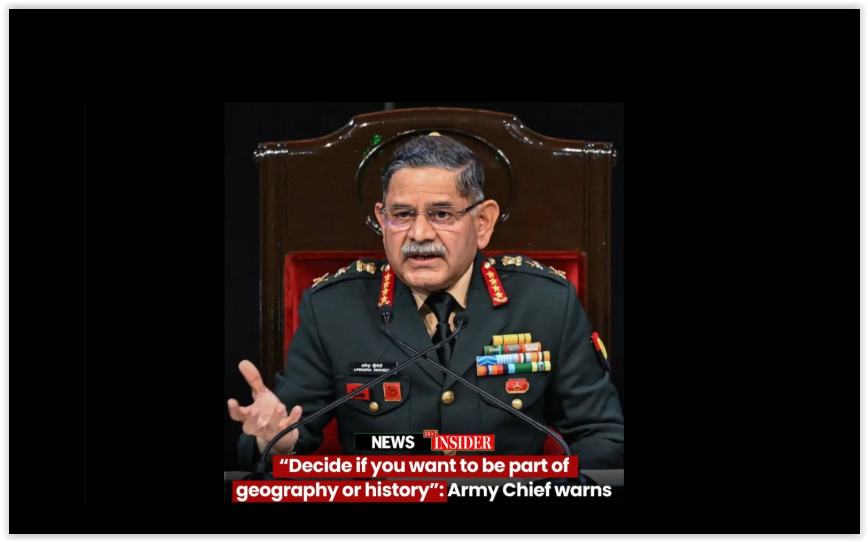
In the twilight of his tenure, the outgoing Indian Army Chief General Upendra Dwivedi made a highly publicized and bizarre assertion: should “Operation Sindur 2” be initiated, Pakistan would have to decide whether it wishes to remain a “part of history or geography.” This he said during an address at the General Manekshaw’s Senak Samavad event in New Delhi on May 16, 2026. For the casual observer, such rhetoric might sound intimidating. However, for the students of military strategy, diplomacy, and statecraft, this statement reveals far more about the internal strategic dissonance within the Indian military establishment than it does about any credible threat to Pakistan.
Any military commander of substance understands that in the current geopolitical climate—an era where the old world order has fractured and the new one is yet to be forged—bluster is a poor substitute for strategy. To the people and the Armed Forces of Pakistan, it is vital to look past the political posturing in New Delhi and understand the cold, hard operational realities that actually secure our national sovereignty.
The Illusion of Indian Operational Control
The fundamental flaw in the Indian Army Chief’s worldview is his apparent disconnect from the actual conduct of modern warfare. A competent military commander knows that strategy is the “art of the general,” requiring a sensible war appreciation, the formulation of military strategy, and, crucially, the maintenance of operational control when force is applied.
Over the last decade, the Indian military has been systematically stripped of this operational control. Under the current political dispensation in New Delhi, the military has been reduced to a tactical instrument of the political leadership. The Cabinet Committee on Security (CCS) now micromanages operations, dictating targeting guidelines and imposing arbitrary timelines, such as the reported 30-minute ceasefire directives seen in recent skirmishes. When the political leadership dictates that only specific terrorist infrastructure be hit while strictly forbidding strikes on military installations, it is not conducting war; it is managing a political narrative.
An army that is denied the autonomy to conduct a proper war appreciation and execute operational control is not a strategic juggernaut. It is a politically constrained force, fighting with one hand tied behind its back by a leadership more interested in domestic optics than military victory.
The PLA Paradigm: The Shift to Intelligencized Warfare
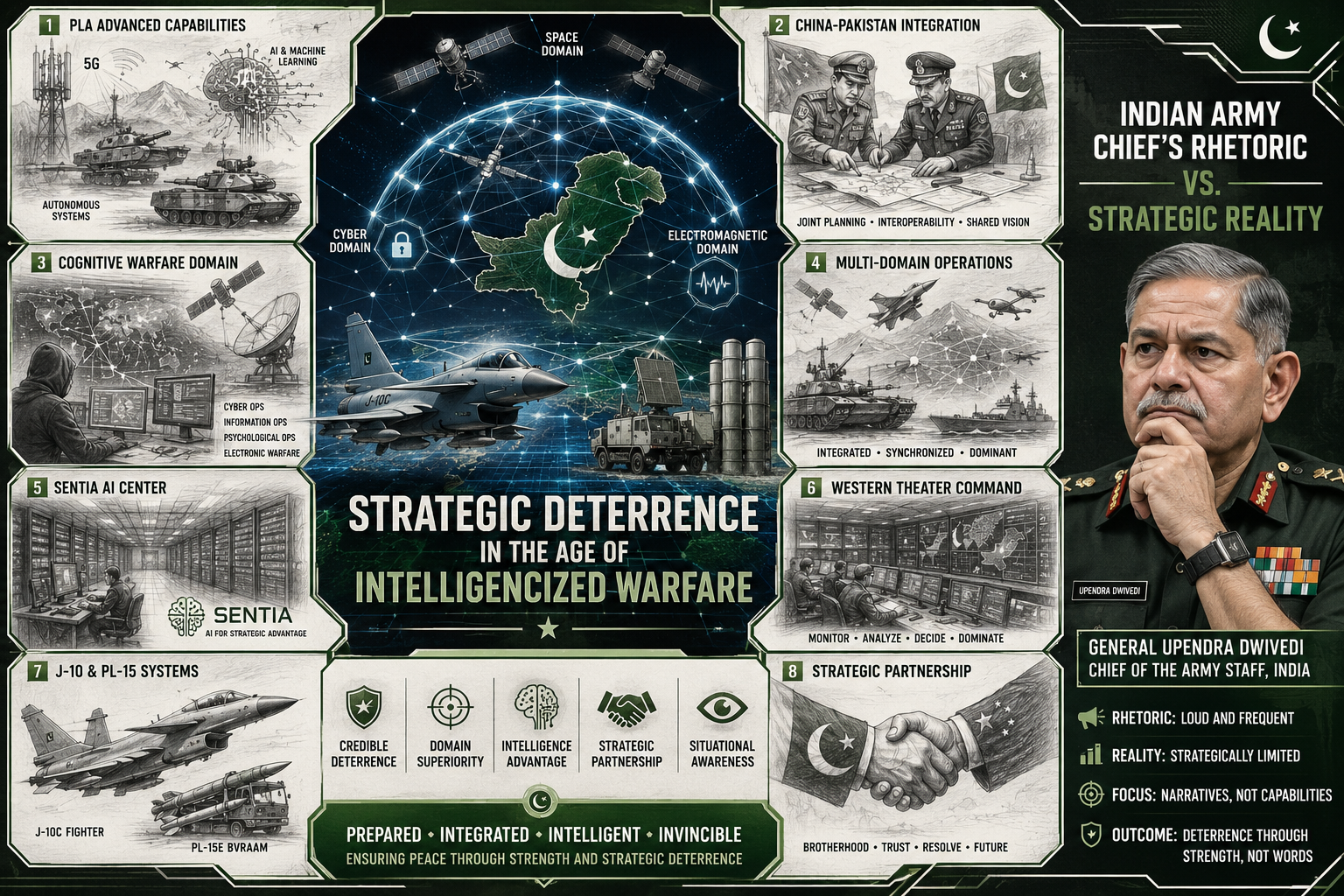
The Indian military’s myopic focus on counter-terrorism and political directives blinds it to the most critical factor in its war appreciation: the People’s Liberation Army (PLA). The PLA is currently at the cutting edge of global military innovation, having fundamentally shifted from mechanized and informatized warfare to intelligencized warfare.
For the Indian military, which is still largely grappling with platform-centric mechanized warfare, the PLA’s operational concepts present a paradigm shift. The PLA operates on six critical pillars that redefine the battlespace:
- Cognitive and Operational Dynamics: The ability to paralyze an adversary’s national infrastructure (cyber and space) to win the war before the first kinetic shot is fired.
- Physical and Virtual Domain Integration: The seamless merging of kinetic fires (rockets, jets) with non-kinetic fires (cyber, electronic warfare) at the speed of light.
- Dominance in the Continuum: Unmatched competitiveness in the integrated cyber-electromagnetic-space continuum.
- Intelligencized Warfare: Treating data as a primary weapon. The deployment of 5G networks in the Ladakh theater since 2020 has allowed the PLA to harvest unprecedented operational data on Indian deployments and logistics.
- Operational Surprises via AI: The integration of Lethal Autonomous Weapons Systems (LAWS) to execute unpredictable, AI-driven tactical maneuvers.
- Algorithmic Warfare: Moving beyond networks to cloud computing and AI-enabled autonomous systems, including the prioritization of humanoid robotics in their 15th Five-Year Plan.
The Indian Army Chief’s rhetoric ignores a glaring reality: his military is fundamentally outclassed in the virtual and cognitive domains by the PLA.
The Iron Brotherhood: China-Pakistan Strategic Integration
What makes this PLA capability directly relevant to Pakistan’s security is the unprecedented, institutionalized military integration between Beijing and Islamabad. This is not merely a transactional buyer-seller relationship; it is a deeply integrated strategic partnership aimed at maintaining the balance of power in South Asia.
Since last one decade or so, the integration has accelerated across multiple domains:
- Multi-Domain Operations: The Shaheen series of exercises between the Pakistan Air Force (PAF) and the PLA, over the years, have evolved to include advanced virtual domain integration, allowing the PAF to demonstrate multi-domain concepts utilizing PL-15 missiles and J-10 fighters.
- Institutionalizing AI: The establishment of the SENTIA (Center for Artificial Intelligence and Computing) in Pakistan, with PLA assistance, has elevated Pakistan’s capabilities in AI-driven electronic and cyber warfare.
- Theater Integration: Pakistani military observers are integrated within the PLA’s Western Theater Command and the Xinjiang Military Division. This has effectively merged the Kashmir and Ladakh sectors into a single, cohesive operational theater.
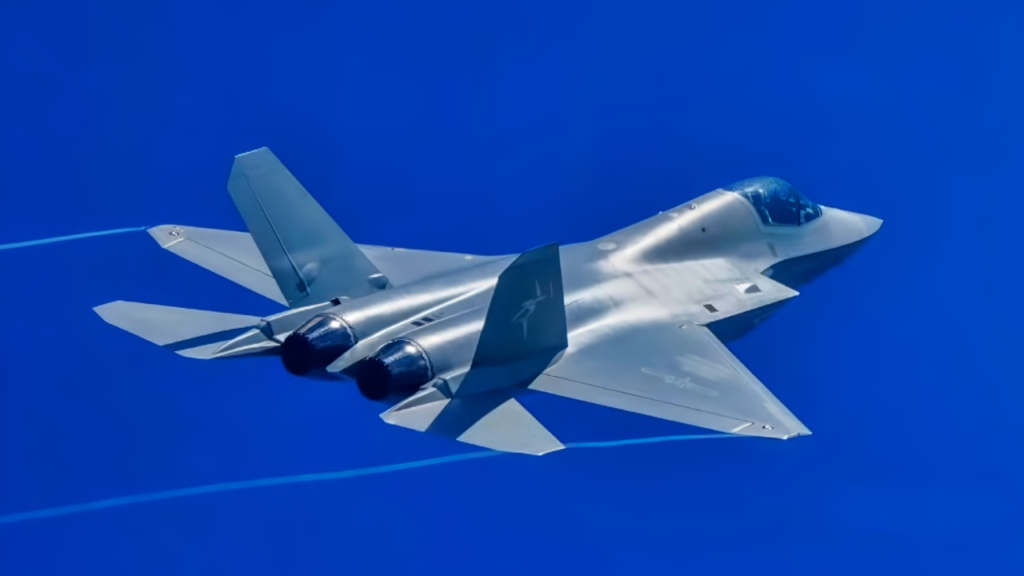
Rumors suggesting that China is withholding advanced platforms like the J-35 stealth fighter jets due to financial constraints are strategically illiterate. Beijing’s support for Pakistan’s territorial integrity is a geopolitical imperative, not a commercial transaction. The technological transfer is continuous, ensuring that the Pakistan Armed Forces remain at the forefront of regional military innovation.
A Strategic Guide for the Armed Forces of Pakistan
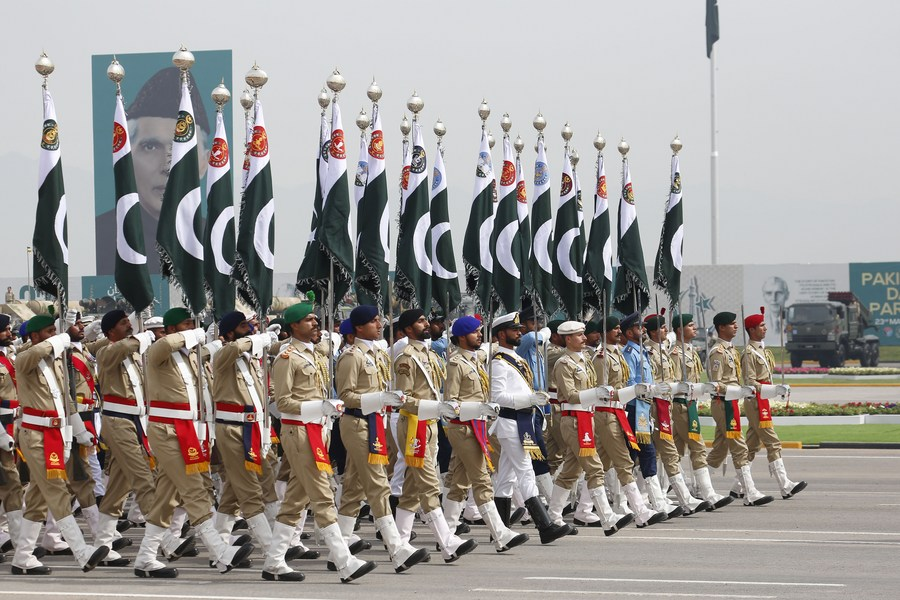
For the valiant men and women of the Pakistan Armed Forces, the evolving strategic environment offers clear directives. The modern battlefield does not forgive complacency, nor does it reward reliance on past glories.
- Prioritize Combat Knowledge over Experience: In modern warfare, combat knowledge accounts for 80% of success, while traditional combat experience accounts for only 20%. The rapid induction of new technologies means that understanding the science and art of modern war is paramount. Continuous learning in AI, cyber, and space domains must be institutionalized at all levels of command.
- Master the Virtual Continuum: The physical battlefield is now subordinate to the cyber-electromagnetic-space continuum. Dominance in this virtual domain is the non-nuclear substitute for strategic deterrence. Our electronic warfare and cyber commands must remain aggressively postured to blind and paralyze adversary networks in the opening hours of any conflict.
- Deepen the Strategic Nexus: The integration with the PLA is our strategic multiplier. We must continue to absorb cutting-edge concepts in intelligencized warfare, autonomous systems, and cognitive warfare. The seamless interoperability between the Pakistani and Chinese militaries is the ultimate deterrent against any Indian misadventure.
- Maintain Professionalism Amidst Adversary Bluster: Let the Indian political and military leadership engage in rhetorical theatrics. Our response should not be counter-rhetoric, but the quiet, relentless modernization of our full-spectrum deterrence.
Conclusion
The outgoing Indian Army Chief’s assertion that Pakistan faces an existential choice between “history and geography” is a profound miscalculation. It is born of a flawed war appreciation, a military stripped of operational autonomy, and a willful ignorance of the technological revolution spearheaded by the PLA.
Pakistan’s place in geography is not in question; it is secured by the resolve of its people, the professional excellence of its Armed Forces, and an ironclad strategic partnership with China. We have successfully transitioned into the era of intelligencized, multi-domain warfare.
To the people of Pakistan: take comfort in the fact that your Armed Forces are not merely preparing for the wars of the past, but are actively shaping the battlefield of the future. To the Armed Forces of Pakistan: remain vigilant, continue your professional evolution, and trust in the robust deterrence you have built. In the complex chessboard of South Asian statecraft, peace is not achieved through loud rhetoric, but through the unassailable credibility of our strategic and military posture. Pakistan’s geography is secure, and its history will continue to be written by the brave.