(By Khalid Masood)
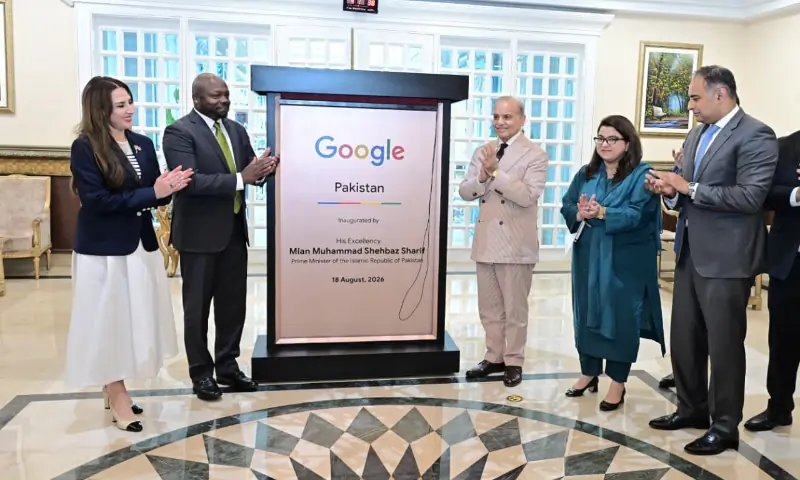
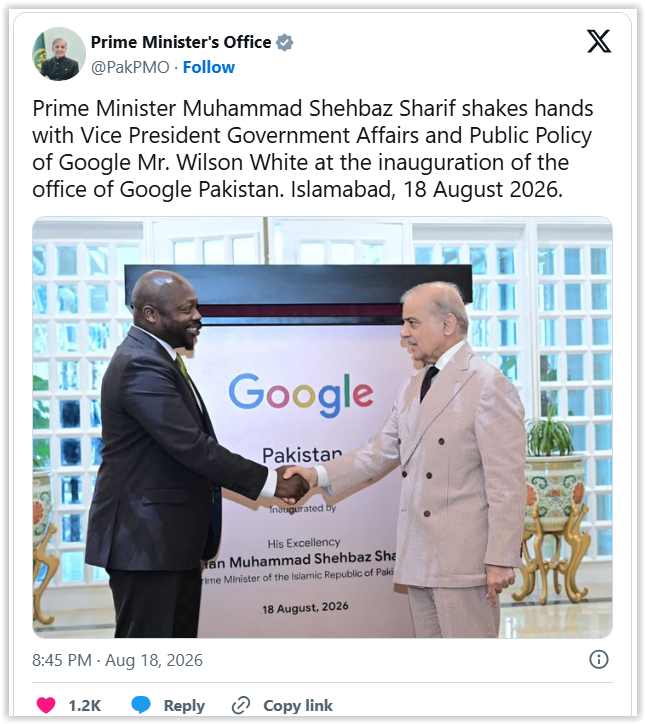
On 18 August 2026, Prime Minister Muhammad Shehbaz Sharif stood beside Wilson L. White, Google’s Vice President of Government Affairs and Public Policy, and unveiled the foundation plaque of the company’s first office in Pakistan. The ceremony at the Prime Minister’s House in Islamabad carried the weight of a nation eager to prove its digital credentials. Within hours, headlines across Pakistani media hailed a “historic milestone” and a “defining moment” for the country’s technology sector.
But between a foundation plaque and a transformed economy lies a long, uncertain road.
Google made three concrete commitments that day: a Chromebook assembly line already operational in Haripur, free Gemini subscriptions for every Pakistani student, and training programmes for 100,000 developers paired with 100,000 Google Career Certificates. Each is genuine. Each is valuable. And each faces distinct execution risks that will determine whether this moment is remembered as a symbolic gesture or the start of something transformative.
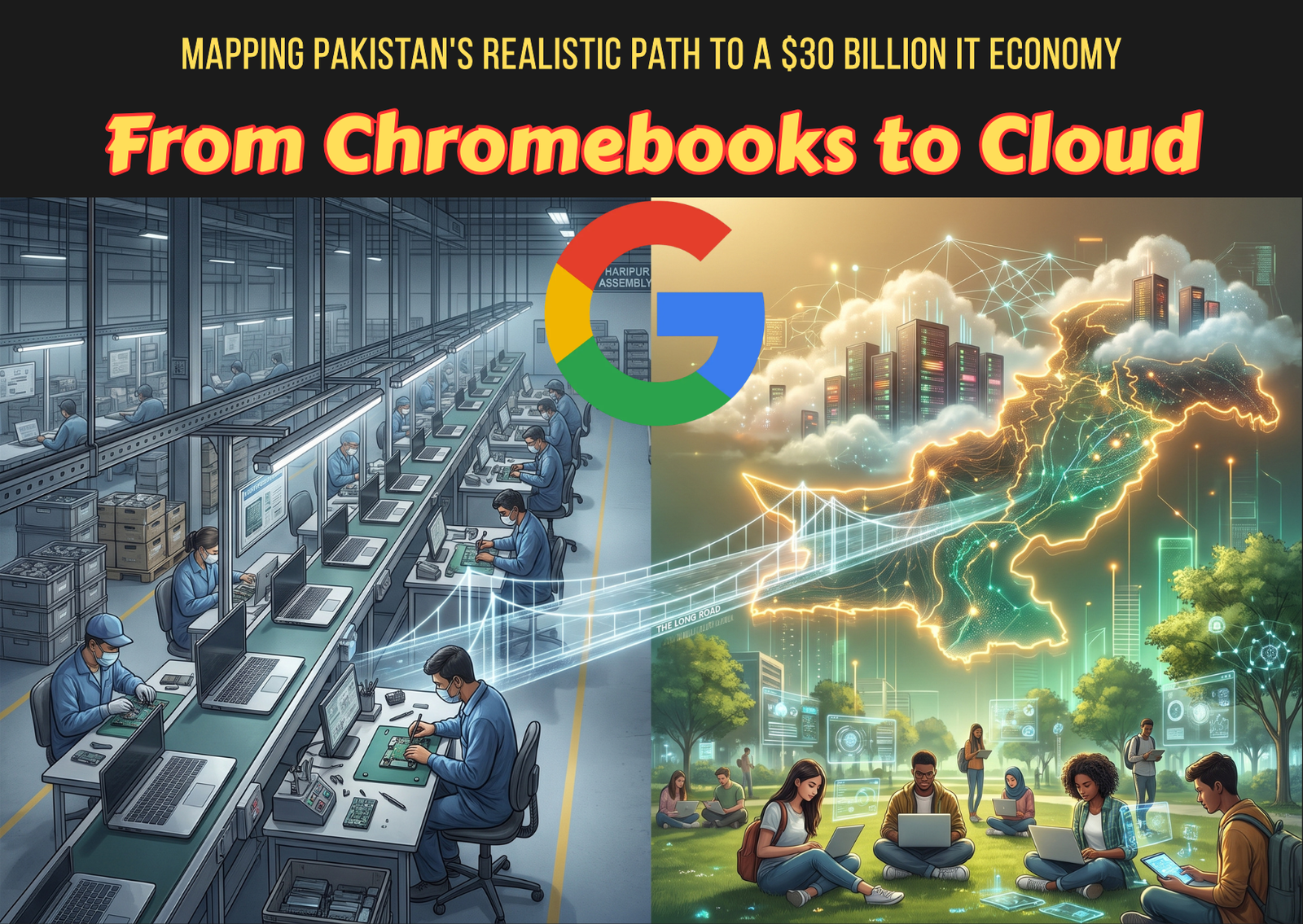
Pakistan’s stated ambition is to become a $30 billion IT export hub. Its current IT exports sit in the range of $2–3 billion annually. Closing that gap will not be achieved by announcements. It will be achieved — or not — by what happens in the next 18 to 24 months.
This article examines each of Google’s three promises through the lens of infrastructure, policy, and human capital. It asks the uncomfortable questions that inauguration ceremonies rarely address, and it offers a realistic roadmap for what success would actually look like.
I. The Haripur Chromebook Factory: Assembly Is Not Manufacturing
What Was Announced
In November 2025, Federal IT Minister Shaza Fatima Khawaja announced that Google would manufacture approximately 600,000 Chromebooks annually in Pakistan. The assembly line, established in Haripur, Khyber Pakhtunkhwa, operates as a public-private partnership involving the National Radio and Telecommunication Corporation (NRTC) and local private partners. Deputy Prime Minister Ishaq Dar, who formally launched the facility, called it a “historic milestone” that would make digital tools more affordable and accessible, particularly in education.
Wilson L. White expressed satisfaction over the assembly line and noted there is “huge potential” for exporting Pakistan-assembled Chromebooks to other countries in the region.
The Real Questions
Localisation depth. The critical question is not whether Chromebooks are being assembled in Haripur, but what is being assembled there. Are PCBs being fabricated locally? Are displays, batteries, or memory modules sourced from Pakistani suppliers? Or is the facility primarily importing semi-knocked-down kits and screwing them together?
In electronics manufacturing, the value gradient runs from assembly → component sourcing → design and R&D. Pakistan’s mobile phone “manufacturing” boom of recent years has largely remained at the assembly tier. If the Chromebook project follows the same path, its economic spillover will be limited to low-skill warehousing and screw-driving jobs, with most of the value captured by component suppliers in China, Taiwan, or Vietnam.
Supply chain viability. Even at the assembly stage, Pakistan’s electronics supply chain remains thin. There is no domestic semiconductor fabrication, limited PCB manufacturing capacity, and a nascent ecosystem of precision component suppliers. Building that ecosystem requires years of industrial policy, not a single factory announcement.
Export competitiveness. White’s mention of regional exports is aspirational, but the arithmetic is tough. Vietnam produces Chromebooks and laptops at scale with deeply integrated supply chains, lower logistics costs to ASEAN markets, and years of experience meeting global quality certifications. Pakistan-assembled devices would need to compete on price, quality, and delivery reliability — none of which can be assumed.
Employment quality. How many jobs does the Haripur facility create, and at what skill level? Electronics assembly typically generates large numbers of low-wage, low-skill positions with limited upward mobility. Without parallel investment in engineering, quality assurance, and supply chain management roles, the facility risks becoming an island of basic manufacturing in a sea of underemployment.
The Precedent Check
India’s Production-Linked Incentive (PLI) scheme for electronics offers a useful comparator. By offering tax breaks and subsidies tied to incremental sales and local value addition, India has attracted major investments from Apple, Samsung, and others. But even India’s success has been criticised for remaining assembly-heavy. Vietnam, by contrast, moved up the value chain by embedding itself in Samsung’s global supply chain over more than a decade — a patient, long-term courtship that Pakistan cannot replicate overnight.
Pakistan’s previous manufacturing promises — particularly in mobile phone assembly — have delivered units but struggled to move beyond kit assembly. The Chromebook project risks following the same trajectory unless there is a deliberate, transparent plan for deepening local content.
Verdict on Promise One
The Haripur factory is a genuine step forward. It creates jobs, builds some industrial capacity, and signals that Pakistan can host global electronics operations. But unless it evolves from assembly toward component sourcing and eventually design capability, its contribution to the $30 billion target will be marginal. Assembly lines do not transform economies. Integrated supply chains do.
II. Free Gemini for All Students: Access Without Infrastructure Is Just a Password
What Was Announced
Wilson L. White announced that Google would make Gemini subscriptions free for one year for all Pakistani students. The details were to be formalised later in the same week. Framed as a democratisation of artificial intelligence, the offer could theoretically put cutting-edge generative AI tools into the hands of millions of young Pakistanis.
The Real Questions
Who qualifies as a “student”? Pakistan’s education system is vast and fragmented. There are public universities, private colleges, madrassas, vocational institutes, and millions of children in government schools without reliable enrolment records. Google’s definition of “student” will determine whether this reaches 500,000 university students or 20 million school-age children. Verification mechanisms — institutional email domains, student ID checks, or government database integration — will shape both reach and integrity.
The hardware gap. A Gemini subscription is meaningless without a device and an internet connection. This is where the Chromebook announcement and the Gemini announcement must be read together, but they are not yet integrated. Will every student who receives free Gemini access also receive a Chromebook? If not, the programme’s impact will be concentrated among students who already own laptops or smartphones — disproportionately urban, affluent, and male.
Power and connectivity as binding constraints. Pakistan’s energy crisis is not abstract. Load-shedding of 8–12 hours persists in many areas outside major cities. Broadband penetration, while growing, remains uneven. A student in rural Sindh or Balochistan with a free Gemini subscription but no reliable electricity or internet has been given a key to a locked door.
Curriculum integration. Access to AI tools does not automatically produce AI literacy. Will teachers be trained to incorporate Gemini into coursework? Will there be guidelines on responsible use, or will the tool become primarily a vehicle for plagiarism and shortcut-taking? Globally, schools that have successfully integrated generative AI have invested heavily in teacher training and curriculum redesign — investments that take time and money.
The one-year cliff. Perhaps the most under-discussed risk is sustainability. What happens when the free year ends? Does Pakistan have a transition plan to subsidised or institutional paid subscriptions? Or will millions of students develop AI-dependent workflows only to lose access abruptly, creating a digital skills cliff? One-year giveaways generate headlines. Sustainable integration generates capability.
The Global Parallel
Kenya’s rollout of digital learning tablets and India’s National Digital Education Architecture (NDEAR) offer cautionary tales. Both invested heavily in device distribution but struggled with teacher training, content localisation, and maintenance. India’s PM eVIDYA programme, while massive, has faced criticism for uneven implementation across states. The lesson is clear: hardware and access are necessary but never sufficient conditions for educational transformation.
Verdict on Promise Two
Free Gemini access is potentially transformative for AI literacy in Pakistan, but only if it is paired with device distribution, teacher training, reliable connectivity, and a credible plan for year two. Without that ecosystem, it risks becoming a well-intentioned but temporary experiment whose benefits accrue mainly to students who were already digitally privileged.
III. 100,000 Developers and Career Certificates: Certificates Are Not Capability
What Was Announced
Under a strategic memorandum of understanding, Google and Pakistan will collaborate on skills training for 100,000 developers nationwide, 100,000 Google Career Certificates, and targeted programmes for the gaming and startup industries. White noted that Google has already contributed to the upskilling of one million Pakistanis through career certificates and teacher training over the past decade.
The Real Questions
Certificate ≠ job. Google’s Career Certificates — in fields like data analytics, project management, UX design, and IT support — have produced mixed global outcomes. A 2023 study by Google and Accenture found that certificate holders reported positive career impacts, but the translation to formal employment varied significantly by labour market conditions. Pakistan’s challenge is not just training people; it is creating the jobs to absorb them.
Market demand alignment. Are Pakistani enterprises and foreign clients hiring for the skills these certificates teach? Pakistan’s IT export economy is dominated by software services, business process outsourcing, and freelancing. Cloud architecture, cybersecurity, and data analytics are growing fields, but they require not just individual skills but organisational maturity — secure development practices, compliance frameworks, and client trust — that take years to build.
Gaming and startups: ambition vs. reality. Pakistan’s gaming industry is genuinely nascent. There are talented indie developers and a handful of studios, but the ecosystem lacks publishers, venture capital, and a domestic market large enough to sustain mid-sized studios. If the 100,000 developer training slots focus on generic coding rather than specific, market-relevant skills (Unreal Engine proficiency, live operations, monetisation design, asset pipeline management), the output may not match industry needs.
The brain drain risk. This is perhaps the most politically sensitive question. If Pakistan trains 100,000 skilled developers but cannot create local opportunities at competitive wages, the primary outcome may be accelerated emigration to the Gulf, Europe, or North America. Remittances are valuable, but they do not build domestic industrial capacity. The $30 billion target requires exporting services from Pakistan, not exporting the people who provide them.
The Structural Gap
Pakistan’s IT exports are currently services-heavy and product-light. Freelancers on Upwork and Fiverr earn foreign exchange, but they rarely build intellectual property. The $30 billion target requires a shift from hourly billing to product licensing, from body-shopping to platform-building. That shift requires not just more developers, but different kinds of companies — venture-backed startups, enterprise software firms, and AI product labs.
Google’s developer training could accelerate this, but only if it is complemented by:
- Startup funding: Pakistan’s venture capital ecosystem remains shallow. Training 100,000 developers without capital to hire them produces 100,000 frustrated job-seekers.
- IP protection: Weak patent and copyright enforcement discourages product innovation. Why build proprietary software if it can be copied with impunity?
- Enterprise demand: Local banks, telecoms, and government agencies must become sophisticated buyers of advanced IT services, creating a domestic market that incubates capability before it exports.
Verdict on Promise Three
The skilling commitment is necessary and welcome. But without parallel investments in startup funding, IP protection, and local enterprise demand, certificates risk becoming exit visas rather than economic engines. The measure of success is not how many Pakistanis hold Google certificates. It is how many Pakistani companies those certificate-holders build or power.
IV. The Hard Truth: What None of These Promises Fix
The Missing Cloud Region
The most consequential absence from Google’s announcement was any mention of local cloud infrastructure. Pakistani businesses, government agencies, and startups accessing Google Cloud, Gemini APIs, or analytics services must route traffic through facilities in Singapore, Mumbai, or Europe. This has three practical consequences:
Latency. For real-time applications — financial trading platforms, AI inference workloads, telemedicine, or multiplayer gaming — the extra 80–150 milliseconds of round-trip time to a foreign data centre matters. It degrades user experience and limits the sophistication of services that can be hosted from Pakistan.
Data sovereignty. Sensitive government data, financial records, and healthcare information must leave Pakistani jurisdiction to reach foreign servers. This raises compliance concerns under emerging data-protection frameworks and creates vulnerability to foreign legal jurisdictions. For a government pursuing “Digital Nation Pakistan,” hosting citizen data outside the country is a strategic contradiction.
Resilience. Pakistan’s international internet connectivity depends on a handful of submarine cables that have suffered repeated outages. A domestic cloud region would not eliminate that dependency entirely, but it would allow critical services to operate with reduced latency and improved redundancy.
Google operates cloud regions in Singapore, Jakarta, Mumbai, and Hyderabad. AWS has regions in Mumbai and Hyderabad; Azure in Pune, Chennai, and Mumbai. None have announced plans for Pakistan. The justification for a cloud region is straightforward: sufficient enterprise demand, regulatory clarity, and power reliability. Pakistan currently struggles on all three counts.
Power and Connectivity
Pakistan’s energy crisis is the silent killer of digital ambition. A data centre — or even a Chromebook assembly line — cannot operate on intermittent power. The cost of diesel backup generation adds 30–50% to operational expenses, making Pakistan uncompetitive for power-intensive operations like cloud infrastructure or AI training clusters.
Internet connectivity, while improving, remains vulnerable. Pakistan’s international bandwidth is carried by submarine cables that transit through politically sensitive waters. Domestic fibre backbones are incomplete, particularly in Balochistan and rural Sindh. Without redundant, high-capacity domestic and international connectivity, hosting data locally is risky.
Regulatory and Policy Environment
Pakistan’s Personal Data Protection Bill has been in legislative limbo for years. Without clear data-localisation rules, liability frameworks, and cross-border transfer mechanisms, global tech firms hesitate to host sensitive data locally. Taxation policy for IT exports has improved but remains subject to abrupt changes. The Special Investment Facilitation Council (SIFC) has streamlined some approvals, but regulatory unpredictability remains a concern for long-term infrastructure investors.
V. A Realistic Roadmap: 18 Months to Prove the Partnership
If Pakistan and Google are serious about converting these announcements into durable economic value, the following milestones should be achievable by the end of 2027:
For the Chromebook Factory
- Target: 20% local component sourcing by value, up from near-zero today.
- Metric: First export shipment of Pakistan-assembled Chromebooks to a regional market (Afghanistan, Central Asia, or East Africa).
- Indicator: Publication of a transparent supply chain report showing which components are sourced locally and which are imported.
For Free Gemini
- Target: 500,000 active student users within 12 months of launch.
- Metric: Integration into 100 university and college curricula with trained faculty.
- Indicator: A published sustainability plan for year two, including institutional pricing, government subsidy mechanisms, or corporate sponsorship models.
For Developer Training
- Target: 30% of certificate holders placed in paid roles (local employment or remote contracts) within six months of completion.
- Metric: 10 new Pakistani startups funded that trace their technical founding team to the Google training programme.
- Indicator: A public dashboard tracking completion rates, employment outcomes, and salary data for certificate holders.
For Policy
- Target: Finalised Personal Data Protection Act and a clear cloud-localisation incentive framework by mid-2027.
- Metric: At least one major Pakistani bank or telecom formally requesting that Google evaluate a Pakistan cloud region based on demonstrated enterprise demand.
- Indicator: Stable, multi-year tax treatment for IT exports and data centre investments.
VI. Conclusion: The Partnership Is Real, But the Work Is Just Beginning
Google’s decision to open an office in Pakistan, manufacture Chromebooks in Haripur, and invest in mass skilling is not a hollow gesture. Wilson L. White’s presence, the specific commitments made, and the decade of prior engagement (Rs3.9 trillion in economic activity, 960,000 jobs) demonstrate that Google sees Pakistan as a market worth cultivating.
But the $30 billion IT export target is not a marketing slogan. It is an economic transformation that requires moving Pakistan from a low-cost services provider to a high-value digital economy. That transformation cannot be outsourced to a single company, however large. It requires:
- Industrial policy that pushes assembly lines toward integrated supply chains.
- Educational reform that turns free software subscriptions into genuine capability.
- Labour market development that converts certificates into companies.
- Infrastructure investment that eventually makes Pakistan a viable location for cloud regions and data centres.
- Regulatory stability that gives long-term investors confidence.
Google has shown it believes in Pakistan’s potential. The question now is whether Pakistan’s institutions, infrastructure, and policymakers can match that belief with action.
The foundation plaque unveiled at the Prime Minister’s House on 18 August 2026 will gather dust regardless. What matters is whether, five years from now, a Pakistani student uses a locally assembled Chromebook to access a Gemini-powered learning platform hosted on a Google Cloud region inside Pakistan, built by a team of developers trained through the very programmes announced that day.
That is the difference between a symbolic gesture and a transformed economy. The road from one to the other is long, expensive, and uncertain. But for the first time in years, it is at least visible.