(By Khalid Masood)
I. The Internet Shutdown Rebellion
In late 2025, Hibatullah Akhundzada did what he had done a hundred times before. From his compound in Kandahar, the Supreme Leader of the Islamic Emirate of Afghanistan issued an edict. This one was sweeping: a nationwide internet shutdown. The reasoning was characteristically theological. The digital realm, in Akhundzada’s view, had become a vector for vice, dissent, and foreign contamination. The solution was simple. Turn it off.
What happened next was not simple. Within days, the order was reversed. Not by Akhundzada. Not by a clerical council. The reversal came from Kabul — specifically from the men who actually run the country. Sirajuddin Haqqani, the Interior Minister and leader of the Haqqani network, and Mohammad Yaqoob, the Defence Minister and son of Taliban founder Mullah Omar, made it clear that the shutdown would not stand. The internet stayed on. The edict died in the wires.
This was not a bureaucratic delay. It was not a technical glitch. It was a public, unambiguous act of insubordination by the two most powerful men in the regime after the Supreme Leader himself. And it exposed something that the world has been slow to recognize: the Taliban’s most dangerous enemy is not the resistance in the Panjshir Valley. It is not the Pakistani Air Force. It is not the frozen billions in Western banks. The Taliban’s most dangerous enemy is the fault line running through their own regime — a 500-kilometer fracture between Kandahar, where Akhundzada issues divine commands, and Kabul, where Haqqani and Yaqoob manage the machinery of a failing state.
If the Taliban cannot agree on whether Afghans should have internet, what else can they not agree on? And what happens when the man who claims to rule by divine authority is openly ignored by the men who control the guns, the ministries, and the money?
The answer is already unfolding. The Taliban’s civil war has begun. It is not being fought with tanks in the streets. It is being fought in cabinet meetings, in budget allocations, in the slow defiance of governors who prioritize local stability over theological purity. This is a cold war inside an emirate — and it may determine Afghanistan’s future more than any drone strike or mountain ambush.
II. The Two Capitals
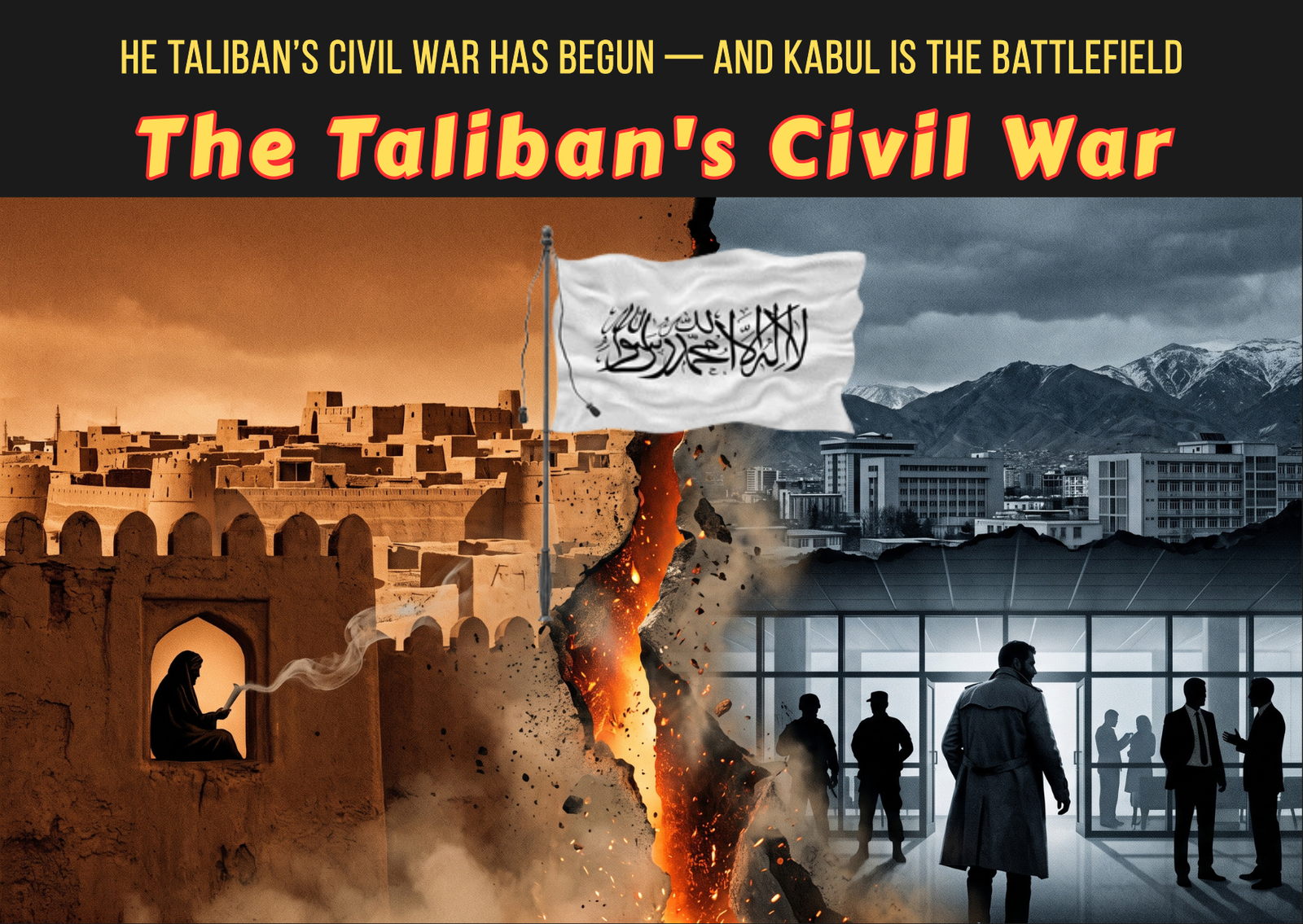
To understand the Taliban in 2026, one must stop thinking of them as a monolith. They are not. They are two governments occupying the same territory, speaking the same language, and wearing the same flag — but pursuing fundamentally different objectives.
Kandahar: The Theocratic Fortress
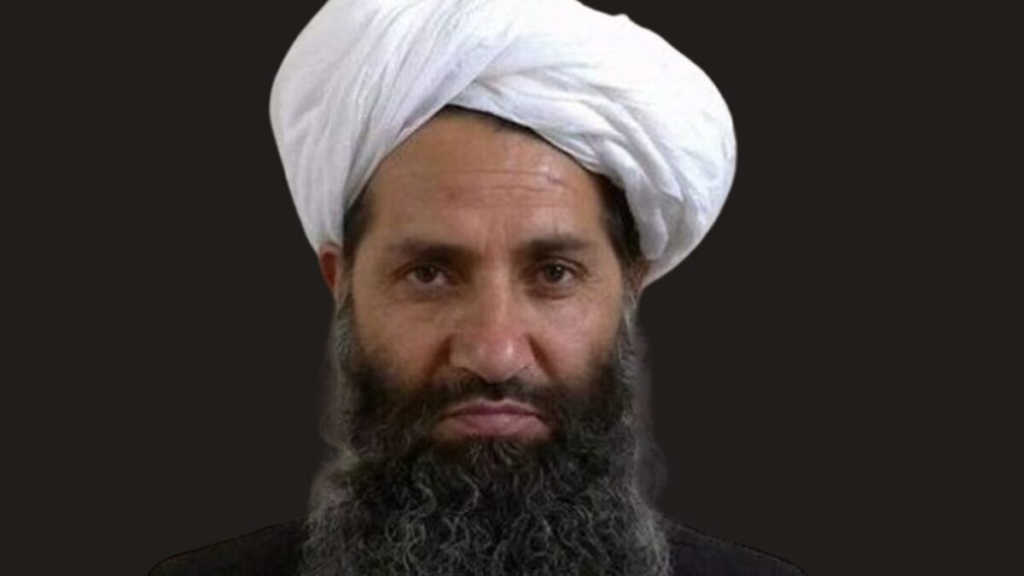
Akhundzada has not set foot in Kabul as a ruler. He governs from Kandahar, the Taliban’s spiritual birthplace, surrounded by a tight circle of clerics and loyalists from the movement’s southern heartland. His authority rests on a specific claim: he is the Amir al-Mu’minin, the Commander of the Faithful, a title that in Taliban theology is not merely political but sacred. He does not see himself as a head of government. He sees himself as the guardian of a divine project.
This worldview has produced a governance style that can only be described as isolationist edictocracy. Akhundzada rules through decrees. Girls’ secondary education is banned — now entering its fifth year. Women are barred from universities — now in its third. Women cannot work in most sectors, cannot travel without a male guardian, cannot visit public parks. The Ministry for the Propagation of Virtue and Prevention of Vice has been empowered to enforce these rules with growing brutality. In Akhundzada’s vision, Afghanistan is to be purified, sealed off from corrupting foreign influence, and governed by a strict interpretation of Hanafi jurisprudence that leaves little room for administrative pragmatism.
But here is the critical point: Akhundzada controls doctrine. He does not control logistics. He has no army under his direct command. He does not manage the customs houses. He does not negotiate with the Chinese engineers at the Mes Aynak copper mine or the Qatari diplomats seeking stability guarantees. He issues commands. Others decide whether to obey them.
Kabul: The Pragmatist Machine
While Akhundzada writes edicts in Kandahar, Sirajuddin Haqqani and Mohammad Yaqoob run a parallel government in Kabul. Haqqani, as Interior Minister, controls the police, the intelligence services, and the patronage networks that keep the capital functioning. Yaqoob, as Defence Minister, commands the military apparatus — an estimated 160,000 soldiers and 210,000 police and pro-Taliban militia, according to the regime’s own 2024 figures.
Their priorities are not theological. They are operational. Revenue must be collected. Borders must be policed. Electricity must flow. The Chinese must be kept engaged. The Russians must be reassured. The Gulf states must be cultivated. Haqqani and Yaqoob understand something that Akhundzada either does not accept or does not care about: the Taliban survived as an insurgency for twenty years because they did not have to govern. Now they must govern — and governance requires money, expertise, and a minimum of international forbearance.
This is not to say that Haqqani and Yaqoob are moderates. They are not. Haqqani’s network has more American blood on its hands than perhaps any other Taliban faction. Yaqoob is the heir to Mullah Omar’s legacy, not a reformist. But they are pragmatists. They understand that an emirate which cannot pay its soldiers, feed its cities, or keep its lights on will not survive — regardless of how pure its theology may be.
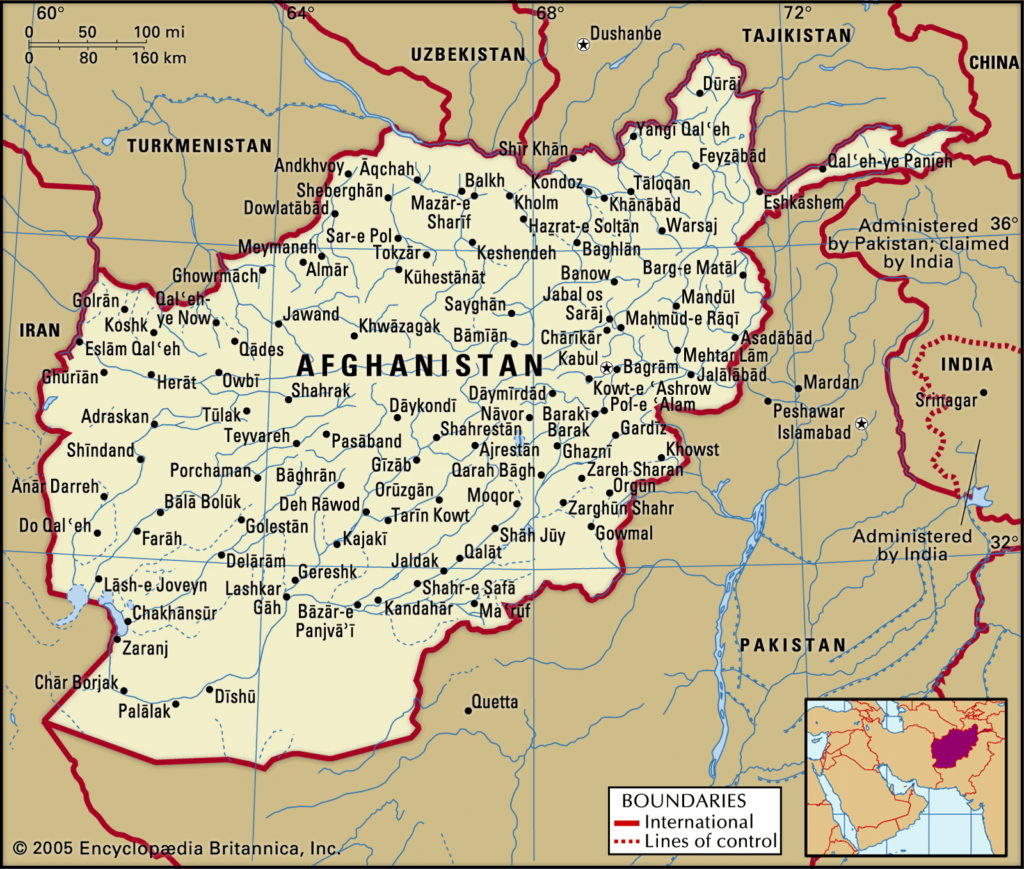
The Geographic Metaphor
The 500 kilometers between Kandahar and Kabul are not merely a physical distance. They represent an operational and ideological chasm. Kandahar issues edicts. Kabul implements, modifies, or ignores them. When Akhundzada ordered the internet shutdown, he was operating from the logic of purification: the digital world is sinful, therefore it must be excised. When Haqqani and Yaqoob reversed the order, they were operating from the logic of state survival: without internet connectivity, tax collection collapses, trade stalls, and the fragile economy that keeps their security forces paid and loyal grinds to a halt.
This is the central tension of the Islamic Emirate in 2026. It is not a government. It is a cohabitation — a theocracy and a bureaucracy sharing the same roof, with increasingly incompatible agendas.
III. Ideology vs. Governance
The internet shutdown was a symptom. The disease is a fundamental disagreement about what the Taliban are for.
The Women’s Ban as the Breaking Point
No issue illustrates this divide more clearly than the oppression of women. For Akhundzada, the ban on girls’ secondary education and women’s university attendance is non-negotiable. It is not a policy. It is a theological principle, a demonstration of the emirate’s commitment to divine law over human convention. He has reportedly told visitors that he would rather rule a poor, isolated, pure Afghanistan than a prosperous, engaged, compromised one.
For the Kabul faction, the women’s ban is a catastrophe — not because they necessarily disagree with it on moral grounds, but because they understand its practical consequences. It has made Afghanistan a global pariah. It has frozen recognition from every major power. It has blocked the release of central bank assets. It has deterred foreign investment. It has alienated a generation of Afghan families who might otherwise have accepted Taliban rule in exchange for stability.
But there is a security dimension that the Kabul pragmatists grasp and that Akhundzada ignores. The women’s ban is not merely a diplomatic liability. It is a military one. In province after province, families who might have tolerated Taliban governance are instead watching their daughters’ futures evaporate — and some of those families are turning to the resistance. The National Resistance Front (NRF), the Afghanistan Freedom Front (AFF), and the Afghan United Front (AUF) all cite the Taliban’s treatment of women as a recruiting tool. When a father in Badakhshan or Baghlan sees no future for his daughter under Taliban rule, the armed opposition becomes less abstract and more personal.
Akhundzada sees this as acceptable collateral damage in a spiritual war. Haqqani and Yaqoob see it as a slow hemorrhage of domestic legitimacy that they cannot afford.
The Economy of Defiance
The Kabul faction’s resistance to Kandahar is not ideological. It is economic. Haqqani and Yaqoob need functioning ministries to maintain their power bases. They need customs revenue to pay their networks. They need some form of international engagement to keep the economy from total collapse. Every edict from Kandahar that deepens Afghanistan’s isolation — every new restriction on women, every cultural prohibition, every rejection of foreign aid conditions — makes their job harder.
The internet shutdown was a perfect microcosm. Kabul ministers understood immediately that cutting connectivity would not just damage the economy. It would damage their own patronage systems. The Haqqani network’s influence depends on its ability to distribute resources. Yaqoob’s military authority depends on his ability to keep soldiers fed and equipped. An internet blackout threatened all of it. So they reversed it — not because they love the internet, but because they love power, and power requires a functioning state.
The Quiet Resistance Within
This dynamic plays out daily in ways that rarely make headlines. Lower-level officials in Kabul ministries slow-walk or simply ignore Kandahar’s most extreme orders. Provincial governors in the north and west — where resistance activity is most intense — prioritize local security and economic survival over strict enforcement of virtue codes. A governor in Badakhshan who is facing armed clashes with the AFF or Sepahiyan-e Mihan has little interest in dispatching his limited security forces to arrest women for improper dress. He needs those forces to fight insurgents.
This is not organized opposition. It is bureaucratic entropy — the natural tendency of an administration to prioritize survival over ideology when the two come into conflict. But entropy, left unchecked, becomes collapse.
IV. The Power Struggle: Who Would Win?
The central question of the Taliban’s internal cold war is simple: if this conflict turns hot, who wins? The answer is complicated by the fact that neither side can afford to let it turn hot.
Akhundzada’s Assets
Akhundzada’s power rests on a foundation that is intangible but not weak. He holds the title of Amir al-Mu’minin, and in the Taliban’s ideological architecture, this is not a job that can be easily contested. The Taliban have never removed a Supreme Leader. Doing so would require a theological justification that no faction has yet been willing to articulate. It would risk fracturing the movement along tribal, regional, and ideological lines that have been papered over since 2021.
Akhundzada also controls the moral authority that binds the rank-and-file Taliban fighter. The average Talib did not spend twenty years in the mountains dreaming of customs revenue optimization or Chinese mining contracts. He fought for an Islamic emirate governed by sharia. Akhundzada speaks to that fighter’s motivations in a way that Haqqani’s budget spreadsheets never will. If the regime splits, Akhundzada would likely retain the loyalty of the most ideologically committed elements — the rural fighters, the madrasa graduates, the virtue police.
But his weaknesses are severe. He has no direct control over the military. He does not manage the treasury. He cannot enforce his edicts without the cooperation of the Kabul apparatus. He is, in essence, a theocratic monarch with no army and no economy — only a microphone and a sacred title.
The Kabul Faction’s Assets
Haqqani and Yaqoob control the hard power. The Interior Ministry and Defence Ministry are not ceremonial posts. They command the soldiers, the police, the intelligence networks, and the prisons. If the regime were to fracture into open conflict, the Kabul faction would hold the overwhelming advantage in coercive capacity.
They also control the money. Afghanistan’s customs revenue, mining concessions, and informal trade networks all flow through Kabul. The Haqqani network, in particular, has spent decades building financial pipelines that are independent of state structures. Yaqoob, as the son of Mullah Omar, carries a legitimacy among certain Taliban factions that rivals Akhundzada’s religious title. He represents the founding bloodline.
Their international relationships are another asset. China, Russia, Qatar, and the UAE do not send diplomats to Kandahar to negotiate with Akhundzada’s clerical circle. They deal with Haqqani and Yaqoob. These relationships are transactional, not affectionate, but they give the Kabul faction options that the Supreme Leader does not have.
The Stalemate
The result is a frozen conflict. Akhundzada cannot purge Haqqani or Yaqoob without risking a military mutiny or a collapse of the state apparatus. Haqqani and Yaqoob cannot remove Akhundzada without triggering a theological crisis that could split the Taliban into warring factions, each claiming the true mantle of the emirate.
So they coexist. Publicly, Haqqani and Yaqoob express loyalty to the Supreme Leader. Privately, they ignore or reverse his most destructive edicts. Akhundzada, aware of his dependence, refrains from direct confrontation — but he continues to issue decrees that deepen the regime’s isolation and undermine the Kabul faction’s governance priorities.
This is not sustainable. It is merely stable — until it isn’t.
V. How the Internal Split Helps the External Enemies
The Taliban’s internal fracture is not happening in a vacuum. It is occurring while the regime faces the most serious external pressure it has encountered since retaking Kabul in August 2021.
The Resistance Reads the Tea Leaves
The anti-Taliban armed groups — the NRF under Ahmad Massoud, the AFF under former generals like Yasin Zia, and the Afghan United Front under Lieutenant General Sami Sadat — are small, fragmented, and chronically under-resourced. They do not have the strength to defeat the Taliban’s security apparatus in open battle. What they have is persistence, and increasingly, they have a narrative.
That narrative is simple: the Taliban regime is cracking. When the AFF seized positions in Zebak district, Badakhshan, in late July 2026, killing 21 Taliban fighters and shooting down two drones, it was not just a tactical victory. It was a message. When Sepahiyan-e Mihan briefly took control of Yaftali Sufla district days earlier, it sent the same signal. The resistance is not winning yet. But it is proving that the Taliban cannot secure their own territory — and that weakness is magnified by the visible disunity between Kandahar and Kabul.
Compounding these pressures, the northern provinces have become an active insurgency laboratory where the regime’s internal paralysis translates directly into tactical losses. In July 2026 alone, anti-Taliban forces demonstrated operational capabilities they had not shown since 2021: the Sepahiyan-e Mihan briefly seized Yaftali Sufla district in Badakhshan, while the Afghanistan Freedom Front killed twenty-one Taliban fighters in Zebak and shot down two drones. Most significantly, Lieutenant General Sami Sadat—former commander of Afghanistan’s most elite special operations corps—launched “Operation Muharib” in August 2026, vowing to “free Afghans from the Taliban” with claimed attacks in Kandahar, Helmand, Badghis, and Faryab. These are not the scattered ambushes of a desperate opposition. They are coordinated, multi-province operations timed to exploit a regime whose leadership is too busy managing its own internal cold war to mount a coherent counterinsurgency. When Kabul ministers are preoccupied with reversing Kandahar’s edicts, they are not reinforcing Badakhshan. And when Akhundzada is preoccupied with theological purity, he is not directing military strategy. The resistance understands this. They are not just fighting a weak regime. They are fighting a regime that is weakening itself.
Pakistan Exploits the Divide
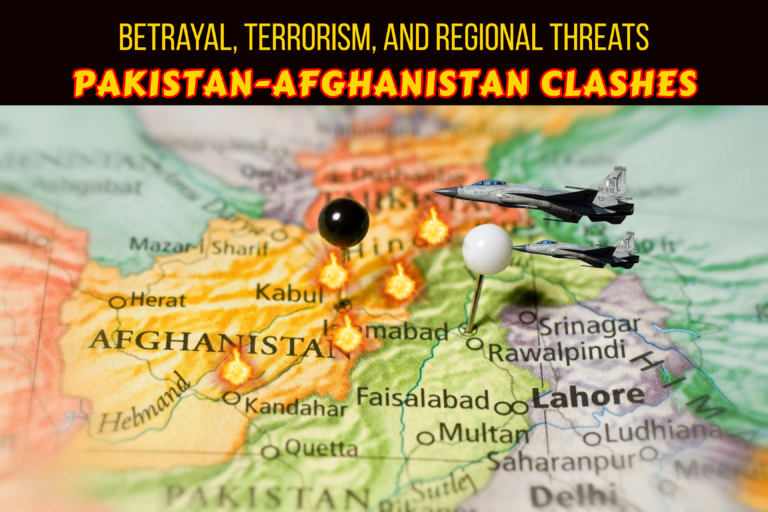
Pakistan’s role has become the most paradoxical element of the conflict. On February 27, 2026, Islamabad declared open war on Afghanistan after a suicide bombing in the capital and a series of TTP attacks in Bajaur. Pakistani airstrikes hit Kabul, Kandahar, Nangarhar, Paktika, and Kunar. The Taliban, who had sheltered the Pakistani Taliban (TTP) for years, suddenly found themselves on the receiving end of the very kind of cross-border violence they had long facilitated.
But Pakistan’s strategy is not purely kinetic. Since 2024, there have been credible reports that Pakistan’s Inter-Services Intelligence (ISI) established covert relations with the NRF — the very group that Pakistan’s own proxies had fought for two decades. The NRF itself released a statement supporting Pakistan’s airstrikes against the Taliban. This is classic ISI hedging: overtly bombing the regime while covertly arming its internal opposition, betting that a fractured Taliban is easier to manipulate than a unified one.
The Kandahar-Kabul split makes this strategy viable. If the regime were monolithic, ISI support for the NRF would be a straightforward act of war against a coherent enemy. But with the regime divided, Pakistan can calibrate its pressure — bombing Kandahar’s loyalists while signaling to Kabul’s pragmatists that a different relationship is possible if they distance themselves from Akhundzada’s hardline course.
The Diplomatic Freeze
No country has recognized the Islamic Emirate. The reason usually cited is the women’s ban, and that is true as far as it goes. But the Kandahar-Kabul split provides an additional, more structural reason for foreign powers to stay away: the regime cannot speak with one voice. Why negotiate recognition terms with Haqqani if Akhundzada will simply issue a contradictory edict the next day? Why invest in Kabul’s infrastructure if Kandahar might shut down the internet or ban female employment in the same sector?
The split turns Afghanistan from a pariah state into an ungovernable pariah state — and that distinction matters. A pariah state can be engaged. An ungovernable pariah state can only be contained.
VI. Where This Goes: Three Scenarios
The trajectory of the Taliban’s internal conflict will be shaped by external events as much as by the ambitions of the men in Kandahar and Kabul. Three scenarios are plausible.
Scenario A: The Stalemate Holds
This is the most likely outcome in the short term. Akhundzada remains in Kandahar, issuing edicts that Kabul selectively ignores. The regime continues its strange dual existence — theocratic in rhetoric, pragmatic in limited practice. Afghanistan remains isolated, poor, and sporadically violent. The resistance harasses but does not overthrow. Pakistan bombs but does not invade. The regime limps on, neither collapsing nor reforming.
Timeline: 1–3 years.
Probability: High.
Cost: Continued suffering for the Afghan population, gradual erosion of state capacity, and a slow bleed of Taliban cohesion.
Scenario B: The Kabul Coup
At some point, Haqqani and Yaqoob may conclude that Akhundzada’s edicts are no longer a nuisance but an existential threat to the regime’s survival. A major military defeat — say, a successful resistance operation in a major city like Herat or Mazar-i-Sharif, or a sustained Pakistani ground incursion — could trigger a move against the Supreme Leader. This would not necessarily be a violent coup. It could take the form of a “request” for Akhundzada to step down for health reasons, or the creation of a governing council that effectively sidelines him.
The risk is enormous. The Taliban rank-and-file is not a professional military. It is a coalition of tribal fighters, madrasa graduates, and ideologues who have been told for years that Akhundzada’s authority is divinely ordained. Removing him could trigger a civil war within the Taliban — southern loyalists against northern and eastern pragmatists, rural fighters against urban administrators. The Afghan state could collapse into factional warfare even more destructive than the current insurgency.
Trigger: A major military defeat, a Pakistani ground invasion, or a successful urban resistance operation.
Probability: Moderate.
Cost: Potentially catastrophic fragmentation of the Taliban movement and state collapse.
Scenario C: The Purge
The reverse is also possible. Akhundzada, increasingly isolated and aware that his edicts are being ignored, could attempt to purge the Kabul pragmatists. He could use his religious authority to declare Haqqani and Yaqoob deviants, replace them with loyalist clerics, and attempt to recentralize power in Kandahar.
This would almost certainly fail. The security apparatus is loyal to Haqqani and Yaqoob, not to the Supreme Leader’s theological claims. A purge would likely result in mutiny, desertion, or open conflict. The regime would lose its ability to fight the resistance and defend against Pakistan simultaneously. It would be an act of ideological purity that produced strategic suicide.
Trigger: Akhundzada concluding that compromise has failed and that only a return to first principles can save the emirate.
Probability: Low, but not zero.
Cost: Rapid collapse of state security apparatus and likely regime fracture.
VII. Conclusion: The Regime’s Real Enemy Is in the Mirror
The Taliban face Pakistan’s bombs, the resistance’s ambushes, and the world’s sanctions. None of these are trivial. But none are as dangerous as the fault line that runs from Kandahar to Kabul.
In 2021, the Taliban retook Afghanistan because they were unified in purpose and their enemy was divided. In 2026, the dynamic has reversed. The resistance is fragmented, yes — the NRF, AFF, and AUF compete for funding and attention, and no single leader has emerged to unify them. But the Taliban are divided at the top. Their Supreme Leader issues commands that his own ministers ignore. Their theocratic vision collides daily with the practical requirements of governance. Their claim to divine authority is undermined by the visible reality that the men who control the guns do not obey the man who claims to speak for God.
The internet shutdown reversal was not an anomaly. It was a symptom of a deeper disease — a regime that has two heads, two brains, and two incompatible nervous systems. One head wants purity. The other wants survival. They are connected to the same body, and they are pulling it in opposite directions.
The world has spent five years waiting for the Taliban to fall to a Northern Alliance cavalry charge or a Pakistani invasion or an American return. None of those things have happened. None of them may need to. The Taliban did not lose Afghanistan in 2021. They are losing it now — not to the mountains, not to the drones, but to the slow, grinding erosion of their own unity.
The mountains did not defeat the Taliban. The ministries might.