(By Khalid Masood)
India’s tendering of the Chenab–Beas Link Tunnel marks the first operational inter-basin diversion from a western river since the Indus Waters Treaty was suspended. It is a calibrated test of Pakistan’s diplomatic and legal response capacity—and a precedent for potentially larger diversions.
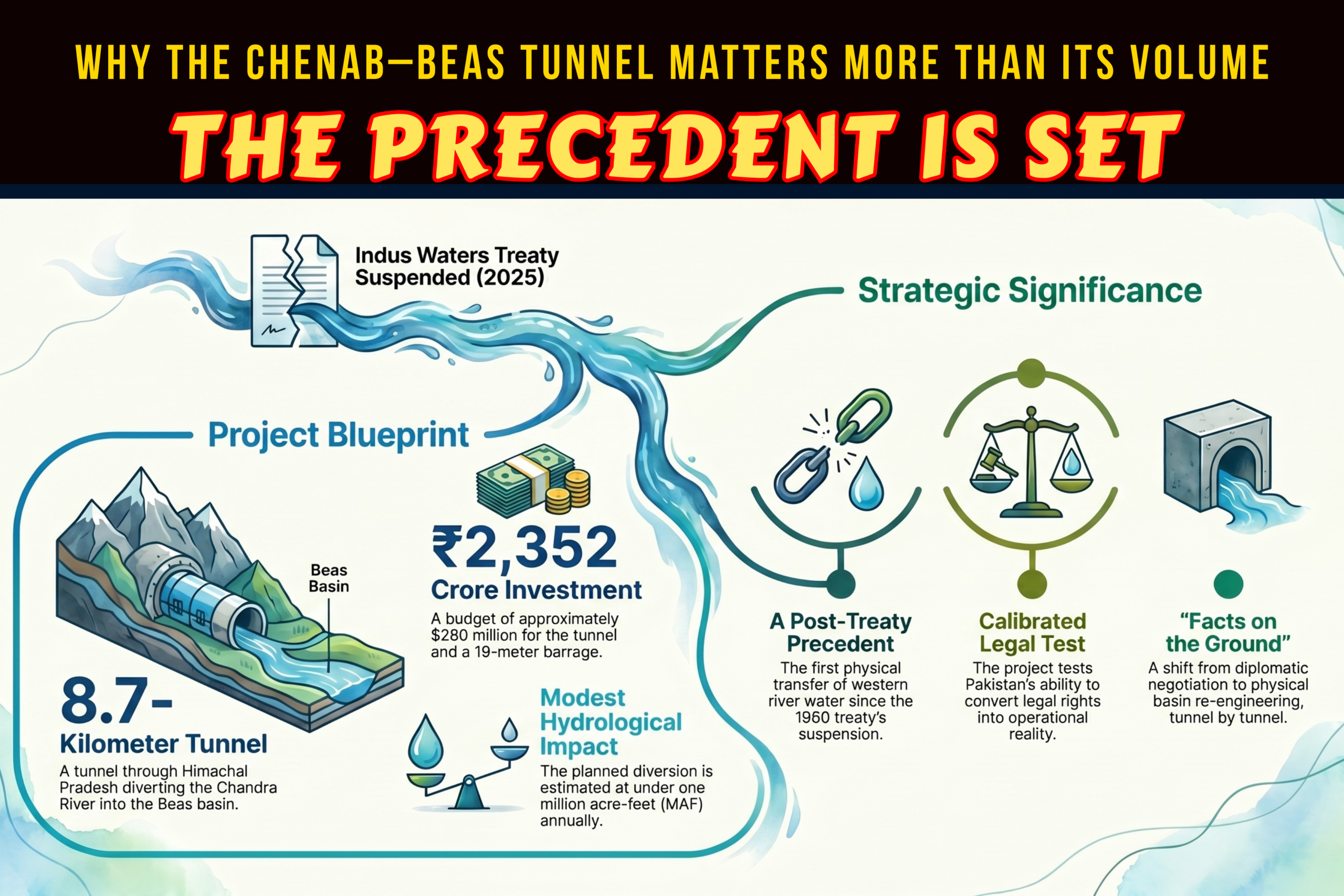
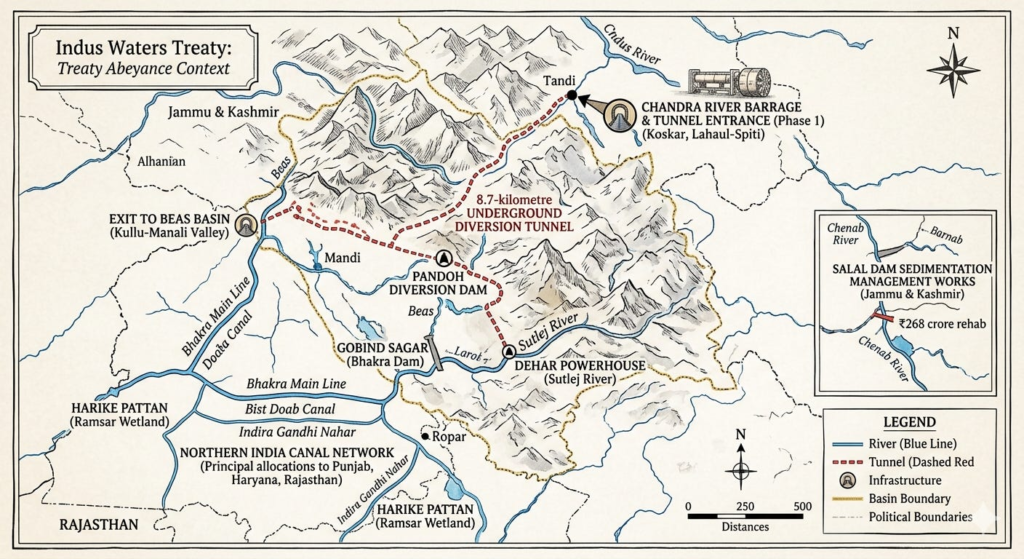
On May 20, 2026, India’s National Hydroelectric Power Corporation (NHPC) formally tendered an infrastructure project that would have been unthinkable eighteen months ago: an 8.7-kilometre tunnel through the Lahaul-Spiti region of Himachal Pradesh, designed to divert water from the Chandra River—the principal tributary of the Chenab—eastward into the Beas basin. The project includes a 19-metre barrage across the Lahaul valley and a diversion point near Koskar village, upstream of the Atal Tunnel’s north portal.
Budgeted at ₹2,352 crore (approximately $280 million), the Chenab–Beas Link Tunnel is modest in scale. Its planned diversion is estimated at under one million acre-feet (MAF) annually—a fractional share of the Chenab’s total yield. But its strategic significance dwarfs its hydrology.
This is the first time since the Indus Waters Treaty (IWT) was signed in 1960 that India has moved to physically transfer water out of a western river basin allocated to Pakistan and into its own eastern river system. The tender did not emerge in isolation. It is the latest, and most concrete, step in a cascade of post-abeyance actions that began on April 23, 2025, when India suspended the treaty following the Pahalgam attack.
The Breaking Point: From Treaty to Abeyance
The Indus Waters Treaty has survived three wars and decades of hostility. But on April 22, 2025, unknown militants killed 26 tourists in Pahalgam, Indian-administered Kashmir. Within 24 hours, New Delhi announced the treaty would be held in abeyance “with immediate effect, until Pakistan credibly and irrevocably abjures its support for cross-border terrorism.”
Pakistan’s response was swift and categorical. An official statement warned: “Any attempt to stop or divert the flow of water belonging to Pakistan as per the Indus Waters Treaty, and the usurpation of the rights of lower riparian will be considered as an Act of War and responded with full force across the complete spectrum of National Power.”
But India did not blink. Home Minister Amit Shah made the position irrevocably clear in an exclusive interview with The Times of India: “No, it will never be restored. International treaties can’t be annulled unilaterally but we had the right to put it in abeyance, which we have done… We will take water that was flowing to Pakistan to Rajasthan by constructing a canal. Pakistan will be starved of water that it has been getting unjustifiably.”
What India Has Done Since: A Timeline
Since the abeyance declaration, India has moved methodically—operationally, infrastructurally, and diplomatically—to dismantle the treaty’s procedural constraints.
Table 1: India’s Post-Abeyance Water Actions (April 2025 – May 2026)
| Date | Action | Significance |
|---|---|---|
| April 23, 2025 | IWT declared in “abeyance” | First suspension in 65 years; removes all notification/coordination obligations |
| April–May 2025 | Hydrological data sharing stopped | Pakistan loses critical flood forecasting and flow data |
| May 2025 | Baglihar Dam flow restrictions | First short-term punitive water measure on the Chenab |
| May 2025 | Off-season reservoir flushing at Salal & Baglihar | Violates former IWT notification requirements; boosts Indian storage |
| June 2025 | Amit Shah declares IWT “will never be restored” | Politically locks in abeyance as permanent policy |
| January 2026 | Pakistan raises IWT at UN Security Council (Arria Formula) | Ambassador Asim Iftikhar Ahmad calls it “a serious violation of international legal obligations, with far-reaching humanitarian, environmental, and peace and security implications” |
| April 2026 | Pakistan Foreign Minister writes to UN Council President | Warns of grave consequences for 240 million Indus-dependent people |
| May 15, 2026 | India rejects Court of Arbitration (PCA) Partial Award | Calls Kishanganga-Ratle pondage ruling “null and void”; refuses to appoint judges |
| May 20, 2026 | NHPC tenders Chenab–Beas Link Tunnel (₹2,352 Cr) | First inter-basin diversion from a western river post-abeyance |
| May 2026 | NHPC initiates Salal Dam sediment-bypass tunnel (₹268 Cr) | Restores storage capacity lost to siltation; strategic desiltation continues |
The Chenab–Beas Link: A Test Run, Not a Finale
The Chandra-to-Beas diversion is technically small. Senior Advocate Mohan Katarki, one of India’s foremost authorities on inter-state river water law, offers a precise assessment: “A good project, benefiting Himachal Pradesh, Punjab, Rajasthan and Haryana, but one whose impact on Pakistan will remain limited, largely confined to minor summer-season issues. Its capacity is less than 1 MAF, whereas the Chenab’s total mean annual yield in India, up to the international border/LoC, is about 26.2 MAF.”
But Katarki’s very precision underscores the danger. The tunnel does not need to dry the Chenab to change the strategic calculus. It establishes three critical precedents.
First, it proves that India can now execute inter-basin transfers from the western rivers without procedural obstruction. The infrastructure template—tunneling through the Pir Panjal watershed to move water into the Ravi-Beas-Sutlej system—can be replicated. If 0.8 MAF is permissible today, what prevents 2 MAF tomorrow, or 5 MAF the year after, once the precedent is normalised?
Second, it tests Pakistan’s response in real time. Will Islamabad accelerate its own legal and diplomatic countermeasures? Will it mobilise the Court of Arbitration despite India’s non-participation? Will it invest, finally, in the domestic storage capacity that has been delayed for decades? Or will institutional inertia and political paralysis signal to New Delhi that larger diversions will meet only rhetorical resistance?
Third, it integrates with India’s broader eastern river strategy. New Delhi is already completing the Shahpurkandi dam, advancing the Makaura Pattan Barrage and Ujh Dam, and maximising utilisation of its allocated share of the Ravi, Beas, and Sutlej. By adding even a sub-1 MAF trickle from the Chenab to this system, India is tightening its grip on every available drop in the upper basin—leaving less margin for downstream variability.
The Cascade Beyond the Tunnel
The Chenab–Beas Link is not the only post-abeyance project in motion. NHPC is executing multiple large-scale projects across the western rivers, many of which were previously stalled by Pakistani objections through treaty dispute mechanisms.
Table 2: Major Post-Abeyance Hydropower & Diversion Projects on Western Rivers
| Project | River | Location | Cost | Capacity/Scope | Status |
|---|---|---|---|---|---|
| Chenab–Beas Link Tunnel | Chandra (Chenab tributary) | Himachal Pradesh | ₹2,352 Cr | <1 MAF diversion; 8.7 km tunnel | Tendered; construction underway |
| Salal Dam Sediment Bypass | Chenab | Jammu & Kashmir | ₹268 Cr | Desiltation & storage restoration | Initiated by NHPC |
| Sawalkote HEP | Chenab | Jammu & Kashmir | ₹5,129 Cr | 1,200 MW hydropower | Under execution |
| Ratle HEP | Chenab | Jammu & Kashmir | — | 850 MW | Fast-tracked; construction ongoing since 2022 |
| Pakal Dul HEP | Chenab | Jammu & Kashmir | — | 1,000 MW | Accelerated |
| Kiru HEP | Chenab | Jammu & Kashmir | — | 624 MW | Fast-tracked |
| Kwar HEP | Chenab | Jammu & Kashmir | — | 540 MW | Fast-tracked |
| Kishanganga II | Jhelum | Jammu & Kashmir | — | 40 MW extension | Planning initiated Jan 2025 |
| Ujh Multipurpose Project | Ujh (Ravi tributary) | Jammu & Kashmir | — | Dam/barrage for Ravi-Beas transfer | Revived post-abeyance |
India has also altered reservoir management practices—flushing sediment outside the monsoon window, a practice that would have violated IWT notification requirements, and exploring dry-season release patterns that could disrupt Pakistan’s winter sowing cycle.
The Legal Vacuum
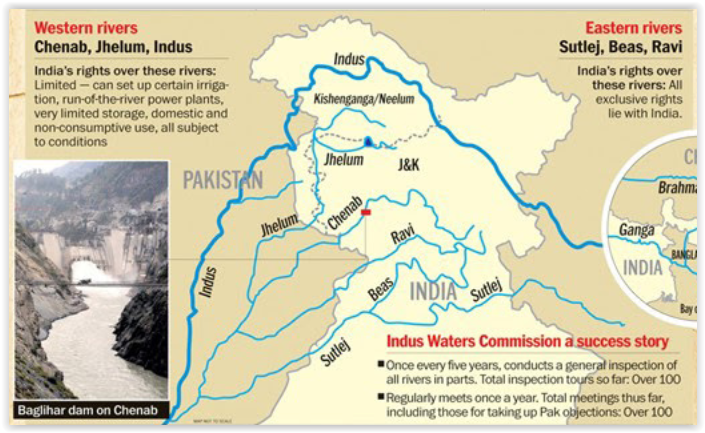
Pakistan’s legal position is not hopeless, but it is constrained. The Court of Arbitration has already ruled that the IWT remains in force and that India’s abeyance declaration lacks legal effect under the treaty’s own framework. Pakistan can continue to press the CoA process, seeking declaratory judgments that characterise India’s post-abeyance projects as treaty violations, even in absentia.
Dr. Muhammad Aslam Tahir, former Chairman of Pakistan’s Council of Research in Water Resources, notes: “Pakistan always acted as responsible state and India under the influence of Modi’s Hindutva ideology resorted to violate all international laws and norms… Instead of reacting emotionally, Pakistan chose to follow legal course of action by approaching institutions already built into the treaty system, including the Court of Arbitration and Neutral Experts.”
But legal process moves slowly, and concrete construction moves fast. The World Bank, the treaty’s facilitator, has explicitly stated it will not intervene. India’s rejection of the PCA award on May 15, 2026, and its refusal to appoint judges to the Court of Arbitration jury, has created a legal vacuum in which India is building water infrastructure on the Chenab without any external oversight mechanism.
The Narrow Window
What Pakistan cannot afford is to treat the Chenab–Beas Link as a one-off infrastructure project. It is a probe—a calibrated test of whether Pakistan has the institutional will to protect its water entitlements in a post-treaty environment. If the response is limited to press statements and delayed diplomatic notes, India will have its answer. And the next project may not be 0.8 MAF.
The urgent imperative is domestic. Pakistan’s live water storage capacity remains critically low—roughly 10% of annual Indus flows—compared to India’s 33% and China’s far higher ratios. Every million acre-foot stored in Pakistani reservoirs is a million acre-foot that cannot be diverted or weaponised upstream. The Diamer-Bhasha and Mohmand dams, long delayed by institutional paralysis, are no longer optional development projects. They are strategic necessities.
Conclusion
The ₹2,352 crore tendered for the Chenab–Beas Link Tunnel is not, by itself, an existential threat to Pakistan’s water security. But it is something more dangerous than a single diversion: it is a precedent. It signals that India has moved from diplomatic suspension to physical re-engineering of the basin. It tests whether Pakistan can convert legal rights into operational reality. And it opens the door to a future in which the western rivers are no longer governed by treaty, but by the facts on the ground—tunnel by tunnel, dam by dam, acre-foot by acre-foot.
The water war has not begun with a flood. It has begun with a tender. And the response to that tender will determine whether it ends there, or escalates into something far more consequential.