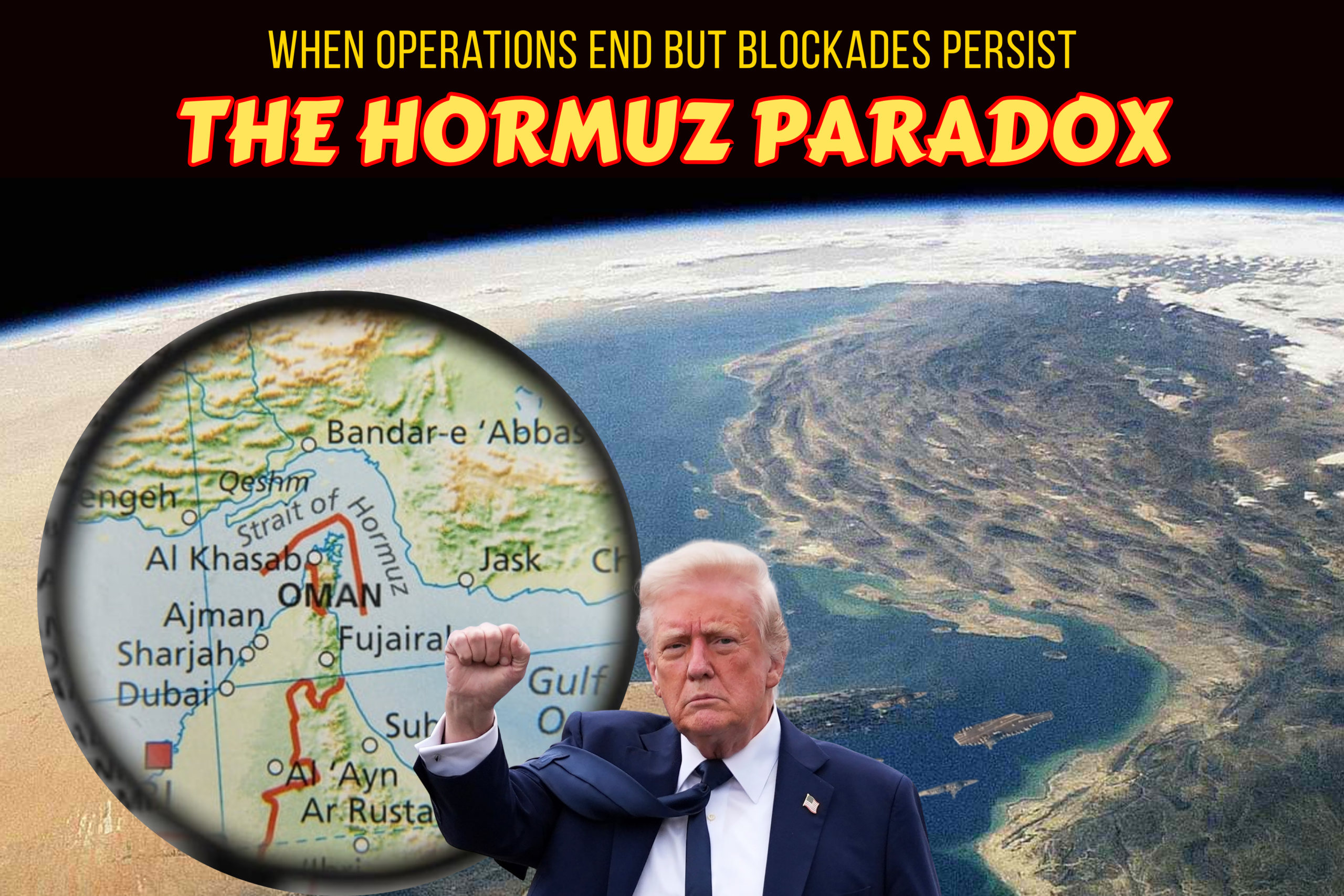
How the termination of Operation Epic Fury reveals the new grammar of maritime coercion—and why global markets, not just militaries, now decide the rules of engagement.
(By Khalid Masood)
I. Introduction: The Day the Clock Ran Out
On 1 May 2026, as the War Powers Resolution’s 60-day clock reached its constitutional terminus, the White House transmitted a brief letter to congressional leadership: “The hostilities that began on February 28, 2026, have terminated.” The statement was terse, triumphant, and technically compliant. Yet across the Arabian Sea, the Strait of Hormuz—the arterial chokepoint for roughly a quarter of global seaborne crude and liquefied natural gas—remained functionally constrained. Throughput hovered at five per cent of normal capacity. War risk insurance premiums for Gulf transits persisted at thirty-three times their pre-crisis baseline. Shipping lanes, though not formally closed, operated under a regime of heightened inspection, rerouting, and uncertainty.
The formal end of Operation Epic Fury has not ended the maritime pressure campaign. Instead, it has shifted the contest from overt military engagement to economic endurance, legal interpretation, and market adaptation. This analysis examines the legal manoeuvring, market responses, and diplomatic positioning—particularly Pakistan’s emerging mediation role—that define the “post-operation” reality. In an era where declarations and data diverge, the true measure of resolution lies not in press releases, but in price signals, shipping manifests, and the quiet recalibration of global supply chains.
II. Context: What “Termination” Actually Means
International law draws a sharp distinction between a formal, declared blockade and sustained interdiction or sanctions enforcement. A de jure blockade requires public declaration, notification to neutral states, and proportional, non-discriminatory enforcement under customary international law and the United Nations Convention on the Law of the Sea (UNCLOS). What has unfolded in the Gulf, however, aligns more closely with an expanded interdiction regime: heightened naval presence, rigorous vessel inspections, secondary sanctions enforcement, and the strategic leveraging of insurance and shipping compliance mechanisms.
Official narratives and operational reality have diverged. The White House claimed that hostilities had terminated and that Iran’s military capabilities had been “significantly degraded”. Yet independent maritime tracking data shows continued vessel inspections, restricted transit corridors, and elevated naval activity. As Senator Richard Blumenthal noted during Senate Armed Services Committee proceedings, verified by PBS transcripts:
“There’s no pause button in the Constitution, or the War Powers Act. We’re at war. We’ve been at war for 60 days. The blockade alone is a continuing act of war.”
This legal ambiguity is not incidental; it is instrumental. By declaring operations “terminated” while maintaining maritime pressure through sanctions enforcement and naval presence, the administration has created diplomatic cover without relinquishing strategic leverage. The question for markets, allies, and adversaries alike is no longer whether hostilities continue, but how risk is priced when political announcements and operational reality no longer align.
III. The Legal Escape Route: War Powers & Executive Authority
The trajectory of Operation Epic Fury has tested the boundaries of executive war powers in ways that may set enduring precedents. Launched on 28 February 2026 without congressional authorisation, the operation triggered immediate constitutional debate. Under the War Powers Resolution of 1973, the President must seek congressional authorisation or withdraw forces within 60 days of initiating hostilities. The clock does not pause for ceasefires, blockades, or ongoing naval operations—according to the text of the law and the interpretation of most constitutional scholars.
Timeline of Constraints:
- 28 February: Operation Epic Fury launched; no congressional vote precedes deployment.
- March–April: Six Senate votes on war powers resolutions; all blocked along partisan lines, with several Republicans joining Democrats in seeking to constrain executive authority.
- 1 May: Presidential letter to Congress declares termination hours before the constitutional deadline expires.
The administration’s legal argument rested on a novel interpretation: that a ceasefire suspends “hostilities” for War Powers purposes, thereby pausing the 60-day clock. Legal experts pushed back immediately. As Professor Elena Vance of Chatham House observed in a recent briefing:
“The architecture of modern maritime coercion rarely involves declared blockades. It operates through compliance markets, risk pricing, and the quiet recalibration of port access. That is where the true geo-economic leverage now lies.”
Whether this interpretation withstands judicial scrutiny remains uncertain. What is clear is that the episode has expanded the toolkit for executive military action without congressional approval—a precedent that may shape future engagements far beyond the Gulf.
Table 1: Congressional War Powers Votes on Epic Fury (March–April 2026)
| Date | Resolution Focus | Senate Vote | Outcome | Key Blocs |
|---|---|---|---|---|
| 15 Mar | Limit ground troop deployment | 48–52 | Failed | GOP majority opposed |
| 2 Apr | Require AUMF for naval interdiction | 47–53 | Failed | 3 Republicans crossed |
| 18 Apr | Fund withdrawal of forces | 46–54 | Failed | Bipartisan deficit concerns |
| 25 Apr | Clarify “hostilities” definition | 49–51 | Failed | Procedural objections |
| 30 Apr | Emergency session request | 45–55 | Failed | Leadership control |
Source: Congressional Record, Senate Floor Proceedings
IV. Market Reality: When Paper Declarations Meet Price Signals
Financial markets, unlike political narratives, respond to observable risk. The termination announcement did not erase the structural uncertainties that had driven volatility since late February. Energy prices, freight costs, and insurance premiums continue to reflect a market that doubts the durability of the “post-operation” framing.
Energy Markets & Pricing Dynamics
Brent and WTI futures have exhibited elevated volatility, with geopolitical risk premiums consistently embedded in daily settlements. More structurally significant is the divergence between spot LNG contracts and long-term agreements. Buyers in Europe and East Asia are increasingly locking in multi-year deals to hedge against transit uncertainty, while spot markets absorb the volatility premium.
Shipping & Supply Chain Reconfiguration
Marine hull and machinery insurers, alongside war risk underwriters, have adjusted premiums for Gulf transits. Major container and tanker operators have begun routing a portion of cargoes via the Cape of Good Hope, accepting longer voyage times in exchange for reduced insurance exposure and geopolitical risk. Pipeline utilisation rates across the Arabian Peninsula have correspondingly increased.
Financial & Macroeconomic Spillovers
The petrodollar recycling mechanism is adapting to altered settlement patterns, while central banks in import-dependent emerging markets are adjusting reserve allocations to buffer against currency volatility. The IMF’s latest World Economic Outlook revisions highlight how energy and freight inflation are transmitting into broader consumer price indices, particularly in South Asia and sub-Saharan Africa.
Table 2: Post-Termination Market Indicators (2–3 May 2026)
| Metric | Pre-Crisis (Jan 2026) | Peak Escalation (Mar 2026) | Post-Termination (2 May) | Interpretation |
|---|---|---|---|---|
| Brent 30-day Volatility Index | 22.4 | 41.2 | 33.8 | Risk premium persists |
| Gulf War Risk Premium (% hull value) | 0.08% | 5.2% | 4.9% | Markets doubt “termination” |
| JKM LNG Spot ($/MMBtu) | $11.40 | $18.60 | $16.20 | Long-term hedging continues |
| Asia–Europe Container Freight Index | 1,020 | 1,680 | 1,440 | Rerouting costs sticky |
| Saudi East-West Pipeline Utilisation | 68% | 91% | 87% | Diversification remains strategic |
Sources: IEA, BIMCO, Drewry, Lloyd’s List, Hormuz Strait Monitor. Figures represent reported averages and are subject to continuous revision.
V. Diplomatic Positioning: Pakistan’s Pivotal Role
Amid the legal manoeuvring and market volatility, Pakistan has emerged as a critical, if understated, diplomatic actor. Islamabad’s geographic position—bordering Iran, proximate to the Strait of Hormuz, and host to the strategically significant Gwadar Port—places it at the nexus of regional stability and economic connectivity. Rather than aligning overtly with any single bloc, Pakistan has pursued a mediation strategy grounded in pragmatic neutrality.
Pakistan as Mediator
Since March 2026, Pakistani diplomatic channels have maintained active backchannel engagement with both Tehran and Washington. Islamabad has proposed a “phased de-escalation” framework linking incremental maritime access to sequenced nuclear dialogue. The approach acknowledges the constraints on all sides: Washington’s domestic political pressures, Tehran’s demand for tangible sanctions relief, and the regional imperative to restore trade flows. As a Pakistani Foreign Ministry spokesperson stated in an April 2026 briefing:
“Pakistan’s geography makes it neither spectator nor belligerent in the Hormuz crisis. Our interest is singular: stability that allows trade, energy, and people to move without fear.”
Geographic & Economic Stakes
Pakistan’s exposure to Gulf instability is direct and multifaceted. The China–Pakistan Economic Corridor (CPEC), centred on Gwadar Port, represents a multi-billion-dollar infrastructure commitment vulnerable to maritime disruption. Insurance costs for Chinese-Pakistani maritime corridors have risen in tandem with Gulf risk premiums. Domestically, Pakistan relies on seaborne crude and liquefied natural gas transiting near Hormuz; sustained disruption impacts power generation, industrial output, and inflation. Furthermore, remittance flows from the Gulf-based Pakistani workforce—a critical source of foreign exchange—are sensitive to regional labour mobility and security conditions.
Strategic Balancing Act
Islamabad’s diplomatic posture reflects a careful calibration of competing imperatives. Security cooperation with the United States on counter-terrorism continues, even as economic ties with Iran and China deepen. The Pakistan Navy has enhanced Arabian Sea patrols and participates in multinational maritime security dialogues without formal alignment to any coalition. Diplomatic language consistently emphasises “restraint”, “dialogue”, and “regional solutions”—positioning Islamabad as an honest broker rather than a partisan actor.
Regional Ripple Effects
Pakistan’s mediation efforts intersect with broader regional dynamics. GCC-Pakistan ties—encompassing labour mobility, investment flows, and security cooperation—are being adjusted in light of Gulf uncertainty. Coordination with China on CPEC security protocols is under review, with Beijing expressing preference for diplomatic resolution over escalation. Should Islamabad’s mediation gain traction, it could establish a template for regional crisis management that prioritises economic stability alongside security concerns.
VI. The New Grammar of Coercion: Lessons for Geo-Economic Statecraft
The Hormuz crisis, in its current phase, illustrates a broader shift in how state power is projected and contested in the twenty-first century. Modern maritime coercion operates less through declared blockades and naval engagements than through compliance markets, insurance mechanisms, and port-access leverage. Legal ambiguity is not a bug in this system; it is a feature. “Termination” declarations create diplomatic cover while maintaining economic pressure, allowing states to signal resolve without triggering full-scale escalation.
Institutional Adaptation
International institutions are beginning to adapt. The International Maritime Organization is debating updated guidelines for “non-declared interdiction” scenarios. Insurance markets are developing dynamic risk models that decouple political announcements from operational reality. Central banks are incorporating maritime risk into reserve allocation frameworks. These adaptations reflect a recognition that ambiguity and prolonged uncertainty are now structural features of the global system—not temporary aberrations.
Strategic Hedging as Default
States and corporations are adjusting their baseline assumptions. Redundancy—in routes, suppliers, and settlement mechanisms—is increasingly valued over pure efficiency. Long-term contracts are preferred to spot markets. Diversification is no longer a contingency plan; it is a core strategy. As former UK Foreign Office adviser Sir Julian Hayes observed:
“Maritime coercion is only sustainable if it is calibrated. The moment risk pricing outpaces diplomatic off-ramps, the system tips from deterrence into self-inflicted economic fragmentation.”
This is not a return to “normal”. It is the emergence of a new operating system for geo-economic competition—one in which markets, legal frameworks, and diplomatic positioning carry more weight than battlefield metrics.
VII. Conclusion: The Paradox Endures
The termination of Operation Epic Fury has not resolved the Hormuz crisis; it has merely shifted the arena of contestation. Legal arguments, market signals, and diplomatic positioning now carry more weight than battlefield metrics. The coming weeks will test whether risk pricing stabilises, whether diplomatic off-ramps gain traction, and whether Pakistan’s mediation efforts can help bridge the gap between Washington’s legal exit and Tehran’s demand for tangible sanctions relief.
For policymakers, the lesson is clear: in an era of ambiguous coercion, declarations matter less than durability. For markets, the signal is equally unambiguous: price in uncertainty until operational reality and political rhetoric converge. For readers seeking to understand the evolving architecture of global power, the most reliable indicators are not press releases—but price signals, shipping data, and the quiet recalibration of global supply chains.
The Strait of Hormuz remains a geographic chokepoint. But its strategic significance now extends far beyond geography. It has become a laboratory for the future of geo-economic statecraft—a place where law, commerce, and coercion intersect, and where the rules of global engagement are being rewritten in real time.