(By Khalid Masood)
November 3, 2026
I. The Scene
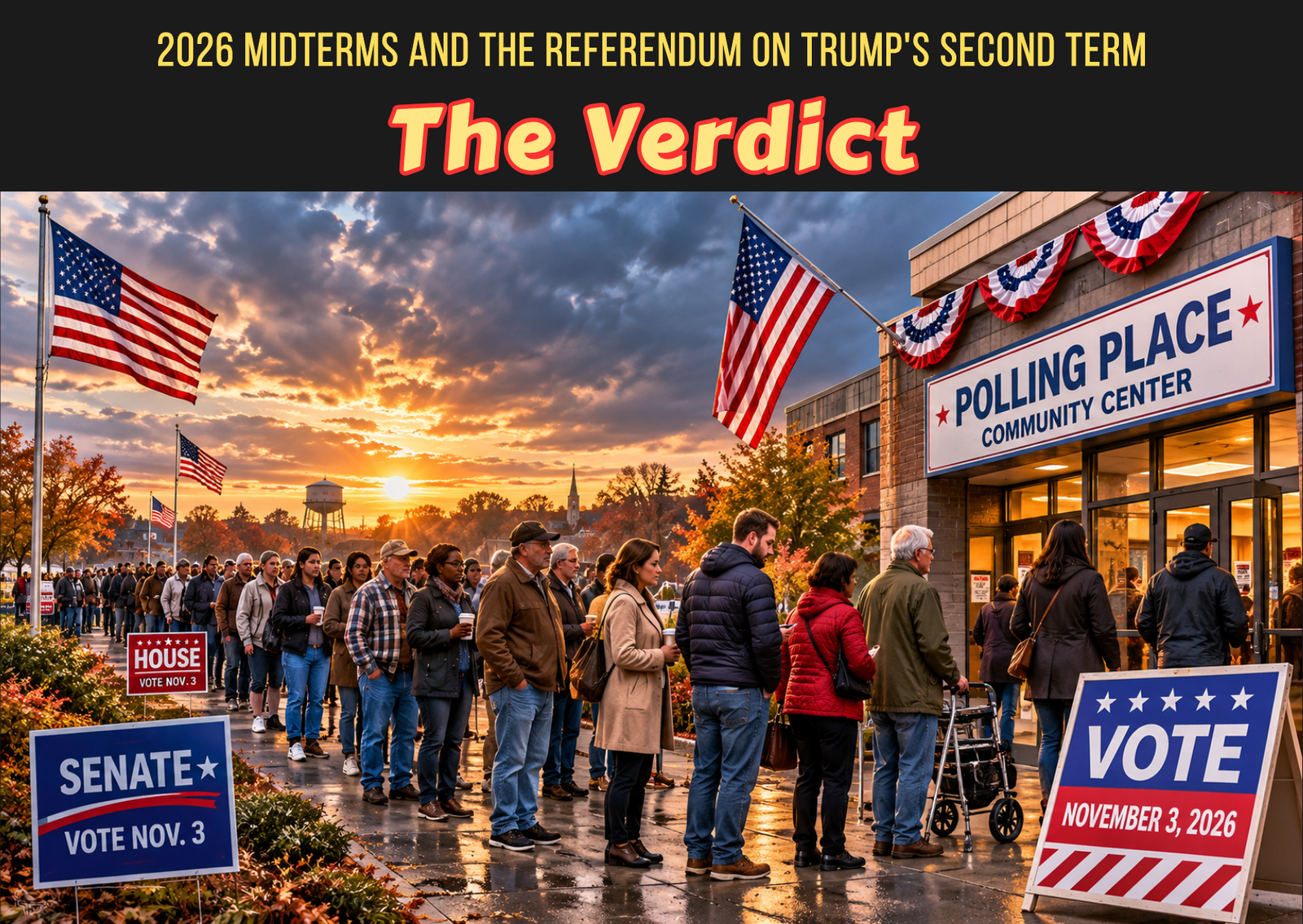
DES MOINES, Iowa — At 7:14 a.m., as the sun burned through October’s last fog, Marlene Kesterson pulled her Ford F-150 into the parking lot of the Franklin Township Community Center. The 61-year-old corn and soybean farmer had already fed the hogs, checked the diesel tank—prices still hovering near $4.80 a gallon, she noted with a grimace—and now stood in line with roughly forty other Iowans, coffee thermoses in hand, waiting for the polls to open.
“I’m not voting for a party today,” Kesterson said, her breath visible in the cold air. “I’m voting because I’m tired. Tired of the war, tired of the prices, tired of feeling like nobody in Washington knows what a gallon of diesel costs or what it takes to run a farm.”
Three hundred miles east, in the Detroit suburb of Sterling Heights, auto worker Marcus Thompson cast his ballot before the morning shift. “Trump says the economy’s great,” Thompson said, wiping grease from his hands. “Tell that to my grocery bill. Tell that to the guys at the plant who are working overtime just to break even.”
And in Tempe, Arizona, suburban mother-of-two Jennifer Delgado voted after dropping her kids at school. “This isn’t about left or right anymore,” Delgado said. “It’s about whether we still have a democracy that works. It’s about whether my vote actually counts.”
Today, November 3, 2026, more than 250 million eligible Americans will render their verdict on Donald Trump’s second, non-consecutive presidency. All 435 House seats, 35 Senate seats, 39 governorships, and thousands of state legislative seats are on the ballot. But this is no ordinary midterm. This is a referendum on three intersecting crises: a seven-month war with Iran that has sent diesel prices to record highs, an affordability crunch that has persisted despite cooling inflation, and a democracy stressed by voter roll purges, federal election operations, and litigation over whose ballots should count.
The stakes could not be clearer. Republicans hold the House by a razor-thin 218–212 margin (with vacancies) and the Senate 53–47. Democrats need a net gain of just three House seats and four Senate seats to seize control of Congress—and with it, the power to investigate, subpoena, and potentially impeach a president whose approval rating has sunk to career lows.
II. The Arithmetic of Power
| Chamber | Current Control | Republican Seats | Democratic Seats | Democratic Gain Needed |
|---|---|---|---|---|
| House | Republican | 218 | 212 (with vacancies) | +3 |
| Senate | Republican | 53 | 45 (+2 Independents) | +4 |
| Governorships | Republican | 27 | 23 | — |
Table 1: Control thresholds for the 120th Congress
The historical pattern is unambiguous: The president’s party loses an average of 28 House seats in midterm elections. The last time the White House party gained House seats in a midterm was 2002, in the post-9/11 environment of George W. Bush. Since then, the pattern has held with remarkable consistency: 2006 (Iraq backlash), 2010 (Tea Party), 2014 (Obama’s “shellacking”), 2018 (Blue Wave), and 2022 (an expected red wave that fizzled into a ripple).
But 2026 presents a unique variable: a former president serving a non-consecutive second term, facing voters amid an active war and a democracy crisis. No historical parallel exists.
III. The Senate Battleground: Five States That Will Decide Control
The Senate map is brutally simple: Democrats must defend incumbents in Arizona, Nevada, Wisconsin, and Pennsylvania, while picking up seats in states Trump carried—some by double digits.
The Toss-Up Tier
Ohio: The Rematch
Former Democratic Sen. Sherrod Brown, who lost his reelection bid in 2024, faces Republican Sen. Jon Husted in a special election to finish the final two years of now-Vice President JD Vance’s term. Trump won Ohio by more than 11 points in 2024, but recent polling shows Brown with a narrow lead heading into Election Day. “This is one of the most expensive and consequential Senate races in the country,” said Kyle Kondik, managing editor of Sabato’s Crystal Ball. “Brown’s populist economics versus Husted’s Trump alignment—it’s a test of whether Democrats can win back Trump country.”
Michigan: The AIPAC Test
Democrat Abdul El-Sayed, a progressive who would be the first Muslim American to serve in the Senate, faces Republican Mike Rogers in the race to replace retiring Sen. Gary Peters. The race has drawn extraordinary attention from pro-Israel groups, with AIPAC shifting $30 million to the United Democracy Project to support Rogers. If Rogers wins, it would mark the first Republican Senate victory in Michigan since 1994—despite Trump carrying the state twice.
Iowa: The Farm Crisis
Democrat Josh Turek faces Republican Ashley Hinson in a race that has become a referendum on the economic pain rippling through agricultural America. Hinson has carefully distanced herself from Trump on the Iran war, recognizing that record diesel prices have hit her rural base hard. “Iowa farmers are hurting,” said one Republican operative who requested anonymity to speak candidly. “The question is whether they blame Trump or whether Hinson’s independence is enough.”
Maine: The Last New England Republican
Sen. Susan Collins, seeking a sixth term in a state Kamala Harris won by three points in 2024, faces former state Senate President Troy Jackson. Collins chairs the powerful Senate Appropriations Committee, but her survival depends on the same ticket-splitting magic that has sustained her for three decades—magic that may be fading in the Trump era.
North Carolina: The Governor’s Gambit
Popular former two-term Democratic Gov. Roy Cooper has led polls to take the seat currently held by retiring Republican Sen. Thom Tillis. If Cooper wins, it marks a rare Democratic pickup in the South—and a potential template for 2028.
The Lean Republican Tier
| State | Democratic Candidate | Republican Candidate | 2024 Presidential Margin | Key Dynamic |
|---|---|---|---|---|
| Alaska | Mary Peltola | Dan Sullivan (inc.) | Trump +10 | 50-50 polling; “other Dan Sullivan” ballot confusion |
| Kansas | Adam Hamilton | Roger Marshall (inc.) | Trump +16 | No Democratic senator since WWII—now competitive |
| Georgia | Jon Ossoff (inc.) | Mike Collins | Trump +5 | Ossoff leading in polls; suburban Atlanta turnout key |
Table 2: Lean Republican Senate races with Democratic pickup potential
The Kansas Anomaly
Perhaps no race better captures the strange dynamics of 2026 than Kansas. The state has not elected a Democratic senator since 1939—since World War II. Yet Adam Hamilton, a little-known Democrat, has pulled within striking distance of Republican Roger Marshall. Trump’s rally in Park City, Kansas, on October 18 underscored the anxiety. “In this election, I’m asking you to pretend please that I’m on the ballot,” Trump told the crowd. “Just pretend.”
Kansas Republican Party chair Danedri Herbert admitted the strategy: Trump would help “turn out voters who might otherwise stay home because he’s not on the ballot.”
IV. The House: Redistricting Wars and Suburban Battlegrounds
The Gerrymander Arms Race
The 2026 House map was not drawn in 2020—it was redrawn in 2025 and 2026 through an unprecedented mid-cycle redistricting war.
| State | Action | Impact |
|---|---|---|
| Texas | Republican gerrymander | +5 GOP-leaning seats |
| Missouri | Republican gerrymander | +1 GOP seat |
| North Carolina | Republican gerrymander | +2 GOP seats |
| California | Prop 50 (Democratic response) | +5 Dem-leaning seats |
| Ohio | Court-ordered map | Uncertain; scrambled incumbents |
| Utah | Court-ordered map | +1 competitive seat |
Table 3: Mid-cycle redistricting changes, 2025–2026
The net effect: Before a single vote was cast, the map had shifted by an estimated 8–10 seats, with Republicans gaining in Texas and Missouri, Democrats countering in California, and courts scrambling the picture in Ohio and Utah.
The Battleground Districts
| District | Incumbent | 2024 Presidential | Key Dynamic |
|---|---|---|---|
| AZ-06 | Republican | Trump +2 | Hispanic shift, border politics |
| CA-22 | Republican | Harris +3 | Central Valley agriculture, Prop 50 remap |
| CO-08 | Democratic | Trump +3 | New district, suburban growth |
| IA-01 | Republican | Trump +4 | Farm crisis, diesel prices |
| MI-07 | Democratic | Trump +1 | Abortion rights, suburban women |
| NC-11 | Republican | Trump +6 | Asheville, court-ordered map |
| PA-07 | Republican | Harris +2 | Lehigh Valley, four-seat Pennsylvania cluster |
| PA-08 | Democratic | Trump +8 | Scranton suburbs, working-class realignment |
| VA-02 | Democratic | Harris +1 | Military communities, federal workers |
| WI-03 | Republican | Trump +4 | Western Wisconsin drift |
Table 4: Key House battleground districts
The structural challenge is stark: 16 Democratic incumbents sit in Trump-won districts, while only 8 Republicans occupy Harris-won seats. The asymmetry favors Democrats in a wave environment—but 2026 is not a normal wave. It is a war election, an affordability election, and a democracy election all at once.
Pennsylvania may be the early bellwether. A cluster of four suburban Philadelphia, Lehigh Valley, and central Pennsylvania districts are all held by Republicans in competitive territory. If Democrats flip all four, they are within striking distance of a majority before the West Coast polls close.
V. The Issues That Moved Voters
The Iran War: Foreign Policy Becomes Kitchen Table
Seven months ago, the United States and Israel launched military operations against Iran. What was expected to be a short, decisive campaign has become a grinding conflict with global economic repercussions. Diesel prices have hit record highs. Shipping costs have surged. Inflation, which had cooled to 3.7% by September 2026, has ticked upward again on energy pressures.
The political fallout is unmistakable. A Fox News poll found 60% of Americans oppose the Iran military action. Even more damaging, a Financial Times report alleged that Trump blocked an Israeli military operation for electoral reasons—suggesting the war’s management was influenced by domestic politics.
Republican candidates have felt the heat. Ashley Hinson in Iowa and Mike Rogers in Michigan have carefully distanced themselves from Trump’s handling of the conflict. “The war has become a political liability in a way no one expected,” said one GOP strategist. “It’s not just about foreign policy—it’s about the price at the pump.”
The Affordability Crisis
Despite cooling inflation, the cost of living remains the dominant theme—one that has persisted since the 2025 off-year elections. Groceries, housing, healthcare, and energy costs have outpaced wage growth for most Americans. The “vibe-cession”—the gap between economic data and lived experience—has become a central campaign talking point.
Immigration and Election Integrity
The SAVE Act, which would impose strict voter ID requirements and restrict mail voting, has become a rallying point for Republicans. But the Trump administration’s aggressive use of the Department of Homeland Security in election-related field operations has sparked a legal and political firestorm.
On October 22, 2026, Judge Araceli Martínez-Olguín of the Northern District of California issued a preliminary injunction barring DHS from conducting election-related field operations in nine states—California, Connecticut, Georgia, Missouri, Nevada, New York, Pennsylvania, Washington, and Wisconsin—until polls close on Election Day. The judge found that the scope of these operations raised voter intimidation concerns.
The Department of Justice, meanwhile, sued California on October 15 to block the counting of more than 20,000 mail ballots—an extraordinary federal intervention in state election administration just weeks before Election Day.
Democracy Concerns
In September 2026, the Supreme Court allowed the administration to use the SAVE system to check voter rolls despite federal law prohibiting systematic removal 90 days before an election. The decision has enabled aggressive voter purges in multiple states, with Democrats alleging unlawful interference.
“This is not a both-sides issue,” said Rick Hasen, an election law expert at UCLA. “One party is currently engaged in systematic efforts to remove voters from the rolls and block ballots from being counted. That is a factual reality, not a partisan talking point.”
VI. The Trump Factor
| President | Midterm Year | Approval Rating | House Seats Lost/Gained | Senate Seats Lost/Gained |
|---|---|---|---|---|
| Clinton | 1994 | ~46% | -54 | -8 |
| Bush | 2002 | ~63% | +8 | +2 |
| Obama | 2010 | ~45% | -63 | -6 |
| Obama | 2014 | ~42% | -13 | -9 |
| Trump | 2018 | ~40% | -40 | +2 |
| Biden | 2022 | ~44% | -9 | +1 |
| Trump | 2026 | ~37-38% | ? | ? |
Table 5: Presidential approval and midterm outcomes, 1994–2026
Trump’s approval rating has sunk to career lows: 38% in the NBC News average, with a Reuters/Ipsos poll showing 32%—his lowest ever. The Silver Bulletin generic ballot shows Democrats leading by 8.8 percentage points, a margin that, if it holds, would produce a wave election.
Yet Trump’s strategy has been unusual, even by his standards. Rather than distancing himself from the midterms, he has nationalized them—telling voters to “pretend I’m on the ballot.”
“The problem that we have is, they say that Trump does great when he’s on the ballot, but when he’s not on the ballot, his people don’t come and they don’t vote for senators, congressmen and other Republicans,” Trump said at a rally in South Carolina. “So what I really want you to do is pretend, please, that I’m on the ballot. Just come and vote. It’s so important.”
He repeated the message in Kansas: “In this election, I’m asking you to pretend please that I’m on the ballot. Just pretend.”
The risk is obvious: If the election is a referendum on Trump, and Trump’s approval is 37%, the math favors Democrats. But Trump’s base remains fiercely loyal, and the Electoral College map—where Democrats must win in Ohio, Iowa, and Alaska—presents structural hurdles that national polls cannot capture.
VII. The Ground Game: Turnout and Early Voting
More than 57 million Americans have already cast their ballots through early voting, mail voting, or in-person early voting—an extraordinary number that suggests turnout may exceed the historical midterm average of 57% of eligible voters.
| Metric | 2022 Midterms | 2026 Midterms (Early Data) |
|---|---|---|
| Early votes cast | ~47 million | 57+ million |
| Total turnout | ~113 million (49%) | Projected: 130+ million (52%+) |
| Mail ballot requests | ~32 million | ~38 million |
Table 6: Early voting comparison, 2022 vs. 2026
Forty-seven states and the District of Columbia offer early voting options. Eight states and Washington, D.C., automatically send mail-in ballots to every registered voter. The early voting data suggests an enthusiasm gap favoring Democrats—but Republicans have closed gaps in final Election Day turnout before.
VIII. Election Night: What to Watch and When
| Time (ET) | States Closing | Key Races to Watch |
|---|---|---|
| 6:00 PM | Parts of Indiana, Kentucky | First clues from Appalachia |
| 7:00 PM | Georgia, Virginia, South Carolina, Vermont | Georgia Senate (Ossoff), Virginia CD-07 (suburban referendum) |
| 7:30 PM | North Carolina, Ohio, West Virginia | North Carolina Senate (Cooper), Ohio Senate (Brown vs. Husted) |
| 8:00 PM | Pennsylvania, Michigan, Maine, Missouri | Pennsylvania House cluster, Michigan Senate (El-Sayed vs. Rogers), Maine Senate (Collins) |
| 9:00 PM | Arizona, Wisconsin, Colorado, Kansas, Texas | Arizona Senate, Wisconsin Senate, Kansas anomaly |
| 10:00 PM | Iowa, Montana, Nevada, Utah | Iowa Senate (Turek vs. Hinson), Nevada Senate |
| 11:00 PM | California, Oregon, Washington | Prop 50 impact, West Coast House seats |
| 12:00–1:00 AM | Hawaii, Alaska | Alaska Senate (Peltola vs. Sullivan) |
Table 7: Election night timeline
The “red mirage” and “blue shift” phenomenon will be critical: States that count mail ballots first may show Democratic leads that shrink as Election Day votes are counted, while states that count Election Day votes first may show Republican leads that shrink as mail ballots are processed. Pennsylvania, Michigan, and Wisconsin—all critical battlegrounds—have varying rules that will affect the timing of results.
Senate control may not be known until late night or even days after Election Day, particularly if Alaska and Arizona are close.
IX. Scenarios and Implications
Scenario A: Democratic Sweep (House + Senate)
If Democrats win both chambers, the 120th Congress will be defined by investigation and oversight. Expect subpoenas related to the Iran war’s origins, the SAVE Act’s implementation, and the Trump administration’s use of DHS in election operations. Impeachment articles are likely—though conviction in the Senate would require Republican votes. Defense Secretary Pete Hegseth could face removal proceedings. Defense spending restrictions and war powers resolutions would follow.
Scenario B: Split Decision
If Democrats win the House but Republicans hold the Senate (or vice versa), the result is legislative gridlock and budget brinkmanship. Government shutdowns become likely. Judicial confirmations stall. Both parties claim momentum for 2028.
Scenario C: Republican Hold
If Republicans defy history and hold both chambers, Trump will claim a mandate—despite low approval ratings. Internal party tensions will surface between moderates who distanced themselves from the war and MAGA loyalists who embraced it. The Iran war continues with congressional authorization fights. US-Israel relations face strain over AIPAC’s electoral investments.
| Scenario | Probability* | Foreign Policy Impact | Domestic Impact |
|---|---|---|---|
| Democratic sweep | 45% | Iran war restrictions, NATO reassurance | Investigations, potential impeachment |
| Split decision | 35% | Gridlock, status quo | Shutdown politics, stalled agenda |
| Republican hold | 20% | War continuation, Israel tensions | Mandate claims, internal GOP conflict |
*Based on Silver Bulletin and aggregated forecasting models
X. The Historical Frame
The 2026 midterms will be studied alongside 1994, 2006, 2010, 2018, and 2022—but they are fundamentally different. Never before has a former president served a non-consecutive second term and faced midterms. Never before has an active war with Iran coincided with a congressional election. Never before has one party engaged in systematic voter roll purges while the other alleged election subversion.
The question historians will ask: Did 2026 restore the “midterm penalty” as a check on presidential power, or did it reveal that American democracy has entered a new, more fragile era—one where elections themselves are contested terrain?
XI. Conclusion: The Morning After
Back in Des Moines, Marlene Kesterson finished her coffee and considered what she wanted from tonight’s results. “I want to feel like somebody’s listening,” she said. “I want the war to end. I want prices to come down. And I want to know my vote counted.”
In Sterling Heights, Marcus Thompson had a simpler demand: “Just fix it. Whoever wins, just fix it.”
And in Tempe, Jennifer Delgado offered a warning: “If we can’t trust the process, we don’t have a country. That’s what I’m voting on today.”
Tonight, America will begin to answer those questions. The verdict, when it comes, will shape not just the 120th Congress, but the 2028 presidential race, the future of the Iran war, and the fate of American democracy itself.