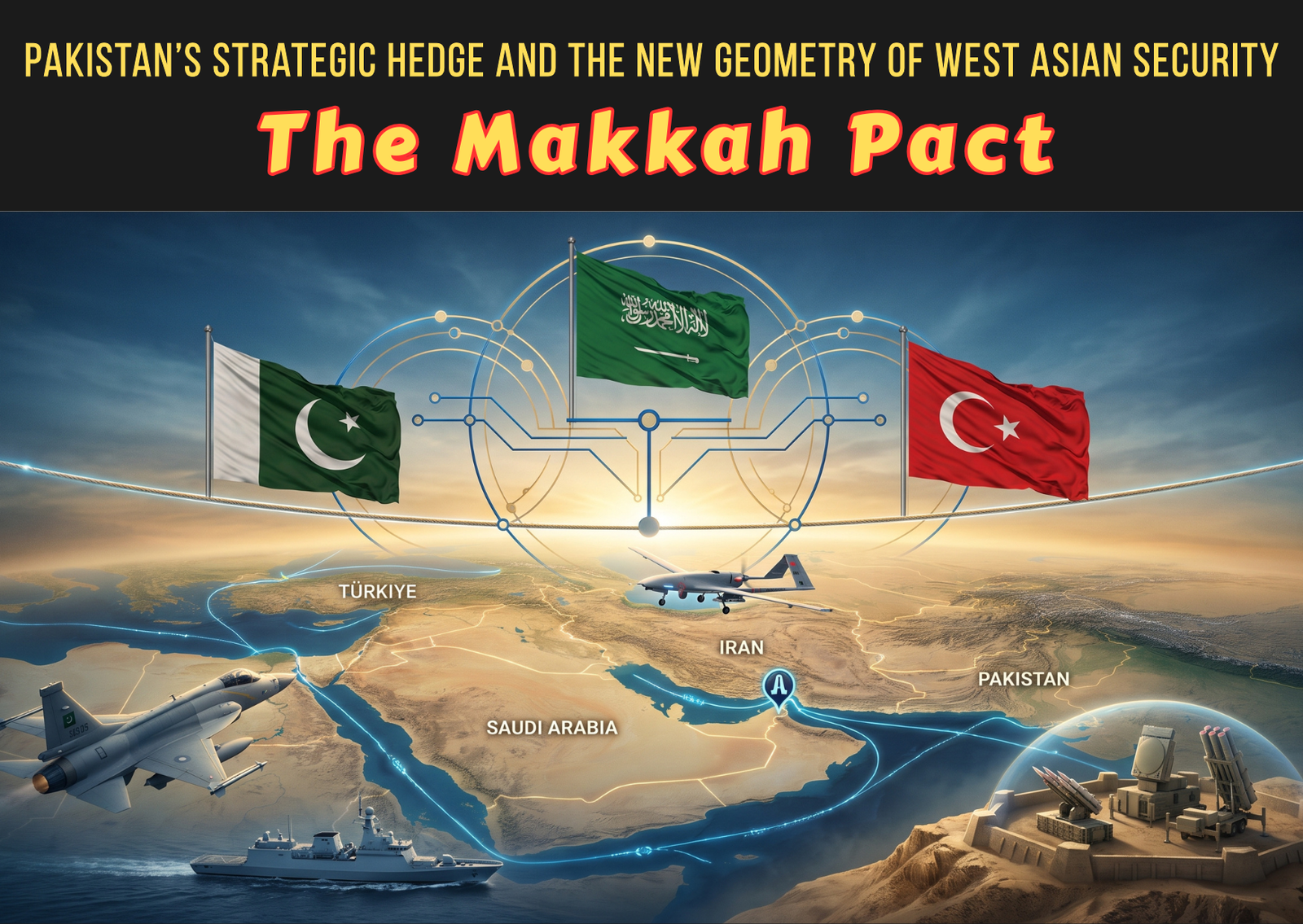
Saudi Arabia, Türkiye and Pakistan have created a new security framework. Its significance, however, will depend less on the language of collective defence than on whether the three states can reconcile very different strategic interests.
(By Khalid Masood)
When Pakistani Prime Minister Shehbaz Sharif, Army Chief Field Marshal Asim Munir, Saudi Crown Prince Mohammed bin Salman and Turkish President Recep Tayyip Erdoğan came together in Makkah on 7 August 2026, they were not merely formalising another defence relationship. They were responding to a profound change in the regional security environment.
The Makkah Joint Defence Agreement declares that an armed attack against any one of the three signatories will be regarded as an attack against all. The agreement therefore represents a significant political commitment and a further institutionalisation of the defence relationship among Saudi Arabia, Türkiye and Pakistan. Yet its practical military obligations remain deliberately less precise than the language of collective defence might suggest.
That distinction matters.
The Makkah Pact should not yet be described as a Middle Eastern NATO. It is better understood as a strategic hedge: an attempt by three important regional powers to increase their collective deterrence, diversify their security partnerships and reduce their dependence on any single external guarantor.
For Pakistan, this creates both opportunity and danger.
The opportunity is obvious. Islamabad gains a stronger strategic relationship with Saudi Arabia, deeper military-industrial cooperation with Türkiye and potentially greater diplomatic weight in a region whose security increasingly affects Pakistan’s economy.
The danger is equally clear: Pakistan could acquire strategic commitments whose consequences extend far beyond its immediate national interests.
The central question, therefore, is not whether Pakistan benefits from the pact.
It does.
The real question is whether Islamabad can convert the agreement into strategic depth without allowing strategic depth to become strategic entrapment.
A Partnership of Complementary Strengths
The three countries bring remarkably different assets to the table.
Türkiye possesses one of the region’s most sophisticated defence-industrial ecosystems, extensive military experience, a large conventional force and growing expertise in unmanned systems, electronic warfare and indigenous weapons production.
Saudi Arabia contributes something different: enormous financial resources, energy leverage, geographical centrality in the Gulf, access to global capital and considerable diplomatic influence.
Pakistan contributes perhaps the most distinctive military asset of all: a large, experienced conventional military backed by an established nuclear deterrent. SIPRI estimated Pakistan’s nuclear stockpile at approximately 170 warheads as of January 2025, although such figures are necessarily estimates rather than officially disclosed numbers.
This creates a powerful strategic complementarity:
Türkiye provides military technology and industrial capacity.
Saudi Arabia provides financial and geo-economic power.
Pakistan provides military manpower, operational experience and strategic deterrence.
But complementary capabilities do not automatically produce a common strategy.
That is where the pact’s first credibility problem emerges.
Three Countries, Three Threat Perceptions
Türkiye, Saudi Arabia and Pakistan do not face identical security environments.
Saudi Arabia’s most immediate concerns have historically centred on missile and drone threats, the security of its critical infrastructure, Iran’s regional influence and the vulnerability of Gulf maritime routes.
Türkiye’s strategic concerns extend across Syria, Iraq, the Eastern Mediterranean, the Caucasus and its complicated relationship with Israel, Iran, Russia and NATO.
Pakistan’s principal strategic concern remains India.
This asymmetry is fundamental.
A successful collective-defence arrangement does not necessarily require identical enemies, but it does require a sufficiently shared definition of what constitutes a threat to the collective.
The Makkah agreement deliberately avoids naming an adversary. Turkish Foreign Minister Hakan Fidan has explicitly stated that no common threat has been identified in the agreement.
That ambiguity should not automatically be interpreted as weakness.
It may actually be the pact’s greatest diplomatic strength.
By avoiding the designation of Iran, Israel or India as an enemy, the three governments preserve room for manoeuvre. Riyadh can continue its complex relationships with India and other international partners; Ankara can preserve its diplomatic channels; and Islamabad can avoid transforming a regional security arrangement into an overt anti-India or anti-Iran coalition.
In classical statecraft, ambiguity is sometimes not indecision.
It is strategic space.
The Nuclear Question: Deterrence Without Automatic Extended Deterrence
The most sensitive dimension of the Makkah Pact is Pakistan’s nuclear capability.
The presence of a nuclear-armed state inside a collective-defence framework inevitably raises the question of whether Pakistan’s deterrence could extend to Saudi Arabia or, by implication, Türkiye.
That question should be treated with extreme caution.
There is a major difference between saying that Pakistan’s nuclear capability contributes to the alliance’s overall deterrent effect and asserting that Pakistan has formally extended a nuclear umbrella to its partners.
The former is a reasonable strategic assessment.
The latter requires evidence that has not been publicly established.
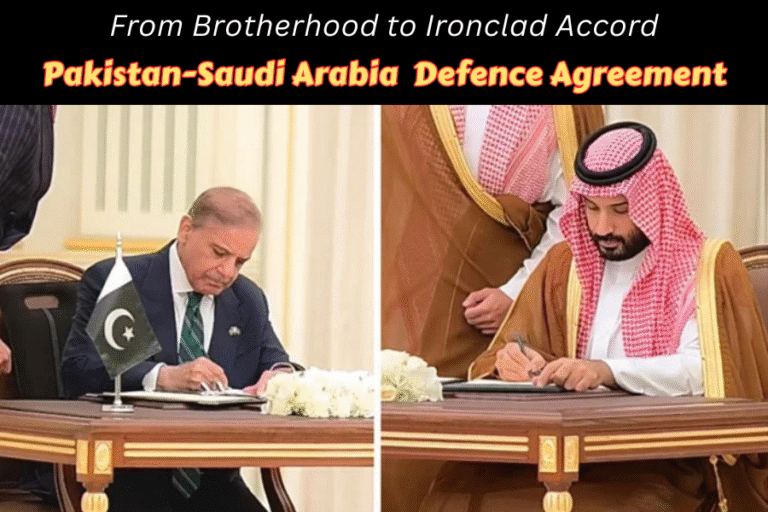
The September 2025 Pakistan-Saudi Strategic Mutual Defence Agreement already created a framework in which aggression against either state would be considered aggression against both. The details of that agreement remain substantially opaque.
The subsequent events of 2026 provide an important empirical test.
During the Iran conflict, Pakistan reportedly deployed a substantial military contingent to Saudi Arabia, including fighter aircraft, drones, air-defence capability and thousands of personnel. Reuters reported that a squadron of approximately 16 aircraft had arrived in early April, while later reporting placed the troop deployment at around 8,000. The precise operational arrangements were not publicly confirmed by the Pakistani or Saudi governments.
This is significant.
It suggests that the bilateral defence agreement was not merely symbolic. But it also demonstrates something more subtle: Pakistan attempted to combine military reassurance to Saudi Arabia with diplomatic engagement involving Iran.
That is not alliance failure.
It is hedging.
And hedging may become the defining feature of Pakistan’s regional strategy.
Pakistan’s Strategic Tightrope
Islamabad faces an extraordinarily difficult balancing act.
Saudi Arabia is an indispensable economic and strategic partner. Türkiye is a close political and defence partner. Iran is Pakistan’s immediate western neighbour. India remains Pakistan’s principal conventional military competitor. China is Pakistan’s most important strategic partner. And the United States remains deeply relevant to the international economic and security environment.
Pakistan therefore cannot afford a foreign policy architecture based upon exclusive alignment.
Its objective should instead be multi-vector strategic autonomy.
The Makkah Pact can serve that objective if Islamabad presents it as a defensive mechanism designed to strengthen regional stability rather than as an anti-Iran, anti-Israel or anti-India coalition.
This distinction is particularly important in relation to New Delhi.
The India Factor
India will inevitably examine the Makkah Pact through the prism of its own security calculations.
The inclusion of nuclear-armed Pakistan in a collective-defence arrangement involving two major Middle Eastern powers creates a new strategic variable on India’s western flank.
Yet Islamabad would be unwise to make India the organising principle of the pact.
Saudi Arabia has developed substantial economic and technological relations with India and has strong incentives to preserve them. Türkiye has maintained a significantly closer strategic posture toward Pakistan on several South Asian issues. The three countries therefore do not share a common approach toward India.
If Pakistan attempts to transform the Makkah Pact into an instrument of South Asian balancing, it could unintentionally force Riyadh to choose between competing strategic relationships.
That would be counterproductive.
Pakistan’s wiser approach would be to keep the pact compartmentalised.
The defence agreement should enhance Pakistan’s deterrence without turning Saudi Arabia or Türkiye into parties to the Kashmir dispute.
In strategic terms, Pakistan should seek the benefits of alignment without accepting the liabilities of bloc politics.
The Maritime Imperative
The economic dimension may ultimately prove more important than the military one.
Pakistan’s economy is exceptionally vulnerable to disruption in Gulf energy supplies and maritime trade. The Strait of Hormuz is therefore not simply a Middle Eastern security issue for Islamabad; it is an economic lifeline.
The Makkah framework creates possibilities for greater cooperation in maritime surveillance, air defence, protection of critical infrastructure, counter-drone operations and the security of commercial sea lanes.
A trilateral structure combining Pakistani maritime experience, Turkish defence technology and Saudi financial capacity could develop into a significant regional security capability.
But this should not be confused with an immediate integrated naval alliance.
The more realistic objective is interoperability rather than permanent military integration.
That distinction makes the project both more achievable and less provocative.
The Geo-Economic Dividend
For Pakistan, the greatest long-term prize may not be military at all.
The country needs energy security, foreign investment, technology transfer, export markets and infrastructure financing.
The Makkah framework could facilitate cooperation in:
- defence production and joint ventures;
- unmanned systems and counter-drone technology;
- maritime security;
- air and missile defence;
- energy security;
- logistics and transport connectivity;
- Saudi investment in Pakistani infrastructure;
- Turkish industrial and technological investment;
- training and professional military education.
But Islamabad should resist the temptation to assume that a defence pact automatically produces an economic windfall.
Saudi investment decisions will continue to be driven primarily by commercial calculations, sovereign interests and the broader economic relationship.
The strategic opportunity is therefore not to ask Riyadh for rewards for Pakistan’s military commitment.
It is to create commercially viable projects in which strategic cooperation and economic interests reinforce one another.
That is a far more sustainable model.
The Egypt Question
Egypt represents the pact’s most interesting potential future variable.
Cairo has participated in the broader quadrilateral consultative process involving Egypt, Saudi Arabia, Türkiye and Pakistan, but it did not join the Makkah agreement at its inception.
Turkish President Erdoğan has indicated that Egyptian accession is possible, but possibility is not probability.
Egypt’s strategic culture is considerably more cautious. Cairo has its own national-security priorities, maintains important relationships with Arab Gulf states, preserves channels with Iran and is traditionally reluctant to enter open-ended military commitments that could limit its freedom of manoeuvre.
For that reason, Egypt should not be viewed as the missing fourth member of an emerging military bloc.
It should instead be understood as a strategic swing state.
If Egypt eventually joins, the geographical and military significance of the arrangement would expand dramatically. If it remains outside, the pact could still evolve through institutionalised cooperation without becoming a formal bloc.
Either outcome is strategically plausible.
The United States and the Question of Strategic Autonomy
The deepest geopolitical meaning of the Makkah Pact may lie beyond the three signatories.
It reflects a broader regional desire for greater strategic autonomy at a time when Gulf states are questioning whether external security guarantees will always be available on predictable terms.
That does not mean Saudi Arabia, Türkiye or Pakistan are abandoning the United States.
Nor should the pact be interpreted as an anti-American coalition.
Rather, it demonstrates a familiar principle of international politics:
States hedge when they are uncertain about the reliability of any single security provider.
The Makkah Pact therefore represents an attempt to create additional strategic options.
Washington remains relevant.
But it is no longer necessarily the only strategic option.
The Real Test: Crisis, Not Ceremony
The signing ceremony was historic.
But ceremonies do not establish alliances.
Crises do.
The real test will come when one of the three states faces a serious military threat and the other two must decide precisely what they are prepared to do.
Will political support be sufficient?
Will intelligence be shared?
Will air-defence assets be deployed?
Will fighter aircraft be committed?
Will naval forces be mobilised?
Who will command them?
Who will finance them?
What constitutes an “armed attack”?
What happens if the conflict is initiated by a non-state actor?
And, most importantly, what happens if the interests of the three capitals diverge during the crisis?
These questions are not minor technicalities.
They are the difference between a political declaration and a functioning security architecture.
Pakistan’s Strategic Choice
For Islamabad, the correct objective is neither to exaggerate the pact nor to underestimate it.
Pakistan should avoid presenting itself as the military protector of the Muslim world. Such rhetoric would generate expectations that no state can realistically satisfy and could unnecessarily alarm neighbouring countries.
Instead, Pakistan should position itself as a credible regional security partner whose military capability strengthens collective deterrence while whose diplomacy reduces the probability of war.
That combination—hard power backed by diplomatic restraint—is far more valuable than military symbolism alone.
Pakistan’s strategic success will therefore depend on four principles:
First, deterrence without provocation.
The Makkah Pact should increase the cost of aggression without becoming an instrument for confrontation.
Second, partnership without entrapment.
Pakistan should honour its commitments while retaining the ability to assess each crisis according to its national interests and treaty obligations.
Third, military cooperation linked to economic strategy.
Defence cooperation should generate technology transfer, industrial capacity, investment and employment rather than simply increasing military expenditure.
Fourth, strategic autonomy without strategic isolation.
Pakistan should deepen its relationships with Saudi Arabia and Türkiye without allowing those relationships to damage its essential ties with China, Iran, the United States or other major powers.
Conclusion: A Hedge, Not Yet a Bloc
The Makkah Joint Defence Agreement is best understood not as the birth of a new NATO, but as the institutionalisation of a regional strategic hedge.
It brings together three countries whose capabilities are unusually complementary but whose threat perceptions remain significantly different.
For Saudi Arabia, it provides another layer of deterrence.
For Türkiye, it expands its strategic influence and defence-industrial reach.
For Pakistan, it offers something particularly valuable: strategic relevance beyond South Asia at a moment when the boundaries between South Asian and West Asian security are becoming increasingly blurred.
But opportunity carries obligations.
Pakistan must resist the temptation to convert the pact into an instrument against India. Saudi Arabia must avoid allowing its relationship with Pakistan to jeopardise its wider economic partnerships. Türkiye must reconcile its ambitions with the interests of its NATO relationships and regional diplomacy. And all three must avoid allowing the agreement to become an escalatory mechanism against Iran or any other state.
The ultimate strength of the Makkah Pact will not be measured by the number of aircraft, missiles, soldiers or warheads associated with it.
It will be measured by whether its members can deter aggression without creating a security dilemma that produces more instability than it prevents.
For Pakistan, the strategic objective should be clear:
Use the pact to increase deterrence, deepen economic connectivity, expand defence-industrial cooperation and strengthen diplomatic leverage—while preserving maximum freedom of action.
That is the essence of statecraft.
The Makkah Pact may become a durable pillar of the emerging West Asian security order.
Or it may remain an ambitious political framework whose members discover, when tested, that shared interests are not the same as shared strategic priorities.
For now, the most accurate verdict is neither triumph nor scepticism.
It is this:
The pact has created a new strategic option. Its real power will depend on how intelligently its members use it.