(By Khalid Masood)
🔍 The Illusion of Pause
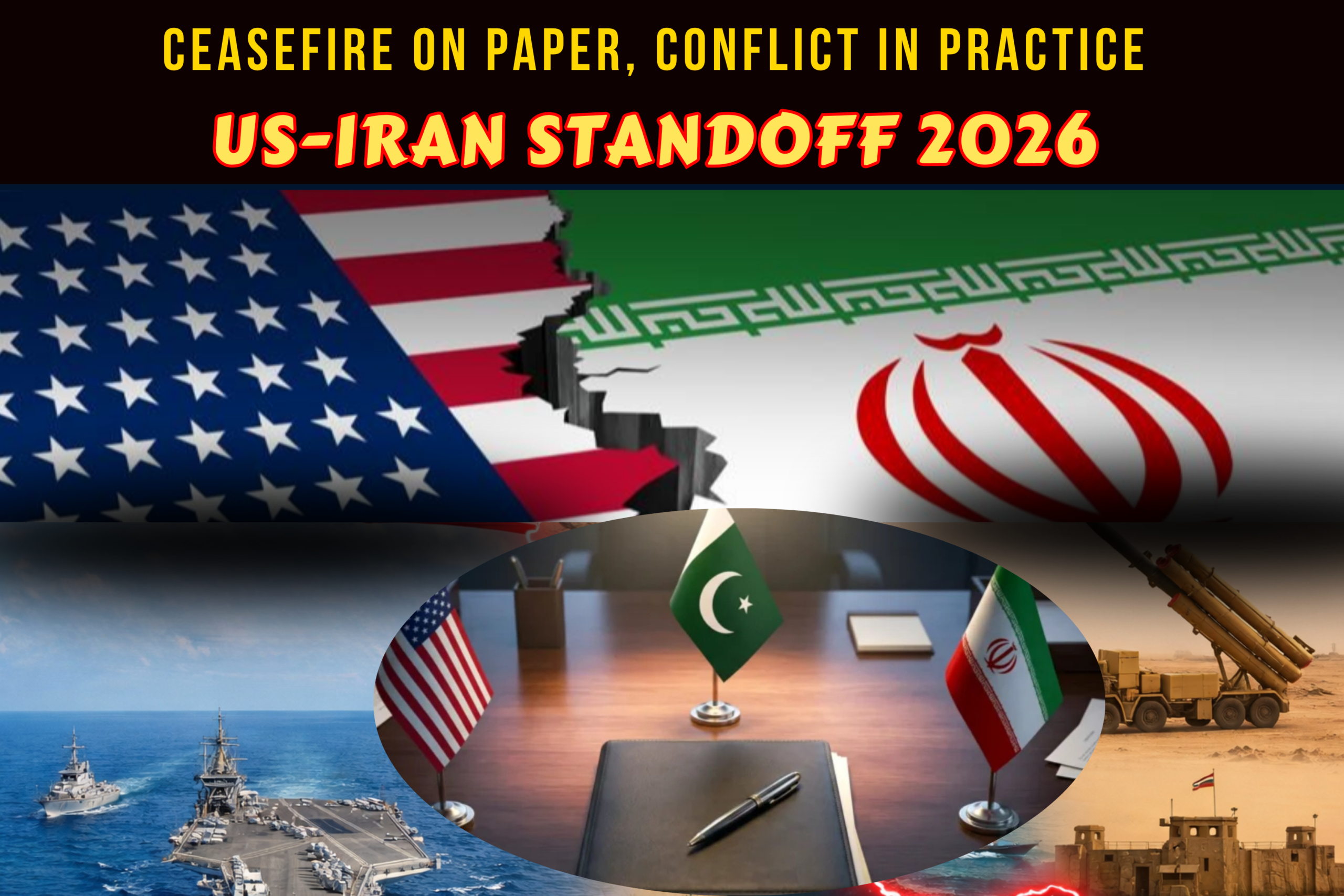
On the morning President Trump announced a unilateral extension of the US-Iran ceasefire, IRGC fast-attack craft conducted live-fire drills just 18 nautical miles from the Strait of Hormuz. The juxtaposition captures the defining paradox of the current Middle East crisis: diplomatic language signals restraint, while operational posturing prepares for escalation.
“The ceasefire is not a surrender of leverage,” a White House senior advisor noted in a background briefing. “It’s a calibrated pause to allow diplomatic channels to function without the noise of active kinetic exchange.” Tehran’s response has been markedly different. Iranian Foreign Ministry spokesperson Abbas Araghchi framed the extension as “a tactical concession by Washington to mask continued economic coercion,” while state media emphasized that “resistance does not pause when pressure continues.”
The reality on the ground tells a more complex story. The US-Iran standoff 2026 is not a binary conflict but a layered competition unfolding across naval corridors, cyber networks, proxy theaters, and diplomatic backchannels. This article decodes the gap between negotiated pauses and operational postures to assess where the crisis is truly headed.
📜 The Ceasefire Architecture: What Was Agreed, What Was Not
The initial ceasefire framework was deliberately narrow. It covered direct state-to-state kinetic exchanges, established a temporary halt to overt strike operations, and opened a 14-day window for diplomatic engagement in Islamabad. However, critical domains were intentionally excluded:
- Naval interdiction protocols remain undefined
- Proxy and militia activities fall outside the agreement’s scope
- Cyber and electronic warfare operations continue under ambiguous rules of engagement
President Trump’s unilateral extension, announced via executive statement, added a conditional clause: Washington expects a “unified Iranian proposal” addressing nuclear thresholds and regional security guarantees before resuming in-person negotiations. Iran has not delivered. Instead, Tehran has characterized the demand as “non-negotiable overreach,” effectively stalling the diplomatic track while maintaining the military pause.
Historical precedent offers caution. Following the 2020 Soleimani crisis, similar temporary halts held for weeks but collapsed when verification mechanisms and communication channels proved inadequate. Without third-party monitoring or joint incident reporting protocols, the current ceasefire functions less as a resolution pathway and more as conflict management under pressure.
“Ceasefires without verification are not peace agreements. They are pressure valves. The question is whether the valve releases tension or simply delays the next explosion.”
— Regional Security Analyst, Middle East Institute
⚔️ Conflict in Practice: Military Postures Below the Threshold
While diplomatic language emphasizes restraint, both Washington and Tehran are actively shaping the operational environment. The US-Iran standoff 2026 is characterized by gray zone tactics: calibrated deployments, signaling maneuvers, and domain-specific posturing designed to project strength without crossing explicit red lines.
Table 1: Military & Operational Posturing Indicators (April 2026)
| Domain | US Position & Activity | Iranian Position & Activity | Strategic Purpose |
|---|---|---|---|
| Maritime | USS Carl Vinson CSG maintains Gulf presence; P-8A surveillance flights daily | IRGC Navy conducts swarm drills; Basij coastal defense activations | Control chokepoint narrative; test response thresholds |
| Air & Missile | MQ-9 Reaper ISR orbits at 45,000 ft; Patriot/THAAD readiness checks | S-300/Bavar-373 radar sweeps; Shahed-136 drone storage relocation | Map defensive coverage; signal strike preparedness |
| Cyber/Info | NSA/CYBERCOM monitors IRGC network anomalies; public attribution delayed | IRGC Cyber Command targets regional infrastructure; narrative campaigns amplify “resistance” messaging | Degrade command integrity; shape domestic/international perception |
| Nuclear/Technical | IAEA monitoring continues; sanctions enforcement tightens | Enrichment sustained at 60% FGEU; centrifuge upgrades reported at Natanz | Maintain technical leverage; signal breakout readiness |
The 60% enrichment threshold remains the most visible technical flashpoint. While Iran maintains the activity is for “medical isotope research,” nuclear experts note that 60% fissile uranium has no practical civilian application and sits just one enrichment step from weapons-grade material. The US frames this as a non-negotiable security concern; Tehran treats it as a sovereign right and bargaining chip.
Proxy dynamics further complicate the picture. Hezbollah, Iraqi Popular Mobilization Forces, and Houthi naval units have reduced high-profile attacks but maintained low-intensity operations. Intelligence assessments suggest Washington and Tehran are indirectly “leashing” regional actors to prevent accidental escalation while preserving strategic depth.
🤝 The Diplomacy Gap: Why Talks Stall While Tensions Persist
The Islamabad talks collapse reveals structural fractures in the negotiation architecture. Vice President JD Vance’s planned delegation was canceled after Iran’s Foreign Ministry announced it would “not attend a forum built on preconditions that deny sovereign equality.” Pakistani mediation efforts, while formally welcomed by both sides, face inherent limitations: Islamabad lacks leverage over US sanctions architecture and cannot guarantee Iranian security guarantees.
Table 2: Core Sticking Points & Negotiation Realities
| Issue | US Position | Iranian Position | Zone of Potential Compromise |
|---|---|---|---|
| Nuclear Enrichment | Cap at 3.67%; dismantle advanced centrifuges; full IAEA access | Maintain 60% as sovereign right; reject “permanent restrictions” | Time-limited caps with phased verification; civilian energy guarantees |
| Regional Proxy Activity | Cease materiel transfers; restrict cross-border operations | “Resistance axis” is independent; US bases are legitimate targets | Deconfliction protocols; transparency on non-state actor movements |
| Sanctions & Economic Relief | Relief tied to verifiable compliance; phased sequencing | Upfront unfreezing of assets; SWIFT reconnection before concessions | Escrow mechanisms; humanitarian trade corridors; incremental trust-building |
| Security Guarantees | Non-aggression pact contingent on behavioral change | Mutual non-interference; US withdrawal from regional bases | Third-party monitoring; incident reporting hotline; maritime safe passage |
The “unified Iranian proposal” demanded by Washington exposes an internal governance dilemma. While President Pezeshkian’s administration handles diplomatic messaging, the IRGC retains operational control over nuclear facilities, regional proxy coordination, and maritime security. Analysts note that Tehran’s negotiating position often reflects institutional bargaining rather than a single executive directive.
“You cannot negotiate with a monolith when the state operates as a matrix. The Foreign Ministry drafts language, but the Guard holds the levers. Until internal alignment is visible, external talks will remain theatrical.”
— Former IAEA Senior Advisor, Nuclear Policy Review
🌍 Regional Ripple Effects: GCC, Iraq, and the Wider Arena
The US-Iran standoff 2026 is not contained. Gulf Cooperation Council (GCC) states are navigating a precarious balancing act. Saudi Arabia and the UAE have accelerated integrated air defense interoperability while maintaining discreet economic backchannels with Tehran. Qatar and Oman continue hosting quiet diplomatic exchanges, positioning themselves as potential neutral venues should Islamabad remain untenable.
Iraq remains the most exposed frontline state. Baghdad’s government faces simultaneous pressure: Washington expects counter-militia coordination, while Tehran demands non-alignment. Lebanese economic fragility further complicates Hezbollah’s strategic calculus; reduced Iranian funding has forced the group to prioritize domestic stability over regional escalation.
Extra-regional actors are also recalibrating. China’s energy imports from Iran remain steady, but Beijing has avoided explicit diplomatic alignment, preferring economic engagement over security commitments. Russia continues technical cooperation with Tehran but lacks capacity to offset US sanctions. The EU’s diplomatic bandwidth remains stretched across multiple theaters, limiting its mediation potential.
🔮 Scenario Assessment: Where Does This Go Next?
The next 90 days will determine whether the current pause hardens into a managed stalemate or fractures into controlled escalation.
Table 3: 90-Day Scenario Matrix (May–July 2026)
| Scenario | Trigger Conditions | Likely Outcomes | Early Indicators to Watch |
|---|---|---|---|
| Managed Stalemate | Low-level incidents contained; backchannel diplomacy resumes | Ceasefire extensions roll over; frozen diplomatic track; sanctions pressure persists | Reduced USCENTCOM alert levels; quiet GCC-Iran trade normalization |
| Controlled Escalation | Proxy strike crosses casualty threshold; maritime clash triggers retaliation | Limited kinetic exchange; emergency UN Security Council session; rapid de-escalation talks | Increased ISR flight density; emergency diplomatic contacts; oil price volatility |
| Breakdown & Conflict | Major infrastructure attack attributed to state actor; domestic political pressure mounts | Wider regional engagement; humanitarian corridor activation; global energy market shock | Mobilization orders; civilian evacuation advisories; SWIFT disruption reports |
Wild Cards to Monitor:
- Domestic political shifts in Washington or Tehran altering risk tolerance
- Unilateral Israeli action against nuclear facilities or IRGC assets
- Currency crisis in Iran forcing economic recalibration
- Unexpected third-party Intervention (China, Russia, or UN-led initiative)
✅ Conclusion: Beyond the Headlines – What Neutral Observers Should Track
A ceasefire on paper buys time; whether that time is used for de-escalation or preparation determines what comes next. The US-Iran standoff 2026 demonstrates that modern crises are rarely resolved through single agreements. They are managed through continuous calibration, verified communication, and mutual recognition of red lines.
“In high-stakes standoffs, the most dangerous moment is not open conflict—but the illusion of stability. Diplomacy without verification is theater. Military posturing without communication is gambling. The middle path requires discipline from both sides.”