(By Khalid Masood)
During his recent whirlwind 24-hour visit to Delhi for the BRICS summit, Chinese President Xi Jinping delivered a strategic message that extended far beyond the confines of a standard bilateral meeting with Prime Minister Narendra Modi. While the immediate optics of the summit naturally focused on the direct dynamics between the two Asian giants, Xi’s presence in India was fundamentally about standing firmly by the BRICS framework. He utilised this high-profile multilateral stage to project a clear, unified vision: China’s unwavering commitment to empowering the Global South through robust multilateralism and inclusive globalisation.
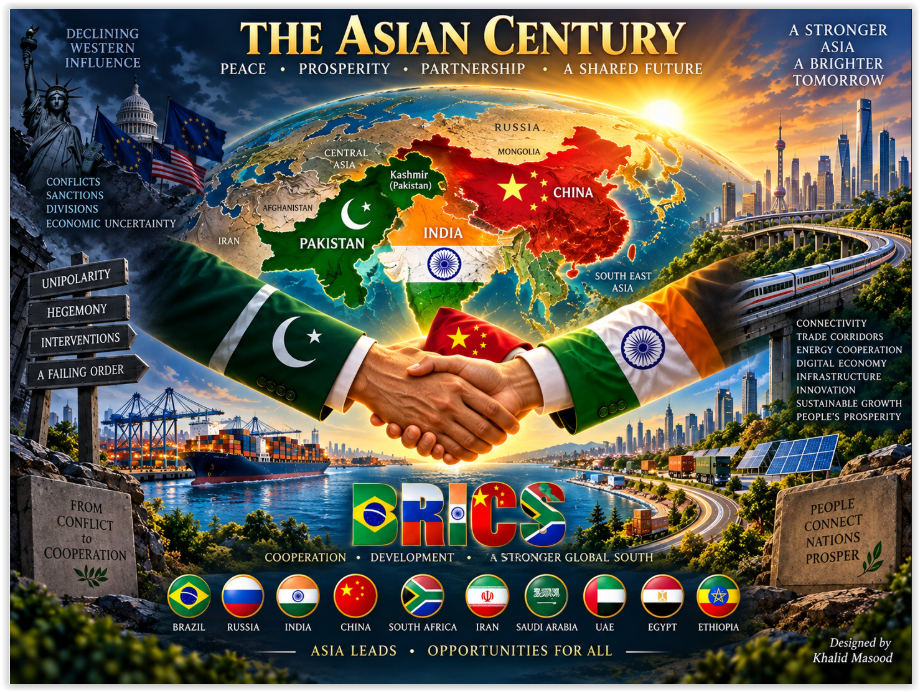
Yet, beneath the diplomatic pleasantries and the collective declarations of the summit lies a much more profound geopolitical subtext. As the global centre of gravity continues its historic shift away from the transatlantic axis, Beijing is actively engineering a new multipolar world order. In this context, Xi’s visit was a calculated manoeuvre to reiterate a pathbreaking concept that has been simmering in Sino-Indian diplomatic discourse for decades: the advent of the “Asian Century“. By championing a series of sweeping global initiatives, the Chinese leadership is not merely seeking to consolidate the developing world; it is signalling to New Delhi that the future of Asia—and indeed the world—hinges on Sino-Indian strategic convergence rather than perpetual friction.
This article delves into the multifaceted dimensions of Xi’s message, exploring how the realisation of the Asian Century requires a fundamental recalibration of India’s foreign policy. From the hard power realities of the Sino-Indian border to the indispensable role of Pakistan in ensuring comprehensive South Asian stability, the blueprint for the next century demands a pragmatic, long-term perspective that transcends immediate political anxieties and photo-opportunism.
The BRICS Summit and the Empowerment of the Global South
By outlining his comprehensive Global Security Initiative (GSI), Global Development Initiative (GDI), Global Civilization Initiative (GCI), and the newly minted Global Artificial Intelligence Initiative (GAII), Xi underscored a strategic pivot towards technological and economic advancement. To actualise this, China has established a BRICS AI development and cooperation centre, alongside a “new quality productive forces” centre, focusing on integrating artificial intelligence into traditional industries to exponentially increase productivity.
Technological and Economic Initiatives for the Developing World
As Xi noted, having held the BRICS chair, China has concrete plans to translate these initiatives into tangible benefits for the developing world. The emphasis on “new quality productive forces” highlights a shift from mere manufacturing to high-tech, innovation-driven growth, a model Beijing is keen to share with its Global South partners to bridge the developmental divide.
The Genesis and Reality of the ‘Asian Century’
However, beneath the multilateral rhetoric of the BRICS summit lies a more profound, bilateral message directed at India—one that requires a fundamental recalibration of New Delhi’s strategic outlook. The concept of the “Asian Century” is not a modern geopolitical buzzword; it is a pathbreaking vision with deep historical roots.
A Historical Paradigm Shift
It was initiated in December 1988 during Prime Minister Rajiv Gandhi’s historic visit to China. During a long, candid meeting with Chinese paramount leader Deng Xiaoping, the two leaders agreed on a paradigm-shifting framework: while the border dispute was a reality, it should be treated as just one of many issues. The key focus, they decided, must be on supporting each other’s national development.
A Shift in the Global Geopolitical Centre of Gravity
Today, this vision has transitioned from a theoretical concept to an undeniable geopolitical reality. As the eminent Singaporean diplomat and scholar Kishore Mahbubani famously articulated, “The 21st century will be the Asian century, not because Asians are better, but because the rest of the world is catching up to Asian standards.”
The global centre of gravity has decisively shifted from the transatlantic axis to the Eurasian landmass (excluding Western Europe). Backed by the comprehensive strategic partnership of China and Russia, this new multipolar world order is fundamentally rooted in the Asian landmass. Therefore, the “Asian Century” is no longer a distant dream; it is the current reality of global geopolitics.
The Core Message to New Delhi: Strategic Pragmatism
President Xi’s consistent message to Prime Minister Modi—reiterated on the sidelines of the BRICS summit in Kazan in October 2024, during a meeting in Tianjin in 2025, and now in Delhi in 2026—is that India and China must adopt a strategic, long-term perspective. Essentially, the two Asian giants must work together in a “win-win mode“.
Economic Interdependence and Supply Chain Realities
If India normalises relations with China, the practical benefits are immense. A strategic reset would help resolve the massive trade imbalance, stimulate people-to-people interactions, and unlock Chinese investments crucial for India’s infrastructure goals. Furthermore, it would mitigate India’s severe supply chain vulnerabilities. With China currently accounting for 31 per cent of global manufacturing, ignoring the “factory of the world” is an economic detriment to India’s own industrialisation.
Sovereign Equality and Collective Security
The fundamentals of this new world order rely on sovereign equality—the freedom of every country to decide its own trade partnerships without coercion—and collective security. Both principles require a stable, cooperative Sino-Indian relationship, moving away from zero-sum competition towards shared continental prosperity.
India’s Strategic Dilemma and the Hard Power Reality
Despite this clear vision, the message of the Asian Century appears to have been lost on New Delhi. India’s current strategic posture seems aligned with the fantasy of a unipolar world, strategically supporting the “Make America Great Again” (MAGA) doctrine, which seeks to maintain American hegemony.
The Myth of a ‘Multipolar Asia’
Furthermore, India pushes for a “multipolar Asia”, a concept China firmly rejects. China operates on geoeconomics; when one believes in free trade, all 193 countries in the world are equal partners. There is no question of a multipolar Asia, Africa, or Latin America in a globally integrated market. India’s desire to position itself as a regional competitor to China ignores the stark reality of the “hard power” gap. National power is a triad of economic, military, and technological strength. The reality is that China is a great power in the multipolar world, and the hard power gap between the two nations is vast and currently unbridgeable.
The Border Conundrum and the Illusion of an ‘Early Harvest’
This disconnect is most visible in India’s approach to the border. The Modi government seeks an “early harvest” or partial resolution of border disputes to show political achievements to the public. However, from a military perspective, piecemeal solutions do not work. A military commander on the Line of Actual Control (LAC) requires comprehensive clarity; resolving a sector like Sikkim hypothetically leaves adjacent flanks vulnerable.
Furthermore, with China’s January 2020 boundary law treating LAC incursions as issues of national sovereignty rather than mere territorial disputes, grey-zone operations carry severe escalation risks. If India normalises relations, these grey-zone operations will cease. But without normalisation, the risk of conflict remains high, especially since the Indian government has shown neither the willingness nor the capacity to engage in a full-scale military confrontation with China.
The Indispensable Role of Pakistan in the Asian Century
Furthermore, the realisation of the “Asian Century” extends beyond Sino-Indian dynamics; it inherently requires comprehensive regional stability, which brings Pakistan into the equation. For the Asian Century to truly flourish, the concept of collective security dictates that India must also normalise relations with Pakistan.
Pakistan as a Catalyst for Regional Connectivity
As a crucial neighbour and a significant, nuclear-armed voice in the Global South, Pakistan’s integration into a cooperative regional framework is indispensable. The Asian Century is fundamentally about connectivity, trade, and shared prosperity. A fractured South Asia acts as a bottleneck to the broader Eurasian integration championed by the Belt and Road Initiative (BRI). Pakistan is the vital land bridge connecting South Asia to Central Asia and the Middle East, most notably through the China-Pakistan Economic Corridor (CPEC). Without a stable and cooperative Pakistan, the physical and economic architecture of the Asian Century remains incomplete.
Overcoming the Security Dilemma in South Asia
Currently, India puts the cart before the horse by demanding that Pakistan first halt cross-border terrorism before initiating dialogue. However, a holistic approach to the Asian Century requires addressing the root causes of these conflicts through comprehensive, sincere engagement. Just as border tensions with China hinder progress, unresolved hostilities and proxy dynamics with Pakistan drain vital resources and disrupt the collective security architecture necessary for Asia’s rise. True regional empowerment cannot be achieved if the South Asian subcontinent remains locked in a security dilemma. Normalising ties with Pakistan is not just a bilateral necessity for India, but a fundamental prerequisite for the unified vision of the Asian Century.
Conclusion: Beyond Photo-Op Diplomacy
India has declared the BRICS summit a success, pointing to the Delhi Declaration and the optics of leaders holding hands. Prime Minister Modi thanked President Xi twice for attending, but the success of any meeting is not measured by photo-operations, hugs, or diplomatic pleasantries.
Embracing the Hard Realities of a New World Order
In an era of once-in-a-century global transformation, nations are looking at hard realities. What matters is what you bring to the table, and what supports your national power. True diplomatic success is derived from a right-sized foreign policy—one that aligns with historical realities, secures your borders through pragmatic engagement rather than posturing, and ultimately uplifts the poor and marginalised of your country.
The geopolitical shift to Asia is inevitable. The “Asian Century” is here, supported by a multipolar world order that prioritises collective development over hegemony. The message from Beijing is clear: look at the bigger picture, and let the border issues diminish in the context of shared continental prosperity. It remains to be seen whether New Delhi will look past immediate political anxieties to embrace the strategic imperatives of the Asian Century.