(By Khalid Masood)
In the grand tapestry of military history, there are conflicts that merely redraw maps, and then there are crucibles that forge the very soul of a nation. For the Islamic Republic of Pakistan, the Indo-Pak War of 1965 was the latter. When the dawn of September 6th broke over the subcontinent, it brought with it the thunder of artillery and the roar of jet engines. The Indian Air Force (IAF), boasting a staggering numerical superiority of nearly four-to-one in combat aircraft, launched a massive offensive aimed at crushing Pakistan’s air defences and securing total air supremacy.
Yet, as the dust of battle settled, it was not the numerical giant that dictated the terms of the sky, but the indomitable eagles of the Pakistan Air Force (PAF). Today, as the nation observes PAF Day on the 7th of September, we look back at a masterclass in asymmetrical warfare, tactical brilliance, and unmatched martial valor.
The Architect of Victory: Vision and Ethos
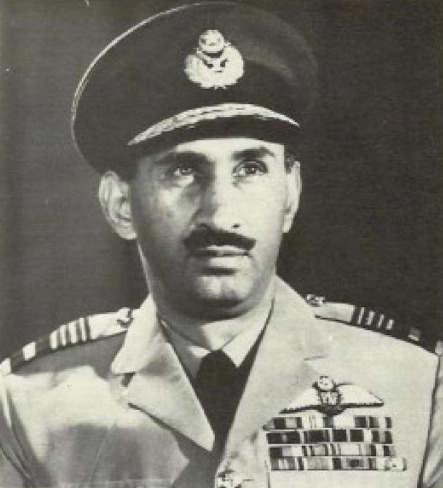
The triumph of 1965 was not born merely in the heat of battle; it was forged in the quiet, rigorous years of preparation that preceded it. At the helm of this transformation was Air Marshal Nur Khan, a visionary leader who recognized that in a conflict with a numerically superior adversary, survival depended on proactive aggression and tactical excellence.
The Shift to Offensive Counter-Air
Under Nur Khan’s stewardship, the PAF shed its passive defensive posture. He institutionalized the doctrine of Offensive Counter-Air (OCA) operations. Nur Khan understood that to defend Pakistan, the PAF had to take the fight to the enemy’s soil.
“We knew we were heavily outnumbered. But numbers alone do not win wars; the spirit of the men, the quality of their training, and the righteousness of their cause do. We were not just defending a piece of land; we were defending the ideology and sovereignty of Pakistan.” — Air Marshal (Retd) Nur Khan, reflecting on the strategic mindset of the PAF leadership prior to the war.
Nur Khan instilled an ethos of decentralized decision-making. Pilots were not merely trained to follow orders; they were conditioned to think, adapt, and dominate in the fluid chaos of a dogfight.
The Asymmetry of Force
To truly appreciate the PAF’s achievement, one must understand the staggering David versus Goliath narrative of the conflict. The following table illustrates the stark numerical asymmetry at the outbreak of the war:
| Metric | Indian Air Force (IAF) | Pakistan Air Force (PAF) | Disparity Ratio |
|---|---|---|---|
| Total Combat Aircraft | Approx. 400+ | Approx. 100 – 130 | ~ 3.5 to 1 |
| Frontline Fighters | Gnats, Hunters, Ouragans, Vampires | F-86 Sabres, F-104 Starfighters | IAF held numerical dominance |
| Bombers/Strike | Canberra, AN-12 | B-57 Canberra | IAF held numerical dominance |
| Combat Squadrons | 29+ | 7 | ~ 4 to 1 |
Despite this overwhelming disparity, the PAF’s qualitative edge in training, tactics, and leadership neutralized the IAF’s quantitative advantage.
The Symphony of Steel: Counter-Air Operations
When the IAF launched its preemptive strikes on the morning of September 6th, targeting PAF bases and attempting to trap the fleet on the ground, they expected a paralyzed enemy. Instead, they awoke a sleeping lion.
The Western Front: Striking the Viper’s Nest
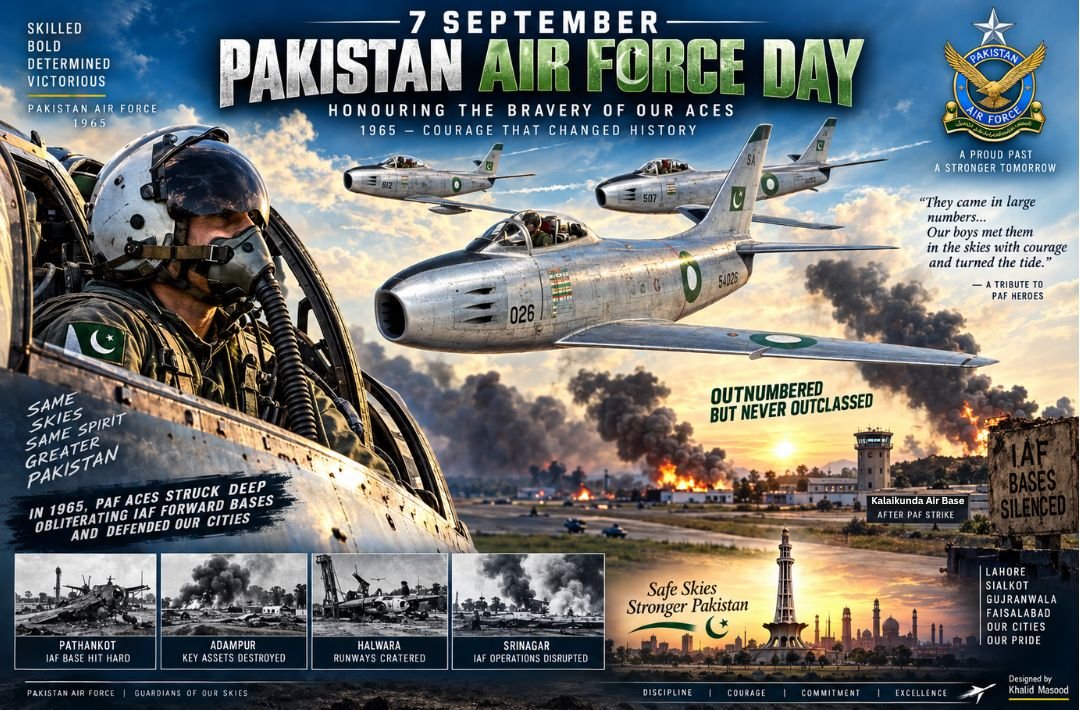
In a brilliant display of counter-air operations, PAF Sabres roared into the skies and struck back at the very nests from which the enemy had launched their attacks. In daring low-level raids, PAF squadrons hit the IAF bases at Pathankot, Halwara, and Adampur.
The legendary strike by 19 Squadron on Pathankot remains etched in military history as a textbook example of precision and audacity. Diving through a lethal curtain of anti-aircraft fire, PAF pilots destroyed dozens of enemy aircraft on the tarmac. The B-57 bombers of No. 6 and No. 31 Squadrons executed devastating night raids, further crippling the IAF’s forward operating capabilities. This strategic masterstroke effectively blunted the enemy’s offensive momentum before it could fully materialize.
The Eastern Front: The Forgotten Thunder at Kalaikunda
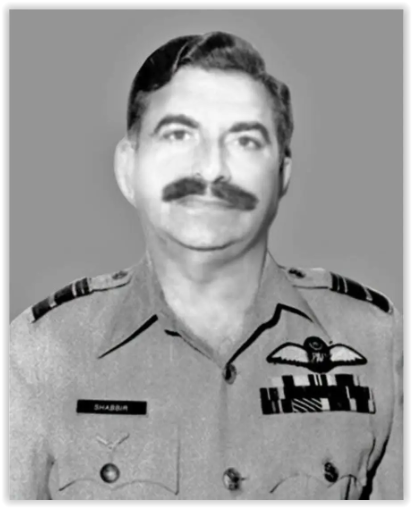
While the Pathankot strike captured public imagination, an equally heroic and arguably more daring operation unfolded on the Eastern Front. The Kalaikunda Air Base strike, launched by 14 Squadron from Dhaka (then East Pakistan), stands as a testament to the PAF’s strategic reach and operational boldness.
Led by the courageous Squadron Leader Shabbir Hussain Siddiqui, this mission penetrated over 300 kilometers deep into Indian territory—an extraordinary feat that the IAF never anticipated. The Indian Air Force, confident in the security of its rear bases, had stationed a significant number of strategic bombers at Kalaikunda, believing them safe from Pakistani reach.
On September 7th, 1965, PAF’s B-57 Canberras from 14 Squadron roared into the skies from Dhaka and unleashed devastation upon Kalaikunda. The strike caught the IAF completely off guard. In a single, brilliantly executed raid, the PAF destroyed 13-14 IAF Canberra bombers and one C-119 transport aircraft on the ground. This was not merely a tactical victory; it was a strategic masterstroke that eliminated a significant portion of India’s long-range strike capability.
The Kalaikunda raid demonstrated the PAF’s ability to project power across both wings of Pakistan, striking deep into enemy territory with surgical precision. As one veteran pilot later remarked: “Pathankot was bold, but Kalaikunda was audacious. To fly 300 kilometers into enemy airspace, hit a heavily defended base, and return safely—that was the mark of true warriors.”
The Defence of Sargodha
At the center of this aerial storm was PAF Base Sargodha, the strategic linchpin of the air campaign. The IAF threw wave after wave of aircraft to neutralize the base. However, the PAF’s masterful air defence, combined with the rapid turnaround of sorties by the ground crew, kept the critical hub operational. Sargodha became a fortress in the sky, a testament to the PAF’s unbreakable resolve.
Legends in the Cockpit: The Immortal Aces
History is ultimately written by the deeds of individuals, and in the skies of 1965, the PAF produced legends whose names are synonymous with valor.
Squadron Leader M.M. Alam: The Marksman of Sargodha
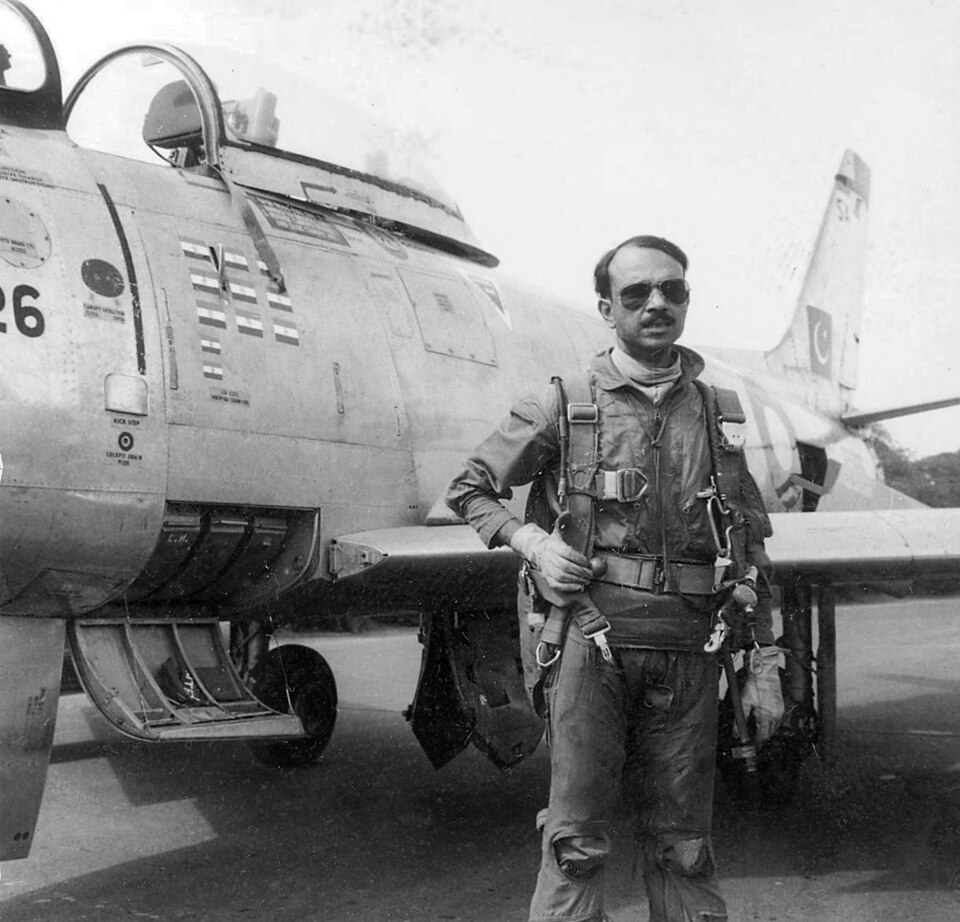
Foremost among them is Squadron Leader M.M. Alam. Over the skies of Sargodha, Alam performed a feat of aerial marksmanship that remains unparalleled in modern jet warfare. In a breathtaking engagement lasting less than a minute, he shot down four IAF Hawker Hunters, adding a fifth shortly after.
Alam’s performance was the pure embodiment of the PAF’s martial prowess. Utilizing the F-86 Sabre’s superior maneuverability and the A-4 gyro gunsight, he demonstrated a chilling lethality.
“Alam’s performance on that day was not just a victory for Pakistan; it was a masterclass in deflection shooting and situational awareness. He turned the F-86 into an instrument of absolute destruction.” — Air Commodore (Retd) M. Kaiser Tufail, PAF Historian.
Flight Lieutenant Cecil Chaudhry: The Unbreakable Spirit
Then there was Flight Lieutenant Cecil Chaudhry, whose fierce defence of Sargodha in a heavily damaged, bullet-riddled Sabre showcased the unbreakable spirit of the PAF. His aircraft was hit by over 60 bullets, yet he refused to yield, continuing to engage the enemy until his aircraft was completely unflyable, forcing him to bail out. Chaudhry’s life—transitioning from a warrior in the cockpit to a distinguished human rights scholar on the ground—represented the profound depth of character within the PAF’s ranks.
Flight Lieutenant Saiful Azam: The Double Kill
We also remember Flight Lieutenant Saiful Azam, who made history on the very first day of the war. Operating from Sargodha, Azam achieved a rare “double kill” by downing both an IAF MiG-21 and a Vampire in a single, chaotic sortie, proving that PAF pilots could hold their own against the IAF’s most advanced Soviet-supplied fighters.
Brothers in Arms: Air-Ground Coordination
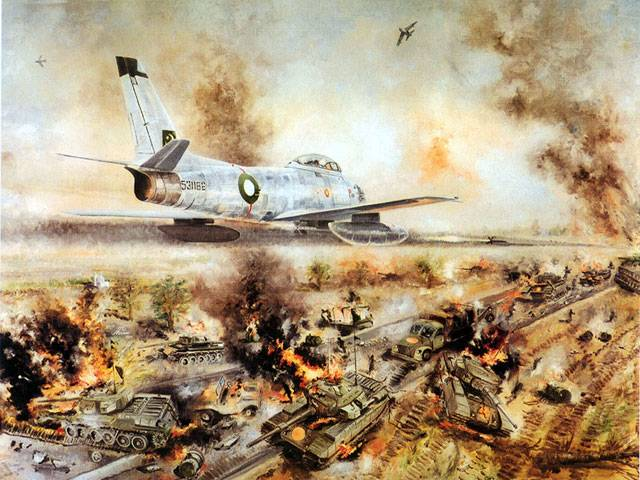
While the air-to-air dogfights captured the imagination of the public, the PAF’s most critical contribution to the war effort was its seamless integration with the Pakistan Army. Acting as flying artillery, the PAF provided devastating Close Air Support (CAS) that fundamentally altered the course of the ground war.
Blunting the Armor at Chhamb and Lahore
When the Indian Army launched a massive armored thrust toward Lahore, threatening the city’s very existence, it was the PAF that blunted the spearhead. Over the critical sectors of Chhamb, Burki, and Dograi, PAF F-86s armed with 5-inch High Velocity Aerial Rockets (HVAR) and 100lb bombs rained destruction upon advancing Indian columns.
The psychological impact of the PAF’s air superiority was profound. The demoralizing effect of the Sabres diving through the clouds broke the momentum of enemy armor.
“The Pakistan Air Force saved Lahore. When our troops were hard-pressed and the enemy armor was advancing, it was the PAF that came to our rescue, striking the enemy with devastating precision and breaking their offensive.” — Major General (Retd) Sarfraz Khan (GOC of Lahore sector operations), acknowledging the pivotal role of CAS.
The Unsung Vanguard: Ground Crew and Logistics
A military historian must acknowledge a fundamental truth: pilots do not fly alone. The miracles of 1965 were equally the triumph of the unsung vanguard—the ground crew, the radar operators, the Anti-Aircraft Artillery (AAA) gunners of Pak Army, and the logistics chain.
The Technical Edge and Ground Defence
The PAF’s ground defence troops and AAA gunners, standing by their Bofors 40mm guns as enemy bombs fell around them, accounted for a significant number of enemy kills. Furthermore, the maintainers worked under fire, repairing runways with astonishing speed and re-arming aircraft in record time.
To understand the technical environment in which these men operated, consider the performance characteristics of the primary adversaries in the sky:
| Aircraft | Role | Max Speed | Climb Rate | Armament | Tactical Advantage |
|---|---|---|---|---|---|
| F-86F Sabre (PAF) | Air Superiority | 687 mph (0.89 Mach) | 9,000 ft/min | 6x .50 cal machine guns | Superior turn rate, excellent gyro gunsight, highly reliable. |
| F-104 Starfighter (PAF) | Interceptor | 1,320 mph (2.0 Mach) | 48,000 ft/min | 1x 20mm Vulcan cannon, AIM-9 Sidewinder | Blinding speed, high-altitude dominance, psychological deterrent. |
| Hawker Hunter (IAF) | Fighter/Ground Attack | 715 mph (0.94 Mach) | 16,000 ft/min | 4x 30mm ADEN cannons | Heavy firepower, good low-altitude performance. |
| MiG-21FL (IAF) | Interceptor | 1,380 mph (2.1 Mach) | 23,000 ft/min | 1x 30mm NR-30 cannon, K-13 AAM | High speed, good climb rate, but suffered from poor rearward visibility. |
Despite the IAF operating a larger and more diverse fleet, the PAF’s focused training on the F-86 and F-104 allowed them to exploit the specific tactical weaknesses of the IAF’s aircraft.
The Balance Sheet of Battle: A Study in Asymmetrical Attrition
To truly comprehend the magnitude of the PAF’s achievement in 1965, one must look beyond the tactical maneuvers and examine the final balance sheet of combat losses. In military history, the ultimate metric of air superiority is the combat kill ratio, and it is here that the PAF’s mastery of asymmetrical warfare is most starkly illuminated.
Analyzing the Attrition: Air-to-Air, Ground, and AAA
While the Indian Air Force entered the conflict with a massive numerical advantage, the PAF’s aggressive counter-air strategy, superior pilot training, and lethal ground defences effectively neutralized this disparity. The following table outlines the combat losses based on the official assessments of the Pakistan Air Force and the Ministry of Defence, reflecting the harsh reality inflicted upon the IAF.
| Category of Loss | Indian Air Force (IAF) Losses (PAF Official Assessment) | Pakistan Air Force (PAF) Losses (Official Assessment) | Strategic Impact & Historical Context |
|---|---|---|---|
| Air-to-Air Combat | ~65 Aircraft | ~14 Aircraft | PAF pilots achieved a staggering 4.6:1 kill ratio in aerial dogfights, proving the superiority of Sabre tactics and pilot skill over sheer numbers. |
| Destroyed on Ground | ~20 Aircraft | ~5 Aircraft | PAF’s preemptive and retaliatory strikes on IAF bases (Pathankot, Halwara, Adampur) successfully trapped and destroyed enemy assets on the tarmac. |
| Destroyed by AAA | ~19 Aircraft | ~5 Aircraft | The PAF’s Anti-Aircraft Artillery gunners created a deadly, impenetrable umbrella over key bases like Sargodha, inflicting heavy losses on low-flying IAF strike packages. |
| Total Estimated Losses | ~104 Aircraft | ~24 Aircraft | The PAF inflicted total losses on the IAF at a ratio of nearly 4.3 to 1, completely shattering the myth of IAF’s invincibility. |
The Fog of War and the Verdict of History
It is a standard reality of military historiography that adversarial nations often inflate their own claims while minimizing their losses. The IAF, in its official post-war narratives, claimed a significantly higher number of PAF kills and a much lower number of its own losses. However, independent international military observers of the era, as well as the undeniable operational reality on the ground, corroborated the PAF’s narrative: the IAF was severely blunted.
The IAF’s inability to achieve air superiority, coupled with their failure to stop the PAF’s close air support from decimating Indian armor at the gates of Lahore, stands as the ultimate historical verdict. The PAF did not just survive the onslaught of a numerically superior foe; it battered the IAF into a state of operational paralysis. The loss of over 100 aircraft, including many destroyed on the ground and shattered by the relentless PAF AAA barrage, broke the offensive spirit of the enemy air force.
As Air Marshal Nur Khan later noted with characteristic understatement, “The enemy had the numbers, but we had the sky.” The balance sheet of 1965 remains an evidence to the fact that in the crucible of aerial combat, the lethality of the eagle far outweighs the size of the flock.
Conclusion: The Strategic Verdict and Eternal Watch
The strategic verdict of the 1965 air war is clear and undisputed by objective military analysts. The PAF achieved air parity, and in critical sectors, absolute air superiority. They fundamentally altered the trajectory of the war, preserved Pakistan’s independence, and proved that in the crucible of combat, the quality of the warrior far outweighs the quantity of the weapons. The IAF failed in its primary objective: to secure total air supremacy.
Today, the blood and sweat of 1965 continue to animate the enduring ethos of the Pakistan Air Force. It is a legacy of audacity, of tactical brilliance, and of an unyielding commitment to the defence of the realm.
On this PAF Day, we bow our heads in reverence to the Shuhada who made the ultimate sacrifice, giving their lives so that Pakistan might live in freedom. We salute the veterans who returned with wings of glory, and we honor the current generation of PAF warriors who stand ready to uphold this sacred trust.
The skies of 1965 may have quieted, but the legacy of those who fought in them remains as vibrant as ever. As long as the crescent and star flies proudly on the national flag, the eagles of the Pakistan Air Force will remain the eternal, vigilant guardians of Pakistan’s sovereign skies.