(By Khalid Masood)
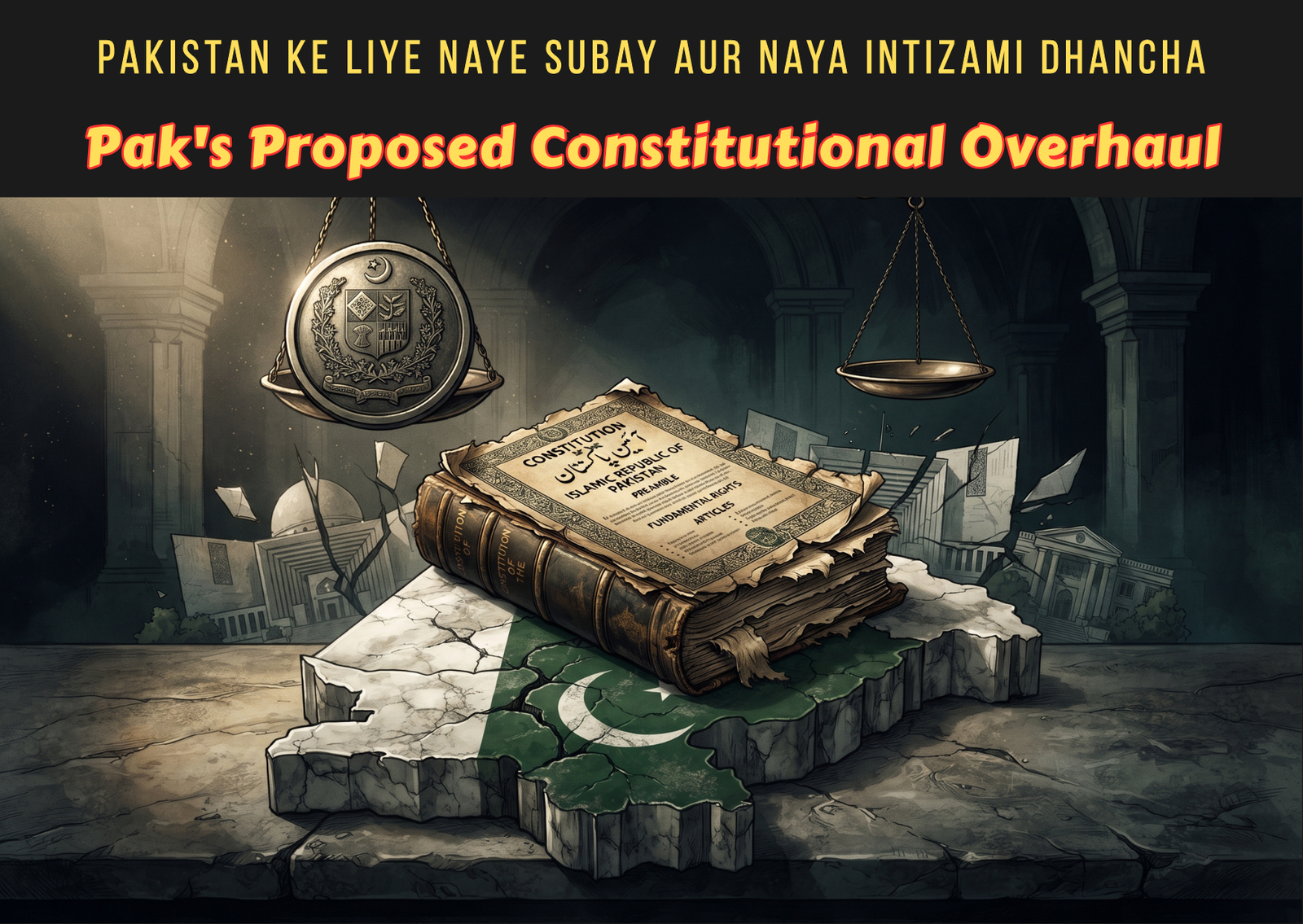
In the perennial search for governance reform in Pakistan, a new constitutional blueprint has emerged that promises nothing less than a root-and-branch restructuring of the state. Titled “Pakistan ke Liye Naye Subay aur Naya Intizami Dhancha”—New Provinces and a New Administrative Structure for Pakistan—the proposal envisions twenty administrative units, a powerful directly elected president, the abolition of the National Assembly, and a constitutional court to settle disputes between federation and provinces. It is, by any measure, an ambitious document. But ambition, in constitutional design, is a double-edged sword. When wielded with precision, it can reshape nations for the better. When driven by political impulse rather than institutional rigor, it risks creating constitutional conflict where it seeks to build stability.
This article offers an in-depth analysis of the proposal, examining its merits, its fatal flaws, and the broader question of whether Pakistan needs constitutional revolution or constitutional repair.
Part 1: What the Proposal Says
The draft is organized into ten Points plus a set of foundational principles. Its architecture can be summarized as follows.
Point I: The Administrative Structure of the State Pakistan is to be a federal, democratic, and constitutional state built on three pillars: a strong federation, empowered provinces, and fully autonomous local government. All state institutions are to be subordinate to the Constitution.
Point II: The New Provinces For better administration and balanced development, the four existing provinces are to be divided into twenty administrative units. Punjab would be split into Northern Punjab, Central Punjab, Southern Punjab, Potohar, and Bahawalpur. Sindh would be divided into Karachi, Hyderabad, Mirpur Khas, Sukkur, and Larkana. Khyber Pakhtunkhwa would become Peshawar, Hazara, Malakand, and Dera Ismail Khan. Balochistan would be reconstituted as Quetta, Makran, Zhob, and Kalat. Gilgit-Baltistan and Azad Jammu & Kashmir would be included as federal territories, subject to constitutional and political consensus.
Point III: The President The President is to be the symbol of the state, the federation, and the Constitution. Crucially, the President is to be elected directly by the people—not by an electoral college. The President is to serve as head of the federal government. The federal cabinet is to work under the President, who is also to act as guardian of national security, foreign policy, and federal institutions.
Point IV: The Federal Cabinet All provincial chief ministers are to be ex officio members of the federal cabinet. Each chief minister is to remain empowered in provincial matters but answerable to the President in national and federal affairs. All chief ministers are to participate in national policy-making to ensure, in the proposal’s words, “complete harmony” between the federation and the provinces.
Point V: The Governor Every province is to have a Governor as the representative of the federation and the President. The Governor is to monitor the implementation of the Constitution and federal policy. If a chief minister violates the Constitution or fails to perform constitutional duties, the Governor may recommend—or take steps toward—the chief minister’s dismissal, subject to the President’s approval. Any such dismissal is to be subject to judicial review by the Federal Constitutional Court.
Point VI: The Federal Legislature The National Assembly is to be abolished entirely. The Senate is to become the sole federal legislative house. All federal laws, the federal budget, and constitutional amendments are to be approved exclusively by the Senate. Senators are to be elected by provincial assemblies through open ballot.
Point VII: Provincial Government Each province is to have an elected provincial assembly. The chief minister is to be elected by the members of the provincial assembly, and the provincial cabinet is to administer provincial affairs.
Point VIII: The Federal Constitutional Court A Federal Constitutional Court is to be established as the highest constitutional authority. It is to assume the constitutional role of the Supreme Court, with final jurisdiction over constitutional interpretation, fundamental rights protection, and the resolution of federal-provincial disputes.
Point IX: Local Government In every district, the District Nazim is to be elected directly by the people. The Deputy Commissioner (DC) is to serve as the administrative officer under the District Nazim. The District Police Officer (DPO) is to work under the District Nazim for the maintenance of district peace and order, though the proposal adds that police professional and legal powers are to remain protected under the Constitution and law. The Tehsil Nazim and Union Council system is to be established with constitutional protection. A majority of development funds are to be transferred directly to local government institutions.
Point X: Fundamental Principles The proposal closes with six principles: a strong federation with empowered provinces; a powerful and constitutionally protected local government system; swift, transparent, and non-political accountability; an independent Federal Constitutional Court; devolution of powers to the lowest level; and the subordination of all state institutions to the Constitution and law.
That is the proposal, in full structural outline. It is ambitious, coherent in intent, and easy to summarize. The question is whether it is constitutionally sound, democratically legitimate, and institutionally workable.
Part 2: The Critical Assessment
The Legal Impossibility
The most immediate obstacle to this proposal is not political; it is legal. Pakistan’s 1973 Constitution, as amended, establishes under Article 239 a rigorous amendment procedure. A constitutional amendment requires a two-thirds majority in both houses of Parliament. More critically, Article 239(4) stipulates that any amendment altering provincial boundaries requires the consent of the affected provincial assembly.
Consider what this means in practice. The proposal wants to divide Punjab into five provinces. That requires the Punjab Assembly’s consent. It wants to divide Sindh into five provinces. That requires the Sindh Assembly’s consent. No provincial assembly in history has voluntarily voted to dissolve itself. The politicians who sit in Lahore, Karachi, Peshawar, and Quetta derive their power, patronage, and identity from their province. Asking them to legislate their own obsolescence is like asking a patient to perform their own amputation. It will not happen.
Moreover, the proposal wants to abolish the National Assembly. Yet the very amendment that would abolish it must first be passed by that same National Assembly with a two-thirds majority. The assembly would have to vote itself out of existence. This is not merely difficult; it is constitutionally paradoxical. The proposal provides no mechanism for its own legal birth. It does not explain whether it intends to amend the 1973 Constitution or replace it entirely. If the latter, it would require either a revolutionary rupture in constitutional continuity—always dangerous in fragile democracies—or the election of a constituent assembly with an explicit mandate to draft a new constitution. The proposal is silent on both.
In short, the proposal is constitutionally impossible under the existing framework. It is a blueprint for a house that cannot be built on the land it claims.
The Democratic Deficit: Abolishing the People’s House
If the legal obstacles could somehow be overcome, the proposal would still face a democratic crisis of its own making. Its most radical institutional change is the abolition of the National Assembly, leaving the Senate as the sole federal legislature. This is not reform. It is constitutional vandalism.
Every stable democratic federation in the world employs bicameralism for a specific reason: to balance two principles of representation. The people’s house represents citizens proportionally. The states’ house represents the federating units. The United States has the House of Representatives and the Senate. Germany has the Bundestag and the Bundesrat. India has the Lok Sabha and the Rajya Sabha. Australia, Canada, Brazil, Mexico—every major federation follows this logic. The lower house ensures that citizens, as individuals, have direct representation in the national legislature. The upper house ensures that smaller or weaker units are not drowned by larger ones.
The proposal eliminates the people’s house entirely. Under this framework, a citizen of Pakistan would have no directly elected federal legislator. Their only elected representatives would be members of the provincial assembly and the district nazim. Federal laws—including taxation, criminal legislation, defense budgets, foreign treaties, and inter-provincial resource allocation—would be made by senators elected not by the people, but by provincial assemblies. The citizen paying federal taxes would have no direct electoral relationship with the body that imposes those taxes.
This violates one of the foundational principles of modern constitutional democracy: no taxation without representation. When citizens cannot hold their legislators directly accountable, accountability is diluted through an intermediary layer of provincial politicians who have their own constituencies and incentives. A senator elected by the Punjab Assembly owes loyalty to the Punjab Assembly, not to the 127 million people of Punjab. The federal legislature becomes an extension of provincial politics, not a national deliberative body.
There is no precedent for this in democratic constitutionalism. The only unicameral federations in the world are micro-states like Micronesia or authoritarian systems like the United Arab Emirates. No stable democracy has ever abolished its people’s house. The proposal’s unicameralism is not innovative. It is aberrant.
The Presidential Trap
The proposal establishes a directly elected president as head of government, with the federal cabinet working under him. On the surface, this resembles the United States or France. But presidential systems are defined not by the direct election of the executive, but by the separation of powers—the checks and balances that prevent the executive from becoming an elective dictatorship.
Pakistan’s history with presidentialism is not encouraging. The 1962 Constitution of Ayub Khan created an indirectly elected president with sweeping powers. It ended in mass protests and martial law. The Legal Framework Order of 2002, under Pervez Musharraf, created a directly elected president with the power to dismiss assemblies. It ended in judicial confrontation and political instability. Pakistan’s political memory associates strong presidents with military-backed centralization. This is not an inherent feature of presidentialism, but it is a political reality that any presidential proposal must address with extraordinary care.
A viable presidential system requires: a strong legislature with real oversight; an independent judiciary; an independent election commission; a genuine impeachment mechanism; legislative control over appointments and budgets; and fixed tenure with no extra-constitutional removal. The proposal provides none of these safeguards. It does not mention impeachment, legislative oversight of appointments, budgetary process, or the Election Commission’s composition. The president is guardian of national security, foreign policy, and federal institutions, with no specified checks. In a country where executive overreach has been the norm, this is not a recipe for stability. It is a recipe for democratic erosion.
The Cabinet of Conflicts
Perhaps the proposal’s most bizarre institutional feature is the requirement that all chief ministers be members of the federal cabinet. This has no precedent in any stable federal democracy. In the United States, no governor sits in the president’s cabinet. In Germany, coordination happens through the Bundesrat, a legislative body, not the federal cabinet. In Australia and India, inter-governmental councils bring chief ministers together with the prime minister, but the executives remain separate.
The reason is simple: a chief minister has provincial interests that frequently conflict with federal interests. If the Punjab chief minister sits in the federal cabinet while demanding more National Finance Commission funds for Punjab, and the Sindh chief minister does the same for Sindh, the cabinet ceases to be a unified executive body. It becomes a bargaining arena where provincial claims are negotiated rather than national policy being formulated. The doctrine of collective responsibility becomes meaningless. If a chief minister supports a federal decision harmful to their province, they betray their electorate. If they oppose it, they undermine cabinet cohesion.
Moreover, if a dispute arises between the federal government and a province, the chief minister of that province is simultaneously a member of the body they are disputing with. They cannot effectively represent their province while being bound by cabinet solidarity. The proposal turns chief ministers into vassals of the federal executive rather than autonomous heads of provincial governments.
A better model would be a constitutionally established Council of Chief Ministers—a forum that meets regularly with the president to coordinate policy, without merging the executives. The proposal’s approach does neither.
The Governor’s Dagger
The proposal revives a power that Pakistan’s Constitution deliberately buried: the governor’s authority to recommend the dismissal of a chief minister. Under the proposal, if a chief minister violates the constitution or fails to perform duties, the governor may recommend dismissal with presidential approval, subject to judicial review.
Pakistan’s constitutional history is scarred by this power. From the 1950s through the 1990s, governors repeatedly used dismissal authority to destabilize provincial governments, often at the behest of the federal executive. The Eighteenth Amendment of 2010, one of the most significant achievements of Pakistan’s constitutional democracy, deliberately removed the president’s power to dissolve assemblies and restricted the governor’s discretionary powers. It was a conscious choice to end federal interference in provincial affairs, based on bitter experience.
The proposal would reverse this. It would politicize the governor’s office—already a federal appointee—and make chief ministers dependent on federal pleasure rather than provincial assembly confidence. A governor who can threaten dismissal becomes a federal commissar in the provincial capital, not a constitutional figurehead. This undermines the very provincial autonomy the proposal claims to champion.
The Constitutional Court That Already Exists
The proposal’s Point VIII calls for the establishment of a Federal Constitutional Court as the highest constitutional authority. Here, the proposal reveals either constitutional ignorance or obsolescence. Pakistan already has a Federal Constitutional Court. It was established through the 27th Constitutional Amendment in November 2025, formally commenced functions on 13 November 2025, and is currently operational with its own website and a sworn-in Chief Justice (Justice Amin-ud-Din Khan). The Court exercises exclusive jurisdiction over constitutional interpretation, fundamental rights, and federal-provincial disputes—precisely the functions the proposal claims to invent.
This is not a minor drafting error. It demonstrates that the proposal was either written before November 2025 and never updated, or its authors are unaware of the most significant constitutional development in Pakistan in recent years. A constitutional draft that proposes institutions already in existence, without acknowledging them, is not a serious blueprint. It is a document detached from constitutional reality.
If the proposal intends to modify, abolish, or restructure the existing Federal Constitutional Court, it says nothing about how. Does it want to replace the current court with a differently composed one? Does it want to change its appointment mechanism, its jurisdiction, or its relationship with the Supreme Court? The silence is deafening. Rather than being the proposal’s “bright spot,” this provision exposes its fundamental weakness: it is not engaging with the constitution as it exists, but with a constitution as its authors imagine it to be.
Local Government: Promise and Peril
The proposal’s local government framework is its greatest governance strength and its most politically sensitive feature. It would constitutionally entrench elected local government, with directly elected district nazims, deputy commissioners working under them, and district police officers accountable to them for public order, while preserving professional and legal police powers.
This addresses a genuine crisis. Pakistan’s provinces have consistently sabotaged local government. Elections are delayed, powers are withdrawn, funds are withheld. Constitutional entrenchment would prevent this sabotage. Direct election of nazims would give them a mandate independent of provincial party bosses. Devolution of development funds would reduce bureaucratic leakage.
But the model carries significant risks. Making the District Police Officer work “under” the district nazim creates a pathway to police politicization. In Pakistan’s rural landscape, where feudal and tribal elites dominate local politics, a nazim with control over the local police could become a local strongman. The proposal says police powers “shall remain protected,” but provides no mechanism for this protection. A viable design would require independent police commissions at the provincial level and clear separation between administrative accountability for public order and operational independence in criminal investigations.
The proposal also closely resembles the local government system introduced by Pervez Musharraf in 2000. That system was criticized for creating parallel power centers and being used to build a pro-military political base. The current proposal must distinguish itself from the Musharraf model through genuine constitutional entrenchment and independent police oversight. Without these safeguards, local empowerment could become local capture.
The Missing Constitution
Beyond its structural flaws, the proposal is institutionally incomplete. A constitution must specify the design of the state machinery with precision. This proposal reads more like a political manifesto than a legal document. It does not mention the National Finance Commission, which determines how federal resources are shared among provinces—a critical question when dividing four provinces into twenty. It does not mention the Council of Common Interests, which resolves federal-provincial disputes on concurrent subjects. It does not mention the Election Commission, leaving entirely unclear how the president, provincial assemblies, or local bodies would be elected. It does not mention the Auditor General, Public Service Commissions, National Economic Council, or anti-corruption institutions.
Most critically, it contains no comprehensive fundamental rights chapter. A constitution that defines institutions but not the rights of citizens is not a modern democratic constitution. The proposal’s “Fundamental Principles” list six items. Notably absent are freedom of speech, freedom of religion, due process, fair trial, equality before law, minority protections, women’s rights, children’s rights, right to education, right to information, environmental protections, and prohibition of torture. These are not optional add-ons. They are the reason constitutions exist: to limit state power and protect individual dignity. Without them, citizens have no constitutional text to invoke against overreach, and courts have no standards to apply.
Political Feasibility: The Impossible Consensus
Even if the proposal were constitutionally sound and institutionally complete, it would face an insurmountable political obstacle: the arithmetic of consensus. Implementing it would require a two-thirds majority in the National Assembly, a two-thirds majority in the Senate, and the consent of every provincial assembly whose boundaries would be altered. No political party or coalition in Pakistan’s history has commanded such majorities. The current political landscape—fragmented among PTI, PML-N, PPP, MQM, JUI-F, Baloch and Pashtun nationalists, and the military establishment—makes such consensus inconceivable.
Moreover, the proposal provides no transitional framework. How would twenty new provincial assemblies be elected simultaneously? Who would administer areas before new governments are formed? How would civil servants, assets, debts, and development projects be divided? The proposal’s silence on transition suggests it has not been thought through to implementation.
Conclusion: Revolution or Repair?
The Naye Subay aur Naya Intizami Dhancha proposal is a mirror held up to Pakistan’s governance frustrations. It reflects real problems: provincial inequality, weak local government, over-centralization, and the need for constitutional innovation. Its proponents are responding to genuine public demand for change.
But a constitution is not a protest. It is a machine that must work every day, under stress, in crisis, and across generations. This proposal, as drafted, would not work. Its abolition of the National Assembly would eliminate direct democratic representation. Its presidential design would concentrate dangerous power without checks. Its inclusion of chief ministers in the federal cabinet would create irresolvable conflicts of interest. Its gubernatorial powers would revive federal interference in provinces. Its call for a Constitutional Court ignores the fact that one already exists, revealing a troubling detachment from current constitutional reality. Its missing institutions and absent rights would leave citizens unprotected and the state unworkable. And its legal and political impossibility means it cannot be implemented without a constitutional rupture that Pakistan’s fragile democracy may not survive.
Does Pakistan need constitutional reform? Undoubtedly. The 1973 Constitution, despite the 18th Amendment’s achievements, retains weaknesses in civil-military relations, judicial appointments, and local government enforcement. But reform requires repair, not demolition. A more viable path would preserve bicameral federal representation, create a clear separation between federal and provincial executives, work with the existing Federal Constitutional Court rather than pretending it does not exist, entrench local government with protected police independence, and above all, embed a comprehensive bill of rights that no executive can override.
The proposal’s value lies not in its current text but in the debate it could spark. If its advocates are willing to engage constitutional experts, political stakeholders, and civil society to address its fundamental weaknesses, it could contribute to a broader conversation about Pakistan’s constitutional future. But as a draft ready for adoption, it is a blueprint for instability masquerading as a vision for reform. Pakistan deserves better. Its citizens deserve a constitution that empowers them, not one that abolishes their voice.