How Tehran Turned the World’s Oil Artery into a Sword — and Why Neither Side Can Afford to Keep It Open
(By Khalid Masood)
On the morning of 28 February 2026, the first cruise missiles arced across the Persian Gulf and the war with Iran began. Five months later, the Strait of Hormuz is no longer merely a shipping lane. It is a battlefield, a bargaining chip, and a weapon of mass economic disruption wielded by a mid-tier power that cannot win a conventional war against the United States and Israel — but does not need to.
Before the war, nearly twenty million barrels of crude oil and petroleum products passed through Hormuz each day, accounting for roughly one-fifth of global oil consumption and nearly one-third of all seaborne oil trade. Today, traffic has slowed to a trickle — fewer than ten vessels per day on most days since late February. The International Energy Agency has described this as “the largest disruption to the global oil market in its history.”
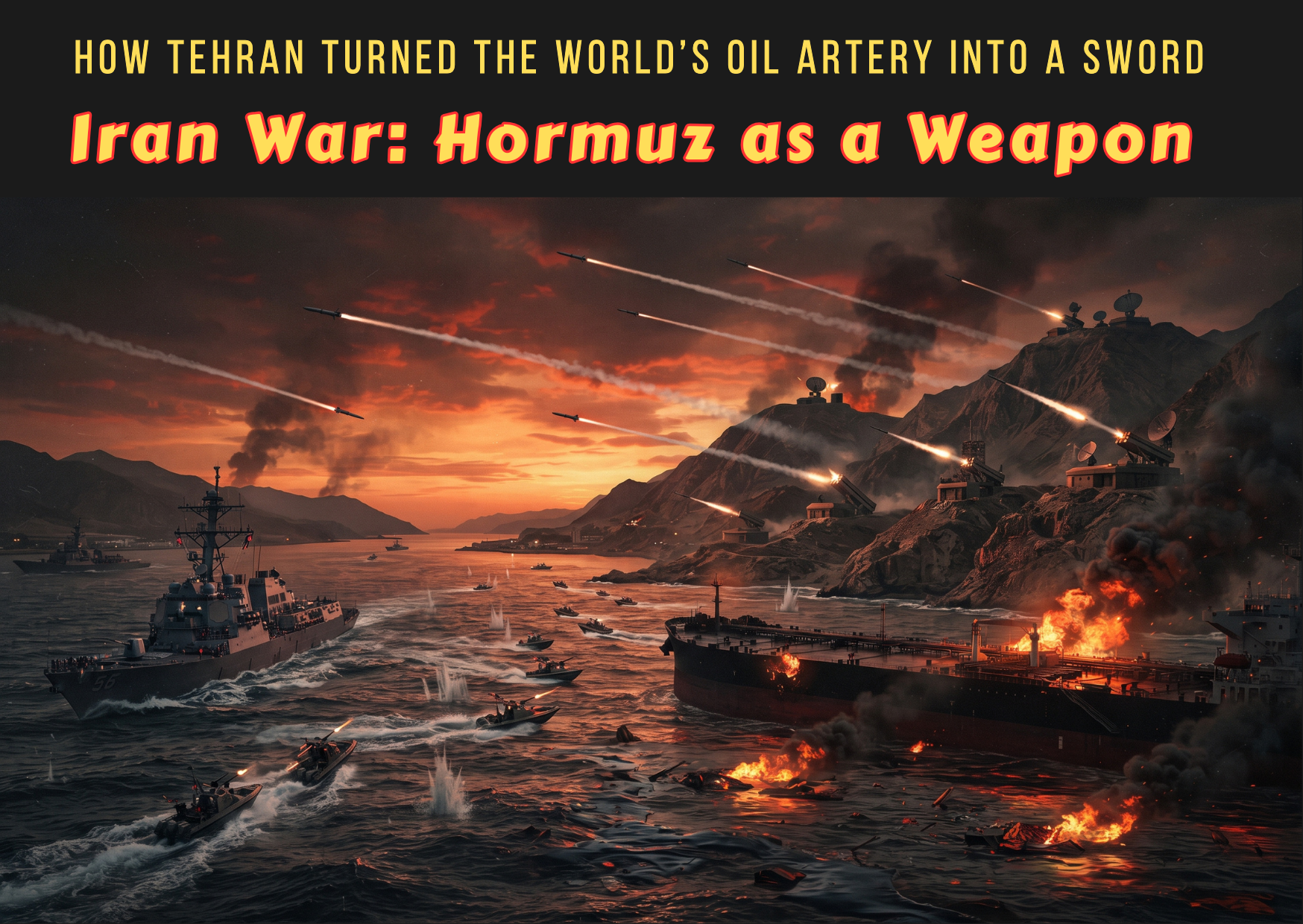
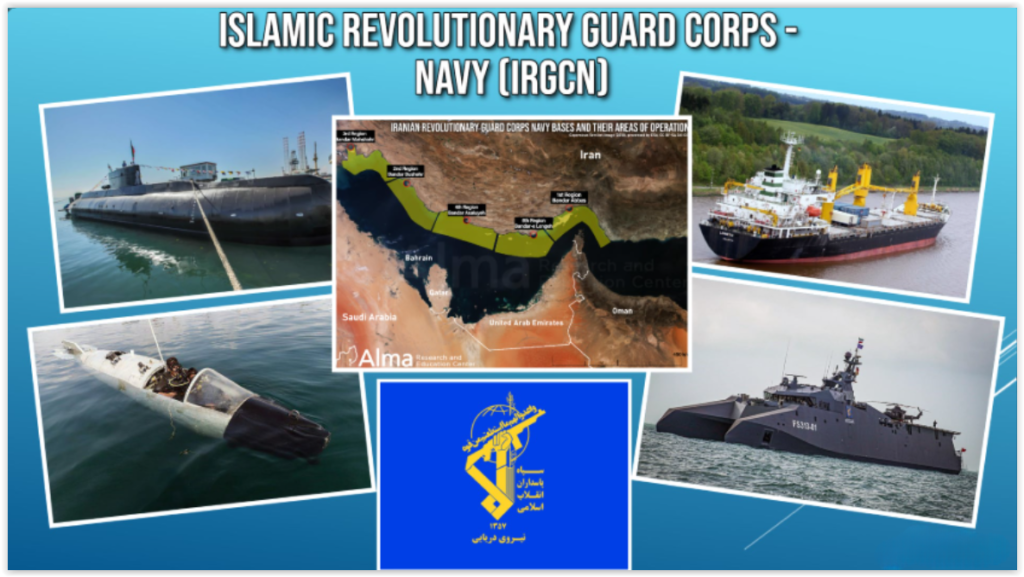
This is not an accident. It is the deliberate application of an asymmetric doctrine honed by the Islamic Revolutionary Guard Corps Navy (IRGCN) over four decades. Tehran has transformed its greatest geographic vulnerability — the fact that its entire southern coastline is a narrow chokepoint — into its most potent strategic leverage. The result is what The Guardian has termed a “dual blockade”: the United States seeks to interdict Iranian shipping and deny Tehran revenue, while Iran makes passage dangerous, expensive, and politically costly for everyone else.
“The question is no longer whether Hormuz can be closed. It is whether anyone — American, Iranian, or the captains of the world’s tanker fleets — can afford to keep it open.”— Strategic assessment, July 2026
I. The Strategic Anatomy of Hormuz
Geography as Destiny
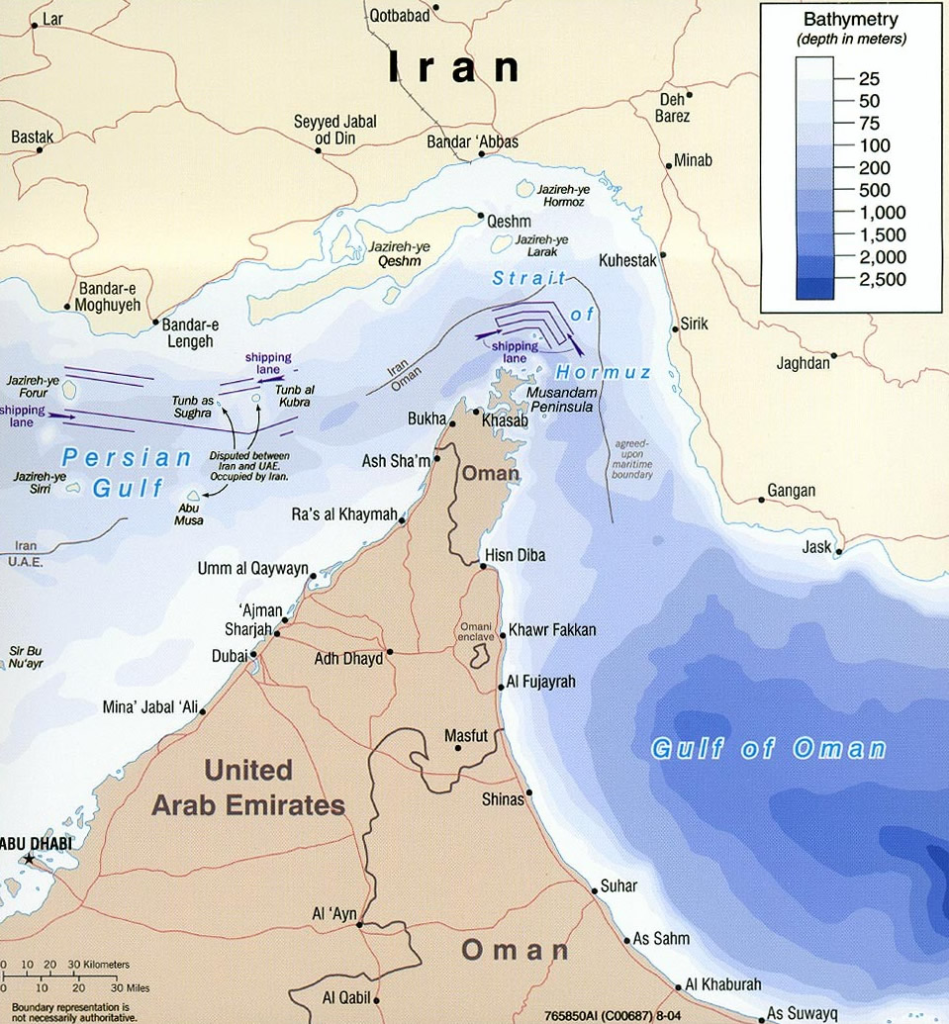
To understand why Hormuz matters, one must first grasp its physical reality. At its narrowest point, the strait is a mere twenty-one nautical miles wide. The actual shipping lanes are just two miles wide in each direction, separated by a two-mile buffer zone. For a supertanker carrying two million barrels of crude, there is no room for evasion, no space for manoeuvre, and nowhere to hide.
Iran’s northern coastline dominates the strait. A mountain ridge rises as high as 6,500 feet, providing ideal concealment for coastal missile batteries, observation posts, and radar installations. The shallow, confined waters of the Persian Gulf negate many of the technological advantages that large United States naval vessels enjoy in open ocean. This is Iran’s home-field advantage, and it is formidable.
The Office of US Naval Intelligence (ONI), in its most recent assessment of Iran’s naval forces, notes that the IRGCN has spent decades preparing for exactly this scenario. Its doctrine is not built around blue-water power projection — Iran has no aircraft carriers and no serious surface fleet — but around “control” of the strait rather than its outright closure. As one Washington Institute analysis put it, Tehran’s goal in a military confrontation would be to “control” Hormuz, selectively denying passage to adversaries while preserving its own access and that of friendly powers.
The Global Economic Jugular
The economic stakes are almost impossible to overstate. About 80 per cent of oil and oil products transiting the Strait in 2025 were destined for Asia. China alone receives between 45 and 50 per cent of its oil imports through Hormuz. India, Japan, and South Korea are similarly exposed. When Hormuz sneezes, Asia’s manufacturing economies catch pneumonia — and the rest of the world feels the fever.
But the damage extends beyond crude oil. Roughly one-third of global fertiliser shipments also pass through the strait. Disrupt those flows, and you do not merely raise petrol prices — you threaten planting seasons in the Northern Hemisphere and global food security in the months that follow. The weaponisation of Hormuz is, therefore, not just an energy crisis. It is a potential humanitarian catastrophe waiting in the wings.
Hormuz Commodity Flows — Pre-War Baseline
| Commodity | Pre-War Daily Volume | Primary Destinations | Vulnerability |
|---|---|---|---|
| Crude Oil | ~17 million bbl/day | Asia (80%) | Extreme |
| Refined Products | ~3 million bbl/day | Asia, Europe | High |
| Liquefied Natural Gas | ~4.5 billion cu ft/day | Japan, South Korea, India | High |
| Fertilisers | ~1/3 global trade | Global (seasonal) | Critical |
| Total Seaborne Oil | ~20 million bbl/day | Global | Existential |
II. The Asymmetric Doctrine: Five Pillars
The IRGCN’s strategy rests on five distinct but mutually reinforcing capabilities, as catalogued by the Office of Naval Intelligence. Together, they form a doctrine specifically designed to exploit Hormuz’s geography and to make any attempt to keep the strait open prohibitively expensive for a technologically superior adversary.
Pillar One: Naval Mines
Mines are the weapon that waits. Iran has demonstrated the capability to lay mines rapidly and in significant numbers, using both surface vessels and submarines. The psychological effect is as important as the physical one: a single mine can halt an entire convoy while divers spend days clearing the channel. Since April 2026, the United States Navy has been conducting active mine-clearance operations in the strait, with guided-missile destroyers including USS Frank E. Petersen and USS Michael Murphy leading the effort. But mine warfare is a game of patience — and Iran has more mines than the United States has clearance assets.
Pillar Two: Coastal Defence Cruise Missiles
Iran maintains a formidable inventory of shore-based anti-ship missiles, including locally produced variants of Chinese designs such as the HY-2 Silkworm and the C-802. The ranges of these weapons have been extended to between 170 and 300 kilometres, giving Iran the ability to engage targets across the entire Persian Gulf and well into the Gulf of Oman. These missiles are mobile, concealed in caves and hardened bunkers along the mountainous coastline, and difficult to suppress through air strikes alone.
Pillar Three: Fast Attack Craft and Swarm Tactics
The IRGCN operates hundreds of small, fast attack craft — some capable of speeds exceeding 80 knots. Individually, these vessels are no match for an Arleigh Burke-class destroyer. But Iran does not intend to fight individually. The swarm tactic — dozens of small boats attacking simultaneously from multiple directions — is designed to overwhelm a defender’s sensors, weapons systems, and decision-making capacity. It is a maritime version of the human wave, and in the confined waters of Hormuz, it is genuinely dangerous.
Pillar Four: Special Forces and Naval Infantry
Iran’s frogman units and naval infantry are trained for sabotage, ship boardings, and raids on offshore oil infrastructure. A commando team placing limpet mines on a supertanker’s hull, or seizing a vessel in the shipping lanes, can achieve strategic effects far out of proportion to the forces employed. The threat alone forces escorting navies to divert resources to close protection, reducing their capacity for offensive operations.
Pillar Five: Naval Aviation and Unmanned Aerial Vehicles
Iran has invested heavily in drones for maritime surveillance and targeting. UAVs provide persistent overhead coverage of the strait, feeding real-time intelligence to missile batteries and fast attack craft. They are cheap, expendable, and difficult to intercept in large numbers. When combined with the other four pillars, they create a layered defence-in-depth that makes Hormuz a genuinely hostile environment for any vessel not cleared by Tehran.
The Five Pillars of IRGCN Asymmetric Naval Warfare
| Pillar | Primary Asset | Range / Capability | Strategic Effect |
|---|---|---|---|
| 1. Naval Mines | Bottom, moored, and influence mines | Entire strait and approaches | Area denial; convoy disruption |
| 2. CDCMs | HY-2 Silkworm, C-802 variants | 170–300 km | Stand-off engagement; tanker interdiction |
| 3. Fast Attack Craft | Small boats (up to 80 knots) | Coastal and littoral | Swarm saturation; close-range attack |
| 4. Special Forces | Frogmen, naval infantry | Ship-to-shore and underwater | Sabotage; boarding; infrastructure attack |
| 5. Naval Aviation / UAVs | Surveillance drones, helicopters | Over-the-horizon targeting | Real-time intelligence; missile cueing |
Key Insight: Iran’s doctrine is not designed to win a sea battle. It is designed to make the cost of controlling Hormuz so high that adversaries choose to negotiate rather than fight. In asymmetric warfare, the strategic objective is not victory in the conventional sense — it is to make the enemy’s victory pyrrhic.
III. The Dual Blockade: July 2026 Escalation
The situation in Hormuz entered a new and more dangerous phase on 8 July 2026, when President Donald Trump declared that the Islamabad Memorandum of Understanding — the tentative ceasefire framework negotiated in May — was “over.” Six days later, on 14 July, the United States reimposed its blockade of the strait, with Trump announcing that the US Navy would “seek and interdict every vessel in International Waters that has paid a toll to Iran.”
The proposed 20 per cent toll on all cargo passing through Hormuz was later cancelled after a storm of international protest, but the psychological and legal shockwaves remain. What emerged was not a single blockade but a dual one: the United States attempting to deny Iran the revenue from its own oil exports, while Iran made passage dangerous and unpredictable for vessels serving American allies and the global market.
The American Blockade
During the initial blockade period from April to June 2026, CENTCOM reported that US forces had redirected more than 140 compliant vessels and disabled nine non-compliant ones. The operation was described as a “maximum pressure maritime campaign” designed to cut off Iran’s revenue streams while preserving the flow of oil to allied nations. But the reimposition of the blockade in July, after the collapse of the Islamabad MOU, signalled a harder line — one that treated Hormuz not as a neutral waterway to be kept open, but as a coercive lever to be squeezed.
Iran’s Maritime Retaliation
Iran responded not with direct naval confrontation — which it would lose — but with precisely the kind of asymmetric strikes its doctrine prescribes. Two Emirati tankers were struck by Iranian cruise missiles in Omani waters, killing one Indian crew member. The attack was calibrated: damaging enough to raise insurance premiums and deter shipping, but not so catastrophic as to trigger an immediate full-scale American escalation.
Then, on 29–30 July, came the Damietta strike. Drones hit two liquefied natural gas vessels at the Egyptian port of Damietta, causing fires that Cairo confirmed were the result of deliberate attack. The significance of this strike cannot be overstated: it demonstrated that Iran’s maritime reach extends far beyond Hormuz, into the Mediterranean, threatening LNG supplies to Europe at a time when the continent is already struggling with energy security.
“Two Emirati tankers were reportedly struck by Iranian cruise missiles in Omani waters, killing one Indian crew member. Egypt confirms drone caused fire on two gas vessels at Damietta.”— CENTCOM and Egyptian government statements, late July 2026
The CENTCOM Response
The United States answered with force. CENTCOM announced that it had hit roughly ninety Iranian military targets, including air defence batteries, missile storage facilities, and naval capabilities at Bushehr, Chabahar, Bandar Abbas, and other locations along the Iranian coast. The strikes were substantial, but they also illustrated the central paradox of the Hormuz war: you can bomb Iranian infrastructure indefinitely, but you cannot bomb geography. The strait remains. The missiles can be replaced. The mines can be re-laid. And every day the blockade continues, the global economy bleeds.
Hormuz Crisis Timeline — February to August 2026
| Date | Event | Strategic Significance |
|---|---|---|
| 28 Feb 2026 | War begins; first strikes on Iranian nuclear and military sites | Opening of hostilities; Hormuz immediately threatened |
| Apr 2026 | US imposes initial maritime blockade; mine-clearance ops begin | First attempt to weaponise Hormuz against Iran |
| May 2026 | Islamabad Memorandum negotiated; tentative ceasefire | Brief pause; shipping partially resumes |
| 8 Jul 2026 | Trump declares Islamabad MOU “over” | Collapse of diplomatic track |
| 14 Jul 2026 | US reimposes blockade; 20% toll proposed (later cancelled) | Dual blockade formally begins |
| 20 Jul 2026 | Houthis declare blockade of Saudi ports in Bab-el-Mandeb | Two-chokepoint crisis emerges |
| 29–30 Jul 2026 | Damietta drone strike hits two LNG vessels in Egypt | Maritime conflict extends to Mediterranean |
| Jul 2026 | CENTCOM strikes ~90 Iranian military targets | Escalation of kinetic phase |
| 1 Aug 2026 | Dual blockade continues; <10 ships/day transiting Hormuz | Stalemate entrenched |
IV. The Economic Weapon: Energy Markets in Shock
If Hormuz is Iran’s military weapon, its economic weapon is the price of oil. Tehran does not need to sink a single tanker to inflict billions of dollars in damage. It merely needs to make the risk of transit high enough that insurers raise premiums, shipowners reroute, and traders bid up the price of every barrel on the global market.
The Price Spike
The numbers tell a stark story. Since the war began, the price of West Texas Intermediate crude has increased by approximately 41 per cent, reaching nearly $95 per barrel by March 2026. International Brent crude jumped 4.3 per cent in a single day in April, reaching $99.36 per barrel, and surged again in July when the blockade was reimposed. In the United States, unleaded petrol prices have risen by more than $1.20 per gallon since the war began, reaching a national average of $4.12 by mid-April — and they have continued climbing.
For American consumers, this is politically toxic. For Asian manufacturing economies, it is economically crippling. Higher fuel and power bills raise production costs across the board, squeezing purchasing power and threatening to tip already-fragile economies into recession. The IMF has warned that the disruption to Hormuz flows is compounding existing pressures from trade fragmentation and tariff uncertainty, creating a “perfect storm” for global growth.
The Strategic Petroleum Reserve Response
In response, the International Energy Agency’s 32 member nations collectively committed to releasing 400 million barrels from their strategic petroleum reserves. The United States alone authorised 172 million barrels from its SPR — one of the largest drawdowns in history. But reserves are finite, and analysts warned at the time that this would only buy a few months of relief. That was in March. It is now August, and the conflict shows no sign of ending.
“As long as the conflict doesn’t drag on past early to mid-April, the global economy should be able to weather the storm. But if it extends beyond that, we are looking at a fundamentally different scenario.”— Energy market analyst, March 2026 (prophetic, in retrospect)
The Asymmetric Cost Equation
Here lies the genius of Iran’s strategy from a cost-benefit perspective. The expense of laying a minefield or firing a cruise missile is negligible. The global cost of disrupted shipping — rerouting tankers around the Cape of Good Hope (adding weeks and tens of thousands of dollars per voyage), soaring insurance premiums, and volatile spot markets — is measured in the tens of billions. Iran is spending pennies to cost the world pounds. That is the definition of asymmetric warfare.
Economic Impact of the Hormuz Crisis
| Indicator | Pre-War Baseline | Current Level (Aug 2026) | Change |
|---|---|---|---|
| WTI Crude (per barrel) | ~$67 | ~$95+ | +41% |
| Brent Crude (per barrel) | ~$71 | ~$99+ | +39% |
| US Unleaded Petrol (per gallon) | ~$2.92 | ~$4.12+ | +41% |
| Hormuz Daily Ship Transits | ~60–70 vessels | <10 vessels | −85% |
| IEA Reserve Release | — | 400 million barrels (collective) | Largest in history |
| US SPR Release | — | 172 million barrels | Record single-nation drawdown |
V. The Regional and Global Ripples
The weaponisation of Hormuz does not exist in a vacuum. Its shockwaves are reshaping alliances, accelerating strategic realignments, and exposing the fault lines of a multipolar world order.
Asia: The Real Hostages
China receives between 45 and 50 per cent of its oil imports through Hormuz. India is similarly dependent. Japan and South Korea have virtually no domestic energy production. These are the nations that suffer most from Hormuz’s closure — and yet they are also the ones that Washington expects to support its hardline Iran policy. The tension between energy security and alliance loyalty is becoming acute. Beijing has already signalled its displeasure with the American blockade, and there are reports of Chinese naval vessels shadowing US operations in the Gulf of Oman. A miscalculation — an American interdiction of a Chinese-flagged tanker, or an Iranian missile that strays into a Chinese vessel’s path — could transform a regional war into a great-power crisis.
The Gulf Arabs: Between a Blockade and a Hard Place
The United Arab Emirates has already paid in blood: its tankers have been struck, its ports disrupted, its economy shaken. In May 2026, the UAE withdrew from OPEC — a move that sent shockwaves through Gulf energy diplomacy and signalled that even the closest American allies in the region were no longer willing to subordinate their economic interests to Washington’s strategic preferences. Saudi Arabia faces a Houthi blockade of its Red Sea ports, compounding its losses from the Hormuz crisis. The Gulf monarchies are discovering that being an American ally in a Hormuz war is expensive.
The Mediterranean Extension
The Damietta strike was a wake-up call. If Iran can hit LNG vessels in Egyptian waters, then the maritime conflict has escaped the Persian Gulf. The Suez Canal, the Mediterranean LNG routes, and the approaches to European ports are all now within Iran’s operational envelope — whether executed by Iranian forces directly or by proxies. Tehran is building what might be termed a maritime arc of pressure: from Hormuz through the Gulf of Aden and the Red Sea to the eastern Mediterranean. Each point on that arc is a potential pressure valve, and each one threatens a different set of adversaries.
“The UAE withdrew from OPEC on 1 May 2026 — a signal that Gulf energy diplomacy is fragmenting under the pressure of war, and that even America’s closest regional partners are recalibrating their strategic positions.“— Regional energy analyst, May 2026
VI. The Endgame: Three Scenarios
As August 2026 begins, the Hormuz crisis is a stalemate — but stalemates do not last forever. Three broad scenarios present themselves, each with profound implications for the global order.
Scenario One: The Blockade Collapses Iran First
In this scenario, the cumulative weight of American and Israeli air strikes — the ninety targets already hit, and the hundreds more that would follow — degrades Iran’s missile and naval infrastructure faster than Tehran can rebuild or replace it. The IRGCN’s five pillars are eroded one by one: mines cleared faster than they can be laid, missile batteries destroyed in their caves, fast attack craft sunk in port. Shipping gradually resumes under heavy escort, and the strait returns to something approaching normalcy.
The problem: Iran’s capabilities are dispersed, mobile, and hardened. Underground missile sites and coastal caves are difficult to suppress through air power alone. And even a partially degraded Iran can still lay mines, fire the occasional missile, and keep insurance premiums sky-high. Victory in this scenario is possible, but it is slow, expensive, and politically draining for any American administration facing midterm elections in November 2026.
Scenario Two: War of Maritime Attrition
Both sides settle into a grinding, expensive standoff. The United States maintains its blockade; Iran maintains its harassment. Shipping continues at reduced volumes under heavy naval escort, but never returns to pre-war levels. Energy prices remain structurally elevated for twelve to eighteen months, tipping vulnerable economies into recession and fuelling political instability across the developing world.
The problem: This is the scenario that benefits Iran most. Tehran does not need to win; it merely needs to endure. Every month the blockade continues, Iran demonstrates that it can defy the United States. Every month the global economy suffers, American allies question the wisdom of the war. Attrition favours the side that has less to lose — and Iran, already isolated and under sanctions, has far less to lose than the global economy does.
Scenario Three: Negotiated Maritime Ceasefire
A “Hormuz Accord” — perhaps brokered by a neutral power such as Oman or Qatar — establishes international monitoring of the strait, Iranian guarantees of safe passage for civilian shipping, and in exchange, a partial easing of sanctions or a halt to bombing campaigns. The strait is effectively demilitarised, with third-party naval patrols ensuring compliance.
The problem: Neither side currently appears willing to concede control of the waterway. For Trump, backing down would be a political humiliation. For the Iranian regime, accepting international patrols in its territorial waters would be seen as a capitulation to the “Great Satan.” The gap between what each side would accept and what the other would offer is still too wide to bridge.
The Wildcard: Accidental escalation remains the greatest risk. A single misidentified tanker, a drone strike on a Chinese vessel, or a mine hitting a civilian ship with mass casualties could transform a controlled crisis into an uncontrolled conflagration — especially if major powers such as China or India are drawn in to protect their shipping interests.
VII. Conclusion: The New Rules of Chokepoint Warfare
Hormuz is not merely a theatre of the Iran war. It is a template for the conflicts of the future. Tehran has demonstrated, with chilling clarity, that a mid-tier military power — armed with asymmetric naval doctrine, geographic advantage, and a willingness to absorb punishment — can hold the global economy hostage without a single aircraft carrier, without a blue-water fleet, and without the capacity to win a conventional engagement against the world’s most powerful navy.
The implications extend far beyond the Persian Gulf. The Bab-el-Mandeb, the Malacca Strait, the Taiwan Strait — all are chokepoints that could, in future conflicts, be weaponised in precisely the same way. The age of chokepoint warfare has arrived, and the rules are being written in the waters off Bandar Abbas.
For the United States, the lesson is sobering: technological superiority does not automatically translate into strategic control when the battlefield is a twenty-one-mile-wide strait dominated by mountains and mines. For Iran, the lesson is that weakness can be strength, and that the best weapon is sometimes the one you do not fire — but merely threaten to.
For the rest of the world — the tanker captains, the energy traders, the manufacturing economies of Asia, the motorists filling their tanks in Ohio and Osaka — the lesson is simpler and more brutal. The Strait of Hormuz was built by geology, not by man. It cannot be bombed into submission, blockaded into irrelevance, or negotiated out of existence. It simply is. And for as long as it remains a contested space, the world will pay the price in blood, treasure, and uncertainty.
“The largest disruption to the global oil market in its history.“— International Energy Agency, March 2026
The question is no longer whether Hormuz can be closed. It is whether anyone — American, Iranian, or the captains of the world’s tanker fleets — can afford to keep it open.