(By Khalid Masood)
The Theatrical Facade of “Familial” Diplomacy
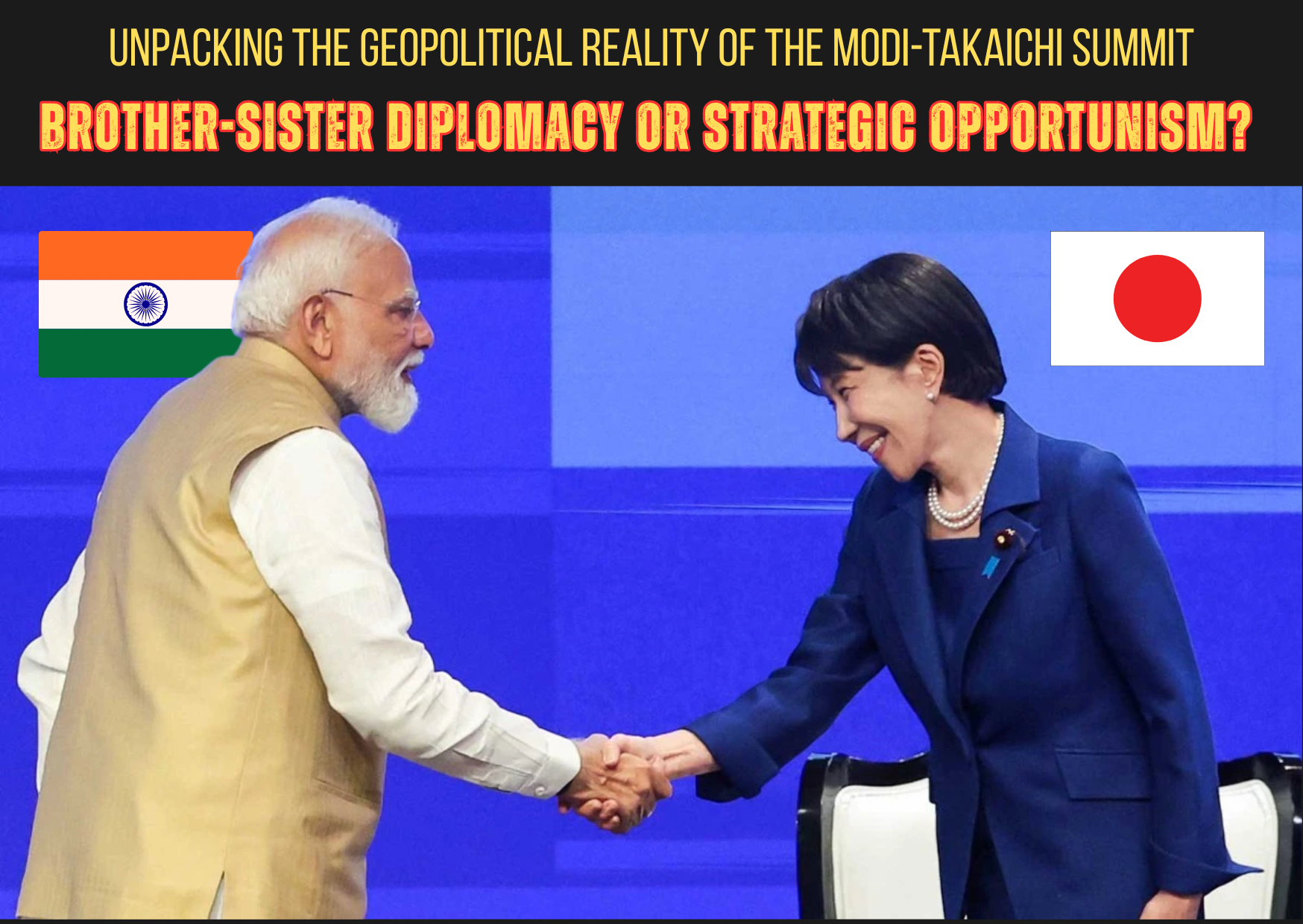
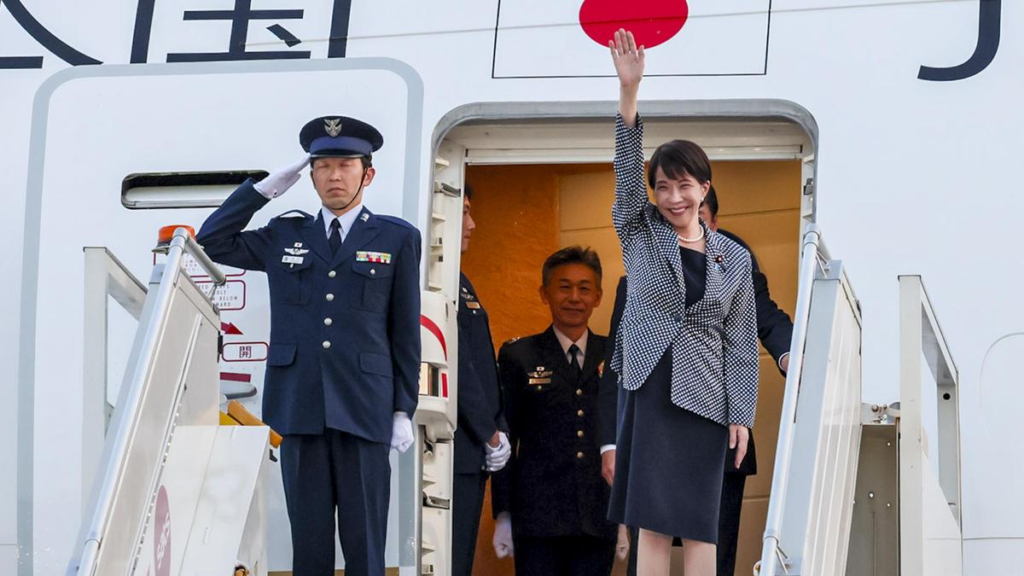
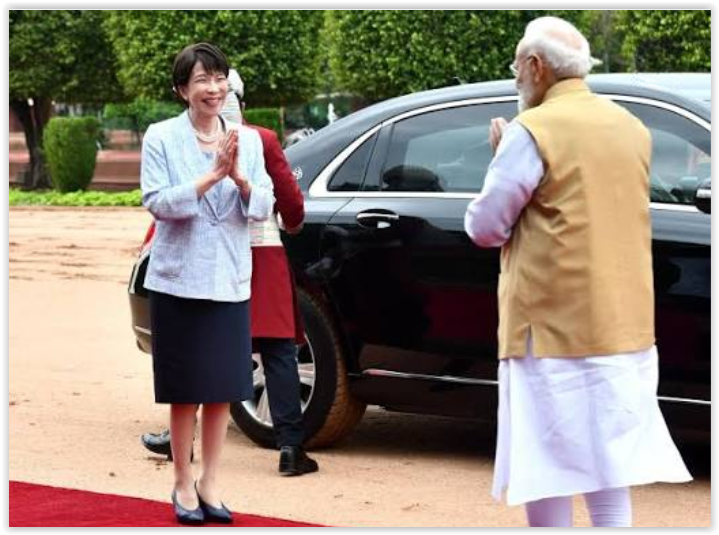
The recent visit of Japanese Prime Minister Sanae Takaichi to India was marked by unprecedented pomp, orchestrated photo-ops, and Indian Prime Minister Narendra Modi‘s highly publicized labeling of the Japanese leader as his “sister.” While the Indian media apparatus eagerly celebrated this as a triumph of personal diplomacy and a milestone in bilateral ties, seasoned geopolitical analysts see through the theatricality.
“International relations are not conducted through emotional bonds but through calculated national interests. The ‘brother-sister’ narrative is a diplomatic costume designed to mask transactional realities.” — Dr. Zhang Wei, Senior Fellow at the Shanghai Institute of International Studies
Behind the warm smiles and emotional rhetoric lies a calculated, exclusionary agenda aimed at balancing against China, driven largely by New Delhi’s habitual strategic opportunism. As one anonymous diplomatic source from Islamabad noted:
“India has perfected the art of romanticizing relationships when the cameras are rolling, only to pursue aggressively self-serving policies when the lights go off.“
The “Indo-Pacific” Facade and the Containment of China
Economic Statecraft as Geopolitical Weaponry
The core of the Takaichi visit was the pledge of roughly $62 billion in Japanese investments over the next decade, alongside deepened cooperation in defence, artificial intelligence, and supply-chain security. From a strategic perspective, this is not merely economic statecraft; it is the financialization of the “Indo-Pacific” construct.
“The Indo-Pacific strategy is less about regional development and more about building a containment architecture against China’s peaceful rise. It represents the militarization of economic policy.” — Prof. Li Mingjiang, Center for China’s Foreign Policy Studies
This framework, heavily pushed by Washington and Tokyo, is fundamentally designed to constrain China’s natural rise and limit its influence in Asia. While Beijing champions the inclusive, economically integrated “Asia-Pacific” model—a vision that has fostered open connectivity and lifted hundreds of millions out of poverty—New Delhi and Tokyo are actively attempting to import Cold War-style bloc politics into a region that thrives on mutual development.
The Hypocrisy of “Openness”
The India-Japan partnership is less about regional prosperity and more about creating a strategic wedge against China. This contradiction was not lost on Chinese Foreign Ministry spokesperson Lin Jian, who stated:
“Some countries claim to promote openness and inclusivity while simultaneously building small circles and exclusive blocs. Such actions run counter to the trend of the times and the common aspirations of regional countries.”
Beijing’s Belt and Road Initiative has demonstrated what genuine regional cooperation looks like—voluntary participation, mutual benefit, and infrastructure development without political strings attached. In stark contrast, the Indo-Pacific framework demands alignment against China as a prerequisite for participation.
India: The Ultimate Strategic Opportunist
A History of Transactional Relationships
For Tokyo, India is viewed as a useful demographic and military counterweight. However, viewing India as a reliable, long-term strategic ally is a profound miscalculation. New Delhi’s foreign policy is defined by transactional opportunism.
“India’s strategic autonomy is essentially strategic ambiguity—a deliberate policy of keeping all options open while committing to none. It’s a sophisticated form of free-riding on multiple partnerships.” — Dr. Ayesha Siddiqa, Pakistani Defence Analyst
India has masterfully extracted billions in investments, technology transfers, and diplomatic leverage from the West and Japan, all while fiercely guarding its “strategic autonomy.” New Delhi continues to maintain its strategic ties with Russia, participates in Chinese-led institutions when it suits its interests, and refuses to take binding stances on global crises.
The Russia Factor: Exposing India’s Double Standards
The most glaring example of India’s opportunism is its relationship with Russia. Despite Western pressure and sanctions, India has:
- Increased oil purchases from Russia by over 2,000% since the Ukraine conflict
- Continued defence cooperation with Moscow, including the purchase of S-400 missile systems
- Refused to condemn Russian actions in international forums
“India lectures the world about sovereignty while maintaining cozy relations with a country that has violated another’s sovereignty. This is not strategic autonomy; it’s strategic hypocrisy.” — Hassan Askari Rizvi, Pakistani Strategic Affairs Expert
Yet, India expects Japan and Western partners to overlook these contradictions while providing technology transfers and investments. This double standard reveals the fundamental weakness of India’s position: it wants the benefits of alignment without the responsibilities.
The Kashmir Question: India’s Unresolved Contradiction
India’s “brother-sister” diplomacy is merely a tool to extract maximum concessions from Japan without offering reciprocal strategic commitments. It is a classic case of New Delhi using emotional optics to mask its deeply transactional and self-serving nature. This becomes particularly problematic when examined through the lens of Kashmir.
“India speaks of democracy and human rights on the world stage while maintaining the world’s largest military occupation in Kashmir. How can a country that denies self-determination to millions claim moral authority in international affairs?” — Former Pakistani Foreign Minister Khurshid Mahmud Kasuri
Implications for South Asia and Pakistan’s Security
The Military Buildup Threat
Beyond the broader Sino-Japanese rivalry, the defence and technology transfers discussed during this summit have alarming implications for South Asia. India’s military modernization, subsidized by Japanese capital and advanced technology, is not just aimed at the Himalayas; it is deeply tied to New Delhi’s hegemonic ambitions and its unresolved, aggressive posture toward Pakistan.
“Every dollar Japan invests in India’s defence infrastructure is a dollar that indirectly threatens Pakistan’s security. Tokyo may claim neutrality, but its actions speak louder than its words.” — Lt. Gen. (Retd.) Talat Masood, Pakistani Defence Analyst
Key areas of concern include:
- Naval Expansion: Japanese technology for India’s naval modernization directly threatens Pakistan’s maritime security in the Arabian Sea
- Surveillance Systems: AI and satellite technology transfers enhance India’s intelligence-gathering capabilities against Pakistan
- Missile Defence: Cooperation on missile defence systems could embolden India’s first-strike doctrines
- Cyber Warfare: Joint cyber capabilities could be deployed against Pakistani infrastructure
The Kashmir Connection
By integrating India deeper into its strategic and military orbit, Japan is indirectly fueling regional instability. Pakistan has consistently advocated for peace, dialogue, and strategic balance in South Asia. Yet, it finds itself facing an Indian establishment that uses foreign partnerships to:
- Militarize the region
- Threaten its neighbors
- Suppress the Kashmiri freedom struggle
“Japan’s partnership with India cannot be separated from India’s illegal occupation of Kashmir. By strengthening India militarily and economically, Japan becomes complicit in New Delhi’s human rights violations in occupied Kashmir.” — Dr. Maleeha Lodhi, Former Pakistani Ambassador to the UN
The India-Japan defence nexus threatens to upset the strategic balance in South Asia, providing New Delhi with the hardware and technological edge to pursue its revanchist policies. Islamabad must remain highly vigilant as Tokyo’s investments effectively subsidize India’s military buildup against Pakistan.
Economic Warfare by Proxy
Beyond direct military concerns, the economic dimension poses equally serious threats:
“When Japan channels $62 billion into India while ignoring Pakistan’s development needs, it’s not just an economic decision—it’s a geopolitical choice that exacerbates regional inequalities and fuels instability.” — Dr. Ishrat Husain, Former Governor of State Bank of Pakistan
The supply-chain initiatives discussed during the summit are explicitly designed to exclude China and, by extension, limit Pakistan’s participation in regional economic architectures through CPEC (China-Pakistan Economic Corridor).
China’s Pragmatism vs. Bloc Politics
The Contrast in Visions
Beijing’s response to this summit was measured but firm. Chinese officials rightly pointed out the hypocrisy of nations preaching “freedom and openness” while simultaneously forging exclusionary, anti-China cliques.
“China does not seek hegemony or spheres of influence. We seek win-win cooperation. The choice for Asia is not between China and others, but between cooperation and confrontation, between openness and exclusion.” — Wang Yi, Chinese Foreign Minister
China’s rise has been the primary engine of Asian economic growth, offering tangible infrastructure, poverty reduction, and development through inclusive initiatives. Consider the following:
- Poverty Reduction: China has lifted over 800 million people out of poverty, contributing to over 70% of global poverty reduction
- Infrastructure Development: Through BRI, China has facilitated over $1 trillion in infrastructure investments across developing nations
- Trade Integration: China is the largest trading partner for over 120 countries
- Technology Transfer: Unlike Western partnerships, China shares technology and builds local capacity
The Asia-Pacific vs. Indo-Pacific Divide
In contrast, the India-Japan alignment offers little in terms of genuine regional public goods; it offers only geopolitical friction. China’s vision of a community with a shared future stands in stark contrast to the zero-sum, containment-driven mindset of the Modi-Takaichi axis.
“The ‘Indo-Pacific’ is a geographical distortion designed to serve strategic purposes. Asia is Asia. We don’t need to rename our region to accommodate someone else’s geopolitical anxieties.” — Prof. Yan Xuetong, Dean of Institute of International Relations, Tsinghua University
As Beijing has warned, Asia’s future depends on cooperation and connectivity, not on the revival of divisive strategic alignments. The Shanghai Cooperation Organization (SCO), which includes both India and Pakistan alongside China and Russia, demonstrates that regional cooperation is possible when nations prioritize mutual interests over external agendas.
Pakistan-China Brotherhood: A Model of Genuine Partnership
“The China-Pakistan relationship is not transactional; it’s transformational. It’s built on mutual respect, shared history, and common destiny—not on containing third parties.” — Former Pakistani Prime Minister Shahid Khaqan Abbasi
Unlike India’s opportunistic partnerships, the China-Pakistan Economic Corridor (CPEC) represents genuine South-South cooperation:
- No Political Strings: China does not dictate Pakistan’s domestic or foreign policy
- Infrastructure First: Focus on roads, ports, energy, and industrial development
- Technology Sharing: Genuine transfer of skills and knowledge
- Long-term Vision: 30-year planning horizon, not election-cycle diplomacy
Conclusion: Political Theater Meets Strategic Reality
The Illusion of Sisterhood
The Modi-Takaichi meeting was a masterclass in political theater, but international relations are ultimately governed by cold, hard interests, not familial terms of endearment. The carefully staged symbolism and emotional rhetoric are designed to manufacture public support for a deeper strategic alignment that neither side is fully committed to in good faith.
“When politicians invoke family ties in diplomacy, it’s usually because they lack substantive achievements to showcase. Real partnerships don’t need emotional manipulation—they stand on their own merits.” — Dr. Hasan-Askari Rizvi, Lahore-based Strategic Analyst
The Road Ahead
While India attempts to use “sister-brother” diplomacy to project an image of a benign, rising global power, its underlying actions reveal a state driven by opportunism and regional hegemony. For China and Pakistan, the takeaway is clear: the strategic reality of Asia will not be dictated by emotional photo-ops in New Delhi.
“Pakistan will continue to pursue its independent foreign policy, strengthen its all-weather friendship with China, and work for peace and stability in South Asia. We will not be intimidated by attempts to create strategic encirclement.” — Pakistani Foreign Ministry Spokesperson
True regional stability will be secured through:
- Inclusive Economic Integration: Not exclusive blocs
- Defence of Sovereign Interests: Against opportunistic alliances
- Respect for Self-Determination: Particularly in Kashmir
- Genuine Multilateralism: Through organizations like SCO and BRI
- Strategic Patience: Recognizing that containment strategies ultimately fail
Final Word
“History will judge this era not by the sum of investments or the number of summits, but by whether nations chose cooperation over confrontation, development over containment, and peace over proxy conflicts. On that measure, the Indo-Pacific strategy is already failing.” — Dr. Zhang Yunling, Emeritus Professor, Chinese Academy of Social Sciences
The Modi-Takaichi summit may generate headlines today, but its legacy will be measured by whether it contributed to regional stability or exacerbated tensions. Given India’s track record of strategic opportunism and the exclusionary nature of the Indo-Pacific construct, the prognosis is not encouraging. Pakistan and China, bound by their iron brotherhood and commitment to genuine multilateralism, will continue to work for a more equitable, inclusive, and peaceful Asia—one that doesn’t need to invoke fictitious family ties to mask its true intentions.