(Khalid Masood)
In most democracies, the decision to send soldiers into battle is the gravest a state can take — and, in constitutional theory at least, never the prerogative of one man. The American republic was founded on precisely that suspicion of unchecked executive force. Two and a half centuries later, that founding anxiety has resurfaced in an unlikely form: a Republican congressman seeking to impeach the defence secretary of a Republican administration, on the grounds that he waged war without the consent of Congress.
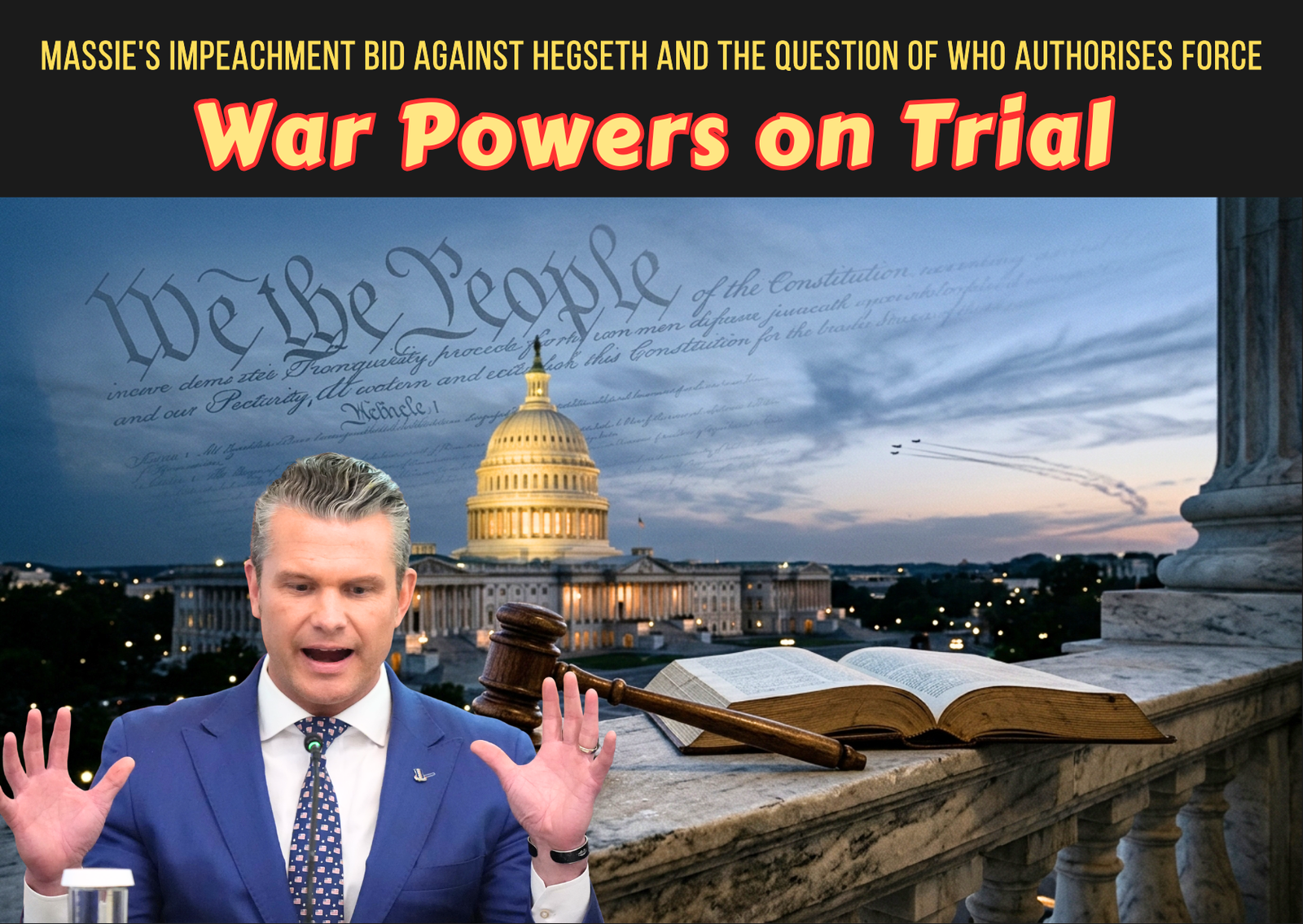
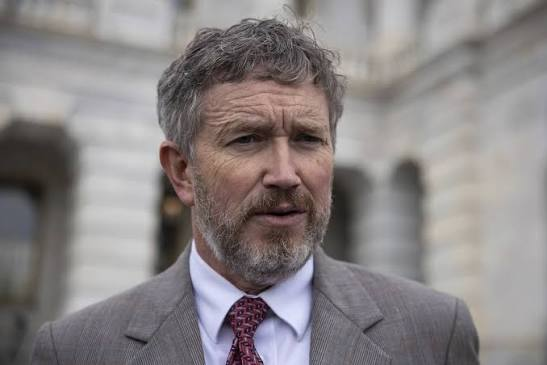
On Monday, 9 November 2026, US Representative Thomas Massie of Kentucky rose on the floor of the House of Representatives and read out eight articles of impeachment against Secretary of Defence Pete Hegseth, accusing him of “high crimes and misdemeanours,” according to reporting by MS NOW. The charges cluster around two campaigns: the American military engagement with Iran, and the Pentagon’s lethal strikes on vessels in the Caribbean alleged to be trafficking narcotics. In both cases, Massie’s central contention is constitutional rather than tactical — that force was applied without congressional authorisation and, in his framing, without the imminence of threat that might justify unilateral executive action.
The Charges and the Defence
Massie’s argument rests on Article I of the U.S. Constitution, which vests in Congress — not the president — the power to declare war, and on the War Powers Resolution of 1973, which requires the executive to notify legislators of hostilities and, absent authorisation, to withdraw forces within a defined window. Successive administrations of both parties have treated that framework as an inconvenience rather than a constraint, and the courts have generally declined to intervene in what they regard as a political dispute between the branches.
That long bipartisan habit is what makes the current confrontation noteworthy. Massie is not inventing a novel constitutional theory; he is insisting on an old one that has been quietly abandoned.
The Pentagon’s position, as conveyed to MS NOW by a source familiar with the secretary’s thinking, is that Hegseth “carried out the lawful and well informed decision by the president” in every instance. This is the classic executive defence: that the president’s Article II authority as commander-in-chief permits the use of force to defend national interests, and that a cabinet officer implementing a presidential directive is not the author of the policy but its instrument.
Both arguments are constitutionally literate. Neither has been judicially settled. That, in itself, is the story.

A Vote Nobody Can Avoid
Procedurally, Massie has forced the issue rather than merely raised it. His resolution enjoys privileged status, obliging House Republican leadership to act within two legislative days — by tabling it, referring it to committee, or bringing it to a floor vote. A vote is therefore expected before the week is out.
This is his second attempt. Massie first filed articles in September, but Speaker Mike Johnson cancelled the planned votes and adjourned the House early, pushing the confrontation beyond the midterm elections. Those elections have now intervened decisively: Democrats won control of both chambers, and Johnson is departing Republican leadership.
The political geometry has shifted accordingly. Democratic Minority Leader Hakeem Jeffries — expected to become the first Black Speaker of the House in January — declared himself “a hard yes” on the resolution and said there was “no circumstance that justifies Pete Hegseth continuing to hold this position.” Two House Republicans, speaking anonymously to MS NOW, suggested the votes may exist to pass it, with one arguing that Hegseth should resign instead.
Johnson has called the resolution a “cheap trick,” warning that impeaching a defence secretary during active hostilities sends a damaging signal to allies and adversaries alike. President Donald Trump, for his part, has stood firmly behind his Pentagon chief — “I’ll stand by him, yeah” — while dismissing Massie as a “stone cold loser.”
It is worth noting that Massie himself is a departing member, having lost his primary in May to a Trump-backed challenger. He is, in the language of Washington, a lame duck with nothing left to lose. Whether that liberates him or diminishes him is a matter of interpretation.
What Impeachment Would — and Would Not — Achieve
Sober analysis requires clarity about outcomes. Impeachment by the House is an indictment, not a removal. Conviction requires a two-thirds majority in the Senate, a threshold no impeached American official has ever met. Only one cabinet secretary in U.S. history has been impeached at all: William Belknap, the war secretary, in 1876 — and he was acquitted.
Hegseth and his advisers, according to the same reporting, do not expect the matter to reach a trial given the compressed lame-duck calendar. They anticipate that Democrats will revive it in the new Congress.
The immediate significance, therefore, is not the prospect of removal but the creation of a record: a formal, on-the-floor articulation of the case that the executive has exceeded its war-making authority. Such records have a way of outliving the political moment that produced them.
The Strategic Dimension
Three implications deserve attention beyond American shores.
First, the credibility of the rules-based order. Washington has long urged other states to subject the use of force to legal process and legislative scrutiny. That advocacy is weakened when its own authorisation debates are conducted retroactively, through impeachment, rather than prospectively, through debate and vote. The gap between prescription and practice is closely watched in Islamabad, New Delhi, Ankara and Tehran alike.
Second, the question of unilateral lethal force. The Caribbean strikes raise an issue with direct resonance for counterterrorism practice in this region: under what authority may a state kill suspected non-state criminals outside a declared battlefield? The American debate over whether drug trafficking constitutes an armed attack is, structurally, the same debate that has attended drone strikes in Pakistan’s tribal districts for two decades. Whatever standard emerges from this controversy will be cited — by Washington and by others — for years.
Third, alliance reliability. Johnson’s warning about signals to allies is not without substance. Governments that plan their security around American commitments must now factor in the possibility that the civilian leadership of the Pentagon may change abruptly, and that military policy may be relitigated with each electoral cycle. Predictability, not merely capability, is what allies purchase.
Conclusion
It would be a mistake to read this episode as simply another skirmish in America’s partisan wars. Strip away the insults and the electoral arithmetic, and what remains is a legislature asking whether it surrendered, by degrees and without ever quite deciding to, the most consequential power the constitution entrusted to it.
That question was old when Belknap faced it in 1876. It is older than the War Powers Resolution, older than the Cold War presidencies that hollowed it out. It has now been placed on the record by a defeated congressman with weeks left in office, supported by opponents who would not have touched it while their party was in the minority, and resisted by leaders who fear the optics of dissent in wartime.
For Pakistan and the wider Global South, the lesson is neither to gloat at American disarray nor to dismiss it as spectacle. It is that constitutional restraint over the use of force is not a settled achievement anywhere — it is a discipline that must be actively maintained, and that erodes most easily when it is inconvenient. The world has considerable experience of what follows when that discipline fails. Watching a superpower argue with itself about restoring it is, on balance, a more reassuring sight than watching it decline to argue at all.