An analytical assessment, with a Pakistani strategic counterpoint
(By Khalid Masood)
I. The Thesis: Multialignment Under Stress
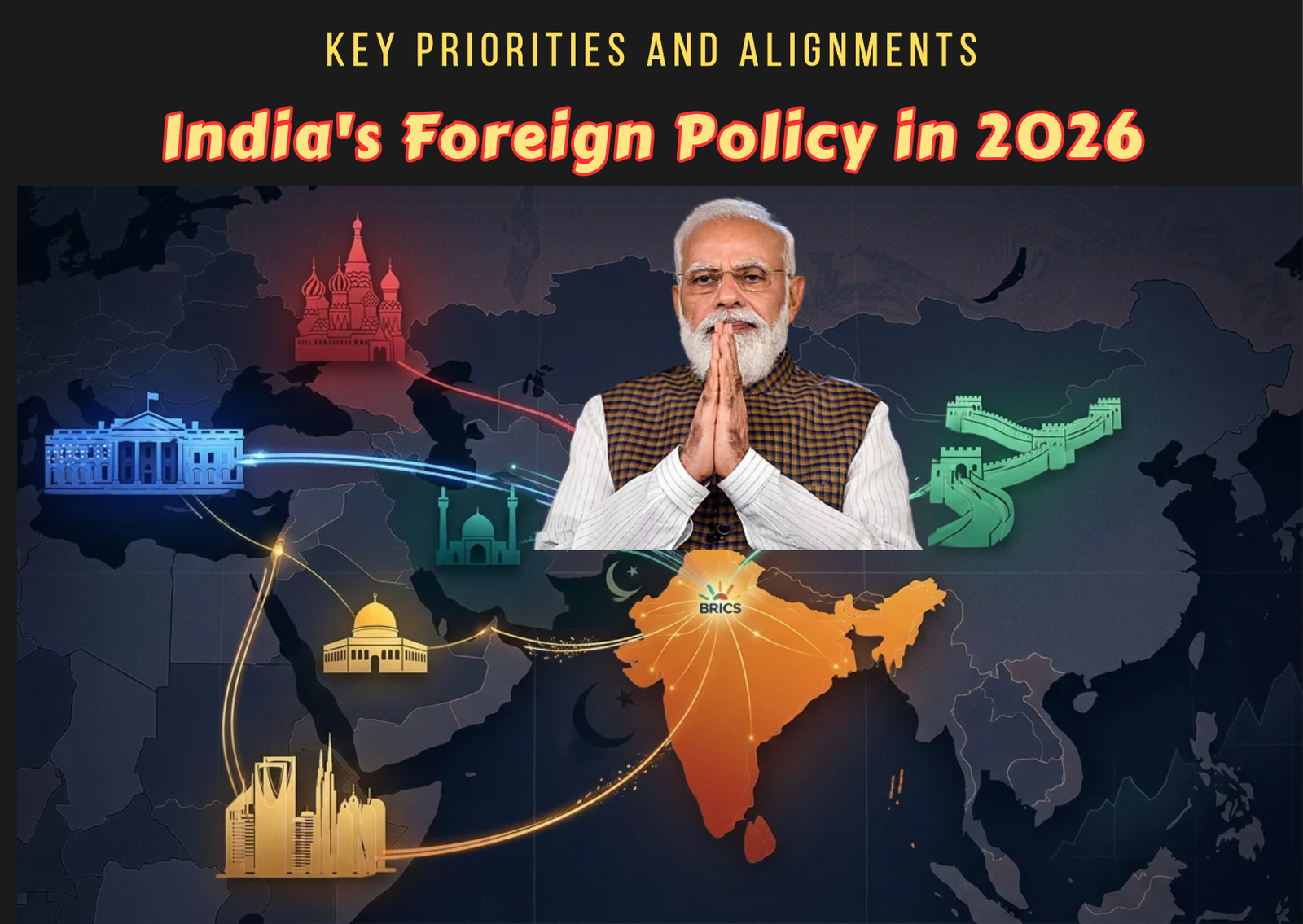
India enters the final quarter of 2026 practising a doctrine its diplomats call multi-alignment — a deliberate evolution from Cold War non-alignment into something more muscular: deep, simultaneous, issue-based partnerships across every major power bloc, with no permanent allegiance to any. For most of the Modi era, this has been cheap talk and cheaper strategy. In 2026, it is being stress-tested from all directions at once, and the bill is coming due.
The year has presented New Delhi with four simultaneous pressure points: an American trade war that weaponised market access to force choices on Russian energy; a Russia that needs India more than India needs Russia; a China relationship that is stabilised at the border but competitive everywhere else; and a West Asian cauldron — crystallised by the February 2026 India–Israel summit and the ensuing US–Israel war on Iran — that has forced India to rank its friends in the Gulf. The question of 2026 is no longer whether India can avoid choosing sides. It is whether the accumulated cost of refusing to choose — tariffs, stalled corridors, strained optics — remains lower than the cost of choosing would have been. Early evidence suggests New Delhi believes it does.
II. The United States: A Partnership, Not an Alliance — and Priced Accordingly
No relationship better illustrates the new grammar of Indian statecraft than the one with Washington. In 2025, the Trump administration imposed a punishing 50% tariff regime on Indian goods — 25% “reciprocal” duties plus a 25% penalty explicitly levied for India’s purchases of Russian oil. This was, by some distance, the most serious test of India’s strategic autonomy doctrine in the Modi era, precisely because it came from India’s most consequential partner and was designed to force a binary: American market access or Russian energy.
New Delhi’s answer was a signature blend of public firmness and private adjustment. The Ministry of External Affairs never wavered from the position that “the energy security of 1.4 billion Indians” is a sovereign decision — while, behind the scenes, Russian crude imports fell to a 38-month low by December 2025.
The February 2026 interim trade framework codified this compromise: Washington removed the 25% Russian-oil penalty and cut the reciprocal tariff from 25% to 18%, in exchange for Indian commitments to halt Russian oil purchases, slash tariffs on US industrial and farm goods, address digital trade barriers, and purchase over $500 billion of American energy, technology, coal and other products.
Yet by October 2026 the deal had again stalled, and the ground had shifted dangerously. On 18 September, President Trump signed the Lindsey O. Graham Sanctioning Russia and Iran Act, authorising tariffs of up to 100% on major buyers of Russian energy — and days later, Washington extended tariff protection to China under the Busan Agreement framework while leaving India exposed.
External Affairs Minister S. Jaishankar, speaking on 14 October, conceded negotiations were still “heading towards a landing point” but pointedly reminded audiences that India and America are “not officially an ally” — a “strategic partnership is a partnership; it’s not an alliance.”
That sentence is the 2026 India–US relationship in miniature: convergence on China, defence technology, critical minerals and the Indian Ocean — coexisting with transactional friction over trade, immigration and Russia policy. The fundamentals remain sound; the pricing of the partnership has simply become more explicit.
III. Russia: The Old Anchor, Newly Weighted
If Washington tested India’s resolve, Moscow tested its loyalty. The paradox of 2026 is that the India–Russia relationship has never been more institutionally dense — and never more asymmetric.
President Putin paid a state visit to New Delhi in December 2025, the 23rd annual summit, producing a joint statement on a “time-tested progressive partnership” and sixteen agreements. Putin returned in September 2026 for the BRICS summit hosted by India — a summit that doubled as India’s chairmanship showcase of its Global South credentials.
Economically, the war in Ukraine transformed the relationship. Bilateral trade, roughly $10 billion before February 2022, hit a record $68.7 billion in FY 2024–25 — driven overwhelmingly by discounted crude, which rose from 2% of India’s oil imports in 2021 to roughly a third, spiking to near half in July 2026 when Middle East disruptions curtailed Gulf supplies.
But the bill for cheap oil arrived in 2026. The American tariff penalty forced India’s hand on purchases, and New Delhi’s posture became one of calibrated retreat: keep the relationship, honour legacy contracts, but diversify fast. Defence tells the same story — Russian systems (Su-30MKI, MiG-29, S-400) formed the backbone of India’s air operations during Operation Sindoor in May 2025, yet India is simultaneously buying French, Israeli and American platforms and pressing for co-production.
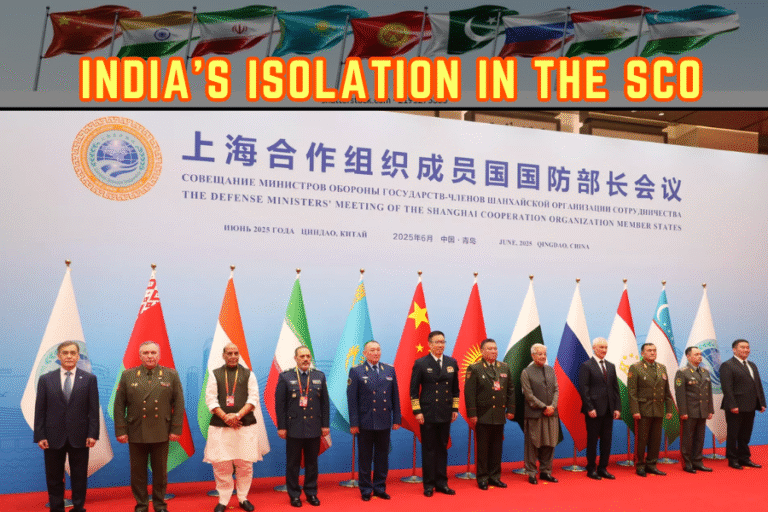
Notably, at the SCO summit in Bishkek on 31 August, Modi publicly urged Putin to end the war in Ukraine — a rare directness that signals India is repositioning Russia from strategic anchor to one option among several.
IV. China: Freeze the Frontier, Contest the Future
With China, 2026 has been a year of managed de-escalation atop unresolved rivalry. The October 2024 disengagement at Depsang and Demchok — the last friction points of the four-year Ladakh standoff — was followed by Modi–Xi meetings at Kazan and Tianjin, and by “constructive” corps-commander and diplomatic exchanges through 2026 linking border peace to normalisation of ties. But stabilisation is not rapprochement. On 13 October 2026, the two governments publicly sparred again after New Delhi named 28 geographical features in Ladakh on its official map.
India’s strategic logic is consistent: restore predictability on a 3,400-km contested frontier it cannot afford to militarise indefinitely, while building — through the Quad, Act East, supply-chain diversification and the technology partnership with Washington — every instrument of long-horizon competition. Trade with China has continued to grow through all of this, which New Delhi tolerates while quietly erecting barriers in sensitive sectors. The border is calm; the balance-of-power contest is not.
V. West Asia: The Triangle Becomes a Trilemma
The defining theatre of Indian diplomacy in 2026 has been West Asia, where the doctrine of simultaneous partnership with Israel, the Gulf monarchies and Iran collided with a widening war.
Israel. Modi’s February 2026 visit to Israel — his second as Prime Minister — elevated ties to a “Special Strategic Partnership for Peace, Innovation and Prosperity,” covering defence co-production, AI-enabled weaponry, missile programmes, cyber and space. The symbolism was unambiguous: Modi skipped Ramallah, received the Knesset’s inaugural medal, and was embraced by Netanyahu as “more than a friend, a brother” — all days before US–Israeli strikes on Iran began.
Iran. The counterweight relationship has visibly atrophied. The US sanctions waiver for Chabahar port lapsed on 26 April 2026, and India froze its annual ~$10 million allocation for the port in its 2026 budget — a quiet retreat from the flagship connectivity project meant to bypass Pakistan into Afghanistan and Central Asia. Tehran, for its part, has moved to allocate land at Chabahar to Taliban-run Afghanistan, underscoring how quickly India’s caution cedes space to others.
The GCC. Here, interest outruns ideology. India–GCC trade reached $178.66 billion in 2025–26, the bloc supplies roughly a third of India’s crude and most of its LNG, hosts eight to nine million Indian workers whose remittances exceed $45 billion annually, and — after a twenty-year stall — formally launched FTA negotiations in February 2026, leveraging the UAE and Oman CEPAs as templates.
The Gulf is simultaneously India’s economic lifeline and its newest exposure: the October 2026 strikes on Riyadh’s airport killed an Indian national and forced Indian airlines to suspend Saudi flights, while Saudi Arabia’s defence pact with Pakistan and the Saudi–Türkiye–Pakistan “Mecca” alignment complicate India’s erstwhile assumption of unchallenged Gulf warmth.
New Delhi’s answer is resilience, not retrenchment: redundant routes (Fujairah bypassing Hormuz, Chabahar, INSTC), deeper bilateral anchoring with each Gulf state rather than any single security architecture, and preservation of IMEC’s vision for the day the region’s wars end.
VI. The Counterpoint: A Pakistani Strategic Reading
Any honest assessment of India’s foreign policy must admit the view from Islamabad, which reads the same architecture not as benign multi-alignment but as encirclement by design.
From the Pakistani strategic community’s vantage, the 2026 record confirms a coherent — if undeclared — adversarial design. The Chabahar project and IMEC are not connectivity initiatives but deliberate instruments to bypass and economically strangle Pakistan, carving alternative corridors that marginalise Gwadar and the China–Pakistan Economic Corridor. The deepening India–Israel defence axis, Indo-American strategic convergence, and quadrilateral networking in the Indian Ocean are perceived as a tightening maritime noose around Pakistan’s sea lines. Indian chairmanship of BRICS and courtship of the Gulf states are read as attempts to diplomatically isolate Pakistan even within forums and regions where Islamabad once moved freely. And the May 2025 Operation Sindoor strikes, conducted with near-total diplomatic insulation — no Western capital condemned them — are cited as proof that India’s multi-alignment has bought it escalation licence against Pakistan.
Islamabad’s counter-strategy in 2026 reflects this reading: accelerated reliance on China as the principal military enabler (J-10C aircraft, JF-17 co-production, air-defence and precision-strike systems); the consolidation of Field Marshal Asim Munir’s authority, giving the military freer hand in calibrated confrontation; and the diversification of partnerships through the Saudi defence pact and alignment with Türkiye.
Pakistani strategists argue that India’s posture rests on a contradiction it cannot sustain: a power that claims strategic autonomy while functioning, in Pakistani eyes, as the Western-aligned counterweight to China in Asia — and one whose normalisation with Beijing is a tactical breather before the next crisis, whether in Ladakh or over Kashmir.
The Indian rejoinder writes itself: Pakistan’s partnerships are rented, India’s are earned; and the May 2025 restraint on both sides after November’s terror attacks showed not encirclement but deterrence working.
Yet the Pakistani critique contains one unavoidable kernel: multi-alignment is judged by its consequences, and from Rawalpindi, those consequences look like coalition-building against Pakistan under the flag of independence.
VII. Conclusion: The Price of Autonomy
India’s foreign policy in 2026 is best understood not as drift but as doctrine under load. The load is real: an 18% tariff floor in its largest export market, a Russian partnership reduced from pillar to option, an Iran corridor quietly shelved, a Gulf exposed to missile fire, and a western neighbour that reads every Indian gain as its own loss. Multi-alignment, as Chatham House observed at the year’s start, now bleeds into domestic politics and economic performance — state elections, farm lobbies agitating over the US deal, and growth data still absorbing the tariff shock.
And yet the alternative — a formal alliance, a chosen bloc, a binary capitulation of the kind Washington demanded — remains absent from India’s conduct. The country absorbed a 50% tariff for months rather than surrender its energy sovereignty, and then compromised on its own terms rather than America’s. That sequence — defiance, endurance, negotiated adjustment — is likely to be studied by other middle powers for years.
The strategic wager of 2026 is that in a fragmenting world, the most valuable asset a great power-in-waiting can hold is not an ally but optionality: the ability to buy Russian oil until it cannot, to host Putin and court Washington in the same month, to stand with Israel in Jerusalem and with the Gulf in Riyadh, and to keep every door open even as each door extracts its toll. India is paying that toll, visibly and expensively. Its bet is that the price of optionality, however steep, remains cheaper than the price of choice.