(By Khalid Masood)
Few nations occupy a position in the emerging international order as fascinating—or as increasingly uncomfortable—as India. On any given week, New Delhi might be deepening intelligence-sharing agreements with Washington, purchasing discounted crude oil from Moscow, exchanging diplomatic pleasantries with Beijing at a BRICS summit, and conducting joint naval exercises with Japan and Australia in the Indian Ocean. It is a diplomatic choreography of extraordinary complexity, and it raises a question that has become one of the most consequential in contemporary geopolitics: Is India practising a form of sophisticated strategic autonomy, or is it walking unknowingly into a strategic trap?
The answer, as with most things involving the world’s most populous democracy, is neither simple nor entirely flattering. But it is worth examining in full, because India’s choices over the coming decade will do more to shape the architecture of the twenty-first-century international order than the decisions of almost any other nation.
The Architecture of Contradiction
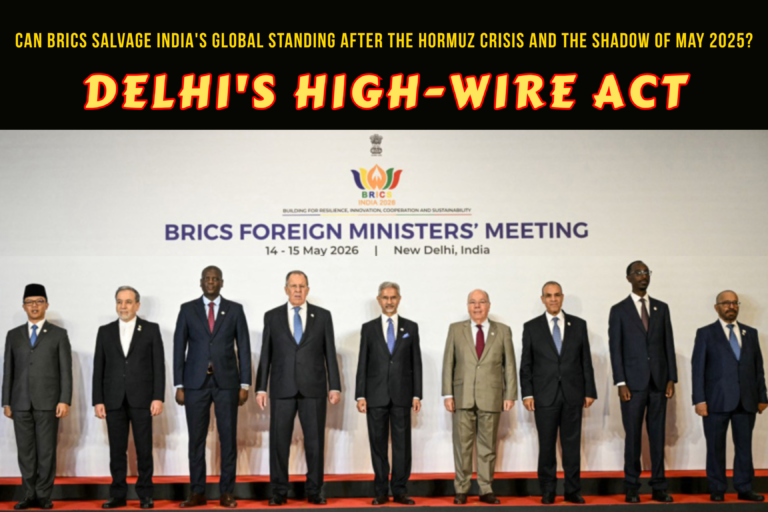
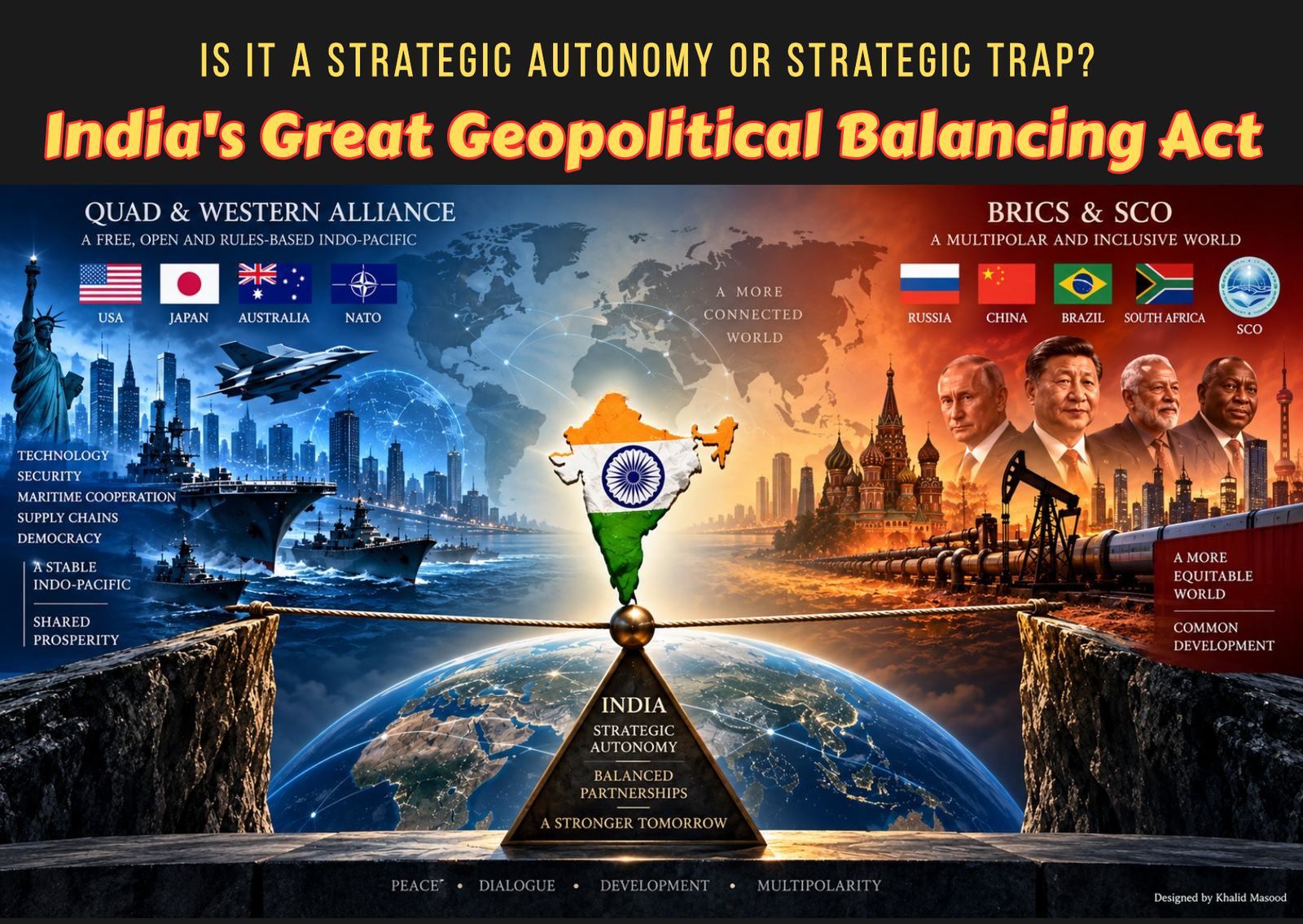
To understand India’s position, one must first appreciate the sheer scope of its simultaneous engagements. India sits inside the Quadrilateral Security Dialogue—the QUAD—alongside the United States, Japan, and Australia, a grouping widely regarded as a central pillar of the Indo-Pacific strategy designed to preserve a favourable balance of power against China’s expanding influence. At the same time, India remains deeply embedded in BRICS and the Shanghai Cooperation Organisation, institutions in which China and Russia are not merely participants but dominant architects.
The contradiction sharpens when one moves from institutional memberships to actual policy. New Delhi is strengthening defence, intelligence, maritime, and technological cooperation with Washington at an unprecedented pace, while maintaining a substantial military and energy relationship with Moscow that dates back decades. It regards China as its principal long-term strategic competitor—the only country with which it shares an active, contested land border and which simultaneously challenges its influence across South Asia and the Indian Ocean—yet it sits alongside Beijing in multiple multilateral forums and continues to import vast quantities of Chinese manufactured goods and intermediate components. It actively courts Western investment and technology while championing a more multipolar international order that, by definition, challenges the institutional dominance of the very Western powers whose capital and expertise it seeks.
This is not the behaviour of a confused state. Nor is it, despite what critics in various capitals occasionally suggest, simple hypocrisy. What India is pursuing is something more ambitious and more precarious: a policy of multi-alignment, in which it cooperates with competing powers across multiple domains without becoming permanently subordinate to any of them. The logic is sound. India’s strategic requirements are too diverse to be satisfied by any single partnership. The United States offers advanced technology, intelligence capabilities, and an indispensable counterweight to Chinese power in the Indo-Pacific. Russia provides defence equipment, energy, and a historical relationship that carries genuine strategic value. China, for all the rivalry, remains an unavoidable economic and geographical reality. BRICS offers a platform for shaping the emerging Global South. The SCO provides access to the Eurasian continental environment, including Central Asia. No single relationship covers all of these needs, and so India refuses to choose. Its operating principle can be distilled to a single sentence: cooperate with everyone, align permanently with no one, and preserve maximum freedom of action.
That is the essence of strategic autonomy. The problem is that strategic autonomy becomes progressively harder to sustain when the international system itself grows less tolerant of ambiguity.
The Logic of the QUAD
India’s participation in the QUAD is driven, above all, by the rise of China. The 2020 military crisis in Ladakh, in which Indian and Chinese troops clashed along the disputed Himalayan frontier in the most serious confrontation between the two nuclear-armed neighbours in decades, demonstrated that the border dispute remains capable of producing genuine military escalation. But India’s concerns extend well beyond the land border. China’s growing naval presence in the Indian Ocean, its expanding network of infrastructure partnerships across South Asia, its deep strategic relationship with Pakistan, and its increasing economic leverage over the region all affect India’s security calculations in profound ways.
India therefore needs external partnerships, and the United States can offer capabilities that Russia, for all its historical importance, increasingly cannot provide at the same scale: advanced surveillance and satellite systems, maritime domain awareness, aerospace technology, high-end defence platforms, and access to the sophisticated technological ecosystems that will define military and economic competitiveness in the decades ahead. Japan and Australia add complementary economic, technological, and maritime dimensions. The QUAD gives India something extremely valuable—strategic leverage against China without requiring a formal military alliance. This distinction matters enormously to New Delhi. India does not view the QUAD as an “Asian NATO,” and it has no desire to see the grouping transform into a rigid anti-China military bloc. The flexibility of the arrangement is precisely what makes it attractive. But that same flexibility creates a latent contradiction: the closer India moves toward the QUAD, the more Beijing will suspect that India’s vaunted strategic autonomy is gradually hardening into disguised alignment with Washington.
The Indispensability of BRICS, the SCO, and Russia
The other side of India’s strategic equation is equally rational, even if it frustrates Western policymakers. BRICS provides India with a platform for influencing the emerging Global South and advocating reforms in global governance institutions that New Delhi has long considered unrepresentative. The SCO offers access to the Eurasian strategic environment, connecting India to Central Asia, Russia, China, and other important regional actors through a forum that would otherwise be dominated entirely by Beijing and Moscow.
Russia, meanwhile, remains particularly important. India’s military relationship with Moscow was built over decades of Cold War-era cooperation, and Russian-origin equipment still constitutes a substantial component of India’s armed forces. Cooperation extends into energy, nuclear power, space, and other strategic sectors. Abandoning Moscow simply because Washington disapproves of Russian policy would dramatically reduce India’s strategic autonomy—and India has no intention of allowing American foreign policy preferences to dictate its relationship with a partner that has, from New Delhi’s perspective, been broadly reliable over half a century.
The energy dimension makes this calculus especially clear. India has purchased large quantities of Russian oil since the invasion of Ukraine because it is economically rational to obtain energy at competitive prices for a developing economy of 1.4 billion people. From India’s perspective, this is straightforward national interest. From Washington’s perspective, it complicates the Western effort to economically isolate Russia. The resulting tension exposes the inherent limits of the US-India relationship: India wants American technology and strategic cooperation, but it does not want American foreign policy to determine India’s relationship with Russia. This is not indecision. It is transactional diplomacy pursued with considerable discipline.
Beijing’s Proposition: The Asian Century
Into this already complex landscape, China has advanced a proposition that deserves careful scrutiny. According to Chinese leaders, including President Xi Jinping, India and China should adopt a longer-term strategic perspective, avoid allowing their border disputes to define the entirety of the bilateral relationship, and work together toward what Beijing describes as an Asian Century—a future in which the two most populous nations on earth support their respective development while contributing jointly to the empowerment of the Global South and the construction of a multipolar, Asia-centred international order.
This represents a fundamentally different geopolitical proposition from anything the QUAD offers. The American strategic proposition is, in essence, that India should help maintain a favourable balance of power in the Indo-Pacific so that China cannot dominate Asia. The Chinese proposition is nearly the reverse: India and China should manage their differences, deepen economic cooperation, and collaborate in shaping a post-Western international order. The argument has an obvious economic foundation. China is the world’s manufacturing powerhouse and occupies a central position in global supply chains. India aspires to become a major manufacturing centre in its own right, and Chinese investment, components, machinery, and supply-chain integration could potentially accelerate that transformation. Normalisation could increase trade, investment, and people-to-people contacts in ways that benefit both economies.
From Beijing’s perspective, this is a win-win proposition. But India has legitimate reasons for caution. Economic interdependence with China can create opportunities, but it can also create strategic vulnerabilities—particularly when the economic partner is simultaneously a territorial rival and military competitor. That combination makes the relationship extraordinarily difficult to manage, and Indian policymakers are acutely aware that excessive dependence on Chinese supply chains could leave the country vulnerable to economic coercion during a future military or diplomatic crisis.
The concept of an Asian Century itself warrants sceptical examination. If the global distribution of economic power continues shifting toward Asia, India has every reason to want to participate in shaping that transformation. But there is a critical distinction between an Asian Century dominated by China and one in which India and China emerge as co-equal centres of power. India is unlikely to accept the former. China may advocate a multipolar world, but New Delhi naturally poses a follow-up question: should Asia itself also be multipolar? India does not want American dominance of Asia, but neither does it want Chinese dominance. Its preferred outcome is considerably more complicated—a multipolar world, a multipolar Asia, and a sufficiently powerful India capable of operating independently within both. This explains why India simultaneously participates in the QUAD and BRICS: the former helps prevent Chinese strategic predominance, while the latter helps prevent Western institutional predominance. India wants both outcomes, and it sees no inherent contradiction in pursuing them simultaneously.
The Border, Pakistan, and the Chicken-and-Egg Problem
The Chinese proposition also raises difficult diplomatic questions about sequencing. India insists on peace and tranquillity along the Line of Actual Control before broader relations can return to normal. China’s position, by contrast, is that normalisation itself could help create the environment necessary for managing the border dispute. This creates a classic diplomatic impasse: must the border be substantially resolved before normalisation, or can normalisation help make a border settlement possible? India’s security establishment has obvious reasons for caution. An economic relationship cannot compensate for unresolved territorial claims and the persistent threat of military confrontation. From a military commander’s perspective, a partial settlement of one section of the frontier does not necessarily eliminate uncertainty elsewhere. For Beijing, however, India’s insistence on resolving security questions before normalising relations may look like an attempt to keep China permanently under strategic pressure. Neither side wants to make the first major concession, and this remains one of the fundamental obstacles to genuine reconciliation.
The Asian Century argument also leads to an uncomfortable question about Pakistan. If India and China are expected to normalise relations as part of a broader Asian framework, then India’s relationship with Pakistan inevitably becomes relevant, because Pakistan is both India’s neighbour and a significant member of the Global South. This is politically fraught for New Delhi, whose security establishment links Pakistan policy inextricably to terrorism, Kashmir, and national security. Yet there is a broader geopolitical reality that neither country can permanently escape: South Asia’s economic potential is severely constrained by its political fragmentation. India cannot fully exploit its geographical position between the Middle East, Central Asia, and East Asia while maintaining permanently hostile relations with its immediate western neighbour. An Asian Century based on connectivity and economic integration would be considerably more difficult to realise if South Asia remained one of the world’s least integrated major regions.
The Trust Deficit and the Price of Autonomy
Against this background, it is worth asking whether Narendra Modi’s government is genuinely undecided or simply pursuing a calculated strategy. The evidence points strongly toward the latter. India’s strategic requirements almost compel multi-alignment. No single relationship satisfies all of them, and so India does not choose—it manages. The risk, however, is that management becomes increasingly difficult as the major powers demand greater loyalty. The strategy works beautifully when India can tell each partner that it cooperates on some issues while disagreeing on others. It becomes much harder when Washington demands clarity on Russia, or Beijing asks India to choose between the QUAD and BRICS, or a military confrontation makes neutrality practically impossible.
This points to the most significant weakness in India’s approach: the growing trust deficit. India may eventually become useful to everybody without becoming fully trusted by anybody. Washington may wonder whether India will stand firm when a decisive confrontation with China arrives. Moscow may question whether India will remain a reliable strategic partner if Washington offers better technology and investment. Beijing may doubt whether India can genuinely cooperate with China while deepening its security relationship with America. India’s answer—that it will decide according to its national interest—is perfectly legitimate, but strategic autonomy carries a price. The more independent India becomes, the less predictable it becomes as a partner, and the greater the temptation for other powers to hedge against it. The central paradox of Indian diplomacy is that India wants everyone to need India without India needing anyone. That is an attractive ambition, but achieving it requires enormous economic, technological, and military power that India does not yet possess.
It would also be naïve to interpret China’s Asian Century message as purely altruistic. A normalised India-China relationship would reduce the pressure created by the QUAD, weaken India’s incentive to deepen security cooperation with Washington, and potentially create Chinese influence over Indian supply chains. Beijing’s message should therefore be understood simultaneously as a genuine proposal for economic cooperation and a strategic attempt to reshape India’s geopolitical calculations. The two are not mutually exclusive. China can sincerely want Asian economic development while also wanting that development to occur within an international order more favourable to Chinese interests. India needs to listen to Beijing without becoming strategically dependent upon it—which is, of course, precisely the same principle it applies to Washington and Moscow.
Three Likely Futures
The trajectory of India’s balancing act will likely resolve into one of three broad scenarios. In the most optimistic, India becomes the ultimate swing power—maintaining strong relations with Washington, Moscow, and Beijing while expanding its influence across the Global South, obtaining Western technology without becoming an American proxy, retaining Russian defence and energy relationships without becoming dependent on Moscow, competing with China without entering an irreversible Cold War, and using BRICS and the SCO to expand its influence without allowing either organisation to become an anti-Western bloc. In this scenario, every major power needs New Delhi, giving India extraordinary bargaining power and vindicating its strategy of multi-alignment as one of the great diplomatic achievements of the century.
The pessimistic scenario is considerably more dangerous. A major India-China military confrontation could force India into much deeper dependence on Washington, as American intelligence, satellite support, military technology, and diplomatic backing become suddenly indispensable. Alternatively, severe Western pressure over India’s Russia policy could push New Delhi toward alternative financial and economic systems associated with BRICS. In either case, India would not necessarily choose its side voluntarily—the crisis would choose for it. This is the fundamental weakness of strategic ambiguity: it works extremely well in peacetime and becomes far harder to sustain during war.
A third possibility is strategic stagnation, in which India never fully commits to any bloc but also never becomes powerful enough to make its ambiguity decisive. It remains dependent on Western technology, Russian military systems, and Chinese supply chains, active in both BRICS and the QUAD, but never achieves sufficient indigenous economic and technological capacity to make those relationships genuinely optional. This would produce a form of constrained strategic autonomy—many partnerships but insufficient power to operate independently of them—which could permanently limit India’s transformation into a true great power.
The Race Against Time
This brings the analysis to its central conclusion. India’s real choice is not between Washington and Beijing. It is between dependence and capability. If India becomes economically, militarily, and technologically powerful enough, it can maintain relationships with both. If it remains dependent on foreign technology, foreign weapons, foreign energy, and foreign supply chains, its diplomatic freedom will inevitably shrink. This is why India’s domestic transformation matters more than its participation in any particular summit or grouping. QUAD membership cannot make India a great power. BRICS membership cannot make India a great power. Neither can strategic rhetoric, however eloquent. Only national power—technological self-reliance, advanced domestic defence production, strong semiconductor and artificial intelligence capabilities, diversified energy supplies, resilient supply chains, a powerful navy, and sustained economic growth—can make strategic autonomy something more than diplomatic manoeuvring.
India therefore faces a race against time. It must become powerful enough before the international system becomes rigid enough to force a choice. India’s current policy is neither simple hypocrisy nor unquestionable diplomatic genius. It is a high-stakes geopolitical gamble. If India becomes sufficiently wealthy, technologically advanced, and militarily powerful, today’s balancing act could eventually be remembered as a masterstroke. If it fails to acquire that power, the same policy could become a strategic trap—leaving India simultaneously dependent on Western technology, Russian defence systems, Chinese supply chains, and a fragmented Global South, with none of them fully reliable and all of them capable of exerting pressure.
The ultimate paradox is profound: India is avoiding choosing a side because it wants to become a great power, but to remain permanently uncommitted, it must first become powerful enough that no side can afford to force the choice. That is the real gamble behind India’s foreign policy. And the coming decade will reveal whether New Delhi has mastered the art of strategic autonomy—or merely postponed the moment when strategic reality forces it to choose.