(By Khalid Masood)
Today, on the 8th of September, the nation of Pakistan stands united to celebrate Pakistan Navy Day. This day is not merely a mark on the calendar; it is a profound tribute to the valor, tactical brilliance, and unyielding spirit of the Pakistan Navy (PN). It commemorates the night in 1965 when the sons of the soil sailed into the darkness, shattered the complacency of a formidable adversary, and etched their names in gold across the annals of global military history.
The Illusion of Safety and the Masterstroke
The 1965 Indo-Pak war was raging with full intensity. While the army and air forces were locked in fierce combat on the borders and in the skies, the Indian Navy considered itself perfectly safe, tucked behind its fortified coastlines. The enemy operated under the arrogant assumption that Pakistan’s military reach was strictly confined to land. They believed their shores were untouchable.
They were about to learn a harsh lesson.
Strategic Objectives of Operation Dwarka
The Pakistan Navy, led by visionaries who refused to accept a defensive posture, devised an audacious plan to take the war directly to the enemy’s doorstep. The target was Dwarka, a coastal city in Gujarat, India. While known to the world as a historical and religious site, Dwarka housed a crucial Indian Navy radar station. This radar was the “eyes” of the Indian Air Force, providing vital navigation and direction to bomber aircraft taking off from Jamnagar to strike Karachi and Pakistan’s southern territories.
The objectives of the Pakistan Navy were crystal clear and strategically devastating:
- Obliterate the Dwarka radar station, effectively blinding the enemy’s aerial navigation.
- Force the Indian Navy out of their safe harbors and into the open waters of the Arabian Sea, where Pakistan’s lone, state-of-the-art submarine, PNS Ghazi, was waiting to hunt them.
- Shatter the enemy’s morale and establish absolute psychological dominance over the seas.
Naval Strength Comparison: Pakistan vs India (1965)
| Category | Pakistan Navy | Indian Navy |
|---|---|---|
| Aircraft Carriers | 0 | 1 (INS Vikrant) |
| Cruisers | 0 | 1 (INS Mysore) |
| Destroyers | 4 | 8 |
| Frigates/Sloops | 3 | 6 |
| Submarines | 1 (PNS Ghazi) | 0 |
| Minesweepers | 3 | 6 |
| Total Surface Combatants | 7 | 15+ |
| Naval Aircraft | Limited | 20+ |
| Coastal Defence | Minimal | Established |
| Radar Stations | Limited | Multiple (including Dwarka) |
Key Note: Despite being significantly outnumbered and outgunned, the Pakistan Navy’s superior training, tactical planning, and audacious spirit led to one of the most successful naval operations in modern warfare history.
The Silent Voyage of the Ghost Fleet
To turn this bold vision into reality, on the evening of September 7, 1965, a formidable task force of seven warships slipped out of Karachi harbor into the pitch-black night. The fleet was a pride of the nation:
The Task Force
- PNS Babur (Flagship)
- PNS Badr
- PNS Khyber
- PNS Jahangir
- PNS Alamgir
- PNS Shah Jahan
- PNS Tippu Sultan
The Stealth Approach
Under the stellar command of Commodore S.M. Anwar, the fleet operated under strict radio silence. No lights, no communication, just the silent cutting of the waves. Navigating by the stars and sheer seamanship, these seven warships crept through the dark waters, reaching a striking distance of just 6 miles from the Dwarka coast by 11:30 PM.
Fifteen Minutes of Fire and Brimstone
At 11:50 PM, a heavy, suspenseful silence hung over the Arabian Sea. Suddenly, the silence was broken by the sharp commands echoing from the flagship.
The Devastating Barrage
At exactly 11:55 PM, the order was given: “Fire!”
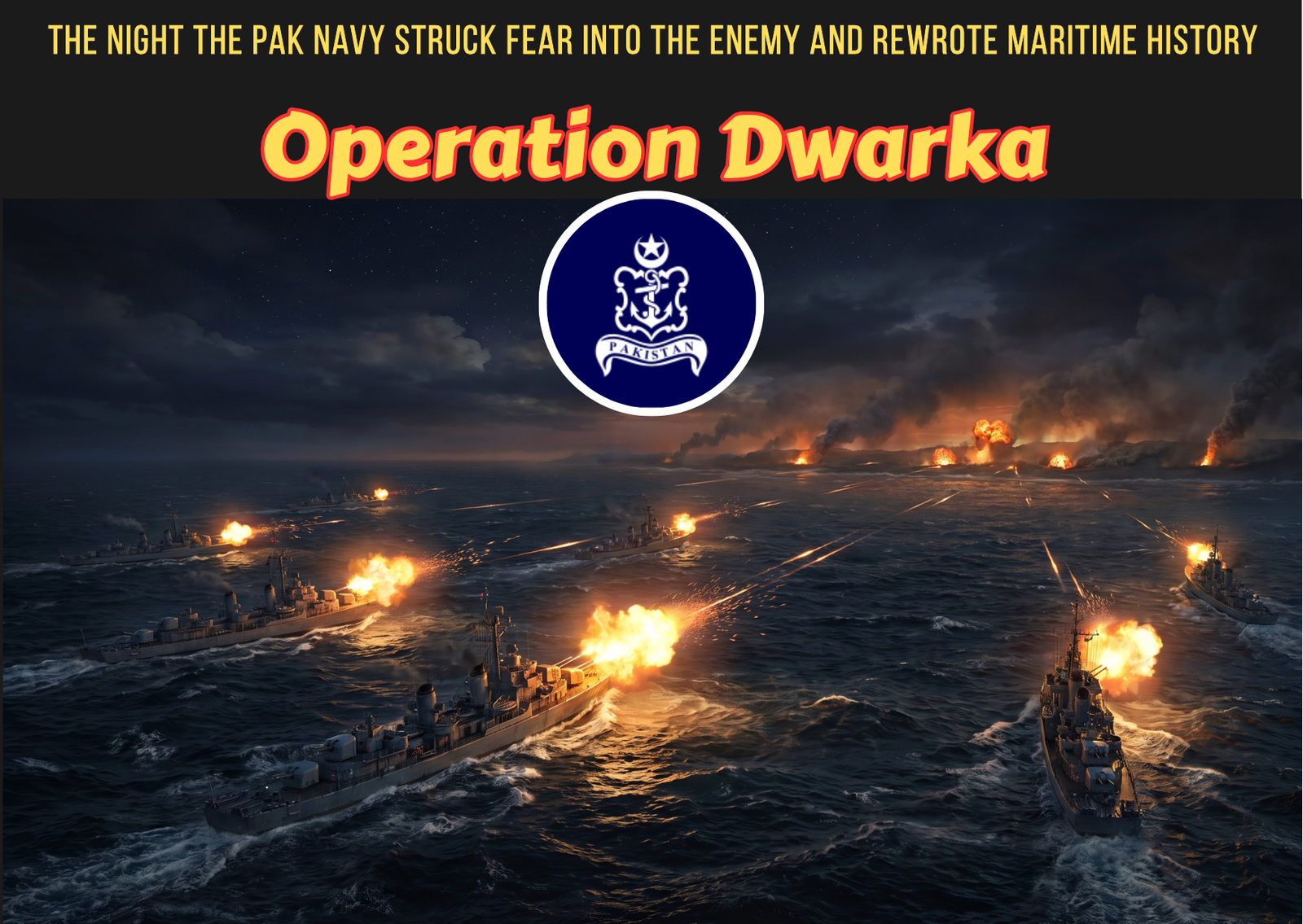
What followed was a terrifying storm of artillery. For the next fifteen minutes, the Dwarka coastline was engulfed in fire and smoke. The naval guns of all seven Pakistani warships roared in unison. Each ship unleashed over 50 to 50 rounds of heavy artillery. In a span of 50 to 60 minutes, more than 300 heavy shells rained down on the Indian radar station, railway lines, and coastal defence installations.
The impact was instantaneous and catastrophic:
- The mighty Dwarka radar station was reduced to rubble
- The “eyes” of the Indian Air Force were gouged out, completely neutralizing their ability to guide bombers toward Karachi
- From miles away, the towering flames of the burning coastal facilities illuminated the night sky, reflecting off the dark waters of the sea
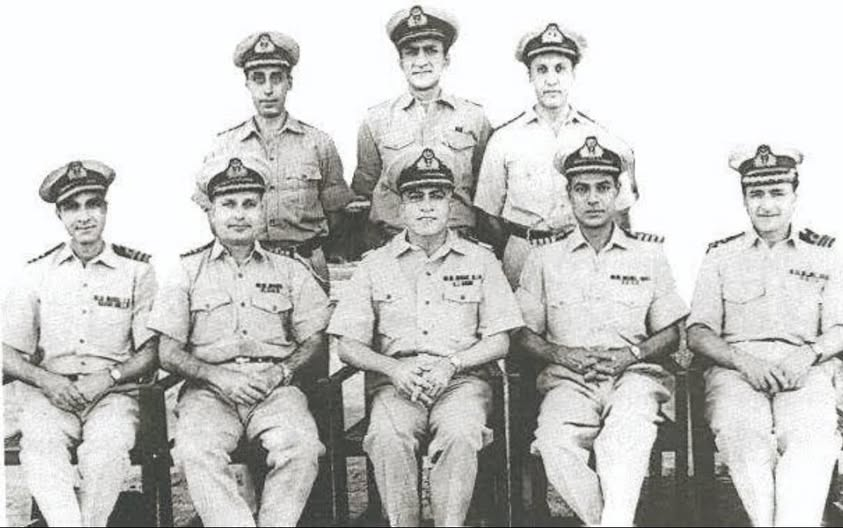
Sitting Cdr A Aslam, Capt M A K Lodhi, Commodore S M Anwar, Capt A Hanif, Cdr | H Malik
A Flawless Retreat
At 12:10 AM, the message flashed through the fleet: “Mission Accomplished.”
Just as swiftly and silently as they had arrived, the Pakistani fleet turned and vanished into the darkness. The Indian Navy and coastal defences were caught completely off guard. By the time the enemy could comprehend what was happening and organize a counter-response, the Pakistan Navy ships were already miles away, safely navigating back to their waters.
The most astonishing fact of this blood-curdling, high-risk mission? Not a single Pakistani ship was scratched, and not a single sailor was injured. It was a flawless execution of naval warfare.
The Legacy of Operation Dwarka
Operation Dwarka was far more than a tactical bombardment; it was a strategic masterpiece that yielded monumental results:
Psychological Victory
The sheer audacity of the strike crushed the pride of the Indian Navy. Terrified and humiliated, they remained confined to their ports for the rest of the war, effectively ceding control of the Arabian Sea to Pakistan.
Air Defence Shield
With the Dwarka radar destroyed, the intensity and accuracy of Indian Air Force attacks on Karachi and surrounding vital installations dropped significantly, saving countless lives and infrastructure.
A Global Marvel
As Pakistan’s first major, full-scale naval offensive since independence, it left global military historians and strategists in sheer awe of the Pakistan Navy’s capabilities.
A Golden Saga of the Sea
Today, as we observe Pakistan Navy Day, we do not just remember a military operation; we honor the lion-hearted officers and sailors who dared to challenge the odds. Operation Dwarka stands as a golden saga of courage, unparalleled skill, and absolute devotion to the defence of the motherland.
It is a timeless reminder that the Pakistan Navy does not merely patrol the waters; it commands them. The waves of the Arabian Sea still whisper the tale of that historic night, and the spirit of Commodore S.M. Anwar and his valiant crew continues to inspire every sailor who steps aboard a PN ship today.
Happy Pakistan Navy Day to the guardians of our maritime frontiers. Your courage remains the shield of our nation, and your legacy, the pride of our history!