Youm-e-Istehsal-e-Kashmir | 5 August 2026
(By Khalid Masood)
I. The Night the Lights Went Out
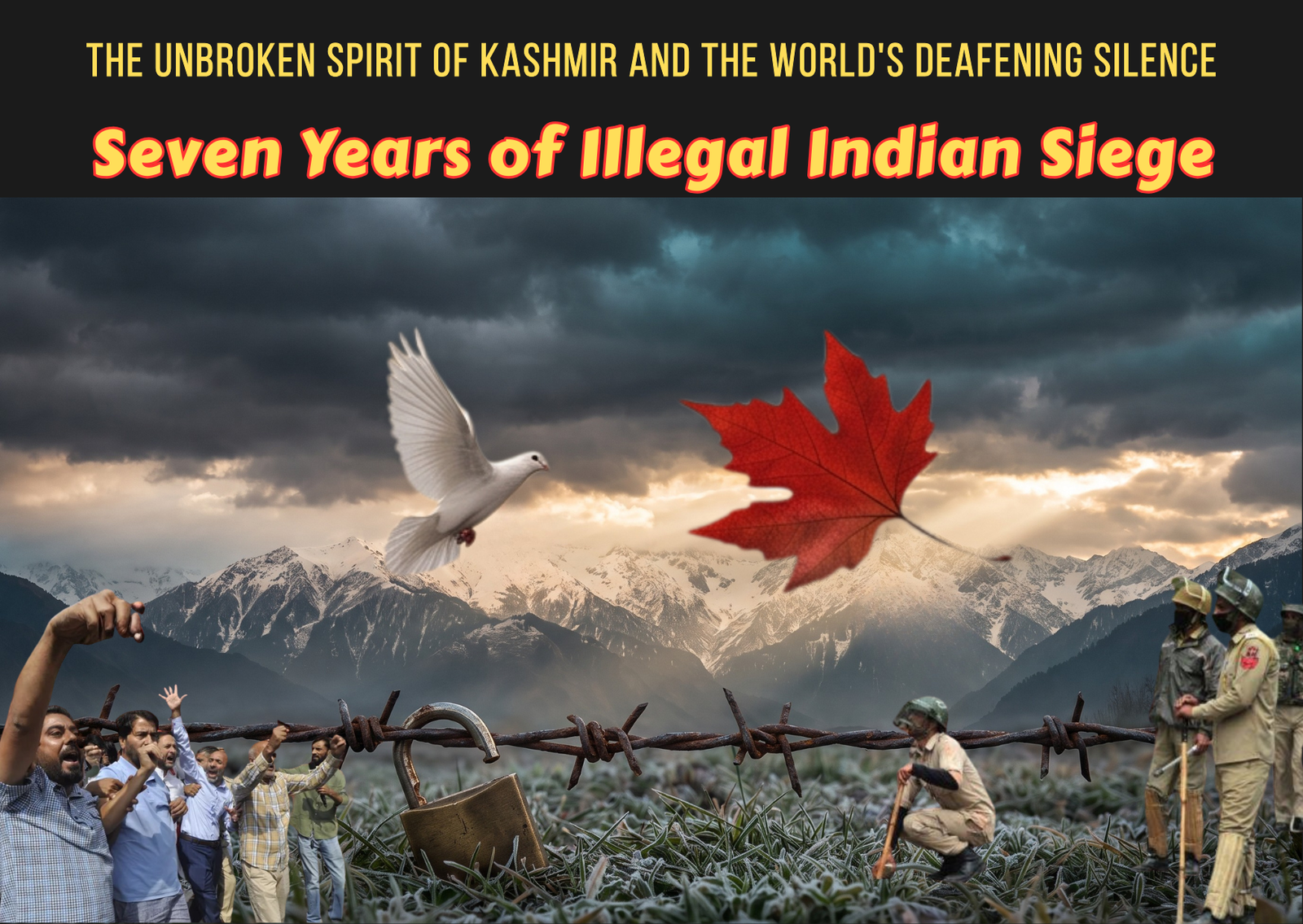
On the evening of 4 August 2019, Srinagar fell silent. Not the gentle silence of a winter snowfall, but the suffocating, terrifying silence of a prison. Within hours, telephone lines were severed. The internet was switched off. Television screens went dark. Over nine hundred thousand boots, already marching through the valley’s narrow lanes, tightened their grip. Elected leaders were dragged from their homes in the dead of night. Barbed wire was unspooled across boulevards. And by the time the sun rose on 5 August, the world’s most militarised zone had been transformed into something far darker — an open-air prison holding twenty-three million souls hostage to the ambitions of a Hindu-nationalist regime in New Delhi.
That was the day India did not merely amend its constitution. It buried it. Alongside it, it buried the United Nations Charter, the Geneva Conventions, the promises made to a dying nation in 1947, and the very concept of democracy it so loudly preaches to the world.
Seven years have passed. The barbed wire remains. The silence has not broken. And the world — that great, self-appointed guardian of human rights — has watched, nodded, and looked away.
Today, Pakistan and the people of Kashmir observe Youm-e-Istehsal-e-Kashmir — the Day of Exploitation — and reaffirm their resolve under the banner of Youm-e-Istehkam-e-Kashmir. Not to mourn. Not to beg. But to remind a conscienceless world that Kashmir is not a territory to be swallowed. It is a people with a promise. And promises, unlike constitutions written in the ink of occupiers, do not expire.
II. The Unfinished Business of 1947
To understand the crime of August 2019, one must return to the crime of 1947 — the year the British left the subcontinent and left behind a wound that has never been allowed to heal.
When the subcontinent was partitioned, the princely state of Jammu and Kashmir, with its Muslim-majority population, was promised the right to determine its own future. The ruler’s controversial accession to India was accepted by New Delhi only on the explicit condition that the will of the Kashmiri people would be ascertained through a free and impartial plebiscite. India’s own first Prime Minister, Jawaharlal Nehru, stood before the world and pledged:
“We have declared that the fate of Kashmir is ultimately to be decided by the people. That pledge we have given, and we shall stand by it.”
That pledge was never honoured. Instead, India took the matter to the United Nations, and the UN Security Council, in a series of landmark resolutions, affirmed the Kashmiri right to self-determination.
Table 1: Key UN Security Council Resolutions on Kashmir
| Year | Resolution | Key Provision |
|---|---|---|
| 1948 | UNSC Resolution 39 | Established the United Nations Commission for India and Pakistan (UNCIP) to investigate the dispute. |
| 1948 | UNSC Resolution 47 | Called for a free and impartial plebiscite to determine the accession of Jammu and Kashmir to India or Pakistan. Demanded withdrawal of troops to create conditions for the vote. |
| 1949 | UNSC Resolution 80 | Reaffirmed the plebiscite demand and called for demilitarisation. |
| 1950 | UNSC Resolution 91 | Appointed a UN Representative to oversee the demilitarisation process. |
| 1951 | UNSC Resolution 96 | Reaffirmed that the question of accession shall be decided through a plebiscite. |
| 1957 | UNSC Resolution 122 | Declared that any action taken by the Constituent Assembly of J&K would not constitute a disposition of the State in accordance with the plebiscite principle. |
Six resolutions. Six unambiguous declarations. And seventy-eight years of Indian defiance.
As the Father of the Nation, Quaid-e-Azam Muhammad Ali Jinnah, declared:
“Kashmir is like a jugular vein of Pakistan. We cannot live if it is severed.”
That vein has been bleeding for seven decades. And on 5 August 2019, India attempted to sever it entirely.
III. The Constitutional Coup: Anatomy of a Crime
Let us call it what it was. Not an “amendment.” Not a “reorganisation.” Not the sanitised language of a government press release. It was a constitutional coup — carried out in darkness, under military occupation, against a people who had no voice, no vote, and no say in their own annihilation.
Here is what happened, step by deliberate step:
First, on the night of 4 August, over 35,000 additional troops were rushed into the valley, adding to the existing garrison of over 900,000 soldiers. Political leaders — Chief Ministers, former Chief Ministers, members of parliament, activists, even separatist voices — were arrested. Over seven thousand people were detained in the weeks that followed.
Second, a complete communications blackout was imposed. Landlines, mobile networks, the internet, television — all severed. Kashmir became the world’s largest communication blackout zone. Families could not reach their children. Hospitals could not contact doctors. Journalists could not file reports. The valley was plunged into an information dark age so that the world would not witness what was being done to it.
Third, on 5 August, the Indian Home Minister stood in Parliament and announced the abrogation of Article 370 — the constitutional provision that granted Jammu and Kashmir its special status — and Article 35-A, which protected the rights of Kashmiri permanent residents. The President of India issued a covert Presidential Order (C.O. 272), rewriting Article 367 overnight, without the consent of the J&K Constituent Assembly, which had been dissolved in 1957. In its place, the Indian government substituted the Governor — an unelected agent of New Delhi — as the “Constituent Assembly” that approved its own dissolution.
Fourth, the state was bifurcated into two Union Territories — Jammu & Kashmir and Ladakh — both governed directly by New Delhi. A state with its own legislature, its own flag, and its own identity was reduced to administrative subdivisions of the Indian central government.
The legal scholar and former UN Special Rapporteur on torture, Juan Méndez, described the move in stark terms:
“What India has done in Kashmir is not a constitutional amendment. It is an act of unilateral annexation of a disputed territory, carried out under military occupation, in violation of international law.”
And yet, the Indian Supreme Court — that institution which has so often bent its spine before the executive — upheld the abrogation in December 2023, ruling that Article 370 was not “permanent.” A court in an occupied land, validating the occupation. The irony is not lost on anyone who remembers that justice is blind only when the judge is free.
IV. The Humanitarian Catastrophe: A Ledger of Suffering
The abrogation was not an administrative act. It was the opening salvo of a sustained campaign of collective punishment against the Kashmiri people. The numbers tell a story that no amount of Indian propaganda can erase.
Table 2: Post-5 August 2019 — The Human Cost
| Category | Details |
|---|---|
| Communications Blackout | Internet shutdown lasted over 500 days — the longest in any purported democracy. Mobile networks suspended for months. |
| Mass Detentions | Over 7,000 Kashmiris detained under the Public Safety Act (PSA), including elected leaders, minors, doctors, and journalists. |
| Militarisation | Over 900,000 troops stationed in the valley. One soldier for every ten civilians. |
| Extrajudicial Killings | Hundreds of “encounter” killings reported, many in staged operations. |
| Pellet Gun Injuries | Over 1,500 civilians blinded or maimed by pellet-firing shotguns used for crowd control. |
| Press Freedom | Local newspapers shut down. Journalists arrested, beaten, and charged under anti-terror laws. Foreign correspondents denied access. |
| Property and Land | New domicile and land laws opened Kashmir to millions of non-Kashmiris, threatening demographic change. |
| Political Representation | Delimitation exercise redrew boundaries to dilute Kashmiri Muslim political power. Elections postponed repeatedly. |
The poet Faiz Ahmed Faiz, who wrote some of his most searing verses in the cause of the oppressed, could have been writing for Kashmir when he penned:
“Bol, ke lab azad hain tere — bol, zabaan ab tak teri hai. Speak, for your lips are still free. Speak, for your tongue is still your own.”
But in Kashmir, the lips are not free. The tongue is not one’s own. To speak is to be branded a terrorist. To write is to be charged under the Unlawful Activities Prevention Act (UAPA). To weep for a slain son is to be called “anti-national.”
This is not democracy. This is not governance. This is fascism wearing the mask of federalism.
V. Demographic Engineering: The Final Solution for Kashmir
If the abrogation of Article 370 was the political murder of Kashmir, the domicile and land reforms that followed are its attempted genocide — not of bodies, but of identity.
In March 2020, the Indian government issued a new domicile order, granting residency rights to over four million non-Kashmiris, including retired bureaucrats, security personnel, and their families. New land laws were enacted, allowing outsiders to purchase agricultural and residential property in the valley for the first time in seventy years. A delimitation commission was constituted, redrawing electoral boundaries in a manner that Kashmiri political parties unanimously condemned as an attempt to reduce Muslim-majority constituencies and dilute Kashmiri political voice.
The parallels are not subtle. They are deliberate.
Article 49 of the Fourth Geneva Convention states unequivocally:
“The Occupying Power shall not deport or transfer parts of its own civilian population into the territory it occupies.”
What India is doing in Kashmir is precisely this. It is importing settlers, altering the demographic fabric, and engineering a future in which the indigenous Kashmiri Muslim becomes a stranger in his own homeland. It is the same playbook used in Palestine. The same architecture of dispossession. The same silence from the international community.
The great Pakistani poet and philosopher Allama Muhammad Iqbal once wrote of the Ummah’s sacred trust:
“Khudi ko kar buland itna ke har taqder se pehle, Khuda bande se khud puchhe, bata teri raza kya hai.” (Elevate your self so high that before every decree, God Himself asks His servant: Tell me, what is your will?)
Kashmir’s will is clear. It has been clear since 1947. It was clear in the streets of 2016. It was clear in the silence of 2019. And it remains clear today, seven years into the siege. Kashmir does not want Indian citizenship. Kashmir wants Kashmiri freedom.
VI. Pakistan’s Stance: A Jugular Vein That Will Not Be Severed
Let no one mistake Pakistan’s position on Kashmir for mere political convenience. This is not a diplomatic lever. This is not a bargaining chip. This is a matter of national identity, historical justice, and moral conviction.
From the very inception of the Pakistani state, Kashmir has been woven into the fabric of its existence. Quaid-e-Azam called it the jugular vein. Every government, every parliament, every military and civilian leadership has echoed that truth. Pakistan has raised the Kashmir issue at the United Nations General Assembly year after year, at the Organisation of Islamic Cooperation, at the Human Rights Council, and in every bilateral and multilateral forum available.
After 5 August 2019, Pakistan did not merely issue statements. It downgraded diplomatic relations with India. It suspended bilateral trade. It expelled the Indian High Commissioner. It refused to recognise the constitutional changes imposed on Kashmir. It declared 5 August as Youm-e-Istehsal and 5 February as Youm-e-Yakjehti-e-Kashmir — twin pillars of national solidarity.
In the words of Pakistan’s national poet, Allama Iqbal:
“Nahin tera nasheman Qasr-e-Sultani ke gunbad par, Tu Shaheen hai, parwaz hai kaam tera, tera dosra aashiana nahin.” (Your nest is not upon the dome of a royal palace. You are an eagle; flight is your vocation. You have other skies to conquer.)
Pakistan’s message to India is clear: You may change your constitution, redraw your maps, and rename our valleys. But you will not change the truth. Kashmir is not yours. It never was. And it never will be, until its people freely choose their destiny.
VII. The World’s Deafening Silence
And what of the world? What of the United Nations, that grand edifice of post-war promises? What of the self-proclaimed champions of human rights in Washington, London, Paris, and Brussels?
They watched. They issued “statements of concern.” They urged “restraint.” They called for “dialogue.” And then they returned to signing arms deals with New Delhi, to courting Indian markets, to balancing their strategic equations against China.
The United Nations High Commissioner for Human Rights published reports in 2018 and 2019 documenting grave human rights violations in Kashmir. The reports were noted. They were discussed. And they were shelved.
Nelson Mandela once said:
“We know too well that our freedom is incomplete without the freedom of the Palestinians.”
One must now add: and without the freedom of the Kashmiris. For what is the United Nations if it cannot enforce its own resolutions? What is international law if it applies to the weak but bends before the strong? What is democracy if twenty-three million people can be stripped of their rights without a single vote, without a single voice, without a single act of accountability?
The silence is not neutrality. The silence is complicity.
VIII. The Unbroken Spirit: Kashmir Lives
Yet, for all the steel and concrete, for all the detentions and the blackouts, for all the demographic engineering and the constitutional vandalism, India has failed in the one thing that mattered most. It has failed to break the spirit of the Kashmiri people.
Walk through the lanes of old Srinagar. Sit with the mothers who have waited twenty years for sons who disappeared into army custody. Listen to the poets who write in whispers. Watch the children who draw pictures of barbed wire and call it “home.” They do not surrender. They do not forget. They do not forgive.
The revolutionary poet Habib Jalib wrote:
“Aise daur mein, aise jhooth ke zamane mein, Sach kahan jurm hai, sach bolna gunah hai.” (In such times, in such an age of lies, to speak the truth is a crime, to tell the truth is a sin.)
But Kashmir speaks. Kashmir tells. Kashmir endures. And Kashmir waits — not in despair, but in defiance — for the dawn that must come.
IX. The Road Ahead: A Demand for Justice
On this seventh anniversary of Youm-e-Istehsal-e-Kashmir, Pakistan and the people of Kashmir do not merely remember. They demand.
We demand that the United Nations Security Council enforce its own resolutions and implement the plebiscite promised to the people of Jammu and Kashmir.
We demand that the international community end its shameful silence and hold India accountable for its illegal occupation, its human rights abuses, and its demographic engineering in violation of the Fourth Geneva Convention.
We demand that the pre-5 August 2019 status of Jammu and Kashmir be restored, all illegal detentions be ended, the communications blockade be permanently lifted, and the people of Kashmir be allowed to exercise their inalienable right to self-determination.
We demand that the world stop treating Kashmir as India’s “internal matter.” It is not. It has never been. It is an international dispute, recognised by the United Nations, acknowledged by history, and etched in the blood of a hundred thousand martyrs.
And to the people of Kashmir, Pakistan says today, as it has said every day since 1947:
We are with you. Not for a season. Not for a headline. Not until it becomes inconvenient. We are with you until the last chain is broken, the last boot is lifted, and the last flag of freedom rises over the mountains of Srinagar.
X. Conclusion: The Promise That Will Not Die
Seven years ago, on a dark August night, India believed it had solved the Kashmir problem. It believed that by tearing up a constitution, silencing a valley, and flooding it with soldiers, it could erase a nation. It believed the world would look away. And for a time, the world did.
But Kashmir is not a problem to be solved. It is not a file to be closed. It is not a line in a constitution that can be deleted by a minister’s signature. Kashmir is a promise — made in 1947, written in the resolutions of the United Nations, sealed in the blood of its martyrs, and carried in the hearts of twenty-three million people who refuse to be erased.
India can abrogate articles. It cannot abrogate history. It can redraw maps. It cannot redraw the will of a people. It can silence the media. It cannot silence the truth. It can occupy the land. It cannot occupy the soul.
The poet Faiz Ahmed Faiz wrote, in words that belong to every Kashmiri who has ever looked up at the sky through a cage of barbed wire and dared to dream:
“Dekh to, aasmaan ki khudaai mein koi kami to nahin. Aur bhi dukh hain zamane mein mohabbat ke siwa, Rahatein bhi hain usi ke liye.” (Look — there is no flaw in the architecture of the heavens. There are sorrows in this world beyond the sorrow of love. And there are comforts, too, made for those who endure.)
Kashmir endures. Pakistan stands with it. And the promise — that ancient, sacred, unbreakable promise of freedom — will not die.
Youm-e-Istehsal-e-Kashmir: We remember. We resist. We shall overcome.
Kashmir Banega Azad.