(By Khalid Masood)
Introduction
“Pakistan will cut off those hands that seek to claim Islamabad’s water share.”
This stark warning, delivered by Climate Change Minister Dr. Musadik Malik on June 30, 2026, marked a dramatic escalation in the simmering dispute between India and Pakistan over the Indus Waters Treaty (IWT). Speaking at Pakistan’s first-ever international seminar dedicated to the treaty in Islamabad, Malik accused Indian leadership of attempting to control Pakistan’s water supply, stating, “There is a tap being controlled by the prime minister of a neighbouring country. He says he will not let even a drop of water flow into Pakistan” .
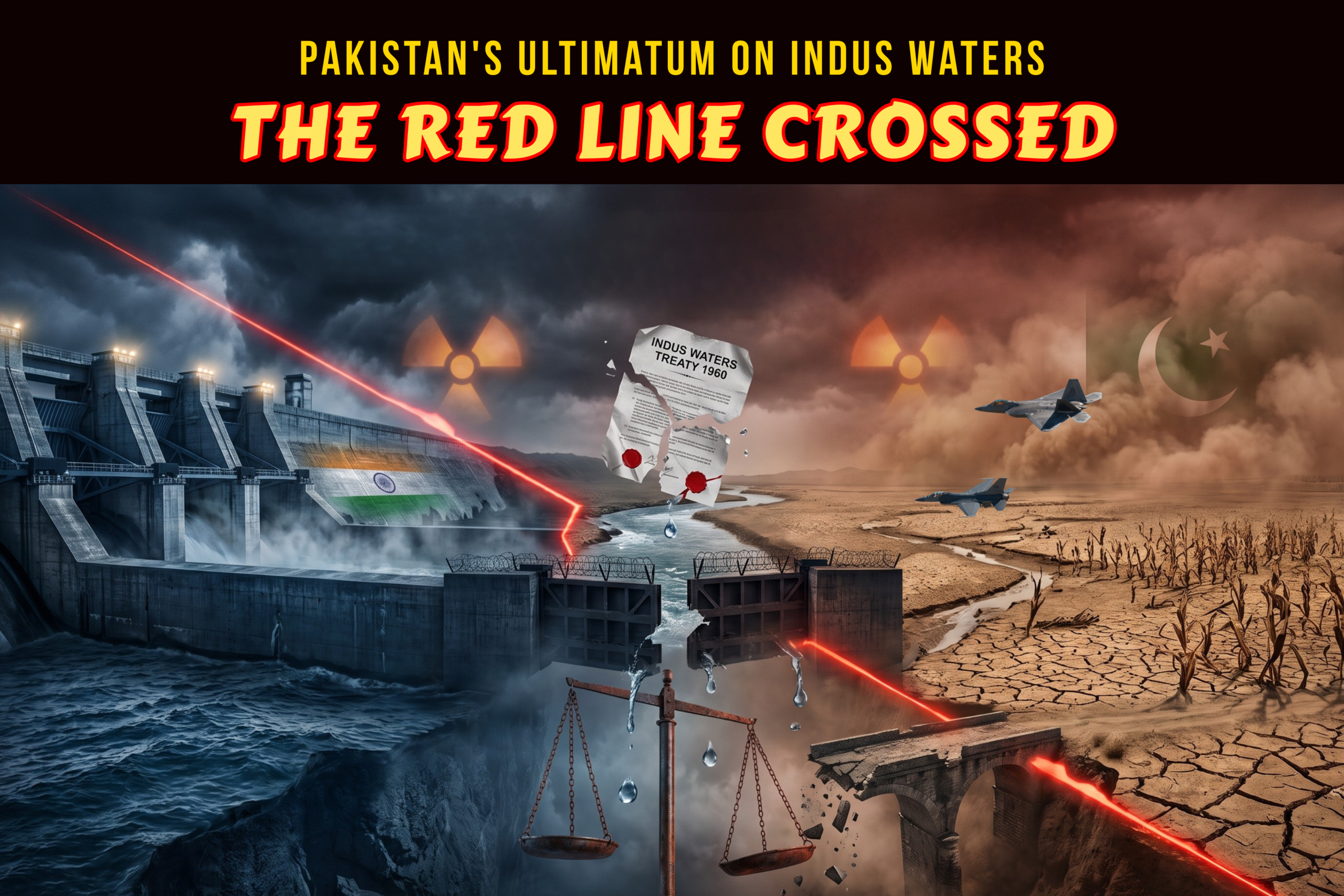
The seminar, titled “Indus Water Treaty: An Instrument of Peace & Regional Stability,” was not merely an academic exercise; it was a diplomatic counter-offensive. For decades, the 1960 IWT has been cited as one of the few successful examples of cooperation between the two nuclear-armed rivals. However, following the April 2025 Pahalgam terror attack and subsequent military exchanges, India unilaterally placed the treaty “in abeyance,” citing national security concerns. Now, with New Delhi declaring it will “never restore” the agreement and investing billions in diversion infrastructure, Pakistan has drawn an explicit “red line.” Water is no longer just a resource; it has become an existential trigger, transforming a bilateral dispute into a potential regional catastrophe with global implications.
The Islamabad Seminar: A Diplomatic Counter-Offensive
On June 30, 2026, Islamabad hosted a historic gathering. For the first time, Pakistan convened an international seminar solely focused on the IWT, bringing together renowned water experts, legal scholars, foreign dignitaries, and diplomats . The event was structured around three sessions, featuring papers from both Pakistani and international experts who analyzed the legal, technical, and geopolitical dimensions of the crisis.
The high-level participation underscored the gravity Islamabad attaches to the issue. Deputy Prime Minister and Foreign Minister Ishaq Dar, former Foreign Minister Bilawal Bhutto Zardari, Information Minister Attaullah Tarar, and Climate Change Minister Dr. Musadik Malik all addressed the audience. Their presence signaled a unified state position: the suspension of the IWT is not a negotiable policy shift but an act of aggression that threatens regional peace.
Mehar Ali Shah, Chairman of Pakistan’s Indus River System Authority (IRSA), used the platform to present technical evidence, alleging that India had already reduced water flows in the Chenab River in recent months, violating the treaty’s provisions even before its formal suspension . This move from rhetorical complaint to technical accusation marks a significant shift in Pakistan’s strategy, aiming to build a case for international intervention based on factual breaches rather than just political grievances.
The Ultimatum: Explicit Warnings from Pakistan’s Leadership
The tone of the Islamabad seminar was unequivocal. Pakistan’s leadership moved beyond diplomatic niceties to issue direct ultimatums, framing the water dispute as a matter of national survival.
Foreign Minister Ishaq Dar appealed to international law and moral responsibility, warning that any attempt to deprive Pakistan of its water share constituted “weaponization of water.” He stated:
“Shared waters must never be weaponized. They should remain a bridge between nations, guided by cooperation, dialogue, and respect for international law.”
However, it was Climate Change Minister Musadik Malik who delivered the most aggressive rhetoric. Accusing Indian Prime Minister Narendra Modi of deliberately controlling Pakistan’s water supply, Malik issued a chilling threat:
“There is a tap being controlled by the prime minister of a neighbouring country. He says he will not let even a drop of water flow into Pakistan… We will cut off those hands that seek to claim Islamabad’s water share.”
Information Minister Attaullah Tarar reinforced this stance with a legal argument, asserting that the IWT “cannot be unilaterally revoked, suspended, or amended” by any single party. He claimed that while Pakistan’s position had received international backing, India’s stance found little global support. Tarar referenced declarations by Prime Minister Shehbaz Sharif and Field Marshal Asim Munir, who have jointly defined water as Pakistan’s “lifeline and red line” .
| Key Pakistani Leader | Role | Key Statement/Position |
|---|---|---|
| Ishaq Dar | Deputy PM & Foreign Minister | “Shared waters must never be weaponized.” Warns of serious consequences for regional peace. |
| Musadik Malik | Climate Change Minister | “We will cut off those hands…” Accuses India of controlling the “tap.” |
| Attaullah Tarar | Information Minister | IWT cannot be unilaterally revoked. Claims international backing for Pakistan. |
| Mehar Ali Shah | Chairman, IRSA | Alleges India already reduced Chenab River flows in violation of treaty. |
| Shehbaz Sharif | Prime Minister | Declared water as Pakistan’s “lifeline and red line.” |
Timeline of Crisis: From Terror Attack to Water War
The current standoff is the culmination of a rapid deterioration in relations since early 2025. The trajectory from cooperation to confrontation has been steep and dangerous.
| Date | Event | Significance |
|---|---|---|
| April 2025 | Pahalgam Terror Attack | 26 tourists killed in Kashmir; India blames Pakistan-based militants. Catalyst for crisis. |
| May 2025 | Missile Exchanges & Ceasefire | Tit-for-tat strikes between India and Pakistan. US President Trump announces ceasefire. Diplomatic ties frozen. |
| Post-April 2025 | IWT Suspension | India places treaty “in abeyance” citing national security concerns. |
| June 2025 | “Never Restore” Declaration | India declares it will “never restore” the IWT, planning to divert waters for internal use. |
| Jan 2026 | UN Arria Formula Meeting | Pakistan internationalizes the issue at the UN Security Council. |
| June 10, 2026 | ISSI Roundtable | Institute of Strategic Studies Islamabad holds session on “Weaponisation of Water.” |
| June 30, 2026 | Islamabad International Seminar | First-ever international seminar on IWT held in Islamabad. High-level warnings issued. |
| July 1, 2026 | Current Status | Diplomatic ties downgraded, border crossing closed, visas revoked. No immediate response from New Delhi. |
India’s commitment to this new path is evident in its financial investments. Since the suspension, New Delhi has accelerated dam construction projects, investing over 41,000 crore rupees (approx. $4.9 billion) to enhance its capacity to store and divert Indus basin waters . This infrastructure buildup suggests that India’s suspension is not a temporary bargaining chip but a long-term strategic shift.
Geo-Strategic Implications: Why This Matters Beyond Bilateral Relations
The stakes of the IWT dispute extend far beyond the borders of India and Pakistan. The potential “weaponization” of water introduces a new dimension of instability in South Asia, with profound geo-strategic implications.
1. Water as an Existential Threat
Pakistan’s agricultural economy is overwhelmingly dependent on the Indus river system, with approximately 80% of its agriculture relying on these waters. With a population of over 240 million, any significant reduction in flow poses a direct threat to food security and social stability. As summer peaks in July and August, the timing of India’s potential restrictions on the Ravi river flows becomes critical . For Pakistan, this is not an economic adjustment; it is an existential challenge.
2. Nuclear-Armed Neighbors at the Brink
Both India and Pakistan possess nuclear arsenals. Historically, conflicts between them have been constrained by the fear of nuclear escalation. However, adding water—a resource essential for survival—to the list of contentious issues lowers the threshold for miscalculation. When leaders speak of “red lines” and “cutting off hands,” the risk of conventional conflict spiraling out of control increases significantly.
3. Challenge to International Law
The unilateral suspension of the IWT challenges the sanctity of international treaties. Brokered by the World Bank in 1960, the treaty has survived three major wars. Its abrogation sets a dangerous precedent for other transboundary water disputes globally, such as those in the Nile, Mekong, and Tigris-Euphrates basins. If a major power like India can discard a treaty citing “national security,” the entire framework of international water law faces erosion.
4. Regional Security Architecture
The crisis undermines regional stability mechanisms like SAARC. It also draws in other powers. China, as an upstream neighbor on some tributaries, has a strategic interest in the outcome. The United States, despite mediating the May 2025 ceasefire, has struggled to resolve the underlying structural issues. The silence from New Delhi following the Islamabad warnings suggests either confidence in its position or a strategic decision to let infrastructure facts on the ground speak for themselves .
International Response: Silence or Support?
Despite Pakistan’s efforts to internationalize the issue, the global response has been muted. While Islamabad claims to have international backing, major powers have remained cautious, likely wary of antagonizing India, a key strategic partner in the Indo-Pacific.
The World Bank, the original guarantor of the treaty, finds itself in a difficult position. Caught between two member states, it lacks strong enforcement mechanisms to compel compliance. Its role has largely been procedural, facilitating meetings but unable to prevent unilateral actions.
Regional powers are also divided. China maintains close ties with Pakistan but also has its own upstream water interests. Afghanistan, emerging as a player in water politics, adds another layer of complexity. Meanwhile, expert communities remain split. Legal scholars debate the interpretation of “material breach” clauses, while water engineers question the technical feasibility of India completely diverting the western rivers without causing massive ecological and humanitarian disasters within its own territory.
Scenarios Forward: What Happens Next?
As July 2026 begins, several scenarios are possible:
- Continued Stalemate (Most Likely): India proceeds with infrastructure projects, gradually reducing flows. Pakistan maintains diplomatic pressure and legal challenges but avoids military escalation. Tensions remain high but contained.
- Partial Negotiation: Back-channel talks emerge, leading to a limited restoration of some provisions or a face-saving compromise on specific rivers. This requires significant political will from both sides, which is currently absent.
- Escalation to Conflict (Low Probability, High Consequence): If Pakistan perceives an existential threat due to severe water shortages, it may consider military options. Given the nuclear backdrop, this scenario carries catastrophic risks.
- International Mediation: A third party (US, China, or UN) intervenes to facilitate binding arbitration or comprehensive renegotiation. This would require a significant shift in the current diplomatic deadlock.
Key Variables to Watch:
- Monsoon Patterns: Actual water flows in July-August 2026 will test India’s capacity and intent to restrict flows.
- Domestic Politics: Political pressures in both New Delhi and Islamabad could harden or soften positions.
- Terror Incidents: Any new attack could reignite the crisis and derail potential dialogue.
Conclusion: The Red Line and Regional Future
The Islamabad seminar of June 30, 2026, was more than a conference; it was a declaration of war on the status quo. Pakistan has explicitly defined water as a non-negotiable “red line,” while India has demonstrated its commitment to a new reality through massive infrastructure investments. The absence of an immediate response from New Delhi suggests that India believes it holds the upper hand, both technically and strategically.
For the international community, complacency is not an option. The Indus Waters Treaty was once a beacon of hope in a region plagued by conflict. Its potential collapse serves as a warning for transboundary water disputes worldwide. As Foreign Minister Ishaq Dar rightly noted, “Shared waters must never be weaponized.” Yet, the rhetoric and actions of the past year suggest that the tap is indeed being turned, and the bridge between nations is crumbling.
The “red line” has been drawn. Whether it will be crossed in the coming months will define not just the future of India-Pakistan relations, but the stability of South Asia itself. The world must watch closely, for when water becomes a weapon, peace becomes the first casualty.