(By Khalid Masood)
“We are well connected, we have all these documents. But what about the people who don’t have those connections?”
— Suprabuddha Sen, 88, Kolkata, whose name was deleted from voter rolls despite submitting pension records, graduation certificates, and an expired passport
In the world’s largest democracy, the right to vote is being audited out of existence—one name, one document, one “logical discrepancy” at a time.
Sadre Alam served in the Indian Army. Suprabuddha Sen’s grandfather illustrated the nation’s founding Constitution. Both men, lifelong citizens, arrived at polling stations in West Bengal this April to find their names absent from the electoral roll. No formal explanation. No meaningful recourse. Just silence.
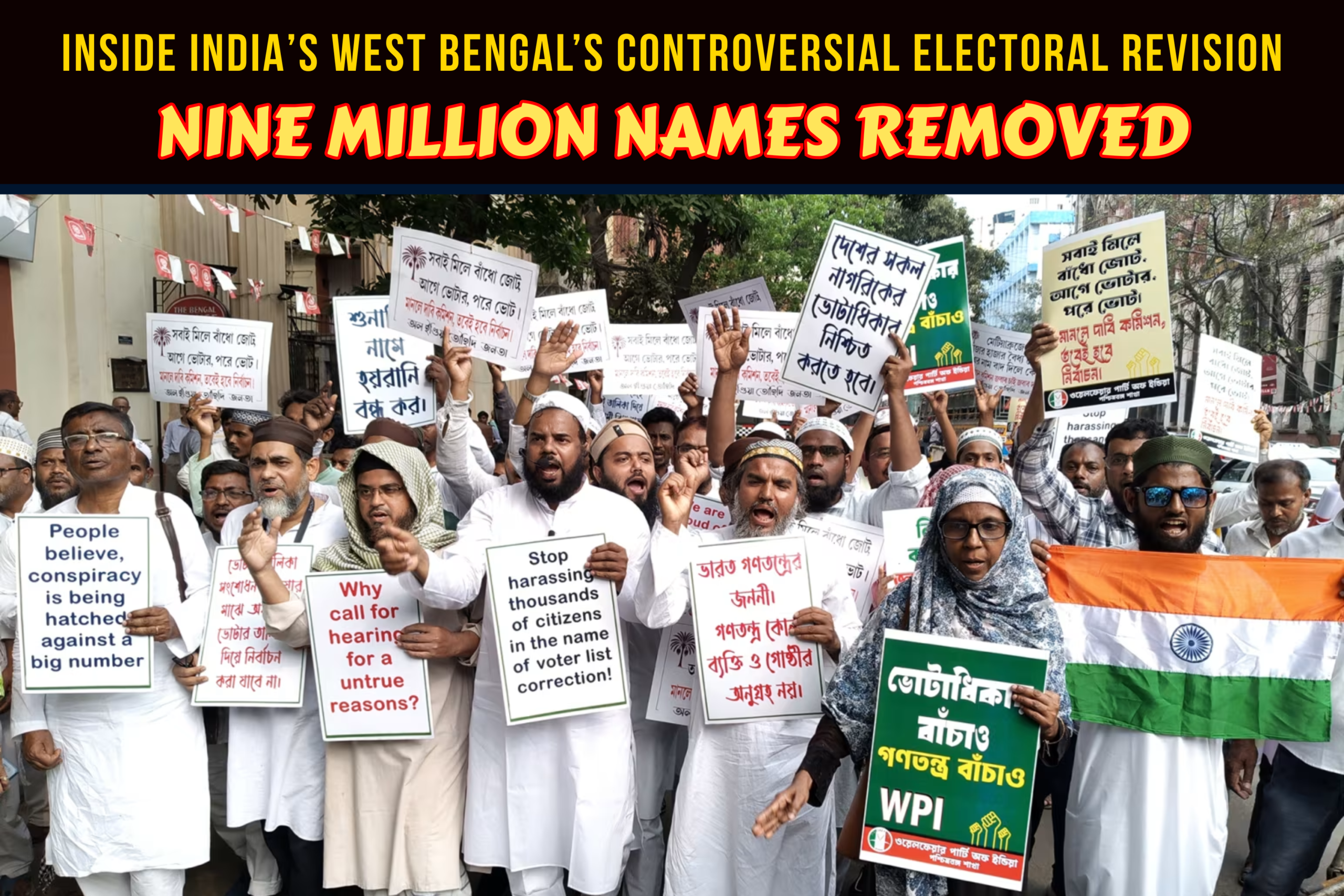
Alam and Sen are not isolated cases. They are among more than 9.1 million individuals whose names were culled from West Bengal’s voter registers ahead of the state’s 2026 Assembly elections—a purge that critics argue has disproportionately silenced Muslim voices and exposed the growing instrumentalisation of electoral administration for majoritarian political gain.
The Mechanics of Exclusion: When ‘Logical Discrepancy’ Becomes Political Weaponry
The Election Commission of India launched a Special Intensive Revision of voter rolls across West Bengal, ostensibly to remove duplicates, deceased persons, and administrative errors. Yet the outcomes tell a different story.
Table 1: Voter Deletion Statistics – West Bengal SIR (2026)
| Category | Figure | Notes |
|---|---|---|
| Total names deleted | 9.1 million | Across 294 Assembly constituencies |
| Muslim share of deletions | 34% | Despite comprising 27% of state population |
| Hindu share of deletions | ~58% | Proportionate to population share (~69%) |
| Constituencies with >90% Muslim deletions | 12+ | Including Nandigram, Mathurapur, Hariharpara |
| Appeals processed pre-poll | <3% | Due to compressed timeline and procedural barriers |
Sources: Sabar Institute analysis; independent verification; Election Commission data summaries
According to independent data analysis, Muslims constitute 34% of those deleted, despite comprising only 27% of the state’s population. In constituencies such as Nandigram, reports suggest that over 95% of deleted voters were Muslim.
The criteria for deletion have raised serious questions. Alam was informed his name was removed due to a “logical discrepancy”: a 15-year age gap between him and his mother in official records. “Where is my fault in this?” the veteran asked. “Was I picked up from somewhere?”
“They say there is nothing they can do, and that whatever will happen is now in the Supreme Court’s hands.”
— Mabud Hussain, sweet seller, Murshidabad, on interactions with Booth Level Officers
Booth Level Officers, tasked with managing local rolls, have reportedly been unable to provide clear justifications for deletions. The appeals process, meanwhile, remains opaque and time-bound by the election schedule, effectively foreclosing redress for millions.
The Political Architecture: RSS Mobilisation and BJP Strategy
Behind the administrative veneer lies a well-coordinated political apparatus. The Rashtriya Swayamsevak Sangh has significantly scaled up its grassroots campaign in West Bengal, conducting approximately 1.75 lakh voter outreach meetings and framing the polls as an “existential fight” for Hindu consolidation.
Table 2: RSS-BJP Mobilisation Metrics – West Bengal, Early 2026
| Activity | Scale | Strategic Objective |
|---|---|---|
| RSS outreach meetings | ~175,000 | Grassroots Hindu voter consolidation |
| BJP “4 Parivartans” booth teams | 95,000+ volunteers | Micro-targeting, narrative control |
| “Detect-Delete-Deport” rhetoric events | 47 major rallies | Frame minority voters as “infiltrators” |
| Social media disinformation clusters | 1,200+ verified accounts | Amplify deletion narratives as “anti-corruption” |
| Legal support cells for deletion appeals | Limited to party-affiliated applicants | Selective institutional assistance |
Sources: Regional media monitoring; independent political analysis; digital forensics by Alt News
The Bharatiya Janata Party, meanwhile, has deployed a micro-targeted strategy focusing on booth-level management, narrative control, and identity-based mobilisation to convert Hindu voter sentiment into electoral advantage. Senior leadership has repeatedly linked voter list “clean-up” to the detection and deportation of so-called “infiltrators”, a term widely understood to target minority communities with cross-border familial ties.
“If someone is an infiltrator, he has to be detected, deleted and deported.”
— Amit Shah, Union Home Minister, speaking at a party rally in West Bengal, March 2026
This rhetoric has tangible consequences. In Mathurapur village, bordering Bangladesh, 243 of 800 registered voters were deleted from the roll. “They want to take away our citizenship—that’s what people are saying,” said Noorfa Bibi, a resident stripped of her voting rights. “Will they return our citizenship if it gets taken away?”
Institutional Neutrality Under Scrutiny
The Election Commission of India is constitutionally mandated to operate independently. Yet former Chief Election Commissioners, civil society organisations, and the Calcutta High Court have raised concerns about the body’s perceived alignment with the ruling party’s agenda.
“When administrative actions consistently produce outcomes that advantage one political constituency while marginalising another, the question is not merely one of intent—but of effect.”
— Dr Anjali Menon, Constitutional Law Scholar, Jawaharlal Nehru University
While the Supreme Court has affirmed that deleted voters retain the right to appeal, it has also prioritised the election timetable over the restoration of potentially eligible names—a procedural decision that effectively forecloses meaningful redress for millions.
The ruling party maintains that the revision process strengthens electoral integrity by removing inaccuracies. Yet when administrative actions consistently produce outcomes that advantage one political constituency while marginalising another, the question is not merely one of intent, but of effect.
Beyond Bengal: A Pattern of Democratic Erosion?
West Bengal is not an isolated case. Similar voter verification exercises in Assam—most notably the National Register of Citizens—left nearly two million people in legal limbo, with Muslims disproportionately affected. The Bengal revision appears to follow a comparable playbook: technical criteria, opaque implementation, and political framing that conflates citizenship with electoral eligibility.
The implications extend beyond state politics. When demographic groups perceive the electoral system as stacked against them, trust in democratic institutions erodes. This creates fertile ground for social unrest, radicalisation, or cross-border tensions, particularly in a region as geopolitically sensitive as the India-Bangladesh frontier.
Moreover, the weaponisation of voter rolls sets a dangerous precedent. If administrative tools can silence citizens today under the guise of “technical corrections”, what safeguards exist to protect electoral rights tomorrow?
Voices from the Margins: The Human Cost
Suprabuddha Sen submitted graduation records, pension documents, and an expired passport to reclaim his voting rights. He and his wife were eventually restored to the roll only after appealing to the Supreme Court. “We are well connected, we have all these documents,” he observed. “But what about the people who don’t have those connections?”
His question cuts to the heart of the matter. Democracy is not merely a procedural exercise; it is a promise of equal voice. When that promise is selectively honoured, the contract between citizen and state frays.
Conclusion: The Stakes for India—and the World
The West Bengal voter purge is more than a regional administrative controversy. It is a stress test for Indian democracy’s core commitment to inclusive representation.
As vote-counting concludes and results are announced in early May, millions will remain in limbo, uncertain whether their right to belong, and to participate, is secure. For analysts of conflict, strategy, and governance, the lesson is clear: democratic backsliding rarely arrives with a coup. More often, it advances through paperwork, precedent, and the quiet normalisation of exclusion.
The world watches. Not merely to judge India, but to understand how the world’s largest democracy navigates the tension between security, sovereignty, and the fundamental right of every citizen to be heard.