(By Quratulain Khalid)
Introduction: A Shared Climate Destiny
In 1877, a catastrophic global famine claimed millions of lives across India, China, Brazil, and Africa—not due to war or disease, but driven by a distant oceanic phenomenon off the coast of Peru. Nearly 150 years later, scientists warn that history may be preparing to rhyme. The World Meteorological Organization (WMO) and Europe’s ECMWF forecasting center indicate that a potentially “strong” or even “mega” El Niño event is likely to develop from mid-2026, with profound implications for Pakistan and its neighboring countries in South and Central Asia.
For Pakistan—a nation born in 1947 from the same subcontinental fabric referenced in historical accounts, yet facing distinct geographic and climatic realities—the stakes could not be higher. Situated at the confluence of monsoon systems, glacial watersheds, and arid zones, Pakistan’s vulnerability to El Niño is amplified by its heavy dependence on agriculture, limited adaptive infrastructure, and the compounding pressures of climate change. This article examines the science of El Niño, its historical and projected impacts on Pakistan and the wider region, and the urgent pathways toward resilience.
Understanding El Niño: The Pacific Engine of Global Weather
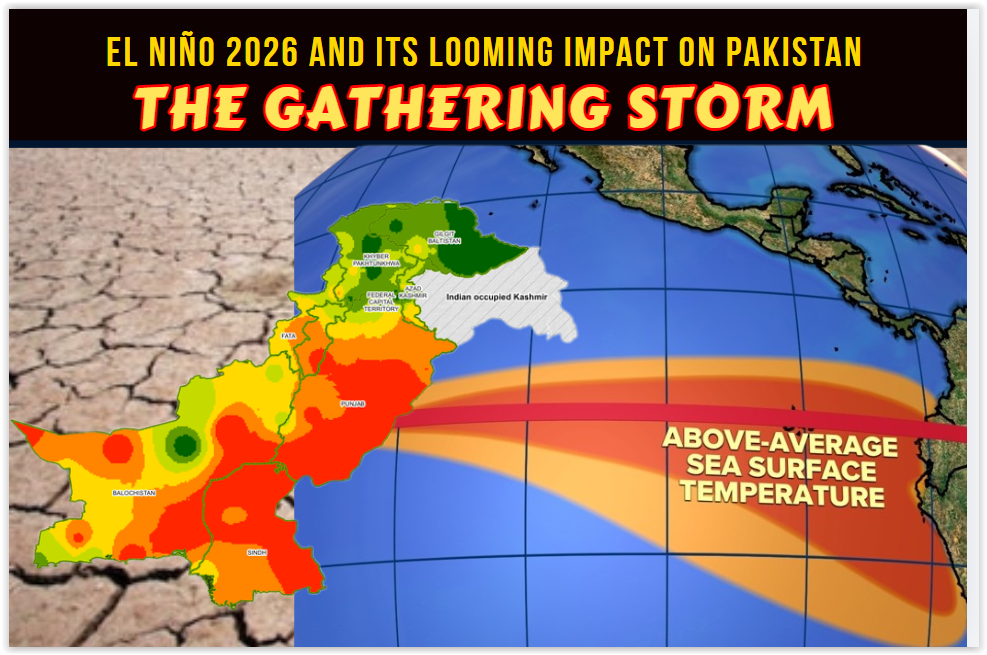
El Niño is the warm phase of the El Niño-Southern Oscillation (ENSO), a natural climate pattern characterized by the warming of sea surface temperatures in the central and eastern tropical Pacific Ocean. Typically recurring every 2–7 years and lasting 9–12 months, El Niño disrupts atmospheric circulation worldwide:
- Normal conditions: Trade winds push warm surface water westward toward Australia and Asia, allowing cold, nutrient-rich water to upwell near South America. This fuels rainfall over Southeast Asia and the Indian subcontinent.
- During El Niño: Trade winds weaken or reverse. Warm water accumulates in the central/eastern Pacific, shifting convection and rainfall patterns eastward. The result: suppressed monsoons over South Asia, increased drought risk in Australia, and altered storm tracks globally.
While El Niño is a natural cycle, its interaction with anthropogenic climate change creates a dangerous multiplier effect. With global temperatures already ~1.4°C above pre-industrial levels, even a moderate El Niño can push regional temperatures into unprecedented territory.
“El Niño is not just a weather event—it’s a global climate disruptor. When the Pacific Ocean warms, it’s like turning up the heat on an already feverish planet. For South Asia, the consequences are measured in crops, water, and human lives.”
— Dr. Petteri Taalas, Secretary-General, World Meteorological Organization
Pakistan in the Crosshairs: Historical and Projected Impacts
Monsoon Variability and Agricultural Vulnerability
Pakistan’s agriculture—contributing ~20% to GDP and employing nearly 40% of the workforce—is critically dependent on the summer monsoon (July–September) and winter precipitation from western disturbances. Research consistently shows that El Niño events correlate with below-average monsoon rainfall over Pakistan.
During the 2015–2016 “Super El Niño,” Pakistan experienced significant agricultural stress, with reduced yields in key crops like wheat, rice, and cotton. A 2023 issue brief from the Institute of Strategic Studies Islamabad noted that El Niño-induced monsoon deficits can trigger drought conditions, while paradoxically increasing the risk of intense, concentrated rainfall events that cause flash floods.
With 60% of Pakistan’s population directly or indirectly reliant on rain-fed agriculture, even modest monsoon shortfalls can cascade into food insecurity, rural distress, and inflationary pressures.
Heatwaves: The Silent Emergency
El Niño amplifies the frequency and intensity of heatwaves across South Asia. Pakistan has already witnessed devastating heat events: the 2015 Karachi heatwave claimed over 1,300 lives, while the 2024 heatwave resulted in more than 568 fatalities. Climate attribution studies indicate that human-induced climate change made such early-season heatwaves in India and Pakistan 30 times more likely.
The health impacts extend beyond mortality. Heat stress reduces labor productivity, particularly for outdoor workers in construction, agriculture, and informal sectors. A study in Delhi found that a 1°C temperature rise reduced daily earnings by 14% for heat-exposed workers—a dynamic equally applicable to Pakistan’s urban and rural labor force.
Water Resources: Glaciers, Rivers, and Uncertainty
Pakistan’s water security hinges on the Indus River system, fed by glaciers in the Hindu Kush-Karakoram-Himalayan region. El Niño influences precipitation patterns in these headwaters, with studies indicating increased drought severity in the Upper Indus Basin during El Niño phases.
Compounding concerns: accelerated glacial melt due to rising temperatures increases short-term runoff but threatens long-term water availability. Lower snowpack and faster glacier retreat jeopardize the perennial flow of the Indus, which supports the world’s largest contiguous irrigation system and 90% of Pakistan’s food production.
The Flood-Drought Paradox
El Niño does not produce uniform dryness. Its disruption of atmospheric patterns can lead to erratic rainfall distribution: prolonged dry spells punctuated by extreme precipitation events. In April–May 2024, El Niño-driven storms caused deadly flash floods across Afghanistan, Pakistan, and Iran, with rainfall made twice as likely by the phenomenon.
This “flood-drought paradox” challenges traditional water management. Drought-hardened soils become impermeable, increasing runoff during sudden downpours and elevating flood risks—a pattern observed repeatedly in Pakistan’s recent climate disasters.
Regional Dimensions: Afghanistan, Iran, and Central Asia
Pakistan’s climate fate is intertwined with its neighbors:
- Afghanistan: Ranked among the world’s most climate-vulnerable nations, Afghanistan faces heightened drought risk during El Niño, compounded by conflict and limited institutional capacity. The 2024 spring floods demonstrated how El Niño can exacerbate existing vulnerabilities, displacing communities and destroying livelihoods.
- Iran: Western disturbances influenced by ENSO patterns affect Iran’s precipitation. El Niño can suppress winter rains critical for agriculture while increasing the risk of extreme spring rainfall and flash floods.
- Central Asia: Though less directly tied to the Indian monsoon, El Niño can influence temperature and precipitation anomalies across Central Asia, affecting water resources in transboundary basins like the Amu Darya and Syr Darya.
Regional cooperation on early warning systems, data sharing, and joint disaster response remains underdeveloped—a critical gap given the transboundary nature of climate risks.
The 2026 Forecast: What Models Suggest
As of April 2026, multiple forecasting centers indicate a high probability of El Niño development:
- WMO: Signals a “clear shift” in Pacific conditions, with high confidence in El Niño onset by May–July 2026 and potential intensification thereafter.
- ECMWF: Projects a possible “strong” event, though the spring predictability barrier introduces uncertainty.
- NOAA: Estimates a 61–62% chance of El Niño formation by June–August 2026, with a one-in-three probability of a “strong” event by year-end.
For Pakistan and South Asia, the timing is particularly concerning. If El Niño peaks during the monsoon season (July–September), it could suppress rainfall precisely when agricultural demand is highest. Combined with elevated baseline temperatures, this raises the specter of compound extremes: heatwaves coinciding with water scarcity and crop stress.
Table 1: Historical El Niño Events and Their Impact on Pakistan
| Year | El Niño Strength | Monsoon Rainfall Deviation | Major Impacts |
|---|---|---|---|
| 1997-98 | Strong | -15% | Drought conditions, reduced crop yields |
| 2002-03 | Moderate | -12% | Water scarcity in Sindh and Punjab |
| 2009-10 | Moderate | -8% | Below-average kharif production |
| 2015-16 | Very Strong | -18% | Severe agricultural losses, heatwave deaths |
| 2018-19 | Weak | -5% | Mild impact, localized drought |
| 2026 (Projected) | Strong to Very Strong | -15% to -25% | Compound risks: heat, drought, food inflation |
Table 2: Temperature Projections for South Asia During El Niño 2026
| Region | Baseline Temp (°C) | El Niño Addition (°C) | Projected Peak (°C) | Risk Level |
|---|---|---|---|---|
| Karachi | 32-35 | +1.5 to 2.0 | 48-50 | Extreme |
| Lahore | 35-38 | +1.5 to 2.0 | 50-52 | Extreme |
| Jacobabad | 38-42 | +1.5 to 2.0 | 52-54 | Critical |
| Islamabad | 30-34 | +1.0 to 1.5 | 44-46 | High |
| Quetta | 28-32 | +1.0 to 1.5 | 42-44 | High |
Pathways to Resilience: Action at Multiple Scales
Addressing El Niño risks requires coordinated action across individual, community, national, and regional levels:
1. Strengthen Early Warning and Adaptive Agriculture
- Expand meteorological monitoring and seasonal forecasting capacity within the Pakistan Meteorological Department (PMD), with targeted advisories for farmers.
- Promote climate-resilient crop varieties, adjusted sowing calendars, and water-efficient irrigation to buffer against monsoon variability.
2. Invest in Nature-Based Solutions
- Protect and restore forests, wetlands, and mangroves to enhance water retention, reduce flood risks, and moderate local temperatures. Evidence shows urban tree cover can reduce ambient temperatures by up to 12°C.
- Prioritize conservation of old-growth trees over symbolic new plantings, as mature ecosystems provide superior ecological services.
3. Enhance Heat Action Plans
- Develop and fund city-level heat action plans, including early warning systems, cooling centers, and occupational safety protocols for outdoor workers.
- Integrate heat-related mortality tracking into public health surveillance to inform targeted interventions.
4. Foster Regional Cooperation
- Revitalize platforms like the South Asian Association for Regional Cooperation (SAARC) and Climate Action Network South Asia (CANSA) to share climate data, coordinate disaster response, and advocate for equitable climate finance.
- Pursue joint research on transboundary water management under changing climate scenarios.
5. Accelerate the Energy Transition
- Scale up decentralized renewable energy, particularly solar, to reduce dependence on fossil fuels and enhance energy security during climate disruptions.
- Leverage declining solar costs to expand access in rural and off-grid communities, building resilience against power outages during extreme weather.
“Pakistan contributes less than 1% of global emissions, yet we are among the top ten countries most vulnerable to climate change. This is not just an environmental issue—it’s a matter of climate justice. We need adaptation finance, technology transfer, and regional solidarity to survive what’s coming.”
— Dr. Aisha Khan, Executive Director, Mountain and Glacier Protection Organization, Pakistan
Conclusion: Beyond Prediction to Preparedness
El Niño is not a new phenomenon, but its interaction with a warming planet is reshaping risk landscapes across South Asia. For Pakistan—a country that contributed minimally to historical emissions yet bears disproportionate climate impacts—the 2026 El Niño forecast is both a warning and a call to action.
The science is clear: waiting for perfect forecasts is a luxury we cannot afford. Proactive investment in adaptation, equitable resource management, and regional solidarity offers the best defense against the cascading risks of a “Super El Niño.” As the children born in 2026 will inherit a climate-altered world, the choices made today will determine whether they face summers of 45°C as the new normal—or whether collective action can still bend the curve toward a more resilient future.
“The children being born today in Pakistan will never know a ‘normal’ summer. For them, 45 degrees will be ordinary. That is not their inheritance—it is our failure. But it is not too late to change the story.”
— Regional Climate Activist, South Asia