(By Khalid Masood)
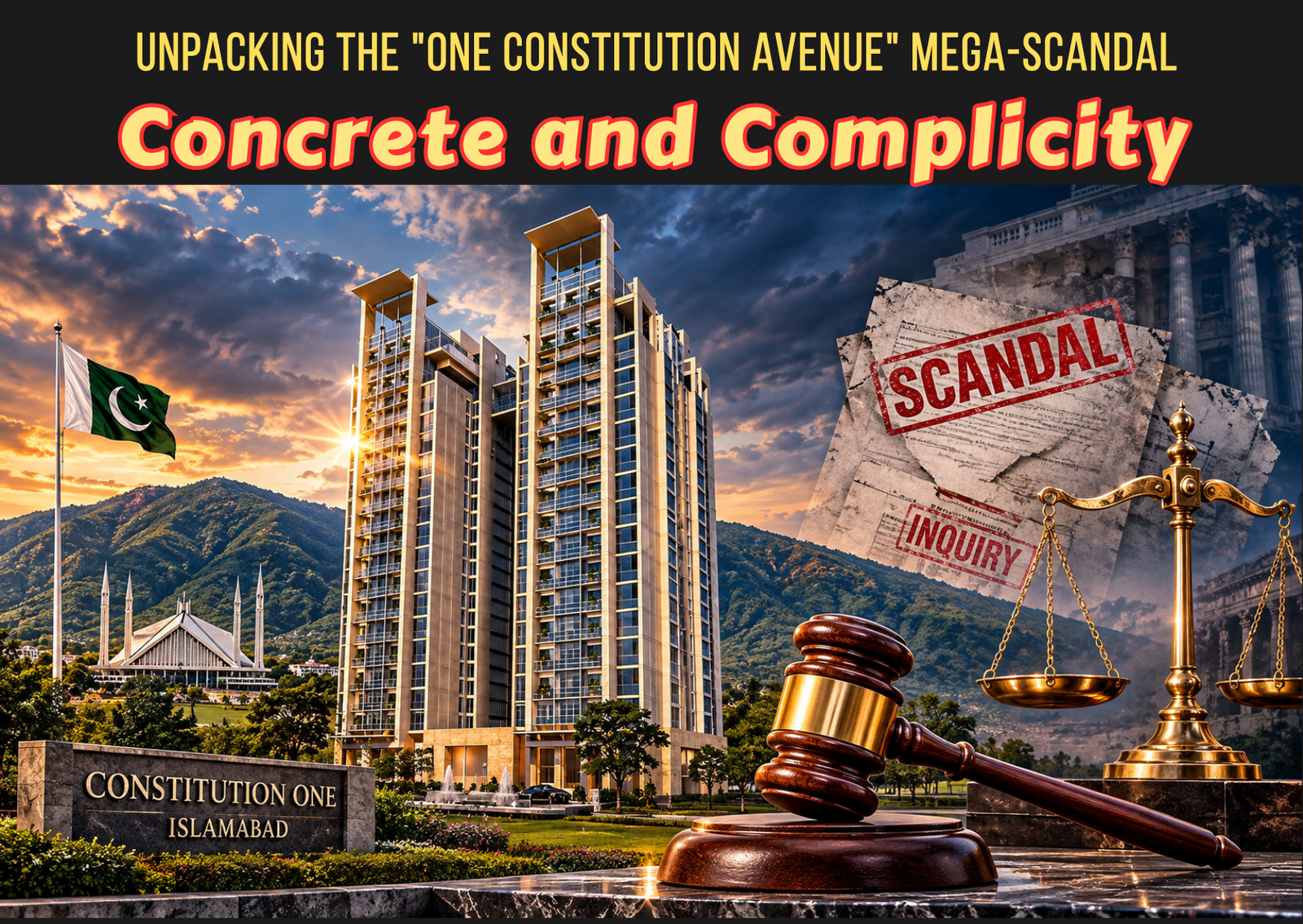
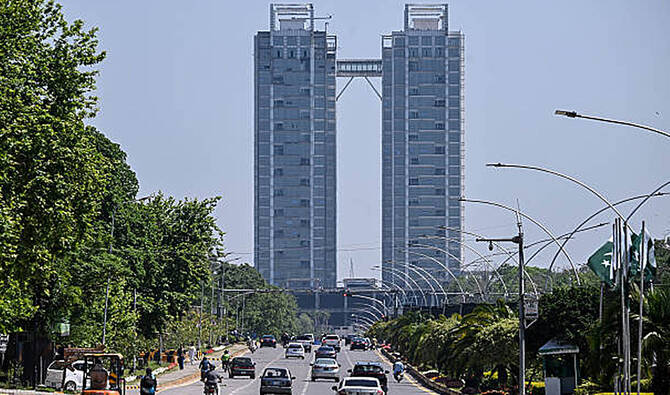
In the heart of Islamabad’s heavily secured Red Zone, where the avenues are lined with the seats of power and the diplomatic enclaves of the world, stands a 13.5-acre anomaly. Originally earmarked to serve the nation as a prestigious five-star hotel, the plot at Constitution Avenue instead became “One Constitution Avenue”—a towering luxury residential complex comprising 263 apartments, quietly acquired by the country’s most powerful elites.
For nearly two decades, this project operated in plain sight, shielded by a complex web of regulatory waivers, manipulated bidding, and judicial interventions. However, the recent approval of a damning Joint Investigation Team (JIT) report by the Federal Cabinet has finally pulled back the curtain. For the Pakistani public, the “One Constitution Avenue” scandal is not merely a case of real estate fraud; it is a stark, uncomfortable mirror reflecting how state institutions can be leveraged to legitimize the elite capture of public resources. As an independent analyst, unpacking this mega-scandal requires looking beyond the political rhetoric to understand the systemic institutional failures that allowed it to happen.
The Genesis: A Five-Star Vision Turned Residential Reality
The story begins in 2005, when the Capital Development Authority (CDA) entered into a lease agreement with BNP (Pvt) Limited. The mandate was clear and critical for a capital city aspiring to host international dignitaries: develop a five-star hotel.
Yet, as the blueprints evolved, so did the project’s nature. Under the guise of commercial development, the project was covertly altered. The hotel was never built. Instead, the space was designed, marketed, and sold as a high-end residential and commercial complex. This “bait-and-switch” was a blatant violation of the master plan for the Red Zone, an area strictly regulated for security and administrative purposes. The transformation of a public commercial asset into a private residential enclave for the elite set the stage for one of the most audacious land grabs in Islamabad’s history.
The Anatomy of the Scam: How the Watchdogs Slept
The critical question that grips the national conscience is simple: How does a 13.5-acre plot in the most secure zone of the country change its legal status without triggering immediate alarms? The recently submitted JIT report—comprising representatives from NAB, FIA, FBR, SECP, IB, and ISI—provides a chilling answer: institutional complicity.
According to the findings, the bidding and auction processes were deliberately manipulated to favor an allegedly ineligible company. Mandatory safeguards, most notably the requirement for an irrevocable bank guarantee, were explicitly removed by CDA officials to benefit the developer. The regulatory bodies tasked with overseeing real estate transactions, corporate compliance, and tax collections either looked the other way or were actively co-opted. The CDA, the very institution mandated to protect the capital’s master plan, became the primary facilitator of its violation.
The Judicial Paradox: From “Legal Cover” to Strict Accountability
Perhaps the most complex layer of this scandal is the role of the judiciary, which inadvertently provided the project with a shield of legitimacy, only to later dismantle it.
In January 2019, the Supreme Court of Pakistan conditionally restored the project’s lease after the CDA had initially moved to terminate it. The apex court mandated that the developer pay Rs 17.5 billion over eight years, backed by structured installments and bank guarantees. While intended to ensure financial discipline, legal analysts note that this verdict provided a “legal cover” to the project. The developer utilized the apex court’s order to reassure buyers, continuing to sell residential apartments under the protection of the highest court in the land, despite the fundamental deviation from the original hotel mandate.
The judicial tide turned decisively in May 2026. The Islamabad High Court (IHC), in a detailed 32-page verdict, dismantled the legal defenses of the developer and the buyers. Delivering the judgment, Chief Justice Sardar Mohammad Sarfraz Dogar upheld the CDA’s lease cancellation due to repeated financial defaults.
The IHC’s ruling was uncompromising. Addressing the elite buyers who claimed legitimate ownership, the court stated unequivocally that “buyers lack ownership rights, as the project’s lease had been terminated and the proper legal processes had not been followed regarding the transfer of ownership.” Furthermore, the court dismissed the developer’s defense regarding the mandatory 30-day notice period, categorizing it as a mere “technical flaw” in the face of systemic financial and legal breaches.
Following this verdict, authorities moved to evacuate the building, prompting a dramatic standoff. A subsequent two-judge IHC bench temporarily restrained the evictions pending intra-court appeals, highlighting the immense legal friction involved in reclaiming state land from entrenched interests.
The JIT Findings: Naming the Masterminds and the Fallout
The federal government’s response to the IHC verdict was the formation of a formidable multi-agency JIT. The resulting report has sent shockwaves through the establishment.
The JIT has identified former Finance Minister Abdul Hafeez Shaikh as the alleged mastermind of the irregularities. The list of accused also includes former CDA Chairman Kamran Lashari, Dr. Faisal Awan, Uzair Ali Chaudhry, Brigadier (Retd) Nasrullah, and the late Rai Nawaz Kharal. The report recommends blacklisting Shaikh and his company from future public-sector projects and initiating strict legal action.
Recognizing the collateral damage, the government has also announced a mechanism to protect bona fide investors. Genuine buyers, including many overseas Pakistanis who invested their lawful life savings, will be refunded their principal amounts with interest calculated at the KIBOR rate. Meanwhile, the building is slated to be converted back into a five-star hotel through a fresh, transparent auction.
The Political and Elite Dimension: A Test of Equality
No discussion of One Constitution Avenue is complete without addressing the “Who’s Who” of its buyers. The apartments were reportedly purchased by top-tier politicians, high-ranking bureaucrats, and establishment figures across the political and institutional divide.
State Minister for Interior Talal Chaudhry rightly noted that the matter should not be viewed as political point-scoring, emphasizing that the law must apply equally to all. He pointed out that various high-profile individuals, including the founder of Pakistan Tehreek-e-Insaf, must also explain how they acquired their apartments.
This is where the scandal becomes a crucible for Pakistan’s egalitarian aspirations. The public is watching closely to see if the accountability drive will remain impartial, or if it will devolve into a tool for targeting political rivals while shielding others. True institutional revival requires that the elite immunity that built this tower be dismantled with the same concrete resolve used to construct it.
Structural Reforms: Preventing the Next Scandal
Punishing the culprits is necessary, but insufficient. The JIT report wisely recognizes that the system itself is broken. To prevent future occurrences, the report recommends:
- Reviewing the CDA Ordinance to close legal loopholes regarding land-use conversions.
- Establishing an independent Master Plan Commission to oversee zoning changes.
- Complete digitization of CDA records to eliminate the manipulation of physical files.
- A mandatory two-year rotation policy for officers in the planning, enforcement, and building control departments to break the nexus of vested interests.
Conclusion: Reclaiming the Capital’s Conscience
The “One Constitution Avenue” scandal is a microcosm of a broader challenge facing Pakistan: the persistent gap between the rule of law on paper and its application in practice. For too long, the sanctity of Islamabad’s master plan has been treated as a suggestion rather than a statute, bent to accommodate the convenience of the powerful.
While the recent JIT report and the government’s commitment to refunding genuine investors are steps in the right direction, the true measure of success will not be found in the dramatic eviction of residents or the naming of high-profile figures. It will be found in the rigorous implementation of structural reforms. The concrete of One Constitution Avenue may have been poured over compromised foundations, but the foundation of the Pakistani state does not have to be. If Islamabad is to remain the pride of Pakistan, its Red Zone must reflect the rule of law, not the rule of the influential. The eviction of this building must be followed by the permanent eviction of the elite impunity that built it.