(By Khalid Masood)
Introduction: The Most Allied Ally — and the Most Distrusted Partner
No bilateral relationship in modern diplomatic history has been described in such contradictory terms as the Pakistan-US alliance. Pakistan has been called America’s “most allied ally” — yet it has also been labelled its “most sanctioned ally.” Washington has poured more than $33 billion in assistance into the partnership since 2001, yet senior American officials have publicly accused Islamabad of “duplicity” and “deceit.”
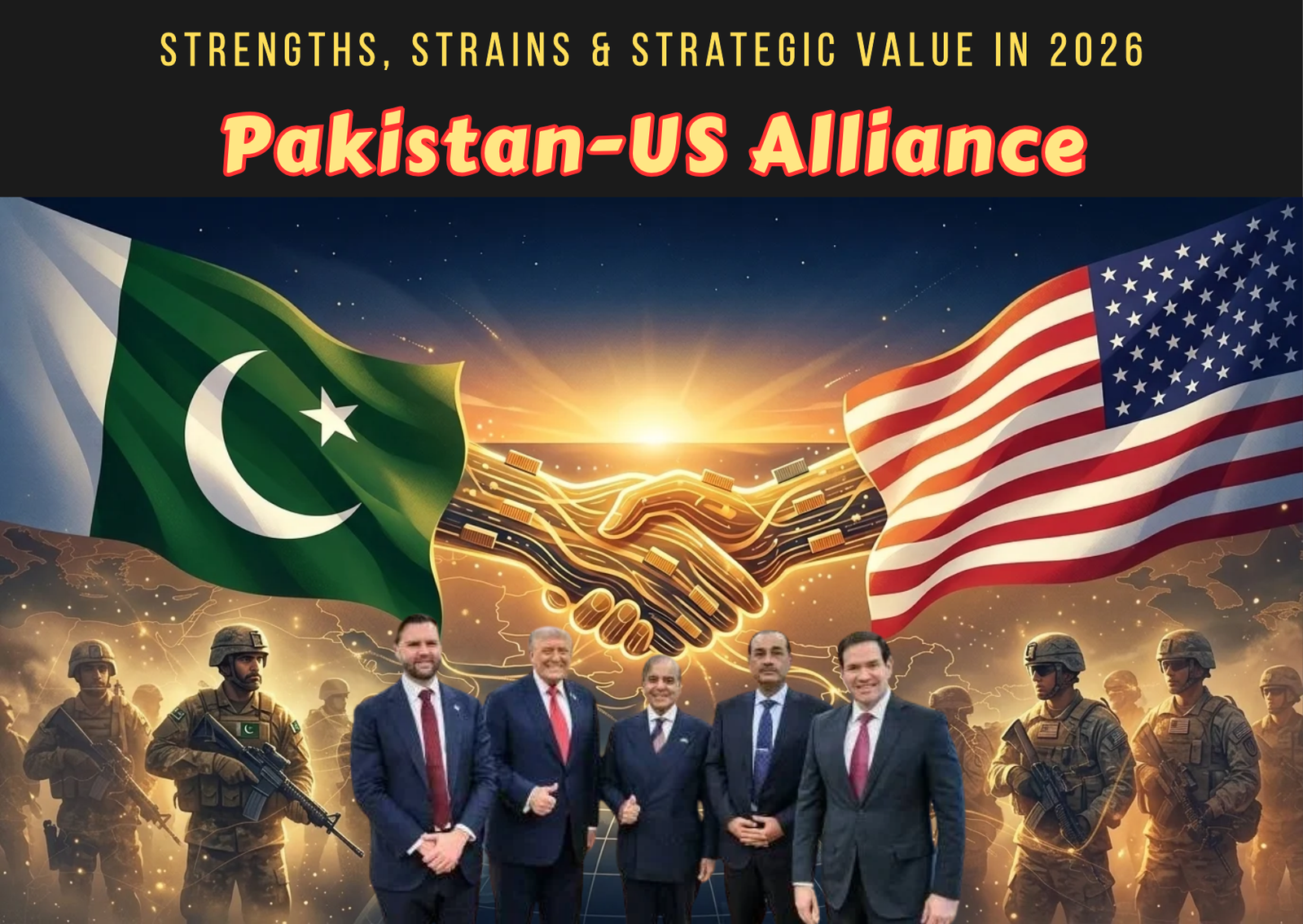
In 2025–26, this storied and stormy relationship has entered yet another of its dramatic phases — a rapid reset under President Donald Trump’s second administration. From a 19% tariff trade deal and a $500 million critical minerals MoU, to Pakistan’s mediation of the US–Iran conflict through the June 2026 Islamabad Memorandum, and Chief of Army Staff General Asim Munir’s White House reception — the Pakistan-US strategic partnership appears revived.
But is this a genuine realignment, or simply the latest chapter in a 75-year cycle of transactionalism? This article examines the strengths, strains, and strategic value of the Pakistan-US alliance — its historical arc, structural foundations, fault lines, and the road ahead.
Historical Evolution: The Arc of a Transactional Partnership
The Cold War Foundations (1947–1969)
The Pakistan-US alliance began not with shared values but with shared geography. In 1950, Prime Minister Liaquat Ali Khan chose Washington over Moscow — a choice that defined South Asian geopolitics for generations. By 1954, the two signed the Mutual Defence Assistance Agreement, and Pakistan joined both SEATO and CENTO, becoming a linchpin of America’s containment strategy against the Soviet Union and, later, China.
Yet the original grievance was planted immediately: the alliance never promised collective action against India, Pakistan’s existential concern. When the 1965 Indo-Pakistani War erupted, the United States imposed an arms embargo on both sides — an act Islamabad read as betrayal.
The Great Realignments (1971–1989)
The 1971 war and the creation of Bangladesh shattered Pakistan’s eastern wing — but simultaneously revealed Pakistan’s unique diplomatic utility. It was through Islamabad that Henry Kissinger made his secret 1971 journey to Beijing, opening US–China relations. Pakistan, in effect, brokered the century’s most consequential rapprochement.
Then came 1979: the Soviet invasion of Afghanistan transformed Pakistan into the frontline state of the Cold War’s final theater. The CIA’s largest-ever covert operation funnelled billions through Pakistan’s ISI to the Afghan mujahideen. General Zia-ul-Haq’s instruction captured the strategy coldly: “The water in Afghanistan must boil at the right temperature.” When the Soviets withdrew in 1989, the water stopped boiling — and America left.
The Sanctions Decade (1989–2001)
Within a year, the Pressler Amendment cut off all US military and economic aid over Pakistan’s nuclear programme. The 1998 nuclear tests triggered Glenn Amendment sanctions. From 1990 to 2001, Pakistan was arguably America’s most sanctioned non-pariah state — the definitive proof, in Pakistani eyes, that Washington’s interest was purely instrumental.
The War on Terror Era (2001–2021)
September 11 changed everything. Pakistan became a Major Non-NATO Ally (2004) and received over $33 billion in US aid between 2002 and 2011.
But the decade’s defining feature was accumulated mistrust:
- Abbottabad, May 2011: US Navy SEALs killed Osama bin Laden a mile from Pakistan’s military academy — without informing Islamabad.
- Salala, November 2011: NATO airstrikes killed 24 Pakistani soldiers; Pakistan closed NATO supply routes for seven months.
- Admiral Mike Mullen’s congressional testimony was the low point: “The Haqqani network… acts as a veritable arm of Pakistan’s ISI.”
Hillary Clinton’s warning became the era’s most quoted line: “You can’t keep snakes in your backyard and expect them only to bite your neighbours.” By 2018, President Trump tweeted that the US “no longer pay[s] Pakistan the $Billions” — and by 2021, the Afghan withdrawal seemed to close the book. President Biden’s 2022 description of Pakistan as “one of the most dangerous nations in the world” appeared to confirm the estrangement.
The Post-Afghanistan Low — and the 2025–26 Reset
Engagement shrank to intelligence-level counterterrorism cooperation — “the new, and low, normal.” Then, in 2025, the pendulum swung back with remarkable speed:
- March 2025: Pakistan extradited an IS-K operative to the US; CENTCOM chief Gen. Michael Kurilla publicly called Pakistan a “phenomenal partner” in counterterrorism.
- May 2025: The India–Pakistan military conflict ended with a ceasefire Trump claimed to have brokered — and Pakistan backed Trump for the Nobel Peace Prize.
- June 2025: General Asim Munir became the first Pakistani Army Chief hosted at the White House in years; Islamabad announced US oil reserve exploration rights.
- September 2025: The US–Pakistan trade agreement — 19% tariffs for Pakistani exports, near-zero Pakistani duties on 4,000+ American products; a $500 million critical minerals MoU; a World Liberty Financial crypto MoU (January 2026).
- 2026: Pakistan hosted the Islamabad Talks between the US and Iran, producing the Islamabad Memorandum and a strategic pause in the Gulf crisis; Islamabad earned a seat on the Gaza Board of Peace; Washington designated the Balochistan Liberation Army (BLA) a Foreign Terrorist Organization.
Table 1: Key Milestones in Pakistan–US Relations
| Year | Event | Significance |
|---|
| 1954 | Mutual Defence Assistance Agreement | Formal start of the alliance |
| 1965 | US arms embargo in Indo-Pak war | Original Pakistani grievance |
| 1971 | Kissinger’s secret visit via Islamabad | Pakistan brokers US–China opening |
| 1979–89 | Anti-Soviet jihad; billions in covert aid | Peak patronage, peak blowback |
| 1990 | Pressler Amendment sanctions cut aid | Instrumentalism proven |
| 1998 | Glenn Amendment sanctions post-nuclear tests | Decade of estrangement |
| 2001–11 | War on Terror; $33bn+ aid; MNNA status | Marriage of convenience |
| 2011 | Abbottabad raid; Salala strike; Mullen testimony | Trust collapses |
| 2021 | US withdrawal from Afghanistan | The nadir |
| Mar 2025 | IS-K extradition; “phenomenal partner” | Reset begins |
| May 2025 | India–Pakistan ceasefire; Trump mediation claim | Pakistan’s diplomatic value reasserted |
| Sept 2025 | Trade deal (19% tariff); minerals MoU | Economic pillar rebuilt |
| Jun 2026 | Islamabad Memorandum (US–Iran) | Pakistan as crisis manager |
Strengths: What Holds the Pakistan-US Alliance Together
1. Geography as Destiny
Pakistan’s location is the relationship’s original and enduring asset. It borders four critical states — China, India, Iran, and Afghanistan — commands over 1,000 km of Arabian Sea coastline near the Strait of Hormuz, and sits astride the Gulf’s energy lifelines. No other country offers Washington simultaneous access to all these theatres.
2. Counterterrorism and Intelligence Cooperation
Counterterrorism is the one institutional track that never broke. With IS-K operating from Afghan soil and the TTP resurgent inside Pakistan, both security establishments remain interdependent. Cooperation extends to nuclear security — legacy scars that paradoxically require continued engagement.
3. Military-to-Military Institutional Memory
Decades of IMET-trained officers and equipment familiarity created an institutional bridge that survives policy swings. China now supplies roughly 80% of Pakistan’s arms imports (SIPRI, 2021–25), but the Pentagon retains channels no other major power fully matches.
4. Economic and Commercial Complementarity
The United States remains Pakistan’s largest single export market, with over $1.5 billion in US investment in 2021–23 across consumer goods, fintech, healthcare, and energy. The September 2025 trade framework — 19% tariffs, among the lowest in South Asia — gave the relationship a commercial backbone it never had in the aid era.
5. Diplomatic Utility and Mediation Value
The 2026 Iran mediation proved what the 1971 China opening first demonstrated: Pakistan is one of the few states with simultaneous access to Washington, Beijing, Riyadh, Tehran, and Kabul. When the Gulf crisis threatened global energy markets, it was Islamabad’s good offices — not any formal ally’s — that produced the Islamabad Memorandum.
Table 2: Strengths vs. Strains — A Structural Balance Sheet
| Dimension | Strengths | Strains |
|---|
| Geography | Irreplaceable location; Hormuz adjacency; Afghanistan access | Proximity to Gwadar/CPEC raises US–China friction |
| Security | CT/intelligence track intact; nuclear security cooperation | Safe-haven suspicions; 2024 missile-programme sanctions |
| Economy | Largest export market; 19% tariff deal; $1.5bn investment | Deals remain MoUs, not bankable projects; mining ≈ 3% of GDP |
| Military | Institutional ties, CENTCOM channels | China supplies 80% of arms; no new defence pact |
| Politics | Military-to-military reliability | US engages Rawalpindi over Islamabad; democracy deficit |
| Diplomacy | Unique mediation value (Iran 2026, China 1971) | Transactional, leader-dependent, revocable deals |
Strains: The Structural Fault Lines
1. The Distrust Deficit
Three generations of grievance — 1965, 1971, 1990, 1998, 2011, 2021 — produced a Pakistani elite conviction that America is a fair-weather friend, mirrored by an American conviction of Pakistani duplicity. The asymmetry compounds it: Pakistan seeks a strategic commitment; Washington offers transactional engagement.
2. The India Problem
Washington’s structural tilt toward New Delhi — the 2008 Civil Nuclear Deal, iCET, the 10-year defence roadmap — has long been Pakistan’s central anxiety. The 2025–26 twist is striking: Trump’s tariff differential (19% Pakistan vs. 50% India) temporarily reversed the hyphenation. Yet India–US strategic ties remain structurally intact, and New Delhi has responded with accelerated diversification.
3. The China Factor — Dual Patronage, Not Realignment
The decisive constraint on rapprochement is Beijing. With CPEC ($62 billion) and its second phase (September 2025), JF-17 and submarine co-production, and China’s dominant share of arms supplies, Pakistan’s strategic architecture is Chinese-built. US minerals ambitions in Balochistan collide directly with Chinese interests around Gwadar — the proposed Pasni port lies barely 100 km away. Beijing tolerates the US engagement because Western capital improves Pakistan’s debt-servicing capacity. The honest conclusion: Pakistan has achieved dual patronage, not realignment.
4. Nuclear Weapons and Non-Proliferation Friction
The 2024 US sanctions on Pakistan’s missile programme show the file is live, not historical. Pakistan’s tactical nuclear weapons keep US crisis planners permanently uneasy, with the 2025 India–Pakistan conflict serving as a live-fire test of escalation management.
5. The Democratic Deficit
The 2025–26 engagement is strikingly Rawalpindi-centric: an Army Chief received in the Oval Office while elected civilian leadership waits in the wings. Washington’s preference for the “addressable institution” risks entrenching military primacy and weakening precisely the constituencies most favourable to long-term partnership.
6. Terrorism as Both Glue and Solvent
Counterterrorism binds the establishments together while corroding trust between them. Pakistan’s “double victim” narrative (80,000+ terrorism deaths since 2001) collides with persistent American suspicion of militant safe havens. The 2025 BLA FTO designation was simultaneously an advance and a quid pro quo — revealing the transactional grammar beneath the partnership language.
7. Transactionalism and Personalisation
Trump-era diplomacy attaches deals to individuals, not institutions: crypto ventures linked to the First Family, a tariff framework struck down by US courts in 2026, MoUs without pilots (the World Liberty Financial stablecoin produced “no project, no licences, no transactions” six months on), and minerals hype over a sector comprising barely 3% of GDP. Everything granted can be revoked; nothing agreed is yet institutionalised.
Strategic Value: What Each Side Actually Gets
Value to the United States: contingency access (Afghan intelligence, IS-K containment, the 2026 Iranian channel); a great-power hedge through a China-partnered state it can still trade with; and an Islamic-world gateway via the Gaza Board of Peace and Saudi–Pakistan alignment.
Value to Pakistan: an economic lifeline (tariff access, investment, multilateral cover); security signalling (CT designations, CENTCOM endorsement, crisis diplomacy raising its weight vis-à-vis India); and strategic optionality hedging against over-dependence on China.
Value to the Region: Pakistan has re-emerged as a crisis manager — for India–Pakistan escalation in 2025 and US–Iran escalation in 2026. But systemic risks loom: sharpened India–Pakistan hyphenation, China–India tactical convergence, a Gwadar–Pasni rivalry on the Arabian Sea, and a Balochistan destabilised by competing external presences.
Scenarios and the Road Ahead (2026 and Beyond)
Scenario 1 — Managed Transactionalism (most likely): narrow, durable cooperation on counterterrorism, trade implementation, and project-by-project minerals; the relationship survives an administration change but shrinks to its institutional floor.
Scenario 2 — Deeper Realignment: would require sustained US investment actually materialising, revived defence cooperation, and visible Pakistani distance from China. None of these conditions currently holds.
Scenario 3 — Reversion to Estrangement: triggered by another India–Pakistan crisis with mediation fatigue, a minerals/crypto scandal, nuclear-sanctions escalation, or an administration change zeroing out personal ties.
Recommendations: For Washington — institutionalise engagement beyond the presidency and condition support on civilian capacity-building. For Islamabad — convert MoUs into bankable projects and leverage dual patronage without provoking either patron.
Conclusion: Episodic, Patron-Client, Durable
The Pakistan-US alliance has never been a conventional alliance — it lacks even a formal treaty. It is a 75-year alignment of mutual instrumentalism: strongest when a third-party threat — the USSR, al-Qaeda, IS-K, or a Gulf conflagration — makes Pakistan’s geography indispensable; weakest when that threat recedes. The 2025–26 warmth is real but shallow: episodic and patron-client in character rather than structural. Its paradoxical longevity — proven by its repeated near-deaths — is itself the strongest evidence that the strategic value of this partnership, on both sides, endures.