(By Khalid Masood)
The air inside a neonatal intensive care unit is normally defined by a fragile rhythm: the hiss of ventilators, the measured beeping of monitors and the hurried but controlled movements of doctors and nurses fighting to keep premature and critically ill babies alive.
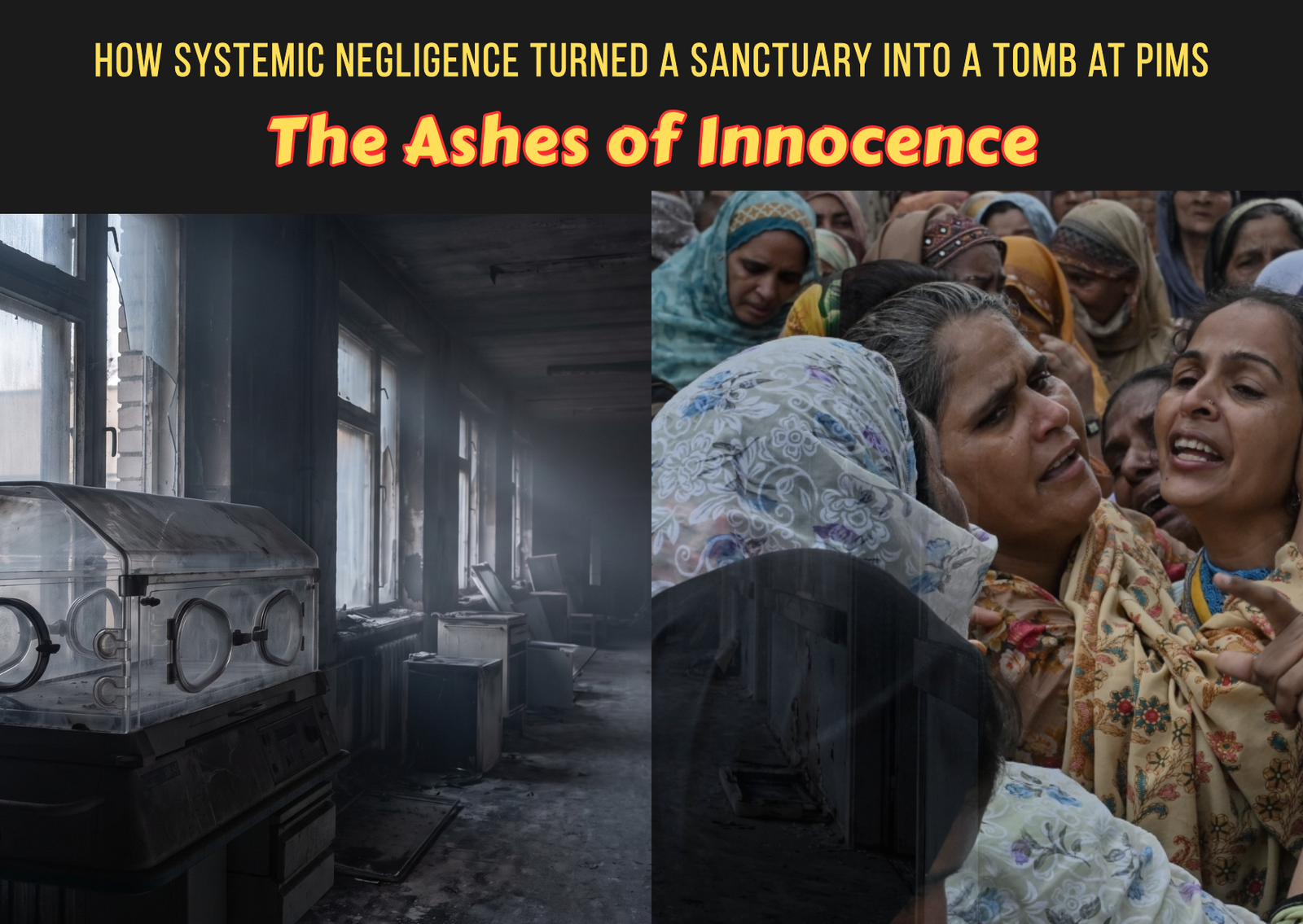
On the morning of 26 August 2026, that rhythm was shattered at the Pakistan Institute of Medical Sciences (PIMS) in Islamabad. A fire erupted in the neonatal unit of the Mother and Child Health Ward. Fourteen newborn babies died. Only one of the infants in the nursery was rescued. The tragedy has shocked the nation and raised a question far more disturbing than the immediate cause of the blaze:How could a modern capital-city hospital become a death trap for the most helpless patients in its care?
The answer cannot be reduced to an air-conditioner, a short circuit, a nebuliser or an oxygen connection.A technical fault may explain how the fire began. It does not, by itself, explain why fourteen newborn lives were lost.
That distinction is fundamental.
The Incident: A Few Minutes That Changed Fourteen Families Forever
What We Know So Far
According to reports from hospital officials and authorities, the fire broke out at approximately 6:45 a.m. on Wednesday, 26 August, in the nursery of the Mother and Child Health Ward on the third floor.
There were approximately 15 newborns in the nursery. Fourteen died and one was rescued.
Initial accounts have not been entirely consistent about the precise mechanism that triggered the fire. Some officials and reports have attributed it to a malfunction or explosion involving an air-conditioning unit, while an initial PIMS report reportedly pointed towards a nebuliser and the presence of oxygen near an incubator. Another official account referred to a short circuit and the rapid spread of fire because of oxygen, gas lines and combustible medical equipment.
These differences are precisely why a transparent technical investigation is essential.
The cause must not be declared settled before investigators have examined the electrical system, air-conditioning equipment, oxygen infrastructure, fire alarms, evacuation arrangements, staffing levels and emergency response.
The Real Question Is Not Merely “What Started the Fire?”
Hospitals are not ordinary buildings.
A fire in a shopping centre is dangerous. A fire in a hospital intensive-care nursery is exponentially more dangerous because the people inside cannot simply run for an exit.
A newborn attached to an incubator, oxygen supply or monitoring equipment cannot evacuate independently.
That means fire prevention, early detection, compartmentalisation, evacuation and emergency response are not optional features in a neonatal facility. They are fundamental life-support systems.
If any of those layers fail, the consequences can be catastrophic.
And at PIMS, the consequences were catastrophic.
The Human Cost: Fourteen Lives That Had Barely Begun
Statistics can conceal the horror of a tragedy.
“Fourteen deaths” is a number.
But each number represented a newborn child who had a name, a mother, a father and a family waiting to take that child home.
For those families, there will be no first birthday, no first day at school, no graduation, no wedding and no ordinary family photograph years from now.
There will only be an empty cradle and a question that may remain with them for the rest of their lives:
Could my child have been saved?
That question cannot be answered by condolences.
It can only be answered by a rigorous investigation that establishes exactly what happened, minute by minute, and identifies every preventable failure.
Institutional Responsibility Must Be Examined
A Fire Is an Emergency. A Hospital Must Be Prepared for Emergencies.
The government has already moved to investigate the tragedy. Prime Minister Shehbaz Sharif ordered an inquiry, and Health Secretary Aslam Ghauri was removed from his position following the incident. Investigators have been tasked with determining the cause of the fire and examining the response.
Those steps are necessary.
But they are not sufficient.
The inquiry must not become another exercise in producing a report, holding a press conference and then returning to business as usual.
The central issue should be simple:
Was PIMS adequately prepared to protect newborns from a foreseeable fire emergency?
Every Safety Layer Must Be Investigated
The investigation should establish, among other things:
Fire Detection
- Were smoke and fire detection systems installed?
- Were they operational?
- When were they last tested?
- Did the alarm activate immediately?
- Who was responsible for monitoring and responding to it?
Fire Suppression
- What fire extinguishing equipment was available?
- Was it functional and properly maintained?
- Was there an automatic sprinkler or suppression system appropriate for the facility?
- Had any safety deficiencies previously been identified?
Oxygen Safety
- What was the condition of the oxygen infrastructure?
- Were oxygen concentrations and equipment arrangements compliant with safety standards?
- Did oxygen accelerate the fire?
- Was the oxygen supply isolated quickly enough?
Electrical and Air-Conditioning Systems
- What exactly failed?
- Had the air-conditioning equipment been inspected?
- Was there evidence of electrical overloading, short circuit or equipment failure?
- Were previous electrical faults reported and, if so, were they rectified?
Evacuation
- What was the emergency evacuation plan for the nursery?
- Had staff been trained and drilled in neonatal evacuation?
- Were evacuation routes unobstructed?
- Was adequate equipment available to move critically ill infants rapidly and safely?
Staffing
- How many doctors, nurses and support personnel were present when the fire started?
- Were staffing levels adequate for an emergency involving multiple critically ill newborns?
- Who had responsibility for initiating evacuation?
These are not bureaucratic questions.
They are questions of life and death.
The Most Important Investigation: What Could Have Been Prevented?
Do Not Stop at the Immediate Cause
If investigators conclude that an air-conditioner malfunctioned, that will explain the ignition mechanism.
It will not explain the death toll.
If a short circuit is established, that will explain the electrical failure.
It will not answer whether the facility had adequate fire protection.
If oxygen intensified the flames, that will explain why the fire spread rapidly.
It will not answer whether the hospital had adequate emergency procedures for an oxygen-rich neonatal environment.
A serious investigation must therefore distinguish between:
the initiating event, the contributing factors and the institutional failures that determined the outcome.
That is where accountability begins.
Pakistan Has Been Warned Before
The PIMS tragedy is particularly disturbing because it does not exist in isolation.
Pakistan has experienced deadly hospital fires before. In June 2024, a fire at Sahiwal Teaching Hospital killed 11 babies, according to reporting at the time. The tragedy prompted scrutiny of hospital fire-safety arrangements, including the condition of firefighting equipment.
Two years later, Pakistan is once again mourning dead newborns.
That should be intolerable.
The lesson is painfully obvious:
A hospital safety failure that is ignored today can become a mass-casualty event tomorrow.
Accountability Must Go Beyond One Suspension
Find the Failure — Then Follow It Up the Chain of Responsibility
Suspending an official may satisfy immediate public anger, but accountability cannot end there.
If an investigation establishes that safety warnings were ignored, equipment was not maintained, emergency procedures were inadequate or responsible officials failed to act, accountability must extend to every level at which those failures occurred.
Conversely, no individual should be condemned merely because of their position before evidence establishes responsibility.
That is what a credible investigation means.
Not a scapegoat. Not a cover-up. Not a predetermined conclusion. Evidence.
The public deserves to know:
- Who was responsible for fire safety?
- Who inspected the facility?
- Who maintained the electrical and HVAC systems?
- Who certified the safety arrangements?
- Were previous complaints or warnings received?
- Were deficiencies recorded?
- If deficiencies existed, why were they not corrected?
- Who had the authority to correct them?
- And why were fourteen newborns unable to survive a fire inside the country’s capital?
These questions must be answered publicly.
A Commission Is Meaningless Without Implementation
Pakistan has no shortage of inquiry reports.
The country has a much greater shortage of implementation.
A commission that produces recommendations which are later forgotten will not honour the fourteen children who died at PIMS.
The government should therefore publish the inquiry’s findings and establish a publicly accountable mechanism for implementing every safety recommendation.
Hospitals treating premature and critically ill babies should be subjected to immediate, independent fire-safety inspections.
The inspections should cover:
Mandatory Hospital Safety Measures
- Fire detection and alarm systems.
- Emergency lighting.
- Fire extinguishers and suppression systems.
- Smoke compartmentalisation.
- Emergency exits and evacuation routes.
- Electrical installations.
- Air-conditioning systems.
- Oxygen and medical-gas infrastructure.
- Emergency evacuation equipment.
- Staff training and evacuation drills.
- Night-shift staffing.
- Regular independent safety certification.
And there should be zero tolerance for falsified certificates, ignored defects or paper compliance.
A hospital is not safe because a file says it is safe.
It is safe only when its systems work when lives depend on them.
The State Must Treat Hospital Safety as a National Security Issue
The tragedy exposes something larger than the weaknesses of one hospital.
Pakistan frequently speaks of healthcare reform in terms of new hospitals, expensive machines, new wards and modern equipment.
All of that matters.
But a multimillion-dollar medical machine is worthless if the building housing it cannot protect human life.
A hospital’s most sophisticated equipment cannot compensate for a failed fire alarm.
A modern incubator cannot protect a baby from smoke.
A state-of-the-art neonatal unit cannot save lives if emergency evacuation procedures exist only on paper.
Healthcare infrastructure is not merely about treating disease. It is about protecting life at every stage of care.
A Nation in Mourning — and a System on Trial
The fourteen newborns who died at PIMS cannot speak.
Their families can.
And the nation must listen.
This tragedy should not be allowed to disappear from public attention once the funerals are over and the headlines move elsewhere.
The government owes the families more than condolences.
It owes them truth.
It owes them accountability.
And it owes every parent who enters a Pakistani hospital the basic assurance that the institution entrusted with their loved one’s life has done everything reasonably possible to keep them safe.
The fire at PIMS may have been caused by an electrical or equipment failure. That question must be settled by evidence.
But the larger question is already before us:
Was the system prepared to protect those babies when the fire began?
If the answer is no, then fourteen deaths cannot be dismissed as an unfortunate accident.
They must become a national reckoning.
The Fire Is Out. The Questions Remain.
Fourteen newborns are dead.
Fourteen families have been permanently scarred.
One child survived.
And an entire country is asking how this could happen inside one of its most important public hospitals.
The investigation must therefore be fearless, independent and comprehensive.
No official title should provide protection.
No institution should be allowed to investigate itself without meaningful independent oversight.
No safety warning should disappear into a file.
No inquiry report should gather dust.
And no future parent should have to wonder whether taking a newborn to a government hospital means placing that child’s life at risk from hazards that should have been prevented.
The fire at PIMS has been extinguished. The responsibility for discovering why fourteen newborns died in it has only just begun.