(By Khalid Masood)
I. Background: From Aid Recipient to Defence Partner
The United States-Israel Defence Technology Cooperation Initiative did not emerge from a vacuum. It is the culmination of a seven-decade military relationship that has evolved from arms sales and financial aid into something approaching structural fusion. Understanding this trajectory is essential to grasping why Section 224 of the FY2027 National Defence Authorisation Act represents a qualitative break from precedent rather than a mere budgetary line item.
The foundation was laid in the aftermath of the 1967 Six-Day War, when Washington began supplying Israel with sophisticated weaponry to offset Soviet support for Arab states. By 1987, Congress had enshrined Israel as a “major non-NATO ally,” guaranteeing it preferential access to American defence technology, joint training, and excess defence articles. For decades, this relationship operated within a clear hierarchy: Israel received platforms (F-15s, F-16s, later F-35s), missile systems (Patriot, THAAD), and roughly $3.8 billion annually in Foreign Military Financing, but it remained fundamentally a client-patron dynamic. Israel developed impressive indigenous capabilities — the Lavi fighter programme, the Merkava tank, the Arrow missile defence family — yet these ran parallel to, rather than integrated with, American systems.
The first structural crack in this hierarchy appeared in January 2021, when the Pentagon transferred Israel from the European Command (EUCOM) Area of Responsibility to Central Command (CENTCOM). The move was presented as bureaucratic rationalisation: Israel’s primary security concerns (Iran, Syria, Lebanon) fell within CENTCOM’s geographic remit, and coordination with Gulf Arab states against Tehran would be streamlined. In practice, however, it placed Israel at the centre of American military planning for the entire Middle East, granting Israeli defence officials routine access to CENTCOM war plans, intelligence assessments, and operational coordination mechanisms that no other non-NATO ally enjoyed.
The Abraham Accords (2020) added a diplomatic veneer to this military convergence. Normalisation with the UAE, Bahrain, Morocco, and Sudan was marketed as a pathway to regional peace, but its defence dimension was equally significant. Joint air and naval exercises between Israel, the US, and Gulf states became routine. Intelligence-sharing protocols, once confined to bilateral US-Israel channels, expanded into trilateral and quadrilateral arrangements. Yet even here, Israel remained a recipient of American largesse rather than a co-architect of American strategy.
The turning point came in 2025, when Representative Marlin Stutzman introduced the FUTURES Act (Fostering US-Israel Technology United for Regional Security), a standalone bill that proposed designating an executive agent within the Department of Defence to synchronise bilateral research, development, and industrial cooperation across artificial intelligence, autonomous systems, cyber warfare, directed energy, and quantum computing. The bill languished in committee, but its core concepts were resurrected, almost verbatim, as Section 224 of the FY2027 NDAA. The fiscal 2027 NDAA, authorising an unprecedented $1.15 trillion in military spending, became the vehicle for embedding Stutzman’s vision into permanent law.
Prime Minister Benjamin Netanyahu recognised the historic nature of the moment. In a June 2026 letter to Representative Stutzman, he explicitly thanked the congressman for endorsing “my plan” for “a new framework of joint defense cooperation, codevelopment, coproduction, and mutual investment.” The letter, later cited by critics as evidence of Israeli political capture of American legislative processes, revealed that the initiative was not merely an American offer but an Israeli demand — one that Netanyahu had been cultivating for years.
The provision’s passage did not go uncontested. The Quincy Institute for Responsible Statecraft warned that the language on “network integration” and “data fusion” would “essentially transform Israel from a top U.S. aid recipient to a full member of the U.S. defense and intelligence apparatus.” Progressive Democrats, already alienated by the Gaza war’s devastation, argued that the executive agent mechanism would reduce congressional oversight and blur the constitutional line between American and Israeli command authority. House Armed Services Committee Chairman Mike Rogers countered that “in no way does it give away command and control of our military operations, personnel, or equipment,” but the reassurance did little to quell unease among defence realists who saw entrapment risks in fused intelligence networks.
The broader geopolitical context amplified the stakes. The Trump administration’s signals of a potential withdrawal from West Asia — coupled with the February 2026 US-Israeli strikes on Iranian nuclear facilities — created a vacuum that Israel sought to fill not with troops, but with technology. If American forces were to draw down, Israeli logic ran, then Israeli capabilities must be hardwired into American systems so that US power could be projected remotely, through shared sensors, AI algorithms, and autonomous platforms, without boots on the ground. The initiative was, in this sense, a hedge against American retrenchment as much as an accelerator of Israeli power.
Against this backdrop, the August 2026 trilateral defence agreement between Saudi Arabia, Turkey, and Pakistan — signed in Mecca just as the NDAA provisions were being finalised in Washington — takes on added significance. It was not merely a Muslim-world counterweight to Iran or Israel; it was a preemptive response to the realisation that the United States was constructing a two-tier security architecture in which Israel would sit at the apex, and every other regional actor, no matter how wealthy or strategically located, would remain a supplicant. The background to the US-Israel Defence Technology Cooperation Initiative is, therefore, the story of an alliance transforming into an amalgamation — and of a region preparing for the consequences.
II. Initiative Overview: Architecture and Strategic Intent
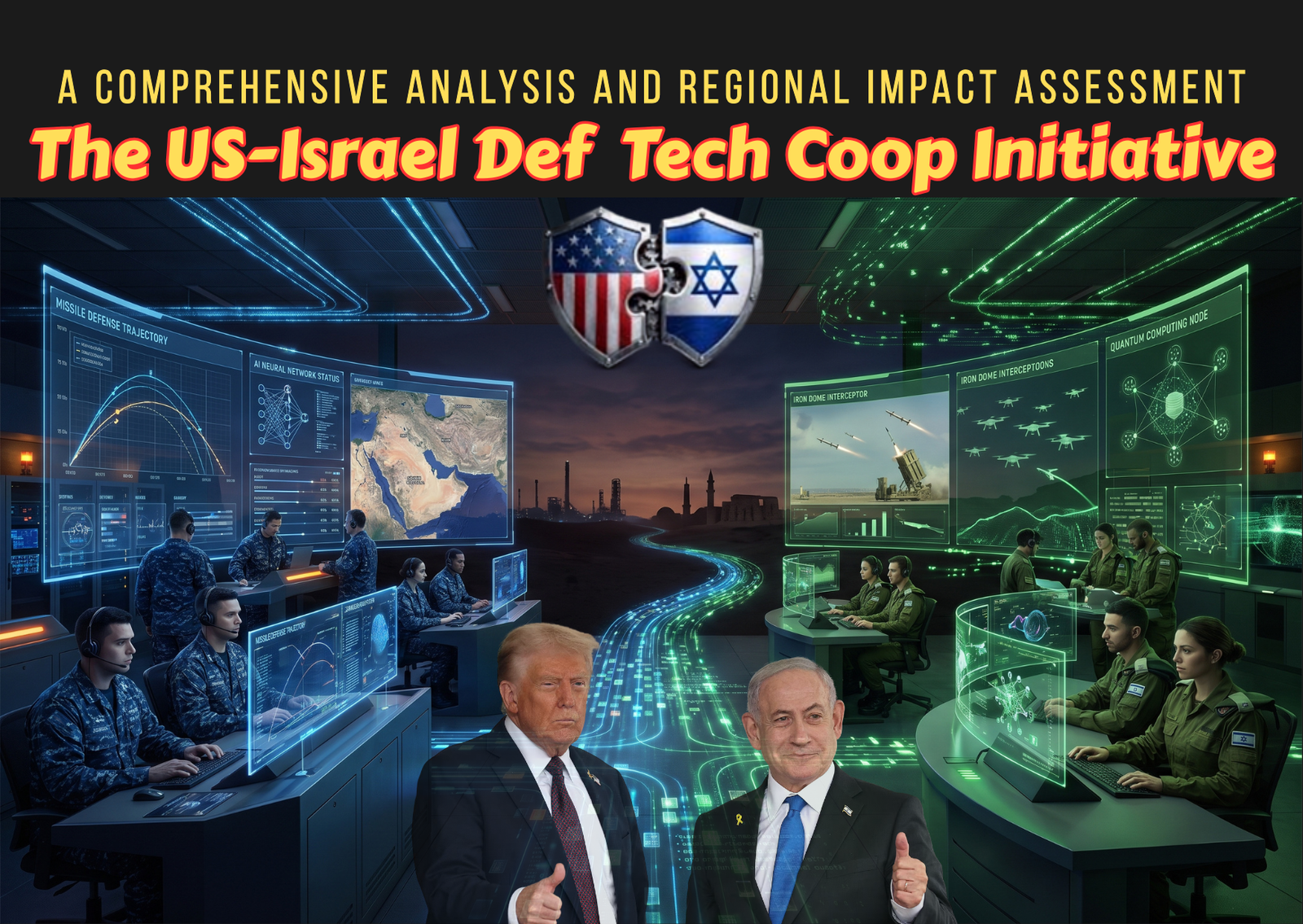
The “United States-Israel Defence Technology Cooperation Initiative” — embedded as Section 224 (later renumbered Section 219) of the FY2027 National Defence Authorisation Act (NDAA) — represents the most ambitious structural integration of two sovereign defence establishments in modern history. Authorising an unprecedented $1.15 trillion in overall defence spending, the NDAA directs the Secretary of Defence to designate an executive agent tasked with synchronising bilateral cooperation across six critical technology domains: artificial intelligence (AI), autonomous systems, cyber warfare, missile defence, space-based assets, and quantum computing.
The Executive Agent Mechanism
The executive agent provision is not merely bureaucratic window-dressing. It creates a single point of authority within the Pentagon — likely a three-star flag officer or senior civilian equivalent — with cross-cutting budgetary and programmatic power to:
- Accelerate joint R&D, testing, and evaluation (RDT&E)
- Mandate “network integration” between US and Israeli command-and-control systems
- Authorise “data fusion” protocols, enabling real-time intelligence and sensor-sharing
- Streamline industrial coproduction and technology transfer
“Network Integration” and “Data Fusion”: The Critical Ambiguity
The most consequential — and controversial — language in the provision concerns “network integration” and “data fusion”. These terms, while technically benign in defence lexicon, carry profound strategic implications:
- Network Integration implies interoperability at the tactical edge: linking Israeli Iron Dome, David’s Sling, and Arrow systems with US Patriot, THAAD, and future directed-energy architectures. It also suggests potential fusion of C4ISR (Command, Control, Communications, Computers, Intelligence, Surveillance, and Reconnaissance) networks.
- Data Fusion suggests shared sensor feeds, AI-driven targeting algorithms, and potentially pooled signals intelligence (SIGINT) and geospatial intelligence (GEOINT) streams.
Critics have not held back in their assessment. The Quincy Institute’s Responsible Statecraft argued that the provision “essentially transforms Israel from a top U.S. aid recipient to a full member of the U.S. defense and intelligence apparatus.” Netanyahu himself endorsed this framework in a June 2026 letter to Representative Marlin Stutzman, thanking him for supporting “my plan” for “joint defense cooperation, codevelopment, coproduction, and mutual investment.”
“In no way does it give away command and control of our military operations, personnel, or equipment.” — Representative Mike Rogers, Chairman, House Armed Services Committee
III. Analysis of the Initiative
| Strengths | Weaknesses |
|---|---|
| Technological synergy: Israeli niche capabilities (Unit 8200 cyber, Iron Dome, Arrow-3, Heron UAVs) complement US platforms | Constitutional and legal ambiguity around the “executive agent” and “network integration” language |
| Deterrence multiplier: fused sensor-shooter network creates overlapping defensive architecture against Iran and proxies | Technology leakage risk: Israel’s documented history of technology diversion raises exposure at source-code level |
| Industrial base resilience: coproduction (Iron Dome in US, Arrow-3 components) diversifies supply chains | Congressional oversight erosion: consolidating authority under one executive agent reduces transparency |
| Intelligence advantage: Israeli HUMINT and SIGINT in the Middle East are unmatched by any US ally | Asymmetric dependency: Israeli defence sector benefits disproportionately from US R&D funding |
Table
| Opportunities | Threats |
|---|---|
| Extending the architecture to Gulf states (UAE, Bahrain, Saudi Arabia) as an “Abraham Accords” defence dimension | Regional arms race escalation: Iran will accelerate missile, drone, and nuclear programmes |
| Countering Chinese technology infiltration (Huawei 5G, DJI drones, BeiDou) in the Middle East | Alienation of key Muslim allies: reinforces perceptions of a “US-Israel military bloc” against the Islamic world |
| Accelerating next-generation warfare by fusing US JADC2 with Israeli battle-tested systems | NATO fracture: Turkey will view this as further evidence of US unreliability, pushing toward Eurasian partnerships |
| Creating combat-proven innovations faster than either nation could achieve alone | Blowback from intelligence fusion: Israeli access to US systems could drag America into unauthorised conflicts |
IV. Regional Impact Matrix: Pakistan, KSA, and Turkey
A. Pakistan: The Nuclear-Conventional Dilemma
Pakistan occupies a uniquely precarious position. It is the only Muslim-majority nuclear weapons state, maintains a sophisticated conventional military, and has recently signed a landmark trilateral defence agreement with Saudi Arabia and Turkey (August 2026) alongside bilateral pacts with Somalia and Kuwait.
Direct Threats from the Initiative:
- Missile Defence Asymmetry: Pakistan’s strategic deterrent rests on a triad of ballistic missiles (Shaheen, Ghauri, Nasr), cruise missiles (Babur, Ra’ad), and air-launched platforms. A fused US-Israel missile defence network with AI-driven discrimination capabilities could, in theory, erode Pakistan’s assured second-strike capability — not immediately, but over a 10 to 15 year horizon as the architecture matures.
- Cyber Vulnerability: Pakistan’s critical infrastructure — including nuclear command-and-control (NC3) systems — relies on a mix of indigenous and Chinese technology. The US-Israel cyber fusion centre could develop tailored offensive capabilities against Pakistani networks, particularly if Islamabad is perceived as enabling Iranian proliferation.
- Air Superiority Gap: The Pakistan Air Force (PAF) operates JF-17 Block III fighters, F-16s, and is inducting Chinese J-10Cs. However, a US-Israel collaborative ecosystem producing next-generation autonomous combat aircraft, loyal wingman drones, and AI-enabled electronic warfare could render Pakistan’s fleet obsolete within a decade unless matched by Chinese sixth-generation equivalents.
Strategic Responses Available to Pakistan:
| Response | Details |
|---|---|
| Deepening the China-Pakistan Defence Compact | Demand accelerated transfers of HQ-19 missile defence, PL-15 long-range AAMs, and quantum-encrypted communications from Beijing |
| Leveraging the KSA-Turkey-Pakistan Trilateral | Position Pakistan as the technology bridge: nuclear deterrence consultation, missile expertise, and battle-hardened military experience in exchange for Saudi financing and Turkish drone/AI systems |
| Indigenous AI and Autonomy Programmes | Emergency funding to NUST and KRL to develop sovereign AI-targeting and drone swarming capabilities |
Net Assessment: Pakistan faces a widening technology gap but possesses asymmetric counters (nuclear deterrence, geographic depth, Chinese partnership). The initiative will likely accelerate Pakistan’s pivot away from US defence technology entirely — a process already underway since the 1990s Pressler Amendment trauma.
B. Kingdom of Saudi Arabia: Vision 2030 vs. Security Dependence
Saudi Arabia’s defence posture is defined by a contradiction: it spends among the highest percentages of GDP on defence globally (7 to 8 per cent), yet remains critically dependent on US platforms (F-15s, Patriot, THAAD) and personnel. Vision 2030 seeks to localise 50 per cent of defence spending by 2030, but the US-Israel initiative complicates this trajectory.
Impact Pathways:
- Technology Access Denial: The NDAA initiative explicitly restricts the most sensitive AI, quantum, and cyber technologies to Israel. Saudi Arabia, despite being a major US arms purchaser, will remain a tier-two partner. This reinforces Crown Prince Mohammed bin Salman’s (MBS) frustration with Washington’s “ally-but-not-equal” treatment.
- Missile Defence Dilemma: Saudi Arabia’s critical infrastructure — oil facilities, desalination plants, royal palaces — remains vulnerable to Iranian and Houthi missile/drone strikes. The US-Israel fusion could theoretically extend coverage to Saudi airspace, but Riyadh fears Israeli intelligence access to Saudi defence networks and sovereign airspace data.
- The China Alternative Accelerates: Already, Saudi Arabia has purchased Chinese Wing Loong drones, ballistic missiles (DF-21 derivatives), and is negotiating for HQ-19 air defence. The US-Israel initiative will likely push Riyadh to diversify further — potentially including joint R&D with China on AI and hypersonics, despite US pressure.
- Pakistan as a Substitute Partner: The August 2026 trilateral defence agreement with Pakistan and Turkey offers Saudi Arabia a “Muslim-majority technology coalition” that bypasses the US-Israel axis. Pakistan’s missile expertise, Turkey’s drone industry, and Saudi financing create a viable — if less advanced — alternative ecosystem.
Yemen Factor: The resumption of Saudi-Houthi hostilities makes air defence existential. If the US-Israel initiative produces integrated counter-drone and cruise missile systems that are withheld from Saudi Arabia, Riyadh may conclude that Washington is an unreliable security guarantor — accelerating the pivot to Beijing and Moscow.
Net Assessment: Saudi Arabia will publicly maintain US ties while privately accelerating diversification. The US-Israel initiative is a catalyst, not the cause, of Saudi strategic hedging.
C. Turkey: The Eurasian Pivot Accelerant
Turkey is perhaps the most consequential case study. As a NATO member with the alliance’s second-largest army, yet increasingly estranged from Washington, Ankara’s response to the US-Israel initiative will shape the broader Muslim world’s defence trajectory.
Points of Friction:
- NATO’s Technology Apartheid: The US-Israel initiative creates a “first-class” defence technology tier from which Turkey is excluded. This confirms President Erdogan’s long-standing narrative that NATO is a vehicle for US-Israeli interests, not Turkish security.
- S-400 Legacy and CAATSA Sanctions: Turkey’s purchase of Russian S-400s (2019) triggered US sanctions and F-35 expulsion. The new initiative effectively closes the door on Turkey ever rejoining the US technology ecosystem. Ankara now has no incentive to return to US dependency.
- Bayraktar and Defence Autonomy: Turkey’s Baykar (Bayraktar TB2, Akinci, Kizilelma) has already demonstrated that middle-power defence industrial autonomy is achievable. The US-Israel initiative will push Ankara to:
- Expand Bayraktar exports to Pakistan, Azerbaijan, Qatar, Somalia, and potentially Saudi Arabia
- Develop sovereign AI-targeting systems and electronic warfare suites
- Deepen defence R&D with Ukraine, South Korea, and Pakistan
- Regional Ambitions Under Pressure: Turkey operates in Syria, Iraq, Libya, and the Caucasus. A US-Israel fused intelligence network could surveil Turkish military movements in real-time, sharing data with Kurdish YPG/SDF forces in Syria or Greek Cypriot militaries. This is an existential concern for Turkish military planners.
The Trilateral Agreement as Counter-Weight: The August 2026 KSA-Turkey-Pakistan defence pact is Turkey’s institutional response. By anchoring itself in a Muslim-majority security architecture, Ankara:
- Reduces bilateral dependency on any single power
- Creates export markets for Turkish defence products
- Gains diplomatic leverage in future NATO negotiations
Net Assessment: Turkey has already crossed the Rubicon on US defence dependency. The US-Israel initiative merely buries the corpse. Ankara will double down on Eurasian partnerships (Russia, China, Central Asia) while using the trilateral pact to build a parallel technology ecosystem.
V. Second-Order Effects: The Hidden Transformations
1. The Cyber Deterrence Shift
A fused US-Israel cyber warfare centre creates an offensive capability against Iranian, Syrian, and potentially Pakistani networks. However, it also paints a massive target on US and Israeli critical infrastructure. Iran’s APT groups (Charming Kitten, APT33), Russia’s GRU, and China’s PLA Unit 61398 will prioritise penetrating this fused network — making it both the sword and the Achilles’ heel.
2. Intelligence-Sharing Asymmetries
Israel’s intelligence services (Mossad, Aman, Shin Bet) operate with fewer legal constraints than US agencies (CIA, NSA, DIA). Data fusion risks “polluting” US intelligence with Israeli assessments — particularly on Iran’s nuclear programme — that may be politically motivated rather than objectively verified. The 2003 Iraq WMD debacle demonstrates the dangers of fused intelligence with an ally possessing its own agenda.
3. The Arms Race Multiplier
For every US-Israel breakthrough in AI targeting or hypersonic defence, Iran will seek a countermeasure from Russia or China. Pakistan will demand Chinese equivalents. Saudi Arabia will shop globally. The initiative does not create security; it accelerates the regional arms race while consolidating US-Israel technological dominance.
4. The “Technology Gap” for Non-Aligned Militaries
Muslim-majority militaries outside the US orbit — Pakistan, Turkey, Iran, Indonesia, Malaysia — face a generational technology gap. They cannot match US-Israel AI, quantum, or space capabilities within a decade. Their only viable strategy is asymmetric deterrence: nuclear weapons (Pakistan), mass drone swarms (Iran), proxy networks (multiple), and cyber disruption.
VI. Strategic Scenarios: Three Futures
| Scenario | Probability | Description |
|---|---|---|
| A: Initiative Succeeds and Deepens | 45% | Executive agent streamlines cooperation. Joint AI combat systems enter service by 2030. Architecture extends to UAE and Bahrain. Iran is contained but not defeated. Pakistan, KSA, and Turkey accelerate Chinese/Russian partnerships. Middle East bifurcates into US-Israel bloc vs. China-Russia-Iran-Turkey-Pakistan alignment. Arms race intensifies. |
| B: Congressional/Political Rollback | 25% | Future administration or Congress, alarmed by technology leakage or entrapment risks, defunds the initiative. Executive agent dissolved. Israel relegated to traditional aid-recipient status. Arab states cautiously re-engage Washington. Pakistan and Turkey slowly normalise ties. Regional multipolarity continues at slower pace. |
| C: Counter-Alliance Formation | 30% | KSA-Turkey-Pakistan trilateral expands to include Iran, Azerbaijan, Malaysia, Indonesia. China provides technology backbone (5G, AI, drones, missiles). Russia offers nuclear and space cooperation. An “Organisation of Islamic Cooperation Defence Technology Pact” emerges as formal counterweight. Middle East becomes theatre of great-power proxy competition reminiscent of the Cold War — but with AI and autonomous weapons. |
VII. Conclusion: The New Architecture of Inequality
The United States-Israel Defence Technology Cooperation Initiative is not merely a defence agreement. It is a declaration of technological apartheid — a formalisation of a two-tier global security order in which Israel sits at the apex of US defence architecture, while Muslim-majority allies are relegated to platform purchasers, not partners.
“It takes money to kill bad guys. So we’re going back to Congress and our folks there to ensure that we’re properly funded.” — Secretary of Defence Pete Hegseth, on Pentagon funding priorities
For Pakistan, the initiative confirms the irreversibility of its China pivot and validates its nuclear deterrent as the ultimate asymmetric equaliser. For Saudi Arabia, it accelerates the painful but necessary diversification away from US dependency. For Turkey, it removes any lingering ambiguity about NATO’s value and cements Ankara’s Eurasian destiny.
The deeper tragedy is that this initiative, sold as a deterrent against Iran, will likely produce the very instability it claims to prevent. By fusing the world’s most advanced military with its most regionally embattled ally, Washington has made a wager: that technological superiority can substitute for diplomatic legitimacy. History suggests otherwise. The Muslim world’s response — the KSA-Turkey-Pakistan trilateral, the Iranian-Russian-Chinese axis, the accelerating arms race — is already writing the next chapter.
And in that chapter, the US-Israel initiative may be remembered not as the foundation of regional security, but as the catalyst for its fragmentation..