(By Khalid Masood)
1. Introduction & Background
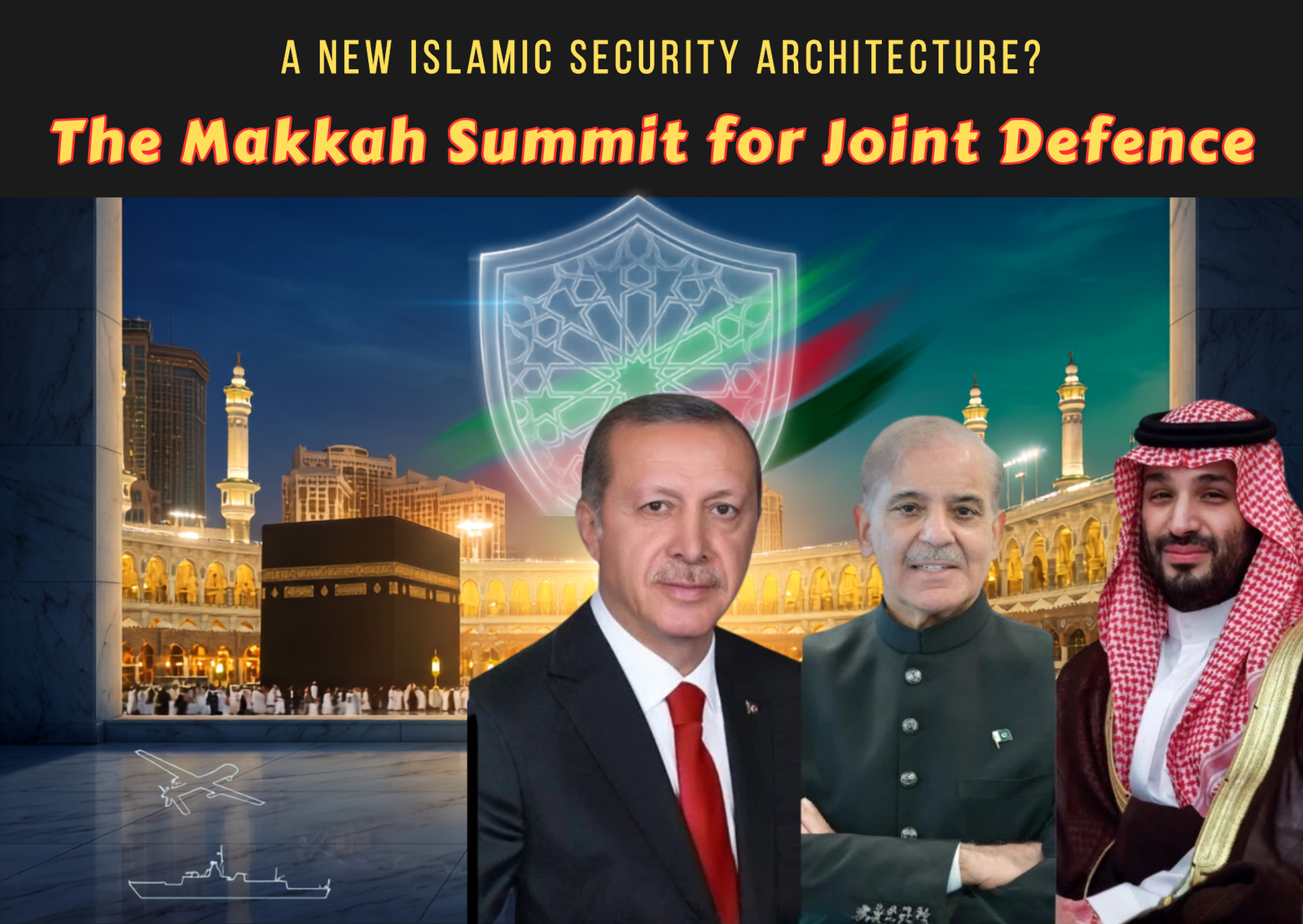
On 7 August 2026, the geopolitical landscape of the Muslim world shifted perceptibly when the Makkah Al-Mukarramah Summit for Joint Defence culminated in a trilateral defence pact among three of the most consequential Sunni-majority military powers: the Kingdom of Saudi Arabia, the Republic of Türkiye, and the Islamic Republic of Pakistan. Convened at the gracious invitation of the Custodian of the Two Holy Mosques, King Salman bin Abdulaziz Al Saud, and hosted at Al-Safa Palace in Makkah, the summit brought together Crown Prince Mohammed bin Salman bin Abdulaziz Al Saud (who also serves as Prime Minister), President Recep Tayyip Erdoğan of Türkiye, and Prime Minister Muhammad Shehbaz Sharif of Pakistan.
The timing and symbolism of the venue were deliberate. Makkah, the spiritual heart of the Islamic world, provided a setting that transcended mere statecraft and framed the agreement within the language of Islamic solidarity and brotherhood. The summit occurred on 24 Safar 1448H, a date chosen with care to underscore the religious dimension of this strategic realignment.
The Makkah Joint Defence Agreement establishes a mutual defence clause modelled on Article 5 of the North Atlantic Treaty: an armed attack against any one of the three States shall be regarded as an attack against them all. Beyond this collective security guarantee, the agreement commits the parties to “the enhancement of all aspects of defence cooperation,” signalling an ambition that extends far beyond a paper alliance into the realms of joint operations, intelligence sharing, defence industrial collaboration, and strategic deterrence.
To understand the weight of this development, one must appreciate the historical, religious, and strategic threads that bind these three nations. Saudi Arabia, as the guardian of the Two Holy Mosques and the world’s largest oil exporter, commands immense financial and religious capital. Pakistan, the only Muslim nuclear power, possesses a battle-hardened military with extensive experience in conventional and sub-conventional warfare. Türkiye, a NATO member with the alliance’s second-largest standing army, has emerged as a regional military-industrial powerhouse, particularly in unmanned aerial systems, electronic warfare, and precision-guided munitions. Together, they represent a contiguous arc of influence stretching from the Bosphorus to the Indus, encompassing the Arabian Peninsula and linking the Middle East with South Asia.
2. Strategic Rationale: Why Now?
The question of timing is critical. Why August 2026? Why these three states? Why a formal mutual defence treaty rather than the informal cooperation that has characterised their relations for decades?
Regional Instability and Threat Perceptions
The immediate geopolitical context is one of acute regional instability. In the Middle East, the aftermath of prolonged conflicts in Yemen, Syria, and Libya has left the region fragmented and vulnerable to external manipulation. Saudi Arabia, despite its vast military expenditure, has faced persistent security challenges from Iranian-backed proxies along its southern and eastern peripheries. The Kingdom’s strategic calculus has increasingly favoured deterrence through diversified partnerships rather than sole reliance on the United States—a trend accelerated by perceived American retrenchment from the region and Washington’s pivot toward great-power competition with China.
For Pakistan, the security environment has grown increasingly precarious. The eastern border with India remains heavily militarised, with periodic crises threatening escalation. Pakistan’s conventional military inferiority relative to India’s larger economy and expanding defence budget has placed enormous strain on Islamabad’s deterrence posture. While Pakistan’s nuclear arsenal provides strategic reassurance, the country requires economic and diplomatic backing to sustain its military readiness. Saudi Arabia’s financial resources and Türkiye’s emerging defence technology offer complementary solutions to Pakistan’s strategic dilemmas.
Türkiye, meanwhile, has pursued an assertive foreign policy under President Erdoğan, expanding its military footprint across the Middle East, North Africa, and the Caucasus. Ankara’s relationships with Western allies have become increasingly transactional and, at times, adversarial. The trilateral pact offers Türkiye strategic depth in the Gulf and South Asia, reducing its dependence on NATO frameworks while projecting power into regions where Turkish influence was historically limited.
Economic and Military Interdependencies
The economic logic underpinning the pact is compelling. Saudi Arabia possesses capital but seeks technological sovereignty in defence manufacturing. Pakistan offers a large, disciplined military workforce and nuclear deterrence credibility but requires sustained financial and energy support. Türkiye provides cutting-edge defence technology—particularly in drones, armoured vehicles, and naval systems—at competitive prices and with fewer political conditions than Western suppliers.
These complementarities create a natural division of labour within the alliance: Saudi financing, Turkish technology, and Pakistani manpower and strategic depth. The potential for joint defence industrial projects—ranging from co-production of unmanned aerial vehicles to collaborative missile development—could transform the military self-sufficiency of all three states.
Islamic Solidarity vs. Pragmatic National Interest
The Makkah Agreement is notable for its explicit invocation of “the enduring bonds of brotherhood and Islamic solidarity.” Yet seasoned analysts recognise that religious rhetoric, while politically valuable for domestic legitimacy, masks a hard-headed strategic calculation. None of these states has historically subordinated national interest to pan-Islamic solidarity when the two have conflicted. The decision to frame the pact in Islamic terms serves multiple purposes: it legitimises the alliance to domestic audiences, distinguishes it from Western-led security structures, and creates a narrative of Muslim self-reliance that resonates across the broader Islamic world.
Nevertheless, the religious dimension is not merely cosmetic. Shared Sunni identity facilitates intelligence cooperation, reduces cultural friction in joint operations, and provides a common ideological vocabulary for justifying collective action. In an era where sectarian polarisation continues to shape Middle Eastern politics, the explicit Sunni character of the pact carries both mobilising potential and significant risks.
3. Opportunities
For Saudi Arabia: Diversification and Strategic Depth
The primary advantage for Riyadh lies in the diversification of its security partnerships. For decades, Saudi Arabia’s defence posture rested on the American security guarantee, formalised through arms sales, basing arrangements, and the implicit promise of US intervention. The Makkah Pact represents a hedging strategy—a recognition that American commitments may not be eternal and that regional threats require regional solutions.
Access to Pakistan’s nuclear umbrella, even if informal and ambiguous, adds a new dimension to Saudi deterrence. While Riyadh has invested heavily in its own ballistic missile programme, the knowledge that Pakistan’s nuclear forces stand behind the mutual defence clause provides psychological reassurance against existential threats. Equally significant is Saudi access to Turkish drone technology. Bayraktar TB2s and their successors have revolutionised modern warfare, and Turkish-Saudi collaboration in this domain could accelerate the Kingdom’s indigenous drone capabilities.
For Türkiye: Expanding the Ankara Sphere
President Erdoğan’s strategic vision has long sought to restore Türkiye’s historical influence across the former Ottoman domains. The Makkah Pact extends this ambition into the Gulf and South Asia—regions where Turkish power projection was previously limited. For Ankara, the agreement opens defence export markets on an unprecedented scale. Saudi Arabia and Pakistan represent two of the world’s largest arms importers, and Turkish defence firms stand to gain enormously from preferential procurement arrangements.
Strategically, the pact provides Türkiye with leverage against its Western allies. As a NATO member participating in a non-NATO mutual defence treaty, Ankara occupies a unique position that complicates alliance discipline while enhancing its bargaining power. The ability to threaten closer alignment with a Saudi-Pakistani axis gives Türkiye additional negotiating currency in its often-fraught relationships with Washington and Brussels.
For Pakistan: Economic Lifeline and Military Modernisation
For Islamabad, the benefits are perhaps the most immediately tangible. Pakistan’s economy has teetered on the brink of crisis for years, with foreign exchange reserves insufficient to cover essential imports, including energy. Saudi financial backing—whether through deferred oil payments, direct budgetary support, or investment in the China-Pakistan Economic Corridor—could stabilise Pakistan’s fiscal position and reduce its dependence on the IMF.
Militarily, Pakistan gains access to Turkish defence technology that Western suppliers have been reluctant to provide. The Pakistan Army’s modernisation needs are extensive, spanning main battle tanks, air defence systems, naval vessels, and aerospace capabilities. Turkish systems, designed for similar operational environments and threat profiles, offer better interoperability prospects than Chinese or American alternatives. Furthermore, the diplomatic leverage gained against India is substantial. New Delhi must now calculate not only Pakistan’s individual capabilities but the potential for Saudi and Turkish involvement in any future conflict—a scenario that would dramatically complicate Indian strategic planning.
Collective Benefits: Toward an Islamic Military Bloc
The most ambitious proponents of the Makkah Pact envision its evolution into something resembling an “Islamic NATO”—a standing military alliance capable of collective deterrence, crisis response, and peace enforcement across the Muslim world. Even in its initial form, the agreement enables joint training exercises, standardised operating procedures, and shared intelligence assessments that could dramatically improve the combat effectiveness of all three militaries.
The potential for a joint rapid-reaction force, while not explicitly mandated in the current agreement, represents a logical next step. Such a force could deploy to conflict zones within the Islamic world—whether for humanitarian intervention, counter-terrorism operations, or deterrence missions—without relying on Western logistical support or UN mandates.
4. Risks & Challenges
Internal Cohesion: The Divergence Problem
For all its symbolic unity, the Makkah Pact faces profound internal cohesion challenges. The three member states harbour fundamentally different threat perceptions. Saudi Arabia’s primary strategic anxiety centres on Iran and its proxy network; Pakistan’s fixation remains India; Türkiye’s concerns span Kurdish separatism, Syrian instability, and Aegean tensions with Greece. An attack on Pakistan by India would activate the mutual defence clause—but would Saudi Arabia and Türkiye genuinely commit forces to a South Asian war? Conversely, would Pakistan send troops to defend Saudi Arabia against Iranian-backed Houthis or direct Iranian aggression?
These questions expose the “commitment problem” inherent in all alliances: the gap between treaty obligations and political will. Leadership rivalries compound this fragility. Crown Prince Mohammed bin Salman, President Erdoğan, and Prime Minister Shehbaz Sharif operate within distinct political systems and face different domestic constraints. Erdoğan’s assertive personal diplomacy has sometimes alienated potential partners; MBS’s controversial record raises questions about long-term stability; Sharif’s government depends on fragile civilian-military relations that could shift abruptly.
Great-Power Dynamics: Navigating the Backlash
The international reaction to the Makkah Pact will significantly shape its viability. The United States faces an acute dilemma: Saudi Arabia remains a key regional partner, and Pakistan has historically oscillated between American and Chinese orbits. A formal Saudi-Pakistani-Turkish alliance that excludes Washington challenges the US-led security architecture that has dominated the Middle East since 1945. While the US may tolerate the pact as a regional initiative, serious friction could emerge if the alliance undermines American interests—particularly regarding Iran policy, Israel’s security, or arms sales competition.
China presents a different challenge. Beijing has invested heavily in Pakistan through CPEC and maintains significant energy interests in Saudi Arabia. A trilateral pact that strengthens Pakistan’s hand relative to India aligns with Chinese interests, but Beijing may resent Turkish influence in a region where China seeks predominance. Russia, meanwhile, watches with concern as Turkish power expands into areas Moscow considers within its sphere.
For Türkiye, the NATO dimension is particularly delicate. Article 5 of the North Atlantic Treaty and Article 1 of the Makkah Pact could conceivably come into conflict. If Pakistan were attacked by India, and Türkiye invoked the Makkah mutual defence clause, would NATO allies be obligated to support Ankara? The legal ambiguity is profound and potentially destabilising for alliance cohesion.
Economic Viability: The Fiscal Burden
Military alliances are expensive. Joint exercises, interoperable equipment, shared command structures, and potential force deployments require sustained financial commitments that may strain the weaker economies. Pakistan’s fiscal position is precarious; Türkiye has faced currency crises and inflationary pressures; even Saudi Arabia, while wealthy, has embarked on ambitious domestic transformation programmes (Vision 2030) that compete for resources.
Saudi conditionality is another concern. Riyadh’s financial support has historically come with strings attached—demands for policy alignment, military commitments, or diplomatic support that may not always serve Pakistani or Turkish interests. If the alliance becomes perceived as a Saudi patronage network rather than a partnership of equals, resentment could erode its foundations.
Operational Hurdles: The Interoperability Nightmare
Perhaps the most technically daunting challenge is military interoperability. The three armies operate equipment from incompatible sources: Saudi forces rely predominantly on American and European systems; Pakistan maintains a mix of Chinese, American, and indigenous platforms; Türkiye has developed its own defence industrial base while retaining NATO-standard equipment. Creating integrated command-and-control networks, shared logistics, and joint operational doctrines from this heterogeneity will require years of effort and substantial investment.
Intelligence-sharing trust deficits present another obstacle. Saudi Arabia and Pakistan have cooperated closely for decades, but Turkish integration into this relationship is newer and untested. Each state possesses sensitive intelligence capabilities and sources they may be reluctant to share fully. Without robust intelligence fusion, the alliance’s operational effectiveness remains theoretical.
Regional Escalation: Provoking Counter-Alliances
The most dangerous risk is that the Makkah Pact triggers the very conflicts it seeks to deter. India, observing a Saudi-Pakistani-Turkish alignment, may accelerate its own defence partnerships—deepening ties with Israel, the United States, France, and potentially Iran. Tehran, perceiving encirclement by a Sunni military bloc, could redouble its support for proxies across the region and accelerate its own nuclear and missile programmes.
An India-Iran-Israel axis, while currently informal and limited, could crystallise into a genuine counter-alliance. Such a development would transform the Middle East and South Asia into rigidly bipolar regions, increasing the likelihood of great-power proxy competition and reducing diplomatic flexibility for all actors.
5. Future Implications
Short-Term (2026–2028): Institutional Foundations
In the immediate aftermath of the summit, the three states will likely focus on building institutional frameworks. Expect the establishment of a permanent secretariat—possibly in Riyadh or Islamabad—to coordinate defence planning and joint exercises. Initial military activities will probably include trilateral naval exercises in the Arabian Sea, air force drills in Saudi Arabia, and special forces training exchanges.
Defence procurement deals will move quickly. Pakistan is likely to finalise agreements for Turkish naval vessels and air defence systems, while Saudi Arabia may invest in Pakistani ballistic missile technology and Turkish drone production lines. These transactions will serve dual purposes: enhancing capabilities and demonstrating alliance credibility.
Medium-Term (2028–2032): Deepening Integration
If the alliance survives its teething problems, the medium term could see the creation of formal military command structures—perhaps a Trilateral Defence Council with operational authority during crises. Joint defence industrial projects may mature into co-development programmes for drones, cruise missiles, cyber warfare tools, and perhaps even space-based surveillance assets.
The nuclear dimension will require careful management. Pakistan’s nuclear arsenal, covered implicitly by the mutual defence clause, creates ambiguity that could be stabilising (through deterrence) or destabilising (if adversaries perceive a Saudi pathway to nuclear weapons). The three states will need to develop clear doctrines regarding nuclear signalling and escalation control.
Long-Term (2032+): An Islamic NATO?
The most speculative but consequential question is whether the Makkah Pact could evolve into a broader Islamic military alliance. Expansion to include other major Muslim states—Indonesia, Egypt, Bangladesh, Malaysia—would create a genuinely global security organisation. However, such expansion would dilute the current members’ influence and introduce new fault lines.
Alternatively, the pact could serve as a caucus within the Organisation of Islamic Cooperation (OIC), transforming that largely symbolic body into a vehicle for collective security. This would represent a revolutionary development in Islamic world politics, shifting the OIC from diplomatic coordination to military integration.
For Gulf security architecture, the pact challenges the existing American-dominated order. If Saudi Arabia can rely on Pakistani and Turkish security guarantees, its incentive to maintain close US ties diminishes—though it would be premature to predict a Saudi departure from the American orbit entirely.
Great-power realignment will be the ultimate test. The US may seek to co-opt the alliance, offering technology and intelligence sharing in exchange for influence. China may attempt to leverage its Pakistani relationship to shape alliance policy. Russia could exploit Turkish ambivalence toward NATO to drive wedges between Ankara and its Western allies. The ability of the three member states to maintain strategic autonomy amid these competing pressures will determine whether the Makkah Pact becomes an independent pole in international politics or merely a bargaining chip in others’ games.
6. Conclusion
The Makkah Al-Mukarramah Summit for Joint Defence represents neither a fleeting diplomatic gesture nor an immediate strategic revolution. It is, instead, a calculated gamble by three major Muslim powers to reshape their security environment through collective action rather than individual vulnerability. The mutual defence clause, modelled on the most successful alliance in modern history, provides a legal and moral foundation of genuine significance. Yet the gap between treaty text and operational reality remains vast.
The pact’s sustainability depends on overcoming three critical challenges: aligning divergent threat perceptions, managing great-power reactions, and building genuine military interoperability. Success in these areas could produce a durable security community that enhances the autonomy and influence of its members while contributing to regional stability. Failure could leave the alliance as a hollow framework—more impressive in declaration than in deed, and potentially provocative without being protective.
For Saudi Arabia, the pact offers a path toward strategic diversification that Vision 2030 alone cannot provide. For Türkiye, it extends Ankara’s influence into new regions while complicating its Western relationships. For Pakistan, it promises economic relief and military modernisation at a time of acute national vulnerability.
Whether the Makkah Joint Defence Agreement proves to be the foundation of a new Islamic security architecture or merely a footnote in diplomatic history will be determined not by the eloquence of its preamble but by the willingness of three proud nations to subordinate immediate interests to collective survival. In a region where alliances have historically been temporary and trust perennially scarce, that willingness remains the most uncertain variable of all.