(By Faraz Ahmed)
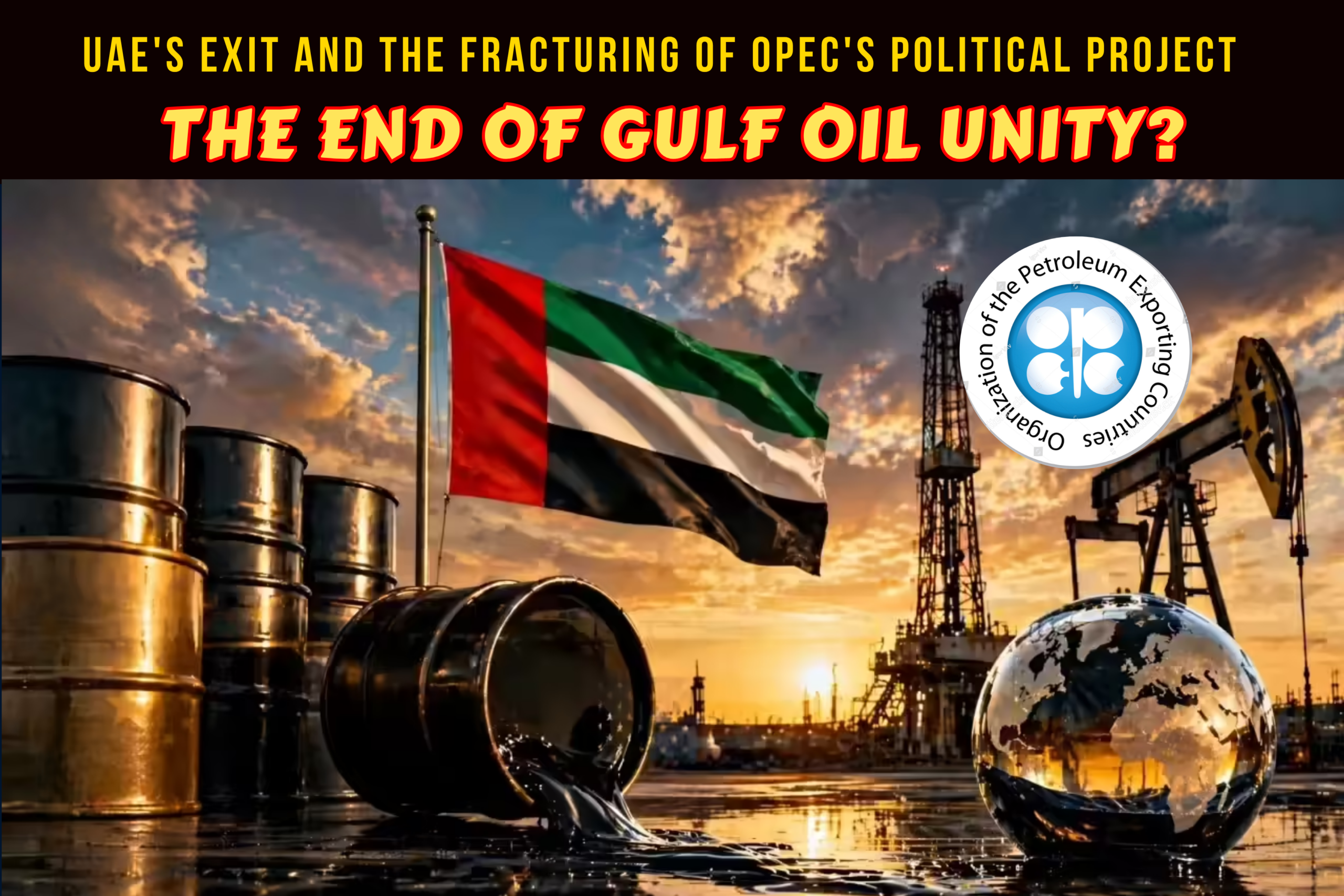
On 28 April 2026, the United Arab Emirates announced its formal withdrawal from both OPEC and the wider OPEC+ alliance, with the exit taking effect on 1 May. The decision ends nearly six decades of Emirati membership in an organisation that has long served as the institutional anchor of Gulf energy diplomacy.
While official statements frame the move as a pragmatic recalibration of production policy, the strategic implications extend far beyond barrel quotas and market management. The UAE’s exit signals the erosion of OPEC’s dual mandate: no longer merely an economic cartel, but a vehicle for Gulf political solidarity. In a multipolar era marked by regional security anxieties, energy transition pressures, and accelerating strategic autonomy, this is not simply an economic realignment. It is a geopolitical inflection point.
The Political DNA of OPEC: More Than a Cartel
OPEC was never conceived as a purely technical commodity forum. Founded at the Baghdad Conference in September 1960 by Iran, Iraq, Kuwait, Saudi Arabia, and Venezuela, the organisation emerged during the wave of decolonisation as a declaration of resource sovereignty. Its political character crystallised during the 1973 oil embargo, when producer states demonstrated that oil could function as both an economic instrument and a geopolitical lever.
For the Gulf monarchies, OPEC membership evolved into a confidence-building mechanism. It provided a structured platform for managing intra-regional competition, coordinating messaging towards Western consumers, and projecting collective influence in global affairs. The Gulf Cooperation Council (GCC), established in 1981, complemented this energy coordination with broader political and security alignment. Together, OPEC and the GCC formed the twin pillars of a Gulf order that prioritised unity as a stabilising force.
“OPEC’s endurance has always relied on the perception that producer solidarity outweighs individual gain. When that perception fractures, the institution loses its political gravity.”
— Energy Geopolitics Fellow, Centre for Strategic & International Studies (CSIS), April 2026 briefing
Yet, beneath the rhetoric of unity, divergent national strategies have repeatedly tested the organisation’s cohesion. The UAE’s exit does not emerge from a vacuum; it is the culmination of structural tensions that have been accumulating for years.
Cracks Beneath the Surface: Historical Fractures
The narrative of monolithic Gulf oil unity has always been overstated. Historical record shows that production disputes, capacity competition, and divergent economic visions have periodically strained OPEC’s internal dynamics.
The most visible rupture occurred in 2021, when Saudi Arabia and the UAE clashed publicly over baseline production quotas. Abu Dhabi argued that using October 2018 output levels unfairly constrained its expansion ambitions, while Riyadh prioritised market stability and price defence. Negotiations stalled for weeks, threatening OPEC+’s credibility until a compromise was brokered in 2023 that preserved Gulf interests at the expense of African producers.
| Period | Event | Underlying Tension | Outcome |
|---|---|---|---|
| 2014–2016 | Oil price collapse & quota discipline | Saudi market-share strategy vs. smaller producers’ revenue needs | Temporary cohesion, followed by OPEC+ creation (2016) |
| July 2021 | Saudi-UAE quota dispute | Baseline calculation & UAE capacity expansion targets | Stalled negotiations; eventual 2023 compromise |
| 2022–2024 | OPEC+ production cuts vs. domestic investment | Short-term price defence vs. long-term market share | Coordinated cuts maintained, but compliance fatigue grew |
| April 2026 | UAE announces OPEC/OPEC+ exit | National capacity strategy & strategic autonomy | Formal withdrawal effective 1 May 2026 |
These episodes reveal a consistent pattern: when national economic trajectories diverge from collective output management, institutional loyalty yields to sovereign calculation. The UAE’s decision formalises what has long been an informal reality.
Why Now? The Strategic Calculus Behind the Exit
The timing of the announcement is deliberate. Three interlocking factors explain Abu Dhabi’s strategic pivot:
1. Capacity Expansion Imperatives
The UAE currently produces approximately 3.4 million barrels per day (bpd), with state-owned ADNOC targeting 5 million bpd by 2027. OPEC quotas constrained this trajectory, forcing a choice between market coordination and long-term production growth. Abu Dhabi chose the latter.
2. Regional Security & Supply Chain Realities
The announcement coincides with heightened tensions in the Arabian Gulf, including shipping disruptions near the Strait of Hormuz and recurring Iranian threats to energy infrastructure. By exiting collective quota structures, the UAE positions itself to respond flexibly to supply shocks without requiring consensus.
3. Energy Transition Positioning
The UAE’s official statement emphasised a commitment to “lower-carbon barrels” and continued investment across oil, gas, renewables, and low-carbon technologies. Abu Dhabi is repositioning itself not as a traditional quota-bound producer, but as a modern, adaptable energy supplier aligned with global decarbonisation pathways.
“The UAE’s decision aligns with its broader national interest: maintaining flexibility to respond to market dynamics while continuing to contribute to stability in a measured and responsible manner.”
— UAE State News Agency (WAM), Official Statement, 28 April 2026
This framing is deliberate. It signals to global consumers that the UAE remains a reliable supplier, just no longer bound by multilateral production constraints.
Implications: Unpacking the Geopolitical Fracture
The UAE’s exit reverberates across three interconnected domains: OPEC’s institutional credibility, Gulf political architecture, and global energy security.
OPEC’s Political Legitimacy Diminishes
Saudi Arabia has long served as OPEC’s de facto swing producer and diplomatic anchor. The departure of a core GCC member undermines the perception of inevitable Gulf unity and weakens Riyadh’s capacity to coordinate collective action. OPEC may survive as a technical forum, but its political heft is diminished.
GCC Cohesion Under Scrutiny
In March 2026, GCC leaders publicly reaffirmed that “unity of position is a source of strength and stability for our countries.” Weeks later, the UAE’s unilateral energy move exposes the gap between diplomatic rhetoric and sovereign strategy. The GCC’s institutional credibility now hinges on whether members can maintain cooperation without energy coordination as a binding force.
Market Volatility & Consumer Strategy Shifts
Early trading sessions saw Brent crude push towards the $100/barrel threshold, reflecting market anxiety over reduced OPEC+ cohesion. Importing nations will likely accelerate strategic petroleum reserve reviews and diversify supply partnerships, recognising that Gulf production can no longer be treated as a monolithic bloc.
| Domain | Immediate Impact | Medium-Term Trajectory | Strategic Risk |
|---|---|---|---|
| OPEC Institutionality | Quota enforcement weakened; Saudi leadership challenged | Potential shift to informal coordination among remaining members | Cascading exits if national strategies diverge further |
| Gulf Political Architecture | GCC energy alignment fractured; diplomatic friction possible | Rise of bilateral energy deals; UAE positions as flexible supplier | Reduced crisis coordination capacity in regional conflicts |
| Global Energy Markets | Short-term price volatility; premium on non-OPEC supply | Consumer diversification; increased focus on strategic reserves | Structural uncertainty in long-term supply contracts |
Theoretical Lens: Realism, Institutionalism, and Strategic Autonomy
Understanding the UAE’s exit requires moving beyond market commentary and applying established international relations frameworks.
From a realist perspective, the decision is a textbook illustration of national interest prevailing over institutional loyalty. In an anarchic international system, states prioritise sovereignty, capacity expansion, and strategic flexibility. OPEC survives only as long as it aligns with member calculations; once misaligned, exit becomes rational.
Neoliberal institutionalism offers a complementary view: OPEC’s failure to adapt its quota architecture to shifting power dynamics (particularly the UAE’s growing capacity and diversification strategy) led to institutional decay. Organisations that cannot reform risk irrelevance.
A constructivist reading highlights shifting identities. The shared narrative of “Gulf producer solidarity” is being displaced by new strategic identities: climate-conscious energy exporter, logistics hub, sovereign wealth investor, and independent diplomatic actor. When identity narratives diverge, institutional cohesion fractures.
Conclusion: A Multipolar Gulf and the Future of Collective Action
The UAE’s withdrawal from OPEC and OPEC+ marks the end of a 66-year experiment in Gulf oil coordination that began in Baghdad in 1960. What started as a political project of resource sovereignty and collective leverage has ultimately yielded to the centrifugal forces of national strategy, capacity competition, and multipolar diplomacy.
This is not the death of OPEC, but it is a fundamental recalibration. The organisation will likely persist as a market management forum, but its political aura—the belief that Gulf states speak with one voice—has been irrevocably weakened. In its place emerges a more fragmented, flexible, and strategically autonomous Gulf energy landscape.
For policymakers, military planners, and conflict resolution specialists, the implications are clear: energy security can no longer be modelled on assumed Gulf unity. Supply chain resilience, diplomatic hedging, and scenario planning must account for a region where national interest routinely supersedes collective action.
The “Labour Day shock” of 1 May 2026 will be remembered not merely for its market impact, but as the moment when Gulf oil unity transitioned from an assumption to an open question. In a multipolar world, that question will only grow louder.
Frequently Asked Questions (FAQ)
Q: Why is the UAE leaving OPEC and OPEC+?
A: The UAE cites a comprehensive review of its production policy, national interest alignment, and the need for flexibility to respond to market dynamics. Abu Dhabi is also pursuing capacity expansion to 5 million bpd by 2027, which OPEC quotas constrained.
Q: Will the UAE’s exit cause oil prices to spike permanently?
A: Short-term volatility is expected, but long-term pricing will depend on actual UAE production increases, OPEC+’s remaining cohesion, and global demand trends. The UAE has stated it will act “responsibly” and align output with market demand.
Q: Does this mean the GCC is fracturing politically?
A: Not necessarily. The GCC covers broader security, economic, and diplomatic cooperation. However, the loss of OPEC coordination removes a key confidence-building mechanism, requiring Gulf states to rely more on bilateral diplomacy and crisis management frameworks.
Q: How will this affect global energy security?
A: Importing nations will likely diversify supply partnerships, review strategic petroleum reserves, and develop more flexible contracting mechanisms. The assumption of a unified Gulf supply bloc is no longer reliable for long-term planning.
Q: Can OPEC survive without the UAE?
A: OPEC will likely persist as a technical and market coordination body, but its political influence and capacity to enforce collective discipline will be diminished. Informal coordination among remaining members may replace formal quota structures.
___________________________________________________________