(By Khalid Masood)
(A former military officer and security expert)
A Familiar Story, A Different Era
The sound of gunfire near a presidential motorcade or event always sends a shockwave through the public. But beneath the headlines lies a quieter, decades-long story: how the people tasked with protecting leaders have adapted to threats that never stop evolving.
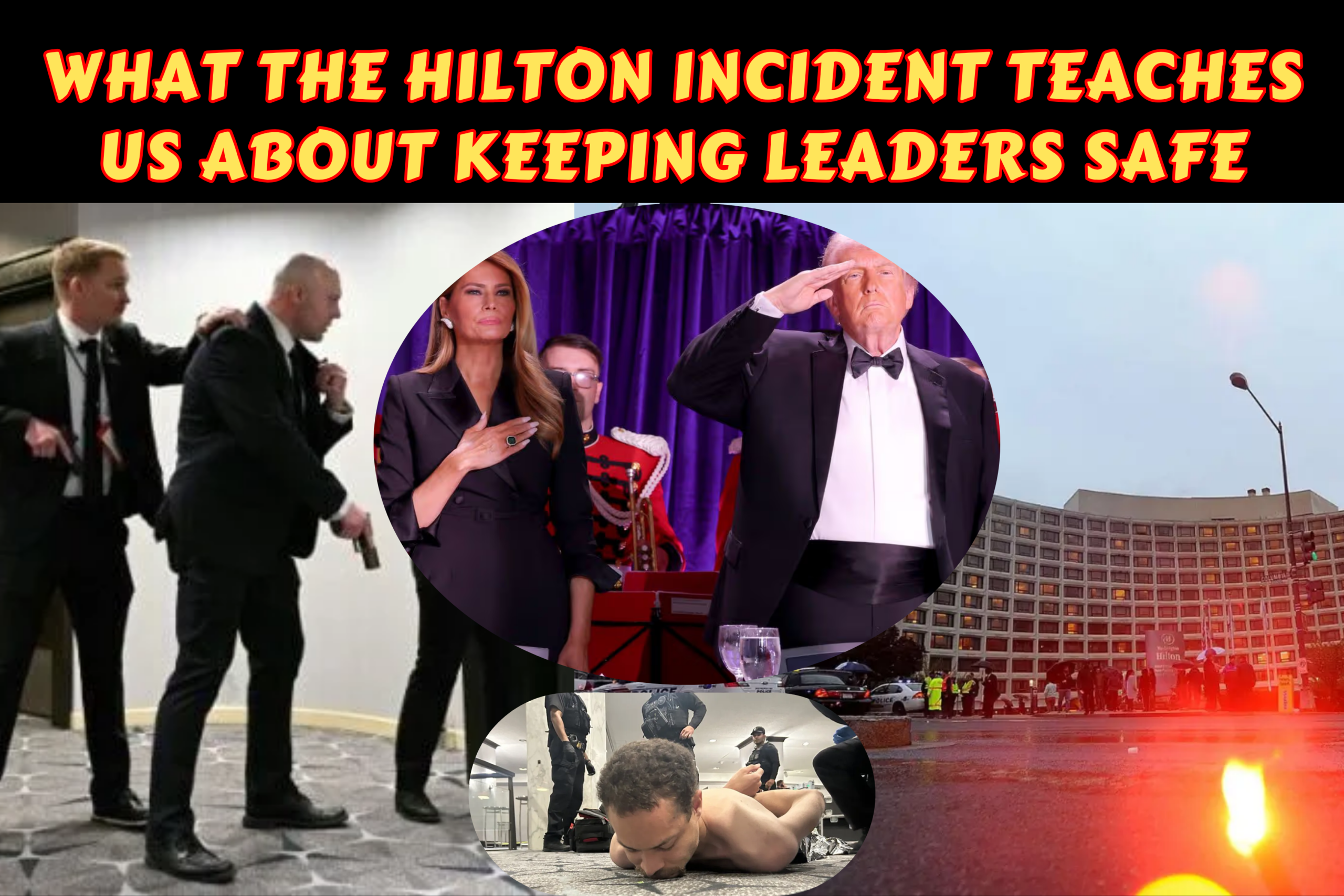
The April 25, 2026 incident at the Washington Hilton during the White House Correspondents’ Dinner is no exception. While investigators continue their work, the event offers a real-time window into how modern protective operations function under pressure. More importantly, it shows how far executive security has come—and where it still needs to improve.
This isn’t about politics. It’s about protocol, preparation, and the lessons history keeps repeating.
What Actually Happened (Verified Facts)
Before drawing conclusions, it’s important to ground the analysis in what’s been officially confirmed:
- Gunfire erupted near a security screening checkpoint at the Washington Hilton.
- The suspect, identified as Cole Tomas Allen, was stopped and taken into custody at the scene.
- One law enforcement officer was hit in a bullet-resistant vest and is expected to recover. The suspect sustained minor injuries during apprehension.
- President Trump, the First Lady, Vice President Vance, and accompanying officials were evacuated using standard protective procedures.
- Preliminary investigative materials suggest politically motivated intent. The case remains under active federal review.
Note: All details cited here come from official U.S. Secret Service statements, Department of Justice briefings, and accredited news reporting. Unverified social media claims and speculative narratives are excluded.
4 Lessons from the Hilton Incident (And Why History Matters)
1. Security Isn’t a Wall—It’s a Series of Filters
Modern executive protection doesn’t rely on a single checkpoint. It uses layered defence: multiple screening zones, credential verification, behavioral observation, and physical barriers that slow down or stop a threat before it reaches the principal.
Why it matters: The 1981 assassination attempt on President Ronald Reagan happened at this exact hotel. Back then, security was largely reactive. Screening was minimal, and the president walked through a public lobby with little buffer. That day, a shooter fired six rounds in seconds. Reagan survived, but the incident exposed a critical gap: protection had to move forward, not just stand guard.
Today’s protocols would look unfamiliar to 1981 planners. The Hilton incident tested those modern layers. While no system is perfect, the fact that the threat was contained at the outer screening zone shows how far layered defence has come. The lesson remains: distance, redundancy, and early intervention save lives.
2. Intelligence Comes Before the Trigger
Protective intelligence isn’t about predicting the future. It’s about connecting visible dots before someone acts. Agencies now track travel anomalies, digital footprints, grievance patterns, and behavioral red flags—not to punish thoughts, but to identify when planning crosses into action.
Why it matters: The 1963 assassination of President John F. Kennedy remains the most studied security failure in U.S. history. Advance work was rushed, route planning ignored known vulnerabilities, and warning signs were fragmented across agencies. After Dallas, the Secret Service completely overhauled how it gathers and shares threat data.
The Hilton incident underscores a modern reality: today’s threats rarely appear out of nowhere. They leave traces. The challenge isn’t collecting information—it’s fusing it across agencies fast enough to act. When intelligence works, the public never hears about the threats that were stopped before they reached a headline.
3. Evacuation Isn’t Panic—It’s Muscle Memory
When shots rang out at the Hilton, protective details didn’t wait for orders. They moved. Executives were guided to secure vehicles, routes were adjusted in real time, and local law enforcement synchronized with federal agents.
Why it matters: In June 2017, a gunman opened fire during a congressional baseball practice in Virginia. Within seconds, Capitol Police and Secret Service agents formed cover, moved principals to safety, and coordinated with EMS. The rapid response saved lives, including that of House Majority Whip Steve Scalise, who survived critical injuries thanks to immediate medical care.
Evacuation success isn’t about heroics. It’s about repetition. Protective teams drill degraded communications, blocked exits, and simultaneous threats until the response becomes automatic. The Hilton evacuation proved that training under pressure translates to action under fire.
4. Officer Safety = Principal Safety
The officer struck in a ballistic vest walked away with bruises, not a casket. That’s not luck. It’s the result of decades of investment in personal protective equipment, embedded trauma training, and rapid medical protocols.
Why it matters: In 1981, Secret Service Agent Tim McCarthy deliberately stepped into the line of fire to shield President Reagan. He took a bullet to the abdomen and survived after emergency surgery. His bravery bought critical seconds. Today, that same principle is engineered into gear, gear placement, and tactical positioning.
Modern protective details carry tourniquets, hemostatic gauze, and portable defibrillators. Officers train in tactical medicine so they can stabilize wounds before ambulances arrive. The lesson is straightforward: you can’t protect a leader if the people forming the shield aren’t protected themselves.
Why This Matters Beyond the Headlines
Executive protection isn’t just about presidents or vice presidents. It’s a blueprint for how institutions respond to unpredictable threats in open societies. The Hilton incident highlights three broader realities:
- Security is adaptive, not static. What worked five years ago may fail tomorrow. Agencies must continuously update training, tech, and protocols.
- Misinformation multiplies risk. In today’s information environment, unverified claims spread faster than official updates. Calm, factual communication is now a security requirement, not a PR preference.
- Public trust depends on transparency. When agencies share verified facts quickly and avoid speculation, they deny oxygen to conspiracy narratives and maintain institutional credibility.
The Bottom Line
History doesn’t repeat itself exactly, but it echoes. The 1963 Dallas motorcade, the 1981 Hilton lobby, the 2017 baseball field, and the 2026 screening checkpoint all share a common thread: threats evolve, but so do the people tasked with stopping them.
The Hilton incident didn’t reveal a broken system. It revealed a system under stress, functioning as designed, and providing fresh data for the next round of improvements. Executive protection will never be perfect. But it doesn’t need to be. It needs to be disciplined, adaptable, and grounded in verified lessons rather than viral speculation.
In an era where hybrid threats move at the speed of a smartphone notification, the most reliable safeguard isn’t a fortress. It’s a framework that learns, adjusts, and prioritizes facts over noise.