(By Khalid Masood)
A World in Transition
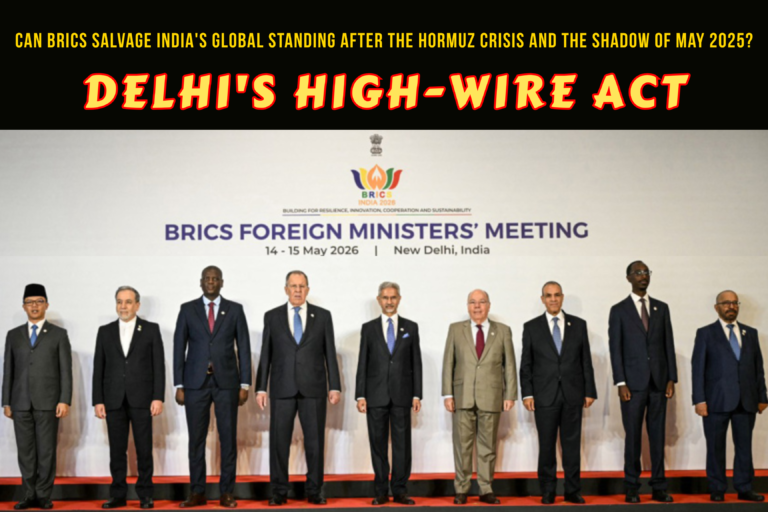
Something fundamental has shifted in the conduct of international politics, and the evidence is no longer confined to strategy papers in Washington and Beijing. It is visible in the eleven-member BRICS grouping that met in New Delhi in September 2026 — a body that did not exist two decades ago and now accounts for roughly 40 per cent of global GDP in purchasing-power terms. It is visible in the deserts of the Gulf, where in November 2026 American, Russian and Ukrainian negotiators held their first face-to-face talks in nearly nine months, with Europe pressing to be at the table. And it is visible in the fact that more than thirty countries, including Pakistan and even NATO member Türkiye, have sought entry into an organisation that Washington once dismissed as a marketing slogan.
The post-Cold War settlement rested on a single assumption: that American predominance — military, financial, technological — was not merely a condition of the era but its organising principle. For roughly three decades the United States functioned as what scholars called the system’s hegemon, underwriting security alliances, anchoring the dollar-based financial order and setting the terms of membership in the international community. That assumption has not collapsed, but it is no longer uncontested. China’s rise, Russia’s strategic resurgence — brutal and costly, but unmistakable — the growing ambitions of middle powers, and the increasingly transactional behaviour of America’s own allies have together complicated the international system in ways the strategists of the 1990s did not foresee.
The question this article addresses is not whether the world is changing; that much is evident. It is what kind of change we are witnessing, and what it means for the states, like Pakistan, that must navigate it.
The Principal Players: Strengths and Limits
The United States remains the most powerful single actor in international politics. Its defence budget exceeds that of the next nine countries combined, the dollar continues to dominate global trade and reserves, and its network of alliances — from NATO to the bilateral pacts in the Indo-Pacific — remains unmatched. America’s technological base, particularly in artificial intelligence, advanced semiconductors and aerospace, retains a substantial lead over any rival. Yet the Trump administration’s conduct of foreign policy has revealed the limits as well as the reach of that power. Washington has simultaneously waged economic warfare on several fronts — tariffs, export controls, sanctions — and discovered that economic interdependence, once a pillar of American influence, has become a channel through which others can retaliate. When Beijing slashed rare-earth and magnet exports in April 2025, it caught Washington and its European allies unprepared, and the leverage has persisted. The United States is still the strongest player on the board, but it can no longer dictate the game’s rules unilaterally.
China has converted three decades of breakneck growth into comprehensive national power. Its economy grew around 4.5 per cent in the first three quarters of 2026 — slower than the heady double-digit era, but from a base that now makes it the world’s largest economy in purchasing-power terms. Its manufacturing dominance, its control over critical minerals and its Belt and Road infrastructure network give it economic leverage that no Soviet planner possessed. Militarily, the People’s Liberation Army has modernised at remarkable speed, and its shipbuilding capacity now dwarfs America’s. Yet China has limits too: it remains dependent on imported energy, encircled by wary neighbours, constrained by American and allied export controls on advanced chips, and burdened by a property-debt hangover and demographic decline. Beijing has demonstrated enormous capacity to coerce; it has not yet demonstrated an equivalent capacity to lead. The question of whether economic mass can be converted into willing political followership remains open.
Russia, nearly five years into its war on Ukraine, illustrates both the persistence and the limits of military power. The conflict has consumed enormous quantities of men and materiel and failed in its maximalist objectives, yet Russia has not been isolated, broken or driven from international politics. Its nuclear arsenal guarantees it a permanent seat at every table that matters; its energy and grain exports have been redirected rather than eliminated; and its partnership with China has deepened into the most consequential strategic alignment in the world today. Moscow’s leverage over European security, demonstrated through its ability to extract serious consideration of its demands in the November 2026 talks, remains substantial. But the war has also exposed Russia’s weaknesses: an economy distorted by military mobilisation, demographic decline, and dependence on Chinese markets and technology that leaves it, in some respects, the junior partner in its own axis.
The European Union is a paradox of power. Collectively it is a market of 450 million people whose regulatory reach — the “Brussels effect” — shapes global standards from data protection to competition policy. Yet it remains militarily dependent on the United States, and that dependence was formalised rather than reduced when, under heavy American pressure, NATO’s 2025 Hague summit committed allies to spending 5 per cent of GDP on defence and security by 2035 — 3.5 per cent on core military capability and 1.5 per cent on resilience and related areas. Europe’s dilemma is structural: it has the wealth to be a great power but not yet the strategic unity, defence-industrial base or political will to act as one. The Ukraine war has accelerated rearmament; it has not yet resolved the question of whether Europe will emerge as a pole of power or remain a wealthy peninsula of the American security system.
India may be the most significant beneficiary of the current disorder. It is the world’s most populous country, it claims to be the third-largest economy in PPP terms, and a member of virtually every important grouping — BRICS (which it chaired in 2026), the G20, the Quad — while simultaneously deepening its strategic partnership with the United States and preserving its historic defence relationship with Russia. New Delhi’s multi-alignment is not indecision; it is a coherent strategy of maximising optionality. Its limitations are equally clear: a still-modest share of global manufacturing, dependence on imported energy and arms, and an unresolved border confrontation with China that erupted into lethal violence in 2020. India’s rise is real, but it is a rise of a decade, not of a year.
The Instruments of Power
What constitutes power in the twenty-first century? The classical answer — territory, population, military capability — remains necessary but is no longer sufficient. The instruments of geopolitical influence have diversified, and the interplay among them now defines the competition.
Military power retains its ultimacy: the November 2026 negotiations over Ukraine are, at bottom, about territory, security guarantees and the shadow of escalation, and Russia’s nuclear arsenal ensures that no settlement can ignore Moscow. Yet the war has also demonstrated that military superiority does not translate automatically into political success. Russia possesses the stronger army and has not achieved its aims; Ukraine, without comparable power, has preserved its statehood through Western-supplied capability and extraordinary societal resilience. Possessing force and converting it into desired political outcomes are different things.
Economic warfare has become the default instrument of statecraft. The United States deploys tariffs and export controls; China retaliates with controls on gallium, rare earths and semiconductor wafers; the European Union has built an Anti-Coercion Instrument it has so far hesitated to use. Interdependence, the great achievement of globalisation, has been weaponised by all sides. The lesson that middle powers have drawn is not that interdependence is bad but that dependence on a single power — for finance, technology, energy or security — is a strategic liability. De-risking has become the organising principle of economic policy from Tokyo to Riyadh.
Diplomacy has followed suit. Alliances are increasingly transactional: the Gulf states maintain defence relationships with Washington while deepening ties with Beijing and hosting BRICS summits; Türkiye remains inside NATO while purchasing Russian air-defence systems and mediating in Ukraine; India buys Russian oil, American weapons and French submarines simultaneously. The formal alliance system has not collapsed, but it is being overlaid by a web of flexible, issue-specific partnerships that reflect convergent interests rather than permanent friendship.
Technology has emerged as a distinct theatre of competition. Semiconductors sit at the centre of American strategy toward China precisely because they underpin everything else — AI, missile guidance, quantum computing, surveillance. Satellite networks, cyber capabilities and data governance now rank alongside tanks and aircraft carriers in strategic planning. The state that sets the standards, controls the chokepoints and attracts the talent will hold a decisive advantage in the decades ahead.
The New Strategic Battlegrounds
These instruments are being contested across a series of interconnected regions. In the Indo-Pacific, the defining struggle is between American alliances and China’s expanding maritime reach, with Taiwan as the most dangerous flashpoint and the semiconductor supply chain as the economic dimension of the same contest.
In Eastern Europe, the Ukraine war has become the crucible of the entire European security order; the November 2026 talks in Abu Dhabi, Moscow and Dublin — exploring ideas ranging from a frozen frontline to Ukrainian withdrawal from the Donbas in exchange for NATO membership — show that diplomacy has re-entered the game, but Russia’s insistence that Kyiv cede territory as a precondition for talks and its revival of demands to renegotiate the broader European security architecture underscore how much remains unsettled.
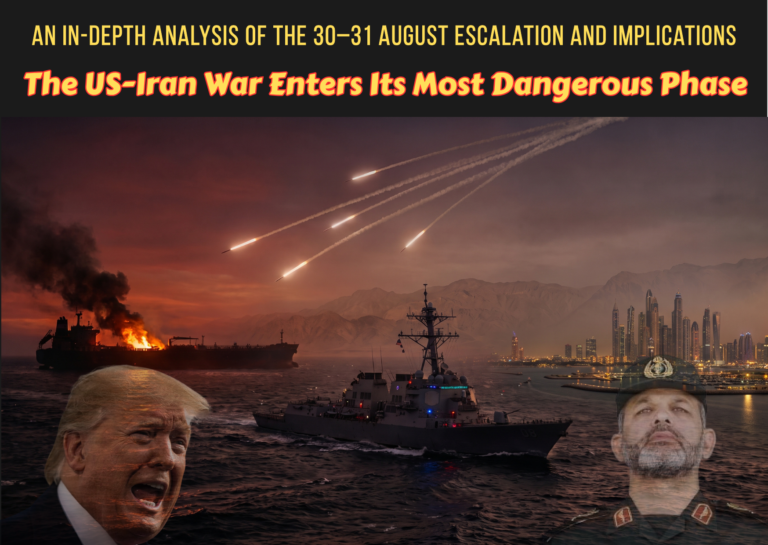
The Middle East, shaken by the United States’ and Israel’s war against Iran that began in February 2026, has demonstrated both the persistence of American military primacy and the limits of American political control, as BRICS members — including rivals Iran and the UAE — gathered in New Delhi even as the conflict continued.
Central Asia has become a quiet arena of three-way competition among Chinese infrastructure and investment, Russian residual influence and Western engagement.
And Africa has moved to the centre of the board as the scramble for critical minerals — cobalt, lithium, rare earths — turns the continent into a zone of Chinese lending, Gulf capital, Russian security partnerships and renewed Western attention.
Crucially, these theatres are linked. European rearmament depends on American production capacity that is also demanded in Asia; Gulf energy security shapes Asian growth, which funds Chinese military modernisation; the Middle East war of 2026 disrupted the energy prices on which Pakistan’s fragile recovery depends. Strategy is no longer regional; it is global or it is nothing.
A World of Flexible Partnerships
The emerging international architecture does not resemble the rigid blocs of the Cold War, nor does it resemble a simple US-China duopoly. It is something more fluid and, in some respects, more dangerous. BRICS — now eleven members strong, having absorbed Egypt, Ethiopia, Iran, the UAE, Saudi Arabia (whose formal status remains ambiguous, as Riyadh has not publicly confirmed accession) and Indonesia — represents not an anti-Western alliance but a platform through which emerging economies seek voice, financing alternatives and insulation from unilateral coercion. The New Delhi Declaration of September 2026 criticised unilateral tariffs and sanctions without naming the United States, a careful ambiguity that itself reveals the limits of BRICS cohesion: it is a coalition of the dissatisfied, not yet a coalition of purpose.
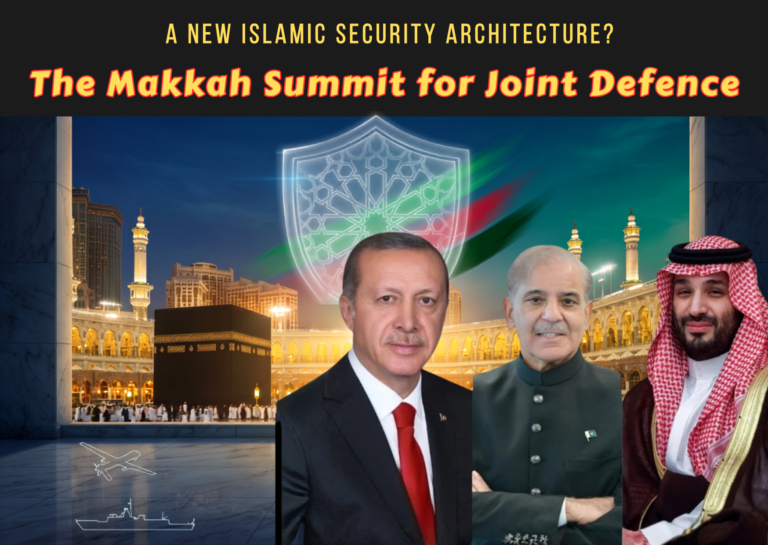
Meanwhile, the middle powers are exercising an influence disproportionate to their size. Saudi Arabia and the UAE arbitrate between Washington and Beijing and host peace talks that the great powers themselves cannot convene. Indonesia has joined BRICS while deepening ties with Washington. Brazil and South Africa give the Global South a diplomatic weight it has not possessed since the Non-Aligned Movement. Türkiye has made itself indispensable in the Black Sea, the Caucasus, the Gulf and the Eastern Mediterranean. Strategic autonomy — the capacity to say no to any great power — has become the most sought-after attribute in international politics.
Pakistan’s Position on the Board
For Pakistan, this fluidity is both opportunity and hazard. The country’s geography — bordering China, India, Iran and Afghanistan, with a coastline astride the Arabian Sea’s energy routes — guarantees that it cannot be ignored. Its alliance with China, anchored in CPEC and deepened by decades of defence cooperation, remains its most consequential external relationship, though the pause in Chinese funding for some CPEC projects is a reminder that even this partnership is conditional on commercial and security logic, not sentiment alone.
Yet Pakistan’s room for manoeuvre has narrowed where it matters most: the economy. The recovery now under way — growth of an estimated 3.6 per cent in fiscal year 2026, reserves rebuilt to roughly $21.5 billion, inflation down to about 10 per cent, and a fourth IMF review agreed in October 2026 — is real but fragile, and the IMF itself has warned of risks from Middle East tensions, volatile energy prices and trade disruption. A country that requires successive IMF programmes has limited capacity for geopolitical adventurism; its dependence on the dollar system, Gulf remittances and energy imports binds it into relationships that strategic autonomy rhetoric cannot dissolve.
The sensible course is the one Pakistan’s diplomats have begun to travel: deepening CPEC and security cooperation with China without becoming a frontline state in America’s rivalry with it; rebuilding a functional, if cooler, relationship with Washington based on economics rather than the militarised partnership of the past; sustaining ties with Saudi Arabia and the Gulf as a financial lifeline while engaging Iran pragmatically; and, as Pakistan’s interest in BRICS membership suggests, positioning itself within the emerging pluralism rather than against it. The danger is the obverse of the opportunity: in a world of competing blocs, states that sit at intersections can become corridors — or they can become battlegrounds. Pakistan’s task is to ensure it remains the former.
What Kind of World Is Emerging?
Three interpretations compete for our understanding. The first holds that the world is becoming genuinely multipolar: that China, the United States, Russia, Europe and India, joined by assertive middle powers, will share and contest influence across domains. The second sees an emerging bipolarity — a system increasingly organised around US-China competition, in which other powers, including Russia, are drawn into one orbit or the other. The third describes a fragmented order: not a single system at all, but overlapping regimes in which American power dominates finance and alliance security, Chinese power dominates manufacturing and infrastructure, and different powers prevail in different regions, technologies and institutions.
The evidence of late 2026 supports the third interpretation more than either of the others. The American financial system has survived every challenge; the Chinese manufacturing base has survived every tariff; Russia has survived the severest sanctions in history; and yet none of these powers can impose its preferred order on the others. Multipolarity in the full sense — several powers each capable of shaping outcomes across the whole system — remains more aspiration than reality. Bipolarity fails to account for the autonomy of the middle powers and the persistence of Europe’s collective weight. Fragmentation, however, describes what is actually visible: a world of partial orders, contested chokepoints and shifting coalitions.
Conclusion: Power Is Being Redistributed
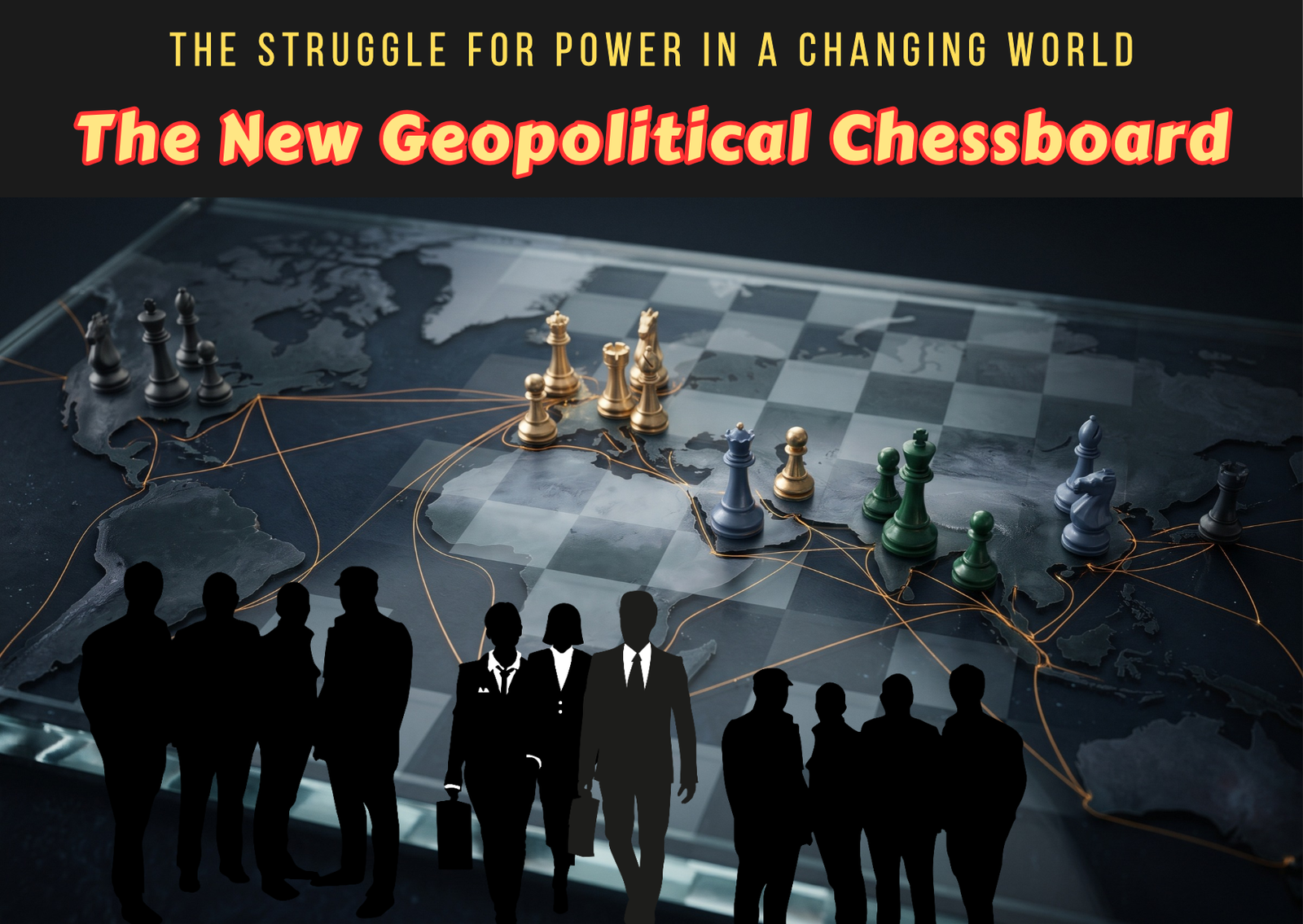
The struggle on the new chessboard is not principally a contest for territory, nor even for military supremacy, though both feature in it. It is a wider struggle over economic influence, technological chokepoints, strategic resources, institutional control and the rules by which states deal with one another. Power is being redistributed — away from the unipolar moment and toward a more crowded, more contested, and in places more dangerous world.
The central lesson for the states that must live in this world is not that alignment no longer matters; it is that rigidity is now the greatest strategic risk. The powers and peoples who prospered in the late twentieth century were those who adapted earliest to the rules of that era. Those who will prosper in the era now beginning will be the states — large and small — that cultivate optionality, build economic resilience, invest in human capital and refuse to mortgage their futures to any single patron. The chessboard has changed. The players who understand that will not merely survive the transition; they will help to shape what comes after it.