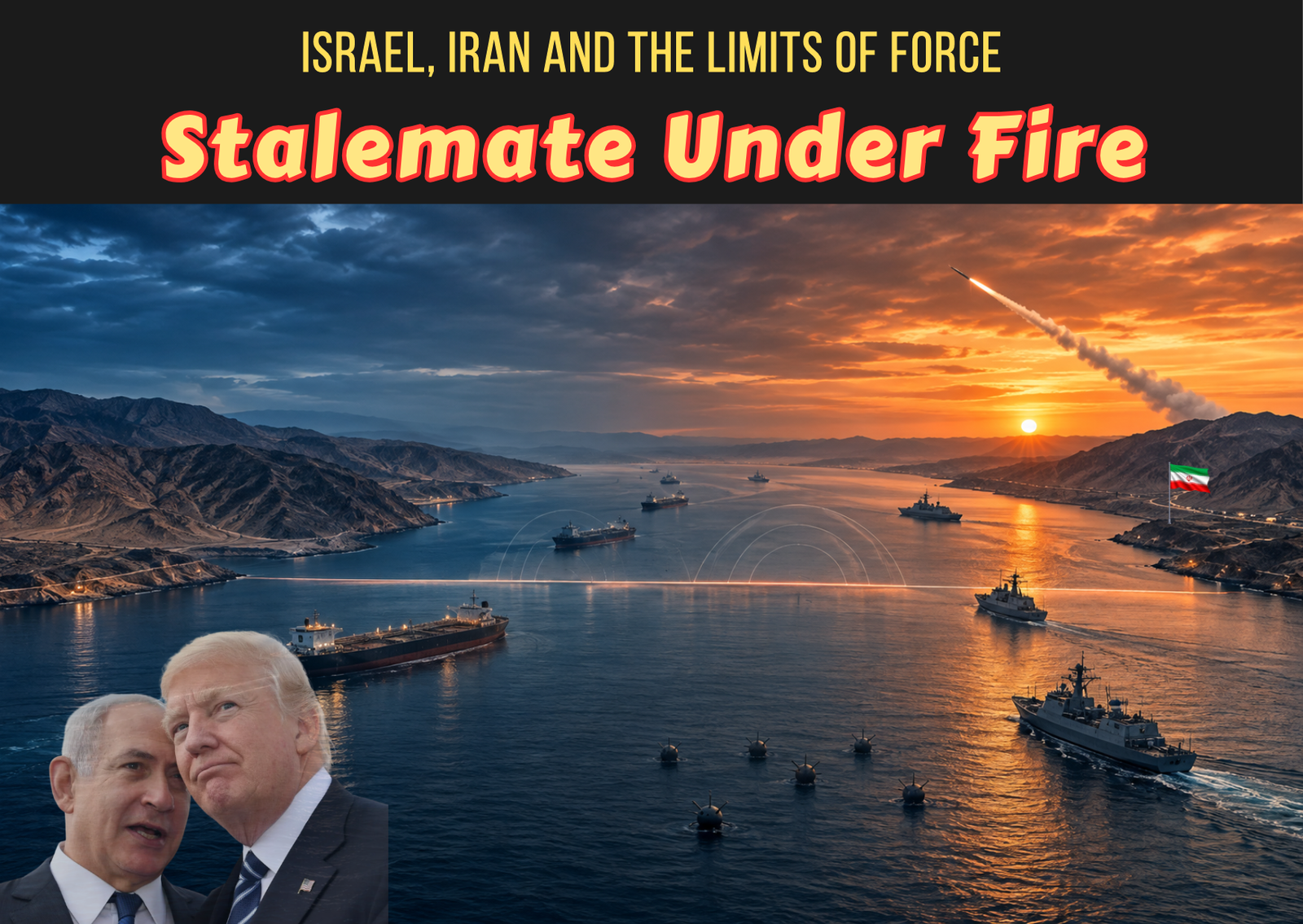
(By Khalid Masood)
As of November 11, no side is fighting a full-scale war, and no side is negotiating one openly. Israel is pressing Washington to restart strikes on Iran. Washington says its blockade and sanctions make major combat unnecessary for now. Tehran denies any talks, insists no enriched uranium will leave the country, and keeps the Strait of Hormuz contested. The Israeli readiness orders that make headlines are real, but the decision to resume war appears to sit in Washington, not Jerusalem.
1. Where things stand on November 11
- US posture. Secretary of State Marco Rubio told G7 counterparts in Paris that the economic campaign is so damaging that there is no need for major combat operations “right now.” US officials say force remains possible if Iran crosses red lines or strikes first. Defense Secretary Pete Hegseth says forces remain “locked and loaded.” Al Jazeera and others report a split inside the administration, with Vice President JD Vance favoring a deal; the Wall Street Journal reports he is weighing face-to-face talks with Iran’s security chief.
- Iran’s posture. Mohsen Rezaei, secretary of Iran’s Supreme National Security Council, denies any talks and says Tehran awaits a US answer to its seven conditions. These reportedly include lifting sanctions and the naval blockade and ending fighting on all fronts, especially Israeli attacks on Lebanon. He said not a single particle of enriched material will leave Iran and that any new US attack would make every US base involved, including in Europe, a target. Parliament speaker Mohammad Bagher Ghalibaf said Hormuz will not return to its pre-war status.
- At sea. The US says it is enforcing a blockade of Iranian ports; Iran claims control of the Strait. Iran says a tanker struck a mine and caught fire on November 11, and the UAE said an ADNOC vessel was damaged on November 10. Saudi Arabia said it intercepted Houthi missiles aimed at the Mecca region.
- Markets. Oil has eased since last week on signals that the US is not heading back to major combat soon, but ticked up about 1% after Rezaei’s uranium statement.
- Israel and the US. Israeli media report a heated Trump–Netanyahu phone call over the weekend about whether and when to resume strikes. Netanyahu’s office calls the account “fake news.” The Financial Times, as relayed by the Washington Times, reports Netanyahu urges Trump almost daily to resume military action.
Both the US and Iran have reasons to shape the story. Rezaei described US claims of talks as lies meant to lower oil prices, while Washington has an interest in projecting momentum. Treat each side’s statements about talks as positioning until a meeting is confirmed independently.
2. How the war reached this point
The US and Israel launched the war on February 28, 2026, according to the Associated Press. On November 11, Trump claimed the US did not start it, which conflicts with that record. A ceasefire took effect on April 8 and a US naval blockade followed in April. A US–Iran memorandum was announced in mid-June, but it did not hold: US strikes and Iranian actions around Hormuz recurred through the summer and into early November. An October 31 draft framework would have transferred or diluted Iran’s uranium and reopened Hormuz within a week, with China as possible guarantor. It has not produced a deal.
The war is contested at home as well. Polling compiled by Wikipedia shows a majority of Americans opposed it, and Hegseth himself said on November 10 that it is “not necessarily popular.” In Israel, a Kan poll in the spring found 58 percent believed the US and Israel had not won. Whether the war achieved its stated aims is therefore disputed even among the participants’ own publics.
3. The uranium impasse
The central dispute is the highly enriched stockpile. Netanyahu says the war is not over until the uranium is removed, enrichment sites are dismantled, support for proxies ends and long-range missile capability is eliminated. That list goes well beyond the nuclear file. A deal that only dilutes or ships out uranium would fall short of his stated goals, which helps explain Israeli skepticism of any compromise.
Iran’s public line keeps shifting. AP reported in May that Tehran offered to dilute part of the stockpile and send the rest to a third country; Iran denied agreeing to a transfer. Now Rezaei says nothing leaves. The likely explanation is bargaining: the stockpile is Iran’s main leverage and a symbol of sovereignty, so no official wants to be seen giving it up for free. Washington adds its own complication: Trump has said he is uncomfortable with Russia or China holding the material, the two countries Iran would most readily accept.
A further unknown is verification. Reporting notes that the precise status of Iran’s nuclear infrastructure after the strikes remains unclear. Any agreement would need inspectors to account for material whose location and condition are not publicly known.
4. Israel: capability and constraint
Capability. Israeli officials said early in the war that about 70 percent of Iran’s launchers and missile stock were destroyed, and reported high interception rates early on. The air force and intelligence services have proved they can reach deep into Iran, and the army has repeatedly ordered readiness steps since the April ceasefire.
Constraints. The weak points are endurance and dependence.
- Interceptors. RUSI estimated Arrow stocks were down about 80 percent and David’s Sling about 55 percent at one point. Other reporting says Israel fired fewer than 100 Arrows because the US absorbed much of the burden. Israel does not publish inventories, so these estimates conflict. The IDF itself has warned that depleted munitions and interceptors undermine readiness for another round.
- Cost. Israeli press estimates put routine operations plus the Iran alert at 100 to 150 million shekels a day, and defense and finance officials have fought over procurement money.
- Dependence on Washington. Israel can strike, but defending against retaliation relies on US interceptors, which the US itself has drawn down heavily, and on US diplomatic cover.
- Politics. If the reported Trump–Netanyahu rift is accurate, Israel’s freedom to act alone is limited by a patron that currently prefers pressure to fighting. Netanyahu’s incentive to push for a restart is also tied to domestic politics, discussed below.
An honest assessment: Israel can hurt Iran again, but it cannot easily force the outcome it wants, and it is unlikely to strike over Washington’s objection while the US is exposed to Iranian retaliation.
5. Iran: leverage and costs
Leverage. Iran’s strongest card is geography. About a fifth of global oil and LNG normally passes through Hormuz, and mines, drone attacks and threats keep insurers and shippers cautious. The IRGC chief said this week that threats and sanctions will not stop the missile program, a message aimed at hardliners as much as at Washington. Iranian officials claim any new war would end within days; these are claims, not assessments.
Costs. The blockade and sanctions have cut Iran’s oil sales sharply, and Rubio says Iran has never been so unable to sell energy. Iran has turned to land routes, and Turkey trade reportedly rose 19 percent to $3.2 billion in the first half of the year. But in October, Iraq and Pakistan reportedly closed several crossings, and Treasury Secretary Scott Bessent said Washington was working with Turkey and Pakistan to cut Iran’s land routes. Turkey has not publicly committed to full closure. A US task force announced in early November aims to cut off Iranian transport of advanced weapons.
Domestic picture. Iran has opened new training centres and announced a plan to train one million paramilitary volunteers, which signals both defiance and preparation for internal as well as external threats. The regime faces a hard choice: concessions risk looking like surrender, while holding out deepens economic pain.
6. Turkey, Pakistan and Saudi Arabia: hedgers, not Iran’s allies
The idea that these three states are backing Iran does not match the evidence. They are hedging against everyone, including Israel and the US.
- Saudi Arabia has been hit by Iranian missiles and drones during the war and again faces Houthi fire; this week it intercepted missiles aimed at the Mecca region, and the US embassy in Riyadh issued a warning. Riyadh says it will not normalise ties with Israel without a path to Palestinian statehood.
- Pakistan is the main mediator between Washington and Tehran and has sent troops and air defence to Saudi Arabia. Yet it also reportedly closed border crossings with Iran in October, in line with US pressure. Iranian hardliners say its Saudi pact cost it neutrality; Washington has at times criticised it for opening land routes that eased Iran’s trade.
- Turkey sits between: a NATO member, Iran’s largest overland trade partner by some measures, loud against Israel’s conduct, and not committed to cutting Iran off.
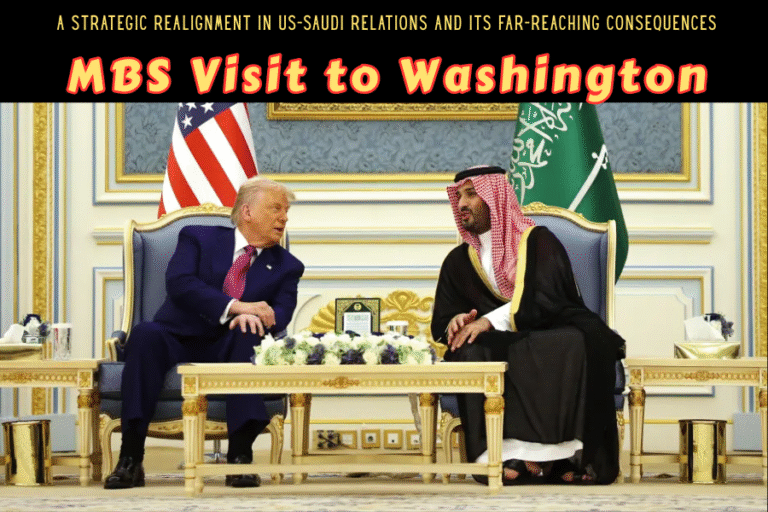
The August 7 Mecca pact, which treats an attack on one signatory as an attack on all, is best read as insurance. Analysts describe it as aimed at deterring Iran, offsetting an unreliable US and signalling to Israel. All three also have grievances with Israel: Reuters notes it has fought in Gaza, invaded southern Lebanon and seized territory in Syria, and the pact partners condemn any notion of a “Greater Israel.” None has shown willingness to fight Iran’s war, and none looks eager to fight Israel’s. The pact’s real effect is diplomatic: it raises the regional cost of Israeli unilateralism and gives Gulf capitals options beyond Washington.
7. The United States: reshaping, not leaving
The claim that America is packing up is only partly true. The US handed its main Syria bases to Damascus and agreed with Baghdad to leave Iraq by the end of September, with a limited presence continuing. NBC reported on October 21 that troop levels at some regional bases and State Department staffing were being cut. The Pentagon is reviewing its Gulf footprint after Iranian strikes showed how exposed large fixed bases are, and some officials want forces freed for a possible conflict with China. On the other side, about 50,000 US troops, two carriers and over a dozen destroyers were still in the region as of September, and viral videos claiming a mass pullout were debunked.
Two things make this more than basing logistics. First, the US used up a large share of its advanced interceptors defending Israel and Gulf partners, which limits how long it can sustain a renewed air war. Second, the current US strategy of blockade, sanctions and land-route pressure is cheaper and less risky than renewed bombing, but it depends on Iran’s neighbours and on oil markets staying calm. For Israel, a lighter US footprint cuts both ways: possibly more freedom to act, but less protection when Iran retaliates.
8. Israeli society: election deadlock, emigration and resolve
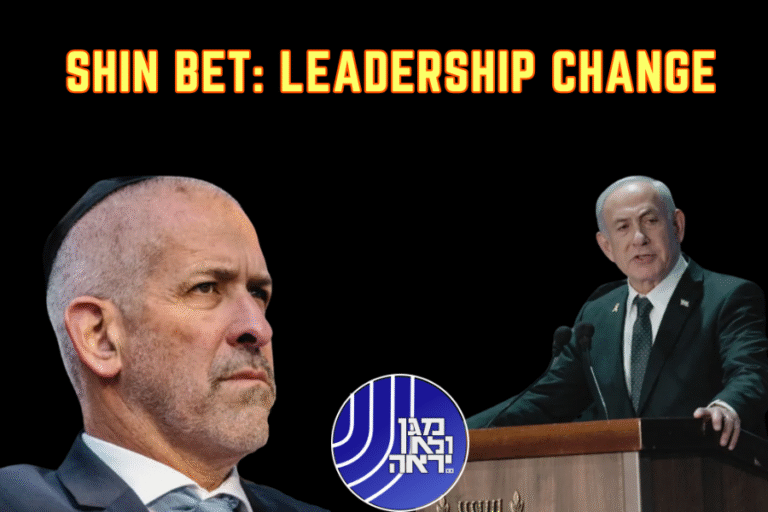
The election. The October 27 vote produced no winner. Final results from the Central Elections Committee give Netanyahu’s bloc 53 of 120 seats, Gadi Eisenkot’s opposition bloc 48, and Arab-led parties a record 19, so neither camp reaches 61. Likud is the largest party with 27 seats, followed by Eisenkot’s Yashar with 21 and Bennett’s Together with 12. Reporting says Netanyahu’s bloc held 68 seats at its peak in the previous Knesset. Both Netanyahu and Eisenkot have ruled out partnering with Arab parties, so a government is far from certain. Netanyahu’s camp has alleged irregularities, and the Shin Bet is investigating suspected foreign interference; Eisenkot accuses Netanyahu of delegitimising the result. Official certification was due shortly after the final count; check it before publishing.
This matters for the war. A prime minister without a clear majority has incentives that run both ways: pressing for renewed strikes can rally supporters, while a failed escalation could end his career. Observers should treat his public pressure on Trump as a mix of strategic conviction and political calculation, and neither explanation can be proved from outside.
Emigration. A Tel Aviv University study found nearly 270,000 Israelis left over three years. About 90,900 left for at least three months in 2025, close to 2024’s roughly 91,500, and nearly 50,000 stayed away for more than a year. Researchers say the numbers do not yet threaten Israel’s resilience, but the profile worries them: reports describe record departures of doctors, engineers and high earners. Germany is the top European destination, with the US and Canada also popular. Israel’s population is about ten million, so this is a significant drain of skills, not a mass exodus.
“Last stand.” There is no reliable measure of how many Israelis are prepared for one. The better indicators are voting, reserve turnout and economic activity, and these show a polarised but functioning society. The election result suggests that a majority of seats did not go to the hard-right bloc, which complicates any claim that the public backs maximalist goals.
9. Is a “Greater Israel” realistic?
The phrase is not official government policy, but annexation of the West Bank is openly advocated by some ministers, and polling shows support for a two-state solution has dropped sharply, though researchers caution this reflects pessimism more than ideological commitment. Reuters notes Israel has seized territory in Syria and fought in southern Lebanon, which critics cite as evidence of expansion and Israeli officials describe as security buffers.
Several limits stand in the way of anything resembling the maximalist version. Netanyahu’s bloc has lost seats and has no majority. Trump is reportedly unhappy with a coalition including Ben-Gvir and Smotrich. Manpower, budget and interceptor shortages already strain the state. The Saudi–Turkey–Pakistan pact and wider Arab opposition raise diplomatic costs. And if US support became conditional, Israel’s room for expansion would shrink further. The plausible path is incremental, with deeper settlement and security buffers rather than a redrawn map, and its pace depends largely on how Washington behaves.
10. Global and regional impact
- Energy. Hormuz risk keeps oil volatile; prices fell this week on hopes of de-escalation while Saudi Arabia led a further rise in OPEC+ output. Europe’s gas storage stood near 61 percent in late October against a target of 80 percent.
- Aviation and travel. Indian carrier IndiGo extended suspensions of flights to Saudi Arabia, a sign of how Gulf risk affects ordinary travel.
- Lebanon. The UN says more than one million people there face acute food insecurity, and Iran’s conditions explicitly include an end to Israeli attacks on Lebanon.
- South Asia. Pakistan, India and Bangladesh face fuel costs, shipping delays and risks to Gulf remittances, and Pakistan is under pressure from both Washington and Tehran.
- Great powers. China and Russia are potential guarantors or custodians in any deal, which raises their standing. Interceptor depletion also strains US readiness in the Indo-Pacific.
- Proliferation. If Iran keeps its stockpile and US presence thins, Gulf states and Turkey may reconsider their own options.
11. Scenarios and signposts
- Managed stalemate (most likely). Blockade and sanctions continue, incidents at sea persist, talks stay deniable.
- Partial deal. Dilution plus a custodian for some material, Hormuz reopens in stages, sanctions ease. Needs a face-saving formula for both Tehran and Washington, and Israeli acquiescence.
- Renewed war. Triggered by a mass-casualty incident, a strike on US forces, or Trump deciding the blockade is not working. Iran has threatened US bases as far as Europe.
- Covert breakout. The scenario Israeli officials fear most, and the hardest to detect.
Watch for: a confirmed Vance–Rezaei meeting, any change in Rubio’s language, mine incidents involving large ships, Houthi attacks on Saudi targets, Israeli coalition talks, further US base cuts and interceptor resupply announcements.
12. Angles often missed
- Everyone claims victory. Trump says the US has won but wants “total victory”; Iranian officials say Trump and Netanyahu were defeated. Such claims are the main obstacle to a face-saving deal.
- Allies diverge. The reported Trump–Netanyahu split shows that US and Israeli goals overlap but are not identical.
- Economic war is a war. The blockade also hurts ordinary Iranians and raises costs for Asia and Europe; “no combat” does not mean no casualties.
- Linkage. Iran ties peace to Lebanon, Israel ties it to missiles and proxies, and neither package is easy to untangle.
- Information war. Both camps circulate unverified claims, from fake withdrawal videos to disputed accounts of phone calls.
- Accountability. The war’s legality and its costs to civilians are contested internationally, and any settlement will be judged partly on that.
13. Conclusion
The region is in a high-tension pause rather than peace. Israel is ready and eager to resume, the US has chosen pressure over bombing for now, and Iran is damaged but holds Hormuz and its stockpile. The Gulf and Muslim-majority neighbours are hedging, not choosing sides. Israeli politics is deadlocked, and Washington’s patience is the variable that matters most. The most likely near-term outcome is more of the same: pressure, incidents and unconfirmed contacts, with a real risk that one miscalculation restarts the war.