(By Khalid Masood)
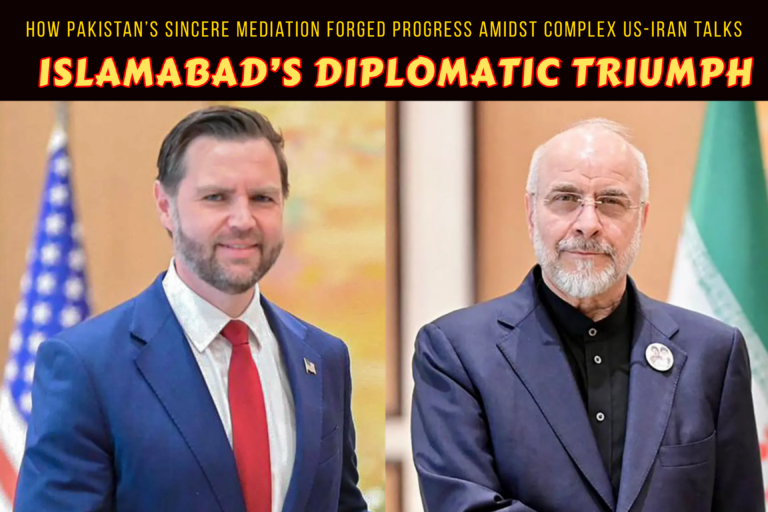
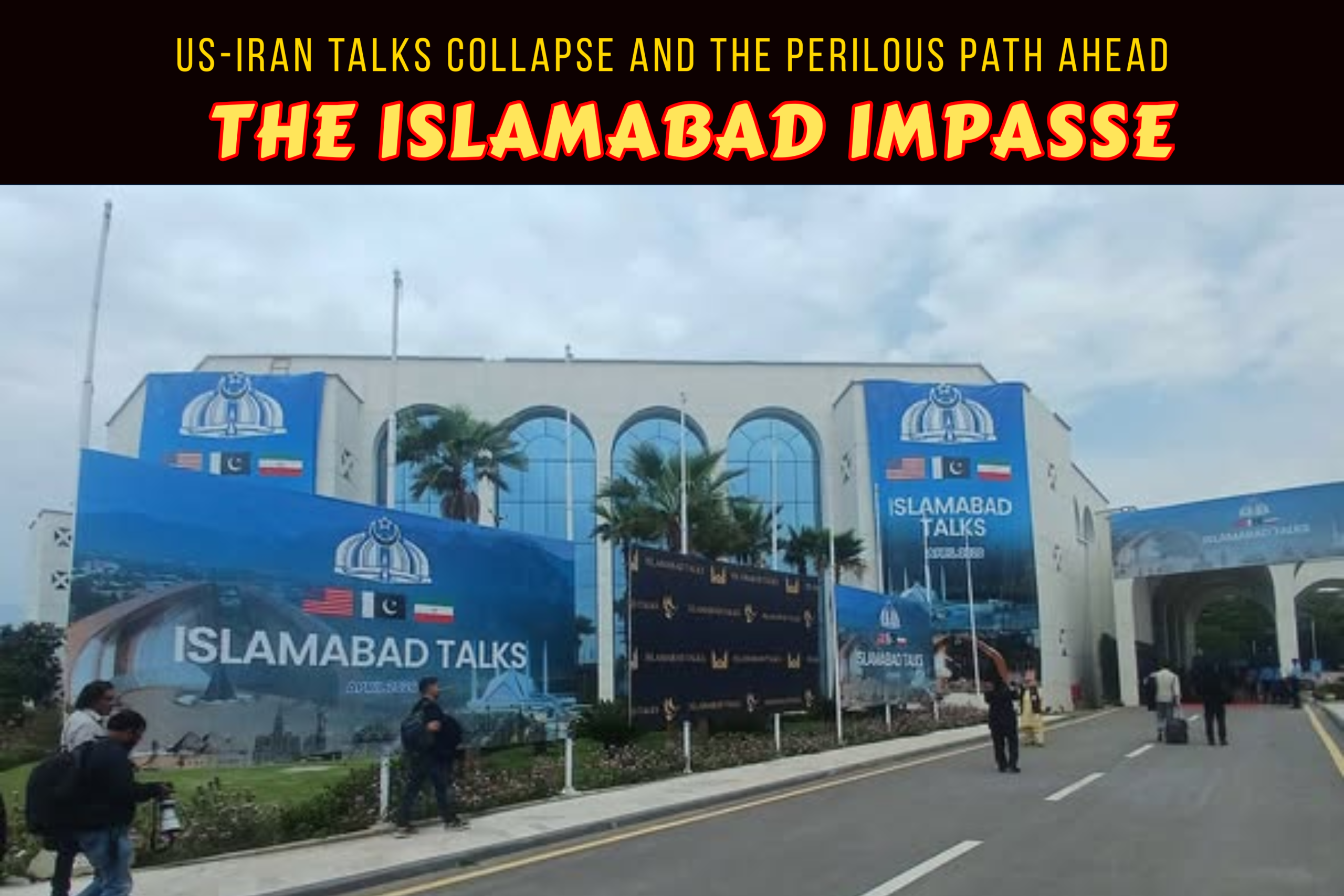
The high-stakes peace negotiations between the United States and Iran, hosted in Islamabad with considerable diplomatic fanfare, have concluded without agreement. Vice President JD Vance’s early departure from the Pakistani capital, coupled with President Trump’s subsequent threat to shut down the Strait of Hormuz, has transformed a fragile diplomatic opening into a potentially dangerous escalation. Oil prices have responded predictably, surging on fears of supply disruption, but the broader implications for regional stability and global security demand sober, clear-eyed analysis.
The Anatomy of a Diplomatic Breakdown
The Islamabad talks represented the most intensive direct engagement between Washington and Tehran in nearly five decades. Pakistan’s role as facilitator was both courageous and strategically astute, offering neutral ground where both sides could engage without the baggage of historical enmity that characterises venues in Europe or the Middle East. For several days, it appeared that breakthrough might be possible: Iranian officials suggested they were “inches away” from agreement, while American negotiators expressed cautious optimism.
Yet the collapse, when it came, was swift and revealing. The fundamental disconnect proved insurmountable: the United States presented what Vice President Vance termed its “best and final offer”, demanding verifiable constraints on Iran’s nuclear programme, restrictions on regional proxy activities, and guarantees regarding maritime security. Tehran, for its part, insisted that any agreement must include provisions for the lifting of sanctions, the unfreezing of assets, and—critically—a ceasefire extension that encompassed Iranian-aligned forces in Lebanon.
The tipping point arrived with President Trump’s announcement of an immediate naval blockade of the Strait of Hormuz. From Washington’s perspective, this was leverage: a demonstration of resolve intended to compel Iranian concessions. From Tehran’s viewpoint, it was an act of economic warfare and a violation of international maritime law. Foreign Minister Abbas Araghchi’s accusation that the United States had “shifted the goalposts” at the eleventh hour captured the Iranian sense of grievance, while also revealing the profound mistrust that continues to poison the well of diplomacy.
What Lies Ahead: Scenarios and Probabilities
Forecasting in geopolitics is an inherently uncertain endeavour, yet certain trajectories appear more plausible than others based on current indicators and historical precedent.
The most likely scenario—assigning it a probability of approximately 45 per cent—is one of limited escalation.
In this pathway, both sides engage in calibrated posturing: the United States reinforces its naval presence in the Gulf while stopping short of intercepting commercial vessels; Iran conducts shows of force through missile tests and proxy activities but avoids direct attacks on American personnel or critical infrastructure. Diplomatic channels, particularly those facilitated by Pakistan, Turkey, and Qatar, remain open for backchannel communication. The ceasefire holds, albeit tenuously, while economic pressure on Iran intensifies.
A second scenario, with roughly 30 per cent probability, involves a negotiated extension of the ceasefire.
This would require both sides to accept face-saving compromises: perhaps a phased sanctions relief in exchange for incremental Iranian concessions, or a humanitarian corridor agreement that addresses immediate concerns without resolving underlying disputes. Pakistan’s continued mediation would be essential here, as would quiet diplomacy from European and Asian powers with stakes in regional stability.
The worst-case scenario—full-scale regional conflict—remains less probable at approximately 25 per cent, but its consequences would be catastrophic.
Should the Strait of Hormuz be closed, even temporarily, global oil markets would face immediate shock. With roughly one-fifth of the world’s seaborne oil transiting this narrow chokepoint, sustained disruption could propel Brent crude well above $150 per barrel, triggering inflationary pressures across developed and developing economies alike. Regional spillover could draw in Israel, Gulf Arab states, and potentially extra-regional powers, transforming a bilateral dispute into a multi-theatre confrontation.
The Fragility of the Ceasefire
The current two-week pause in hostilities hangs by a thread. Ceasefires in complex conflicts rarely endure without addressing the grievances that fuel them. Iran’s insistence that any agreement must encompass Lebanese theatre dynamics reflects a strategic reality: Tehran views its regional network as integral to its deterrent posture. The United States, conversely, seeks to compartmentalise issues, addressing the nuclear file and maritime security before engaging on broader regional questions.
Without movement on core issues—the scope of sanctions relief, the timeline for asset unfreezing, verification mechanisms for any nuclear constraints, and the status of regional proxy forces—the ceasefire is likely to unravel before month’s end. Miscalculation poses a particular risk: a stray missile, an intercepted vessel, or an incident involving third-party actors could escalate rapidly in an environment of heightened tension and mutual suspicion.
Pakistan’s Precarious Position and Strategic Imperatives
For Pakistan, the stakes could scarcely be higher. The country has invested significant diplomatic capital in hosting these talks, enhancing its standing as a potential regional stabiliser. Yet Pakistan also faces acute vulnerabilities: approximately 80 per cent of its oil imports transit the Strait of Hormuz, rendering the national economy exquisitely sensitive to supply disruptions. A sustained spike in energy prices would exacerbate inflationary pressures, strain the balance of payments, and complicate ongoing engagements with the International Monetary Fund.
In this fraught environment, Pakistan must pursue a multi-track strategy that balances principled neutrality with pragmatic crisis management.
Diplomatically, Islamabad should maintain its role as honest broker while avoiding alignment with either bloc. This requires careful calibration: facilitating dialogue without appearing to endorse positions that could compromise Pakistan’s relationships with other regional partners. Expanding the mediation coalition to include Turkey, Qatar, and China could provide additional leverage and share the diplomatic burden. Simultaneously, Pakistan should utilise multilateral forums—the United Nations, the Organisation of Islamic Cooperation—to advocate for international guarantees on maritime security and humanitarian access.
Economically, resilience must be the watchword. Accelerating energy diversification—through liquefied natural gas infrastructure, renewable energy projects, and strategic petroleum reserves—would reduce vulnerability to supply shocks. Negotiating emergency fuel supply agreements with Gulf partners could provide short-term buffer capacity. Engaging proactively with the IMF to seek flexibility on fiscal targets, while demonstrating continued commitment to structural reforms, would help maintain market confidence amid external volatility.
From a security perspective, Pakistan should enhance maritime domain awareness through coordination with regional navies, focusing on information-sharing and de-confliction rather than direct combat involvement. Reinforcing border security preparations would mitigate risks associated with potential refugee flows or cross-border militant activity should the conflict widen. Clear, consistent strategic communication—articulating Pakistan’s red lines and national interest parameters to both domestic and international audiences—would help manage expectations and reduce the risk of misinterpretation.
Looking to the longer term, Pakistan might capitalise on its mediation role to enhance its diplomatic standing across South Asia and the Muslim world. Advancing discussions on the Iran-Pakistan gas pipeline, contingent upon sanctions resolution, could serve both energy security and regional connectivity objectives, provided such efforts are coordinated with engagement with Washington. Exploring non-aligned security partnerships focused on counter-terrorism and maritime capacity-building could further consolidate Pakistan’s position as a responsible regional actor.
Conclusion: Navigating Uncertain Waters
The collapse of the Islamabad talks reflects not merely a tactical impasse but deep structural disagreements that have festered for decades. Mutual distrust, divergent strategic objectives, and domestic political constraints on both sides create formidable obstacles to breakthrough diplomacy.
Yet the alternative—unrestrained escalation—serves no rational interest. The United States seeks to constrain Iran’s nuclear ambitions and regional influence without becoming embroiled in another protracted Middle Eastern conflict. Iran seeks relief from economic pressure and recognition of its legitimate security concerns without surrendering its strategic autonomy. Both objectives might, in theory, be reconciled through patient, principled negotiation.
Pakistan has demonstrated that it can provide the space for such dialogue. The question now is whether the international community can muster the political will to support a process that may yield results only incrementally, and only if all parties accept that compromise is not capitulation.
In the immediate term, the most probable path forward involves a short-term extension of the ceasefire through backchannel diplomacy, coupled with modest confidence-building measures on humanitarian issues and maritime de-confliction. However, without sustained engagement on core strategic questions, the region will remain in a precarious equilibrium where a single miscalculation could trigger rapid, dangerous escalation.
For the world, the lesson is sobering: in an interconnected global system, regional disputes rarely remain contained. The choices made in Islamabad, Tehran, and Washington in the coming weeks will reverberate far beyond the Middle East, affecting energy markets, economic stability, and the broader architecture of international security. Prudence, patience, and a renewed commitment to dialogue remain the surest guides through these uncertain waters.