(By Quratulain Khalid)
I. Introduction: A Capital Under Pressure
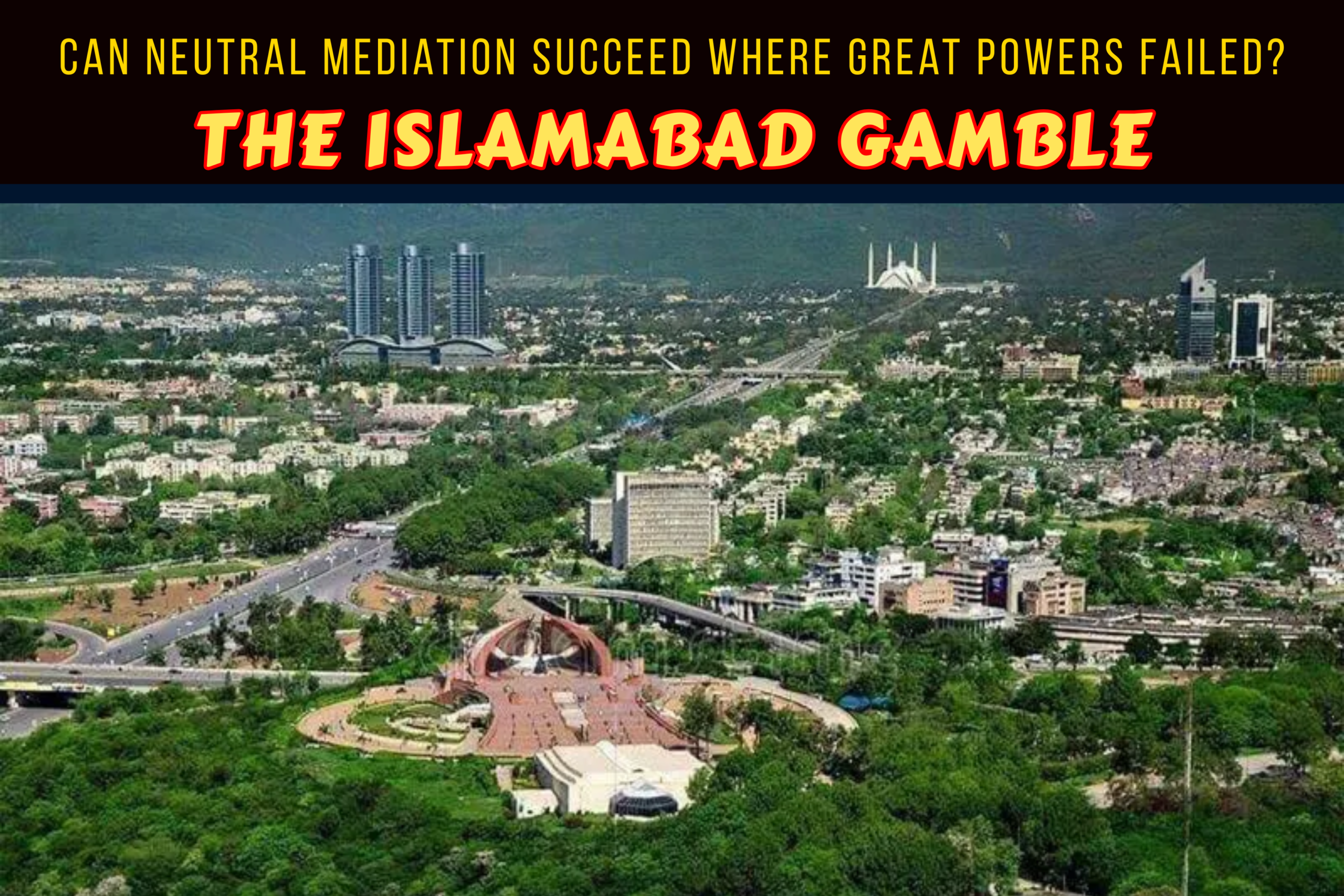
Islamabad is not traditionally viewed as a crossroads of global diplomacy. Yet in April 2026, Pakistan’s capital has become the focal point of what may be the most consequential peace process of the decade. Senior Iranian and American delegations are seated across the table from one another under Pakistani auspices, attempting to convert a fragile, two-week ceasefire into a durable political settlement. The conflict they seek to end has already lasted 44 days, disrupted critical maritime chokepoints, strained regional economies, and exposed the limits of traditional conflict resolution architectures.
The central question animating this diplomatic experiment is straightforward but profound: Can a middle power, operating without coercive leverage or institutional backing, succeed where the United Nations, European states, and direct great-power channels have stalled? Pakistan’s mediation represents both an unprecedented opportunity and a high-risk gamble. Its success would signal a structural shift toward multipolar, regionally anchored diplomacy. Its failure could accelerate escalation, destabilize South Asia’s western flank, and reinforce the perception that neutral convening is insufficient without hard power backing.
What follows is a strategic assessment of the Islamabad talks: the context that made them necessary, the structural advantages and constraints of middle-power mediation, the sticking points that will determine outcomes, and the broader implications for how 21st-century conflicts may be managed.
II. The 44-Day War: Context and Consequences
The conflict that brought Iranian and U.S. envoys to Islamabad escalated rapidly in mid-February 2026, following a series of maritime incidents, cross-border strikes, and retaliatory operations that quickly expanded into a multi-front confrontation. Within weeks, the fighting had spilled into contested airspace, disrupted commercial shipping in the Persian Gulf, and triggered secondary escalations involving allied non-state actors and regional defense networks.
The human and economic toll has been substantial. Regional humanitarian monitors report significant civilian displacement, infrastructure damage across border zones, and mounting strain on medical and logistical networks in affected areas. Globally, the conflict triggered volatility in energy markets, with oil and liquefied natural gas prices spiking as insurers reassessed risk premiums for Gulf transit routes. The Strait of Hormuz, through which approximately one-fifth of global oil trade flows, experienced intermittent disruptions, prompting naval deployments and emergency shipping reroutes.
On April 7, 2026, both sides agreed to a conditional ceasefire, brokered through backchannel communications and publicly endorsed by Pakistan. The truce is explicitly time-bound: two weeks. It is also deliberately narrow, focusing on cessation of hostilities, humanitarian access corridors, and deconfliction mechanisms rather than comprehensive political settlement. The clock is now ticking. The Islamabad talks are not merely about ending violence; they are about determining whether a temporary pause can be institutionalized into a verifiable, phased de-escalation framework.
III. Why Great-Power Mediation Failed
The failure of traditional mediation architectures to halt or resolve this conflict is not an anomaly; it is a structural feature of contemporary geopolitical polarization. Several factors converged to render established diplomatic channels ineffective:
Institutional Paralysis: The United Nations Security Council, historically the primary forum for high-stakes mediation, has been constrained by veto politics and deep procedural divisions. Emergency sessions yielded statements rather than mandates, and peacekeeping or monitoring frameworks faced insurmountable political hurdles before deployment.
Perceived Partisanship: European mediators, despite robust diplomatic infrastructure, struggled to project neutrality. Alignment with transatlantic security frameworks and conditional aid architectures led regional actors to view EU-led initiatives as extensions of Western policy rather than impartial facilitation.
Competing Strategic Agendas: Russia and China, while advocating dialogue, brought competing geopolitical priorities to the table. Moscow’s strategic alignment with Tehran and Beijing’s cautious, trade-first approach limited their willingness to impose costs or guarantee compliance. Neither possessed the leverage to bridge the fundamental trust deficit between Washington and Tehran.
Direct Channel Breakdown: Bilateral U.S.-Iran communications have historically been fragile, constrained by domestic political cycles, congressional oversight, and mutual narratives of strategic encirclement. When crisis escalation accelerates, the absence of established off-ramps and face-saving mechanisms leaves diplomacy reactive rather than preventive.
The cumulative effect has been a mediation vacuum. Traditional architectures assume either hierarchical leverage or institutional authority—neither of which exists in a multipolar environment where regional actors, non-state networks, and domestic political constraints operate independently of great-power direction.
IV. Why Islamabad? Pakistan’s Strategic Calculus
Pakistan’s emergence as the convening power is neither accidental nor purely altruistic. It reflects a calculated alignment of diplomatic positioning, regional necessity, and self-interest.
Historical Positioning: Islamabad maintains functional, if complex, relationships with both Tehran and Washington. Decades of border management, intelligence coordination, and pragmatic trade have prevented complete rupture with Iran, while security cooperation and diplomatic channels with the United States, despite periodic strain, remain intact. This dual-access model positions Pakistan as one of the few capitals capable of maintaining credible backchannels to both sides.
Diplomatic Groundwork: The late-March quadrilateral summit in Islamabad—bringing together foreign ministers from Pakistan, Saudi Arabia, Türkiye, and Egypt—established a regional consensus on de-escalation. Though not a formal mediation mandate, it signaled collective endorsement of Islamabad as a neutral venue and laid logistical and political groundwork for higher-level talks.
Geopolitical Endorsement: China’s public backing of Pakistan’s mediation role has added strategic weight to the initiative. Beijing’s endorsement is carefully calibrated: it supports dialogue without committing to enforcement, aligning with its broader preference for non-interventionist diplomacy while signaling to regional actors that the talks carry multipolar backing.
Pakistan’s Self-Interest: Islamabad’s stakes are immediate and material. The conflict has disrupted energy imports, strained remittance corridors, and heightened security threats along its western borders. Domestic pressures—including managing sectarian sensitivities, countering militant spillover, and stabilizing macroeconomic indicators—create urgent incentives for resolution. Simultaneously, successful mediation offers diplomatic prestige, potential economic partnerships, and a pathway to reposition Pakistan as a regional stabilizer rather than a peripheral security state.
Perceived Neutrality: As a Muslim-majority democracy with a tradition of non-aligned diplomacy, Pakistan lacks the colonial baggage or alliance entanglements that compromise Western mediators. It is neither a regional hegemon nor a proxy state, allowing it to project impartiality while leveraging cultural and religious familiarity with Iranian and broader Gulf dynamics.
Yet this positioning carries inherent risks. Pakistan’s domestic political fragmentation, economic vulnerability, and security challenges limit its capacity to absorb diplomatic backlash if talks collapse. Hosting high-profile delegations also requires robust security protocols, intelligence coordination, and crisis management infrastructure that strain state capacity.
V. The Negotiation Architecture & Core Sticking Points
The Islamabad talks are structured around closed-door sessions, working groups, and facilitated shuttle diplomacy. Iranian representation includes senior political and diplomatic figures, alongside military and intelligence advisors, reflecting the integrated nature of Tehran’s foreign policy apparatus. The U.S. delegation combines executive branch leadership with experienced special envoys, signaling a preference for pragmatic, deal-oriented negotiation rather than ideological posturing. Pakistani facilitators operate as coordinators rather than arbitrators, managing logistics, drafting working documents, and ensuring procedural continuity.
At the center of the negotiations is Iran’s reported 10-point framework, which has not been officially published but has been consistently referenced in diplomatic communications. Core elements include:
- A binding U.S. commitment to non-aggression and cessation of hostilities across all theaters
- Restructuring of U.S. force posture in the Middle East
- Recognition of Iranian oversight mechanisms for maritime traffic in the Strait of Hormuz
- Affirmation of nuclear enrichment rights under International Atomic Energy Agency (IAEA) monitoring
U.S. priorities, as indicated by preliminary statements and diplomatic signaling, center on ceasefire durability, verification protocols, regional de-escalation (particularly regarding allied non-state actors), and constraints on nuclear latency. Washington has reportedly accepted temporary Iranian management of Hormuz shipping coordination during the ceasefire window—a significant tactical concession that underscores the priority placed on immediate de-escalation over long-term structural settlement.
The fundamental gap lies in temporality and enforcement. Iranian proposals emphasize permanent guarantees; U.S. preferences lean toward phased, confidence-building steps with reversible commitments. Verification remains undefined: no joint monitoring body has been agreed upon, and consequences for violations are unspecified. The two-week ceasefire window compresses negotiation timelines, increasing pressure but also raising the risk of rushed compromises that lack implementation pathways.
VI. The Middle-Power Advantage: Why Neutral Mediation Can Work
Middle-power mediation succeeds not through coercion, but through process design, credibility, and structural flexibility. Several factors favor Islamabad’s approach:
Reduced Historical Baggage: Unlike Western or Russian mediators, Pakistan does not carry the weight of past interventions, sanctions regimes, or ideological campaigns. This allows negotiators to focus on present incentives rather than historical grievances.
Cultural and Regional Literacy: Shared linguistic, religious, and strategic contexts enable Pakistani mediators to navigate nuanced regional dynamics, including tribal networks, sectarian sensitivities, and informal power structures that external actors often misread.
Operational Flexibility: Without alliance obligations or domestic lobbying constraints, Islamabad can propose creative formats, adjust timelines, and offer face-saving mechanisms that rigid institutional frameworks cannot.
Regional Ownership: Solutions emerging from within the region are more likely to be perceived as legitimate and sustainable. External imposition often triggers resistance; internally facilitated agreements, even if imperfect, carry higher compliance potential.
Historical precedents suggest middle-power mediation can succeed when leverage is substituted with persistence, trust-building, and third-party guarantees. Qatar’s facilitation of the Doha Agreement, Norway’s role in various Latin American and Asian peace processes, and Oman’s longstanding backchannel diplomacy with Iran demonstrate that neutrality, when paired with strategic patience, can create off-ramps where hierarchical diplomacy fails.
VII. Structural Constraints & The Spoiler Problem
Despite these advantages, the Islamabad gamble faces formidable structural hurdles.
Power Asymmetry: Pakistan cannot compel compliance. Its influence derives from persuasion, incentive alignment, and diplomatic capital rather than economic or military leverage. Without enforceable guarantees, agreements risk remaining declaratory.
Domestic Political Constraints: In Washington, congressional scrutiny, public opinion, and electoral cycles limit executive flexibility. In Tehran, hardline factions and institutional power-sharing arrangements constrain concession-making. In Islamabad, economic fragility and security pressures reduce diplomatic bandwidth and increase vulnerability to backlash.
Spoiler Dynamics: Regional and non-state actors operate with strategic autonomy. Israel’s operational independence in Lebanon, Gulf Arab security calculations, and militia networks outside state control create parallel escalation pathways. A bilateral agreement that does not address spillover risks remains vulnerable to sabotage.
Verification and Enforcement: The absence of an agreed monitoring framework is the talks’ most critical vulnerability. Without transparent compliance mechanisms, mutual suspicion will persist. Escalation triggers, dispute resolution protocols, and graduated response frameworks must be defined—or the ceasefire will remain fragile.
Risk of Collapse: If talks fail, the two-week window expires. Renewed hostilities could accelerate rapidly, with both sides potentially interpreting breakdown as validation of maximalist positions. Pakistan could face diplomatic isolation, economic strain, and security deterioration.
VIII. Scenarios & Strategic Implications
The trajectory of the Islamabad talks will likely unfold along one of four pathways:
- Comprehensive Framework: Parties agree on a phased settlement within the ceasefire window, establishing joint verification committees, humanitarian corridors, and confidence-building measures. Implementation begins immediately, with regional actors invited to participate in monitoring. This outcome would mark a historic shift in Middle East security architecture.
- Moderate Success: Core issues are deferred, but the ceasefire is extended. Working groups continue on humanitarian access, maritime deconfliction, and nuclear verification protocols. Progress is incremental but stabilizing.
- Limited Outcome: Only logistical and humanitarian arrangements are formalized. Political and security questions remain unresolved, but temporary calm allows for diplomatic breathing room.
- Failure: Talks collapse without extension. Ceasefire expires, hostilities resume, and regional escalation accelerates. Pakistan faces diplomatic and economic repercussions; multipolar mediation models face renewed skepticism.
Indicators to monitor in the coming days include joint press statements, formation of technical working groups, shifts in military posture along contested corridors, commercial shipping data in the Strait of Hormuz, and parliamentary reactions in all three capitals. The absence of public posturing, coupled with sustained closed-door sessions, often signals substantive progress. Conversely, premature declarations or withdrawal from working groups typically indicate structural impasse.
IX. Conclusion: The Future of Conflict Mediation
The Islamabad talks are not merely about ending a 44-day war. They are a stress test for a new paradigm of international diplomacy. The traditional model—hierarchical, institutionally backed, great-power driven—has proven inadequate in an era of multipolar competition, decentralized security networks, and domestic political fragmentation. Middle-power mediation does not replace hard power; it compensates for its absence by prioritizing process, credibility, and regional ownership.
Whether Pakistan’s gamble succeeds or stumbles, it marks a turning point. Success would validate networked diplomacy, demonstrate the value of neutral convening, and establish precedents for future crisis management. Failure would reinforce structural pessimism, accelerate regional militarization, and highlight the limits of persuasion without enforcement.
The broader lesson is clear: 21st-century conflict resolution will increasingly depend on actors who can operate across ideological divides, manage spoiler dynamics, and design verification architectures that survive political turnover. Islamabad’s role is not to dictate terms, but to create the conditions under which terms can be negotiated. In a world where great powers are often constrained by their own alliances, domestic politics, and historical narratives, neutral mediation may not be a luxury—it may be a necessity.
The next two weeks will not resolve decades of strategic distrust. But they will reveal whether diplomacy, when anchored in neutrality, regional stakes, and pragmatic process design, can still outpace escalation. The world is watching Islamabad not because it holds the keys to peace, but because it is testing whether peace can still be built without them.