(By Faraz Ahmed)
Introduction
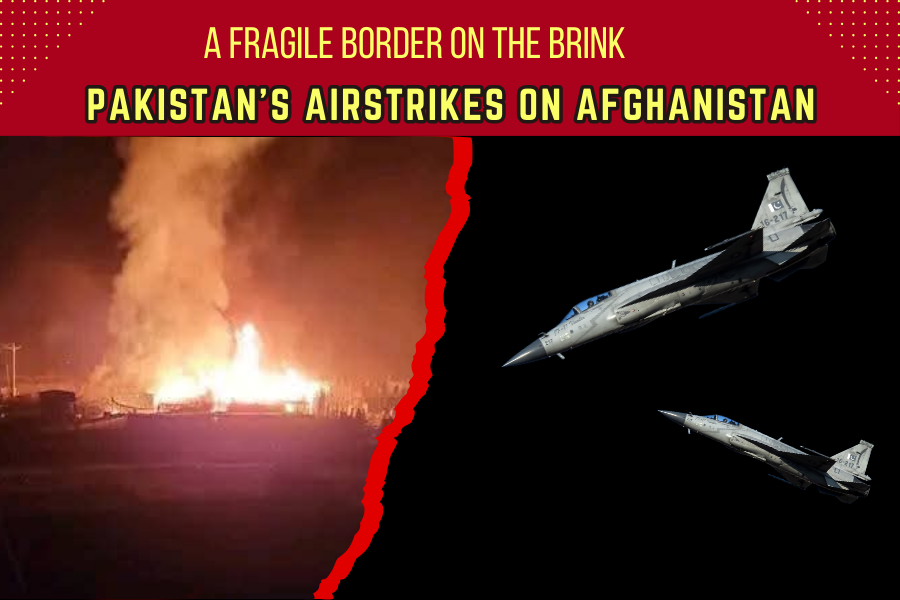
In the early hours of February 22, 2026, the volatile border between Pakistan and Afghanistan once again became a flashpoint of conflict. Pakistan’s military launched a series of airstrikes targeting alleged hideouts of the Tehrik-e-Taliban Pakistan (TTP) and affiliates of the Islamic State Khorasan Province (ISKP) in Afghanistan’s eastern provinces of Nangarhar and Paktika. Described by Pakistani officials as “intelligence-based, selective operations,” these strikes were a direct response to a recent surge in militant attacks within Pakistan, including a devastating suicide bombing at a Shia mosque in Islamabad on February 6 that claimed 31 lives and injured over 160 others. The operation has reignited tensions between the two neighbors, with conflicting reports on casualties—Pakistan claiming the elimination of 70-80 militants, while Afghan authorities and local witnesses report at least 17-28 civilian deaths, including women and children.
This incident is not an isolated event but a culmination of years of simmering distrust and unresolved grievances along the Pakistan-Afghanistan border, the porous 2,670-kilometer border that has long served as a conduit for militants, refugees, and trade. As of today, February 22, 2026, the strikes have prompted vows of retaliation from the Afghan Taliban government, raising fears of escalation during the holy month of Ramadan. The broader significance lies in its potential to destabilize South Asia, a region already grappling with economic woes, climate vulnerabilities, and great power rivalries. For Pakistan, facing internal security challenges and economic pressures, these actions reflect a shift toward unilateralism when diplomacy falters. Yet, they risk alienating international partners and exacerbating humanitarian crises.
This article delves into the background of Pakistan-Afghanistan relations, the details of the recent strikes, and the potential future repercussions. Drawing from reliable sources such as international news outlets, think tanks, and official statements, it aims to provide a balanced analysis, incorporating perspectives from both sides and regional stakeholders. The implications extend beyond bilateral ties, touching on geopolitics, security, economics, and society—where cross-border dynamics influence daily life through trade disruptions and security alerts.
Background: A History of Uneasy Neighbors
The roots of the current crisis trace back to the colonial era, when the Durand Line was drawn in 1893 by British diplomat Sir Mortimer Durand, dividing Pashtun tribes between British India (now Pakistan) and Afghanistan. Afghanistan has never fully recognized this border, viewing it as an artificial imposition that fragments ethnic Pashtun communities. This historical dispute has fueled ongoing tensions, with accusations of interference from both sides.
Post-2001, following the U.S.-led invasion of Afghanistan, Pakistan became a key ally in the “War on Terror,” providing logistical support while allegedly harboring Taliban elements—a charge Islamabad denies. The 2021 withdrawal of U.S. forces and the Taliban’s return to power marked a turning point. Pakistan initially welcomed the change, hoping for stability and cooperation against cross-border militancy. However, relations soured rapidly as TTP, an offshoot of the Afghan Taliban formed in 2007, regrouped in Afghan territory. Banned in Pakistan and designated a terrorist group by the UN, TTP has ideological ties to the Afghan Taliban but operates independently, launching attacks to establish Sharia law in Pakistan’s tribal areas.
By 2025, TTP attacks had surged, with over 600 incidents reported, resulting in more than 3,500 casualties in Pakistan since the Taliban’s takeover. Pakistani officials, including Prime Minister Shehbaz Sharif and military chief General Asim Munir, have repeatedly accused the Afghan Taliban of providing safe havens to TTP leaders like Noor Wali Mehsud. Kabul denies this, countering that Pakistan’s own policies, such as the forced repatriation of over 1.5 million Afghan refugees in 2024-2025, have exacerbated instability. Diplomatic efforts, including tripartite talks involving China in 2025, yielded limited results. A fragile ceasefire brokered in late 2025 held tenuously, but mutual distrust persisted.
Recent escalations began in early 2026. On February 6, a TTP-claimed suicide bombing targeted a Shia masjid in Islamabad during Friday prayers, killing 31 worshippers, including children, and injuring 160. This was followed by attacks in Bajaur on February 16, where 11 soldiers and a child died in an ambush, and in Bannu, where militants overran a checkpoint. Pakistani intelligence traced these to TTP bases in Afghanistan, prompting public warnings. On February 18, Pakistan summoned the Afghan chargé d’affaires in Islamabad, issuing a demarche demanding action against TTP. Defence Minister Khawaja Asif stated on February 19, “Pakistan reserves the right to act anywhere to protect its citizens,” signaling impending operations.
Broader regional dynamics complicate the picture. China’s China-Pakistan Economic Corridor (CPEC), a flagship Belt and Road Initiative project, has seen attacks on Chinese workers in Balochistan and Khyber Pakhtunkhwa, attributed partly to TTP. Beijing has urged Islamabad to enhance security, while quietly pressuring Kabul. The U.S., post-withdrawal, maintains over-the-horizon counterterrorism capabilities but views the region through the lens of great power competition with China. India, Pakistan’s arch-rival, has strengthened ties with the Taliban, providing humanitarian aid and reopening its embassy in Kabul in 2025, often framing Pakistan’s actions as aggressive.
Ethnic Pashtun nationalism adds a societal layer. The Durand Line bisects Pashtun heartlands, with communities on both sides sharing familial and cultural bonds. Incidents like these strikes fuel anti-Pakistan sentiment in Afghanistan and bolster separatist voices in Pakistan’s Pashtun areas, such as those led by the Pashtun Tahafuz Movement (PTM). Humanitarian issues loom large: Afghanistan’s economy is in tatters, with 28 million people needing aid in 2026, per UN reports, and border closures disrupt essential trade.
In Lahore, far from the border but connected through migration and commerce, these tensions manifest in heightened security at masjids and markets, economic ripple effects from disrupted Afghan trade (worth $2 billion annually), and public discourse on national security. Polls by Gallup Pakistan in January 2026 showed 65% of urban Pakistanis supporting stronger action against TTP, but 40% worried about civilian casualties in Afghanistan.
Present Actions: The Strikes and Immediate Fallout
The airstrikes commenced around 2:00 AM PKT on February 22, 2026, involving Pakistan Air Force F-16 and JF-17 fighter jets, supported by drones for reconnaissance. Pakistani military spokesperson Lieutenant General Ahmed Sharif described the operations as “precise and intelligence-driven,” targeting seven militant camps and hideouts in remote areas of Nangarhar and Paktika. Initial reports from Islamabad claimed the strikes neutralized 70-80 high-value targets, including TTP commanders involved in the Islamabad bombing. No visual evidence was released immediately, but officials like Information Minister Attaullah Tarar emphasized that the actions were in self-defence under Article 51 of the UN Charter.
From the Afghan perspective, the narrative differs starkly. The Taliban’s Ministry of Defence condemned the strikes as “unprovoked aggression” and violations of sovereignty. Spokesman Enayatullah Khwarazmi reported that Pakistani jets bombed civilian areas, including homes in Girdi Kas village, a madrasa in Paktika, and a school in Nangarhar. Eyewitness accounts, corroborated by local media like TOLOnews, described scenes of devastation: rubble-strewn homes, injured children, and families fleeing. Casualty figures vary—Afghan officials cite 28 deaths (including 12 from one family) and 17 injuries, while independent sources like the Afghanistan Analysts Network estimate up to 40 affected, with six missing. Videos circulating on social media show Taliban forces securing sites and locals protesting, some chanting against Pakistan.
The Taliban convened emergency meetings in Kabul and Kandahar, vowing an “appropriate and measured response at a suitable time.” Analysts interpret this as a signal for potential asymmetric retaliation, such as facilitating TTP incursions or border skirmishes, rather than direct military confrontation. In Pakistan, the strikes were met with domestic approval from government allies but criticism from opposition figures like Imran Khan’s PTI party, who called for parliamentary oversight to avoid escalation.
International reactions have been swift but measured. India, through its Ministry of External Affairs, condemned the strikes for causing “innocent civilian casualties during the sacred month of Ramadan,” accusing Pakistan of “externalizing its internal security failures.” This aligns with New Delhi’s strategy to isolate Islamabad regionally. The U.S. State Department urged restraint, emphasizing dialogue, while China called for “calm and cooperation” to protect mutual interests like CPEC. Gulf states, including Saudi Arabia and Qatar, which mediated prisoner releases between the two in January 2026, are reportedly engaging behind the scenes.
Humanitarian organizations like the International Committee of the Red Cross (ICRC) expressed alarm over access disruptions. Border crossings at Torkham and Chaman were temporarily closed, affecting thousands of traders and refugees. In Lahore, local markets saw a spike in prices for Afghan imports like dry fruits, underscoring economic interdependencies.
Diverse perspectives highlight the complexity: Pakistani security experts argue the strikes were necessary given Kabul’s inaction, while Afghan commentators view them as hegemonic overreach. Think tanks like the Council on Foreign Relations note that such actions mirror U.S. drone strikes in the region pre-2021, raising questions about international norms.
Future Repercussions: Risks and Pathways Forward
The airstrikes carry profound risks for security, geopolitics, society, and the economy. On security, they may temporarily disrupt TTP operations but could provoke retaliation, fracturing the group into more radical factions or strengthening ISKP alliances. During Ramadan, starting March 1, 2026, militancy often surges, potentially leading to spillover attacks in Pakistani cities like Peshawar or Quetta. Border clashes could evolve into a low-intensity conflict, straining Pakistan’s military resources amid economic constraints.
Geopolitically, the incident isolates the Taliban further, hindering their quest for international recognition. Pakistan’s unilateralism may erode trust with allies; China, invested in $62 billion CPEC projects, fears instability delaying Phase 2 initiatives. The U.S. might ramp up surveillance, while India could exploit the rift to bolster its Afghan presence, perhaps through increased aid or intelligence sharing. Regional forums like the Shanghai Cooperation Organization (SCO) could see heated debates at their 2026 summit in India.
Societally, the strikes deepen ethnic divides. Pashtun communities in Pakistan’s Khyber Pakhtunkhwa province, already marginalized, may see increased unrest, with PTM rallies protesting civilian deaths. In Afghanistan, anti-Pakistan fervor could radicalize youth, exacerbating the humanitarian crisis—UNHCR reports 4 million internally displaced Afghans as of February 2026. Gender dynamics are affected too; women in border areas face heightened vulnerabilities from displacement.
Economically, short-term disruptions could cost Pakistan $100-200 million in trade losses, per the Pakistan-Afghanistan Joint Chamber of Commerce. Long-term, persistent instability deters foreign investment, crucial for Pakistan’s IMF-backed reforms aiming for 3% GDP growth in 2026.
Pathways to resolution exist. Diplomacy, mediated by Qatar or Turkey, could revive talks on joint border management. Confidence-building measures like intelligence sharing or economic incentives—e.g., expanding CPEC to Afghanistan—might yield results. International pressure on Kabul to curb TTP, tied to aid, could help. For Pakistan, integrating Pashtun voices into policy-making would address root causes.
In Lahore, residents should monitor security advisories, as urban centers could face indirect threats. Community dialogues on peace could foster understanding.
Conclusion
Pakistan’s airstrikes on Afghanistan underscore the perils of unresolved border disputes in a region fraught with militancy and power plays. While justified by Islamabad as self-defence, they highlight the failure of diplomacy and risk a vicious cycle of violence. Balancing security needs with humanitarian concerns is imperative for sustainable peace.
As events unfold on this February 22, 2026, stakeholders must prioritize dialogue to prevent escalation. For Pakistanis, this is a reminder of interconnected fates—peace across the border is essential for prosperity at home.