(By Mohsin Tanveer)
Introduction
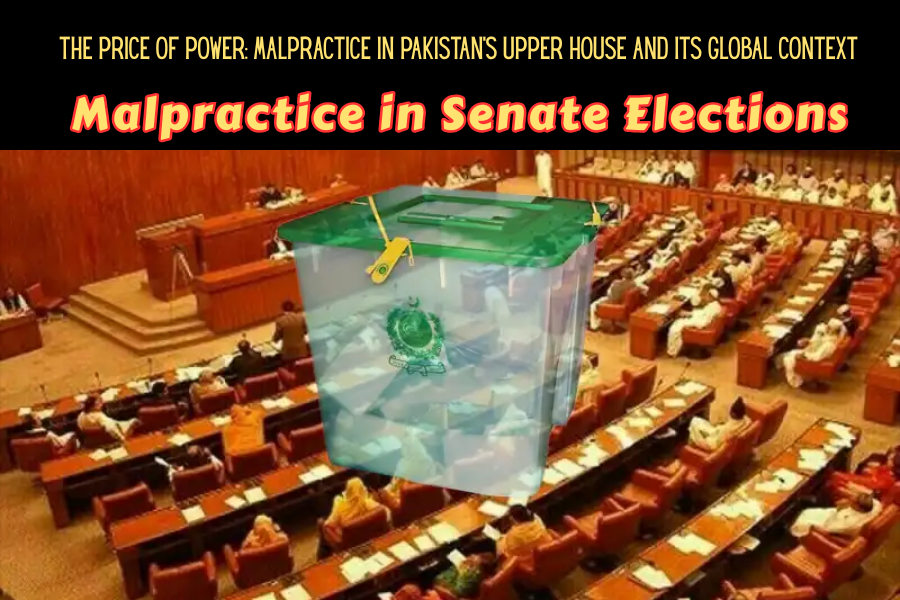
The integrity of a legislative body is paramount to a functioning democracy, yet in countries like Pakistan, the indirect election process for the upper house—the Senate—has been consistently plagued by allegations of vote-buying and “horse-trading.” This practice, where wealthy individuals allegedly purchase their seats by paying huge sums to electors (Members of Provincial Assemblies/MPAs), represents a profound corruption that undermines the entire democratic structure. This malfeasance is not confined to one party; it is an institutionalized flaw in the electoral mechanism that transforms the prestigious chamber of federation into an exclusive auction for the ultra-rich, fundamentally betraying the core spirit of representation and accountability.
Background: The Structural Flaw and The “Everyone Does It” Problem
The current state of corruption in the Senate elections is rooted in the structure of the voting process. Senators are elected indirectly by the provincial assemblies using the Proportional Representation (PR) system by means of a Single Transferable Vote (STV) with a secret ballot.
- The Electoral College: The limited number of electors (a few hundred MPAs nationwide) makes influencing or buying the required votes financially feasible for the wealthy elite.
- The Secret Ballot Trap: The most critical factor is the secrecy of the ballot, which shields the Member of Provincial Assembly (MPA) who sells their vote from party discipline, as the party cannot definitively prove which way they voted. This creates a highly profitable environment for wealthy candidates.
How Seats Are Allegedly Sold by All Major Parties
The phenomenon of seat-selling has become a pervasive issue that has, at various times, implicated virtually all major political parties, including the Pakistan Muslim League-Nawaz (PML-N), the Pakistan Peoples Party (PPP), and the Pakistan Tehreek-e-Insaf (PTI).
The process of “selling” a seat is often two-fold:
- Selling the Party Ticket/Nomination: Parties allegedly select candidates based on their financial muscle and willingness to spend, often prioritizing wealthy industrialists, real estate tycoons, or business magnates who can ‘self-fund’ their campaign and secure additional votes. This provides the candidate with the essential party platform.
- Buying Individual Votes: Once nominated, the wealthy candidate then allegedly pays individual MPAs from various parties to secure the minimum number of votes required for victory. Reported prices for a single vote have historically ranged from $200,000 to over $500,000 USD in some provinces, making the total cost of a seat several million dollars.
The JUI-F Allegation (35 Crore): The recent controversy surrounding Senator Ahmad Khan Khilji vividly illustrates the problem. Following his expulsion from the Jamiat Ulema-e-Islam (F) (JUI-F) for violating party policy on a key vote, a potent social media claim circulated, alleging he had explicitly stated he purchased his Senate ticket from Maulana Fazlur Rehman for 35 crore rupees (PKR 350 million). While unproven, this specific, high-profile figure perfectly encapsulates the public perception that the Senate is a high-cost commodity, where the money is allegedly paid directly to the party chief in exchange for the nomination and the associated privilege of defying party discipline.
The Malpractice in Pakistan’s Senate Elections and Its Repercussions
The consequences of this transactional political culture are severe and far-reaching:
- Erosion of Merit and Ideology: The Senate is filled with individuals whose primary qualification is their wealth, not their commitment to public service, legislative skill, or party ideology. This compromises the quality of legislative debate and oversight.
- Conflict of Interest: Senators who have paid millions to secure their seats are inherently driven to protect their private business interests and recoup their massive “investment” through further corruption, thereby undermining the institutional integrity of the state.
- Deepening Public Cynicism: The widespread perception that political office is for sale destroys public trust in the entire political system, leading to low voter turnout, political instability, and a major crisis of legitimacy for the government.
Historical Precedent: The US Senate’s Reform 🇺🇸
Similar corruption issues once marred the election of the upper house in the United States, leading to a major constitutional reform that fundamentally changed how senators are chosen.
| System | Original US System (Pre-1913) | Reform through the 17th Amendment (1913) |
| Electors | State Legislatures (indirectly elected) | General Public (directly elected) |
| Malpractice | Bribery and political deadlock led to accusations that wealthy industrialists (“Lords of the Senate”) were buying seats by controlling the state assembly members. | Outcome: The reform sought to democratize the Senate, making it directly accountable to the public and removing the power of a few state legislators to be corrupted by money. |
The move from indirect to direct election via the Seventeenth Amendment in 1913 was a crucial step to eliminate the backroom deals and restore democratic accountability to the US Senate, offering a powerful historical example of constitutional remedy.
Electoral Methods in the Region: India and Bangladesh
The way neighboring South Asian countries elect their upper houses offers a comparative perspective on institutional defenses against corruption:
1. India: Rajya Sabha (Council of States)
India’s upper house members are indirectly elected through a method similar to Pakistan’s (by MLAs using STV), but they have adopted a crucial anti-corruption measure:
- Anti-Corruption Measure: Rajya Sabha elections are typically conducted using an Open Ballot system. Electors must show their marked ballot paper to their party agent before placing it in the ballot box. This measure is specifically designed to enforce party discipline and prevent cross-voting or vote-buying by eliminating the secrecy of the vote.
2. Bangladesh: Unicameral System (Currently)
Bangladesh currently operates with a unicameral legislature (Jatiya Sangsad), meaning it has no upper house. However, in the context of proposals to establish a bicameral system, models often focus on:
- Proportional Representation (PR): Any future upper house would likely utilize PR, with members allocated based on the proportion of votes received by political parties in the lower house. This method emphasizes party proportionality and further reduces the incentive for individual vote-buying for a specific seat.
The Push for Reform in Pakistan: Open Ballot vs. Secret Ballot
The widespread allegations of corruption have prompted significant, albeit often politically charged, attempts at reform in Pakistan:
- The Open Ballot Push: In 2021, the government led by then-Prime Minister Imran Khan initiated a major effort to conduct Senate elections through an open ballot instead of a secret ballot. This move was explicitly aimed at curbing vote-buying by exposing legislators who voted against their party’s instructions.
- Supreme Court’s Stance: The government sought the opinion of the Supreme Court of Pakistan on the matter. In a landmark ruling in March 2021, the Supreme Court stated that while secrecy of the ballot is guaranteed by the Constitution (Article 226), it is not absolute. The court directed the Election Commission of Pakistan (ECP) to take all available measures, including the use of technology, to ensure the election is “conducted honestly, justly, fairly and in accordance with law and that corrupt practices are guarded against.” The ruling essentially upheld the secret ballot but directed the ECP to enforce transparency measures.
- Failed Constitutional Amendments: Various proposals, including constitutional amendment bills, have been debated over the years in the Senate and National Assembly to shift either to an open ballot or direct election model, but these efforts have consistently failed to secure the required two-thirds majority, as the issue often divides parties based on whether they are in government (seeking transparency) or in opposition (defending the constitutional guarantee of secrecy).
Conclusion
The selling and buying of Senate seats in Pakistan is not merely a scandal of individual greed but a systemic crisis fueled by the fatal combination of an indirect election process and the secret ballot. The unverified but pervasive allegations of seats being sold for exorbitant sums like 35 crore are symptoms of an institutional failure to safeguard the democratic process. As demonstrated by the successful constitutional reform in the United States and the use of the open ballot in India’s Rajya Sabha, there are clear legislative pathways to mitigate this corruption. Unless Pakistan’s political establishment moves decisively—either by adopting the direct election model or implementing an open ballot system—to prioritize merit over money, the Senate will continue to function as a “rich men’s club,” perpetually eroding public faith and compromising the very foundations of the federation it was created to protect.