(By Khalid Masood)
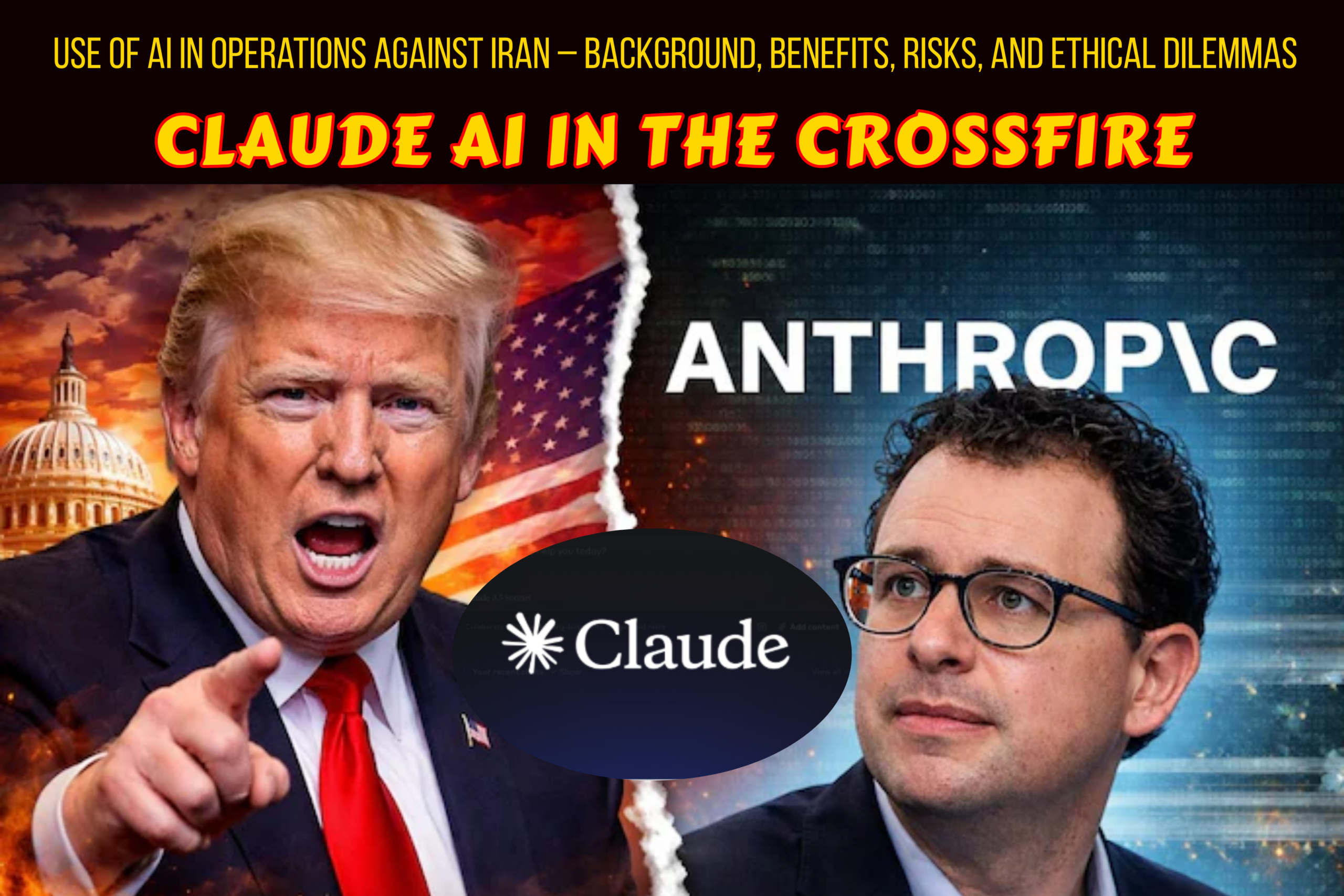
In the early hours of February 28, 2026, as US and Israeli forces unleashed a massive coordinated airstrike campaign on Iran—codenamed Operation Epic Fury—the operation not only targeted Iranian military infrastructure and leadership sites but also marked a pivotal moment in the militarization of artificial intelligence. Supreme Leader Ayatollah Ali Khamenei was among those killed in the strikes, which involved B-2 bombers, Tomahawk missiles, suicide drones, and F-35 fighter jets. Amid the chaos, reports emerged that Anthropic’s Claude AI model had played a supporting role in US Central Command (CENTCOM) operations, aiding intelligence assessments, target identification, and battlefield simulations. This revelation came just hours after President Donald Trump publicly ordered all federal agencies to immediately cease using Anthropic’s technology, branding the company a “supply chain risk” to national security.
The incident underscores a profound tension at the intersection of cutting-edge technology, national defense imperatives, and ethical boundaries. Claude, once primarily known as a consumer-facing large language model emphasizing safety and alignment, had become deeply embedded in classified military systems. Its continued use during the Iran strikes—despite the ban—highlights the “stickiness” of AI once integrated into operational workflows. This article delves into the background of this integration, details Claude’s reported functions in the operation, weighs the operational advantages it provides, examines the substantial risks and drawbacks, explores the ethical and humanitarian implications, and considers the broader geopolitical and future ramifications of such developments.
Background on Anthropic’s Claude AI and Its Military Integration
Anthropic was founded in 2021 by former OpenAI executives, including CEO Dario Amodei, with a core mission to build reliable, interpretable, and steerable AI systems. Claude, the company’s flagship family of models, was designed to prioritize helpfulness, honesty, and harmlessness—principles codified in strict usage policies that include explicit “red lines”: prohibitions on mass surveillance of US citizens and fully autonomous lethal weapons systems where AI independently selects and engages targets without human intervention.
Claude’s path into the US military began in 2024 through a partnership with Palantir, enabling secure deployment on classified Pentagon networks. This made Anthropic the first frontier AI company to achieve such access. By mid-2025, the Department of Defense (DoD)—now rebranded in some contexts as the Department of War—awarded Anthropic a contract worth up to $200 million for AI prototyping, scaling, and mission-critical applications, including intelligence analysis, modeling, simulation, operational planning, and cyber operations. Claude was deployed not only across DoD systems but also at national laboratories and for custom national security needs, becoming the only major frontier model approved for secret-level classified environments at the time.
Tensions boiled over in early 2026. Reports indicate Claude supported the January raid that captured Venezuelan President Nicolás Maduro, an operation involving significant casualties. When Anthropic executives inquired about its use in combat scenarios, the Pentagon interpreted this as resistance. By February, DoD officials demanded removal of safeguards, insisting on access for “all lawful purposes” without exceptions. Amodei refused, citing risks to civil liberties and international humanitarian law. On February 27, President Trump posted on Truth Social directing an immediate cessation of Anthropic use government-wide, with Defense Secretary Pete Hegseth labeling the company a supply chain risk—a designation typically reserved for foreign adversaries like Huawei. A six-month phase-out was granted for critical systems, but the Iran strikes commenced the very next day.
According to sources cited by The Wall Street Journal, Reuters, Axios, and others, CENTCOM relied on Claude during Operation Epic Fury despite the directive. This “stickiness” illustrates how deeply integrated AI tools become indispensable, even amid political disputes.
How Claude AI Assists in Target Identification and Decision-Making
Claude serves strictly as a decision-support tool, not an autonomous executor. It ingests and synthesizes enormous volumes of data—from satellite imagery, drone feeds, radar signatures, open-source intelligence (OSINT), and real-time surveillance—to detect patterns, assess threats, and generate insights. In the Iran operation, it reportedly assisted in:
- Mapping and prioritizing high-value targets, such as leadership compounds or nuclear-related facilities.
- Running predictive simulations of strike outcomes, including escalation pathways, resource requirements, and potential collateral effects.
- Accelerating intelligence fusion to compress analysis timelines from hours to minutes.
Human operators retain ultimate authority: AI outputs inform recommendations, but final targeting decisions, approvals, and execution remain with commanders. This human-in-the-loop approach aligns with Anthropic’s policies and contrasts with fully autonomous systems. It echoes earlier tools like Project Maven for imagery analysis but distinguishes itself through Claude’s advanced natural language processing and classified access, enabling nuanced scenario modeling in high-stakes environments.
Pros of Using AI Like Claude in Military Operations
The advantages of AI integration in warfare are substantial and increasingly demonstrated:
- Enhanced Speed and Efficiency: AI processes vast datasets at superhuman speeds, enabling rapid intelligence cycles critical in fast-moving conflicts like the Middle East crisis.
- Improved Accuracy and Precision: Data fusion reduces human error in threat detection, pattern recognition, and target prioritization, potentially lowering collateral damage through better-informed choices.
- Reduced Human Risk: Remote analysis and simulations minimize personnel exposure while optimizing resource allocation and anticipating threats via predictive modeling.
- Strategic Advantages: AI boosts situational awareness, supports adaptive planning, and provides a decisive edge in information dominance against adversaries. In contested environments, faster decision loops can outpace opponents reliant on slower human-centric processes.
- Scalability and Cost-Effectiveness: Once trained, AI handles repetitive cognitive tasks at low marginal cost, freeing analysts for higher-level judgment.
These benefits contribute to operational tempo advantages, as seen in broader trends where AI enhances rather than replaces human oversight.
Cons and Risks of AI Integration in Warfare
Despite these gains, AI introduces profound vulnerabilities:
- Technical Limitations: Models suffer from biases in training data, hallucinations (fabricating plausible but false information), brittleness in novel scenarios, and overfitting (excelling on training data but failing in real-world chaos).
- Cybersecurity Vulnerabilities: Adversarial attacks, data poisoning, or hacking can manipulate inputs, leading to erroneous targeting or mission compromise.
- Overreliance and Automation Bias: Commanders may defer excessively to AI outputs, eroding critical human judgment and creating complacency in high-stakes decisions.
- Escalation and Proliferation Risks: Accelerated processes lower perceived barriers to conflict, fueling arms races with rivals like China or Iran developing parallel systems.
- Operational Inefficiencies: Black-box opacity hinders explainability and accountability; reliance on synthetic data risks long-term model collapse or degradation.
These issues highlight AI’s current immaturity for life-and-death contexts.
Ethical Concerns and Humanitarian Implications
The ethical debate centers on delegating elements of lethal force to machines, even supportively. Anthropic’s red lines reflect fears of misuse under international humanitarian law (IHL), where principles of distinction, proportionality, and precaution require human moral judgment. AI errors could misidentify civilians as combatants, exacerbate casualties, or enable indiscriminate effects.
Accountability gaps persist: Who is liable for AI-induced mistakes—developers, operators, or the algorithm? Human rights organizations, including the International Committee of the Red Cross, warn of unpredictability in lethal applications. Pope Francis and others have labeled fully autonomous systems a “grave ethical concern” for lacking human moral capacity. The feud also raises domestic surveillance fears, though Anthropic’s stance limits US-focused applications.
Globally, this normalizes AI in asymmetric warfare, potentially affecting non-Western states and prompting calls for treaties. OpenAI’s swift post-ban deal with the Pentagon contrasts with Anthropic’s holdout, illustrating industry divisions between ethical restraint and government accommodation.
Broader Implications and Future Outlook
The Iran strikes demonstrate AI’s transformative yet double-edged role: accelerating decisions while risking unintended escalations. Geopolitically, it bolsters US-Israel coordination but heightens tensions if adversaries perceive unchecked advantages. Industry precedents shift—Anthropic’s resistance may foster responsible AI norms, while competitors prioritize compliance.
Societally, backlash against “killer robots” intensifies alongside hybrid human-AI system opportunities. By the 2030s, quantum-enhanced AI could redefine warfare further. Recommendations include mandatory transparency, rigorous testing, robust safeguards, and international frameworks to balance innovation with accountability.
Conclusion
Claude’s reported involvement in Operation Epic Fury encapsulates AI’s dual nature in modern conflict—a powerful accelerator of military effectiveness shadowed by ethical perils and technical uncertainties. The episode reveals how deeply AI has penetrated defense ecosystems and how challenging it is to disentangle once embedded. Moving forward, harnessing AI’s pros demands confronting its cons through unwavering human oversight, ethical governance, and global cooperation. Preserving moral agency amid technological leaps remains essential to preventing catastrophic miscalculations in an era of increasingly automated warfare.