(By Ayesha Mahnoor)
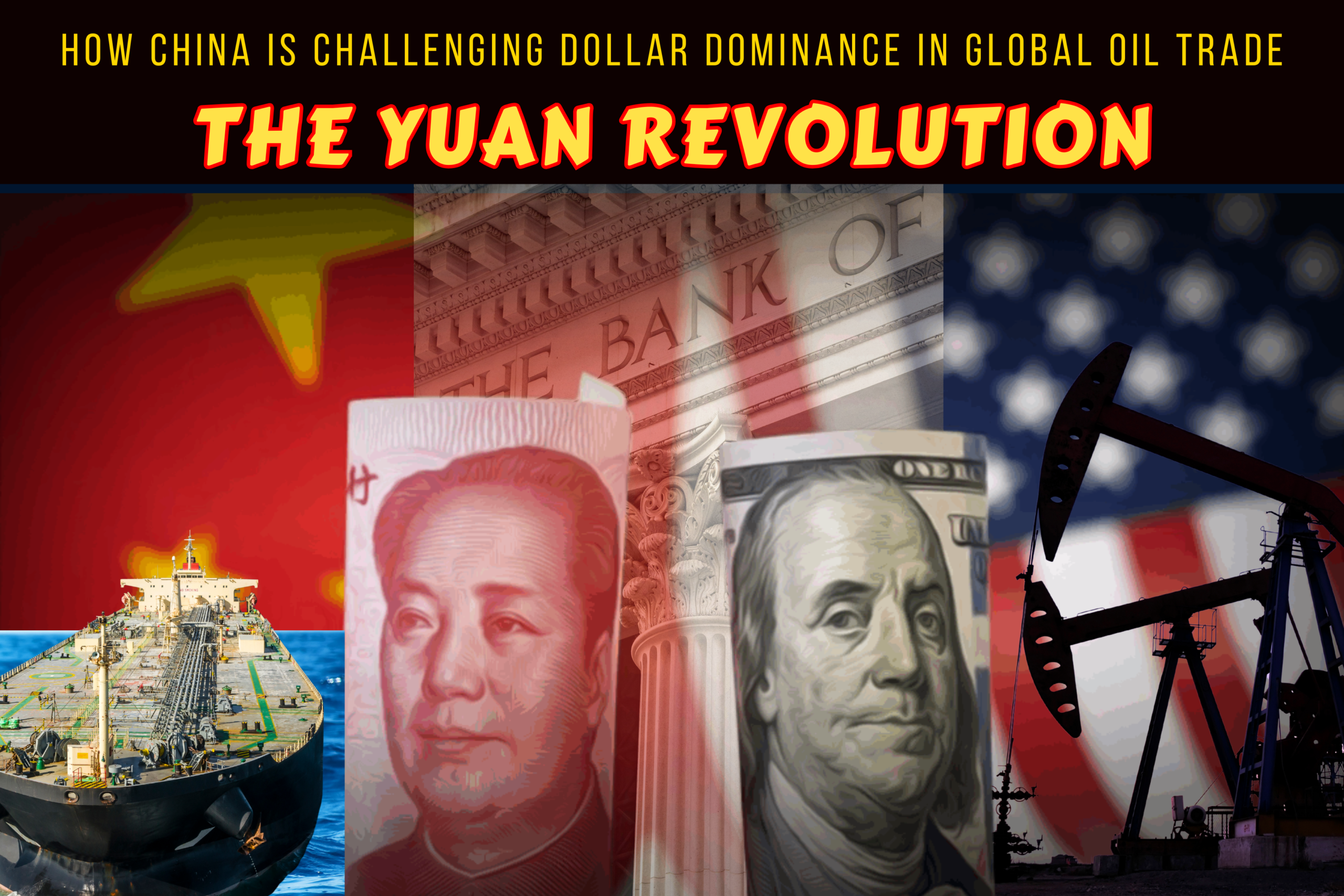
The Chinese yuan has strengthened to 6.8982 against the US dollar in March 2026, marking a three-year high and reflecting a significant shift in global currency dynamics. This appreciation coincides with an accelerating trend of countries paying for oil in yuan rather than dollars—a development that challenges the seven-decade dominance of the petrodollar system. From Russia and Iran to Saudi Arabia and India, major energy traders are increasingly settling oil transactions in Chinese currency, facilitated by China’s Cross-Border Interbank Payment System (CIPS) and the Shanghai International Energy Exchange (INE). This article examines how this transition occurred, the mechanisms enabling it, and the profound implications for the global economic order.
PART I: THE RISE OF THE PETROYUAN
Understanding the Petrodollar System
For nearly 50 years, the global oil market has operated under the “petrodollar” system, established following a 1974 agreement between the United States and Saudi Arabia. Under this arrangement, oil exports were priced and settled exclusively in US dollars, creating constant global demand for the American currency. This system provided the United States with enormous economic advantages:
- Seigniorage Benefits: The ability to print currency that the world needs
- Lower Borrowing Costs: Constant demand for dollars keeps US interest rates low
- Sanctions Power: Control over dollar-based payment systems (SWIFT) enables financial warfare
- Reserve Currency Status: Central banks worldwide hold dollars as primary reserves
However, this monopoly is now fracturing.
The Birth of the Petroyuan
China’s challenge to dollar dominance began in earnest on 26 March 2018, when the Shanghai International Energy Exchange (INE) launched yuan-denominated crude oil futures contracts. This was China’s first international futures contract, designed to:
- Allow oil exporters to receive payment in yuan
- Provide a gold convertibility option (yuan can be converted to gold on Shanghai and Hong Kong exchanges)
- Create an alternative pricing benchmark to Brent and WTI crude
Key Features of INE Oil Futures:
- Contract size: 1,000 barrels per lot
- Price quotation: Yuan per barrel (tax-free)
- Minimum price fluctuation: 0.1 yuan per barrel
- Daily price limits: ±4% from previous settlement
Why the Petroyuan is Gaining Momentum Now
Several converging factors have accelerated yuan adoption in oil trade:
1. China’s Economic Leverage As the world’s largest energy importer, China possesses significant bargaining power with suppliers. Beijing has actively urged oil producers—including Saudi Arabia, Russia, and Iran—to accept yuan for crude shipments.
2. Geopolitical Sanctions The weaponisation of the dollar through sanctions has pushed targeted nations toward alternatives. Russia, Iran, and other sanctioned countries have expanded non-dollar trade settlements out of necessity rather than choice.
3. US-China Tensions Deteriorating relations between Washington and Beijing have motivated China to reduce exposure to US financial systems and potential asset freezes.
4. BRICS Expansion The expanded BRICS bloc (now including Egypt, Ethiopia, Iran, and UAE) is actively pursuing financial independence from Western-dominated institutions.
PART II: HOW THE TRANSITION HAPPENED
Phase 1: Bilateral Currency Swaps (2009-2018)
China’s central bank, the People’s Bank of China (PBOC), began signing bilateral currency swap agreements with foreign central banks as early as 2009. These agreements:
- Provide liquidity in yuan for trading partners
- Total approximately 3.7 trillion yuan ($550 billion) across 39 central banks
- Create confidence that yuan can be obtained even without liquid markets
Key Swap Partners:
- Russia
- Saudi Arabia
- United Arab Emirates
- Brazil
- Argentina
- South Korea
- United Kingdom
Phase 2: Building Alternative Infrastructure (2015-Present)
CIPS: China’s SWIFT Alternative
Launched in 2015, the Cross-Border Interbank Payment System (CIPS) represents China’s alternative to the Western-dominated SWIFT network.
CIPS Infrastructure (as of 2025):
- 176 direct participants
- 1,467 indirect participants across 119 countries
- Links approximately 4,800 banks in 185 countries
- Processes tens of trillions of yuan annually
How CIPS Works:
- Enables yuan-denominated transactions without converting to dollars
- Reduces exposure to US financial oversight and sanctions
- Provides reliable, efficient, and low-cost clearing services
Important Caveat: Approximately 80% of CIPS transactions still rely on SWIFT messaging, indicating continued interdependence with Western infrastructure.
Phase 3: Major Oil Trade Settlements (2022-Present)
Russia-China: The Pioneer Case
Following Russia’s invasion of Ukraine in 2022 and subsequent Western sanctions, Russia and China accelerated yuan-based oil trade:
- Russia-China oil trade: $19.14 billion in 2025, with the vast majority settled in yuan and rubles—not dollars
- By late 2024: Roughly 90% of Russia’s trade with BRICS partners conducted in national currencies
- Sakhalin dividends: Russia began paying dividends from Sakhalin 1 and 2 oil projects in yuan instead of dollars
India’s Yuan-Ruble-Rupee Triangle
In a significant development, India has begun paying Russia for oil in Chinese yuan instead of US dollars. This arrangement:
- Solves India’s rupee accumulation problem in Russia
- Saves India an estimated $7 billion in foreign exchange costs
- Creates a complex three-way currency settlement mechanism
Brazil-China Direct Settlement
Brazil and China formalised direct currency settlement (yuan-real) in 2023, bypassing the dollar entirely. This is particularly significant because:
- China is Brazil’s largest trading partner (30% of Brazilian exports)
- Brazil exports massive quantities of oil and commodities to China
- Sets precedent for Latin American de-dollarisation
Saudi Arabia: The Holy Grail
Perhaps the most significant development involves Saudi Arabia, the world’s largest oil exporter and the cornerstone of the petrodollar system:
- September 2024: Saudi officials expressed willingness to accept yuan for crude oil ahead of Premier Li Qiang’s visit
- Ongoing negotiations: Discussions about yuan-based oil sales to China continue, though implementation remains gradual
- Trade volume: China-Saudi trade surpassed $450 billion in 2025, with energy comprising a major portion
S&P Global Assessment: “Saudi-China ties and renminbi-based oil trade face significant challenges, and may take decades to grow to a meaningful scale”.
Iran and Venezuela: Sanctioned States
Countries under comprehensive US sanctions have been the earliest and most enthusiastic adopters of yuan settlements:
- Iran: Has called for replacing the petrodollar with yuan and conducts most oil trade with China in yuan
- Venezuela: Uses yuan for oil exports to China as sanctions relief mechanism
Phase 4: Digital Yuan Integration (2024-Present)
China’s central bank digital currency (CBDC)—the digital yuan or e-CNY—is enabling faster, more efficient cross-border transactions.
Advantages of Digital Yuan:
- Removes friction from cross-border transactions
- Enables real-time settlement without correspondent banks
- Reduces transaction costs significantly
- Provides China with greater visibility into transaction flows
Strategic Implication: “This is not ideological anti-Americanism. This is engineering”.
PART III: CURRENT STATUS OF YUAN INTERNATIONALISATION
Yuan Exchange Rate Performance
The yuan has demonstrated remarkable strength in recent months:
- March 10, 2026: Yuan strengthened to 6.8982 against the dollar (central parity rate)
- March 11, 2026: PBOC set RMB central parity at 6.8917 per dollar—a three-year high
- December 2025: Yuan strengthened to 7.0686 against the dollar
- Nine-month gain: Yuan appreciated nearly 6% against the dollar, driven by export strength and rising conversions
Forecast: Top forecasters predict the yuan will cross the 7 per dollar threshold in 2026, before ending the year at approximately 7.03 per dollar.
Yuan’s Share in Global Finance
Despite progress, the yuan’s global role remains modest compared to the dollar:
Global Reserves:
- Yuan: 1.93% of global reserves (Q3 2025)
- US Dollar: 57-58% of global reserves (down from 71% in 2000)
- Euro: Approximately 20% of global reserves
However, in specific areas, yuan usage is surging:
Trade Finance:
- Yuan’s share in global trade finance quadrupled to 8% by early 2026
- Since 2022, yuan has become the second-largest trade finance currency (after the dollar)
- By end of 2024, yuan ranked fourth in global payments and third in trade financing
Cross-Border Payments:
- Yuan’s share reached 3.2% in global cross-border payments (January 2022)
- Cross-border yuan payments grew 23% year-on-year in 2024
- By early 2025, 41% of China-Russia trade was settled in renminbi
UBS Projection: “Yuan reserve allocations could climb toward 10% if US policy tensions persist, up from a 6% long-term target”.
Countries Using Yuan for Oil Trade
Confirmed Users:
- Russia: Majority of oil exports to China settled in yuan/rubles
- Iran: Extensive yuan usage for oil exports to China
- India: Paying Russia for oil in yuan
- Brazil: Direct yuan-real settlements with China
- Venezuela: Yuan for oil exports
- Malaysia: Exploring yuan settlements
- Thailand: Increasing yuan usage in energy trade
In Negotiations:
- Saudi Arabia: Discussions ongoing for yuan oil sales
- United Arab Emirates: Exploring yuan options
- Iraq: Considering yuan for Chinese oil purchases
- Angola: Potential yuan adoption
PART IV: IMPLICATIONS FOR THE GLOBAL ECONOMY
Implications for the United States
1. Reduced Seigniorage Benefits As global demand for dollars declines, the US will face:
- Higher borrowing costs (interest rates)
- Reduced ability to finance deficits cheaply
- Potential dollar depreciation
2. Diminished Sanctions Power The effectiveness of US financial sanctions depends on dollar dominance:
- Alternative payment systems (CIPS) reduce sanction impact
- Countries can circumvent SWIFT restrictions
- US loses a key foreign policy tool
3. Inflation Risks If countries reduce dollar reserves:
- Excess dollars could flow back to US
- Import prices would rise
- Federal Reserve would face difficult policy choices
4. Geopolitical Influence Dollar dominance underpins US global leadership:
- Reduced currency leverage weakens diplomatic power
- Allies may pursue more independent policies
- Multipolar financial order reduces US centrality
Expert Assessment: “Meaningful de-dollarisation would have profound implications for the global security architecture, reducing the United States’ capacity to fund [military operations and deficits]”.
Implications for China
Advantages:
1. Reduced Exchange Rate Risk Chinese importers can pay for oil in yuan, eliminating:
- Dollar-yuan conversion costs
- Exposure to dollar volatility
- Foreign exchange risk
2. Enhanced Geopolitical Power Yuan internationalisation provides:
- Greater autonomy from US financial system
- Ability to offer sanction-resistant trade options
- Increased leverage with trading partners
3. Lower Transaction Costs Direct yuan settlements reduce:
- Banking fees for currency conversion
- Time delays in cross-border payments
- Intermediary costs
4. Reserve Currency Status As yuan becomes a reserve currency:
- Global demand for yuan assets increases
- China gains seigniorage benefits
- Chinese financial markets deepen
Challenges:
1. The “Impossible Trinity” China faces a fundamental economic contradiction:
- Cannot simultaneously maintain: (a) independent monetary policy, (b) fixed exchange rate, and (c) free capital flows
- Beijing has chosen (a) and (b), sacrificing (c)
2. Capital Controls Barrier For yuan to become a true reserve currency, China must:
- Allow full convertibility
- Open capital account
- Remove administrative hurdles
Problem: None of these align with Communist Party priorities for control.
3. Trust and Transparency International investors require:
- Transparent financial markets
- Rule of law and legal protections
- Market-driven policies
Reality: China’s financial markets remain opaque and state-directed.
4. Economic Slowdown China’s economic challenges create headwinds:
- Slower GDP growth
- Property sector crisis
- High debt levels
- Demographic decline
These factors reduce confidence in yuan as a store of value.
Implications for Energy Exporters
Opportunities:
1. Currency Diversification Oil exporters can:
- Reduce exposure to dollar volatility
- Hedge against dollar depreciation
- Access Chinese markets more easily
2. Sanctions Avoidance Countries facing US sanctions can:
- Continue trading with China
- Access global markets via yuan
- Reduce vulnerability to financial warfare
3. Closer Ties with China Yuan settlements strengthen:
- Economic integration with China
- Access to Chinese investment
- Political alignment with Beijing
Risks:
1. Currency Mismatch Exporters face new challenges:
- Receiving yuan but needing other currencies
- Limited yuan investment options
- Convertibility restrictions
2. Dependency on China Over-reliance on yuan creates:
- Vulnerability to Chinese economic conditions
- Reduced policy autonomy
- Exposure to China-US tensions
3. Limited Liquidity Yuan markets lack:
- Depth of dollar markets
- Ease of conversion
- Global acceptance
Implications for Global Financial Architecture
1. Multipolar Currency System The most likely outcome is not yuan replacing the dollar, but rather:
- Multiple currencies used in oil trade (dollar, yuan, euro, rupee)
- Regional currency blocs emerging
- Fragmented but interconnected systems
2. Regional Payment Systems We are seeing proliferation of alternatives to SWIFT:
- CIPS (China)
- SPFS (Russia’s System for Transfer of Financial Messages)
- BRICS Pay (under development)
- Digital currency platforms (various CBDCs)
3. BRICS Financial Integration The expanded BRICS bloc is developing:
- Common payment infrastructure
- Local currency settlement mechanisms
- Alternative to IMF and World Bank
- Potential common currency (long-term aspiration)
4. Digital Currency Revolution Central bank digital currencies (CBDCs) could:
- Enable direct cross-border settlements
- Bypass traditional correspondent banking
- Reduce transaction costs dramatically
- Create new geopolitical dynamics
Implications for Developing Countries
Benefits:
1. Reduced Dollar Dependency Developing nations can:
- Lower foreign exchange reserves needs
- Reduce vulnerability to US monetary policy
- Avoid dollar shortage crises
2. Trade Facilitation Local currency settlements enable:
- Easier trade with China (largest trading partner for many)
- Lower transaction costs
- Faster settlement times
3. Policy Space Less dollar dependency provides:
- Greater monetary policy independence
- Reduced exposure to US sanctions
- More development financing options
Challenges:
1. Currency Volatility Emerging market currencies face:
- Higher volatility than dollar
- Limited hedging instruments
- Convertibility risks
2. Infrastructure Gaps Many countries lack:
- CIPS connectivity
- Digital payment systems
- Regulatory frameworks
3. Geopolitical Pressure Choosing between dollar and yuan systems may:
- Strain relations with US
- Create alignment dilemmas
- Require difficult diplomatic balancing
PART V: CHALLENGES TO YUAN DOMINANCE
Despite momentum, the petroyuan faces significant structural obstacles:
1. Limited Convertibility
Unlike the freely convertible US dollar, the yuan remains subject to:
- Capital controls restricting cross-border flows
- Administrative approval requirements
- Daily trading bands and PBOC intervention
- Limits on repatriation of profits
Impact: Central banks and investors hesitate to hold large yuan reserves due to uncertainty about access during crises.
2. Lack of Market Depth
US Treasury markets offer:
- Unparalleled liquidity ($24+ trillion market)
- Safe-haven status
- 24/7 trading
- Transparent pricing
Chinese markets lack:
- Comparable depth and liquidity
- Confidence in rule of law
- Independent judiciary
- Transparency in policymaking
3. Trust Deficit
International users require confidence that:
- Assets won’t be frozen arbitrarily
- Contracts will be enforced
- Markets won’t be manipulated
- Information is accurate
China’s challenges:
- State-directed economy raises manipulation concerns
- Geopolitical tensions create weaponisation fears
- Regulatory unpredictability (e.g., tech crackdown)
- Data transparency questions
4. Network Effects
The dollar benefits from powerful network effects:
- Established infrastructure (SWIFT, correspondent banking)
- Legal frameworks (English law contracts)
- Market conventions (oil priced in dollars)
- Inertia (switching costs are high)
Overcoming these requires:
- Massive infrastructure investment
- Coordinated international action
- Time (decades, not years)
5. China’s Economic Challenges
Domestic economic problems constrain yuan ambitions:
- Property crisis: Evergrande, Country Garden defaults
- Local government debt: Estimated $9+ trillion
- Demographics: Shrinking, aging population
- Growth slowdown: From 10% to 4-5% annually
- Youth unemployment: Over 20%
These issues reduce confidence in yuan as a long-term store of value.
PART VI: FUTURE SCENARIOS
Based on current trends, several scenarios are possible:
Scenario 1: Gradual Multipolarity (Most Likely – 60% probability)
Timeline: 2026-2040
Characteristics:
- Dollar remains dominant (40-50% of reserves) but declines from current levels
- Yuan rises to 10-15% of global reserves
- Euro maintains 15-20% share
- Regional currencies gain traction in local trade
- Multiple payment systems coexist (SWIFT, CIPS, regional alternatives)
- Oil trade fragmented across dollar, yuan, euro, and local currencies
Implications:
- Reduced but not eliminated US financial power
- Increased complexity for multinational corporations
- Greater policy autonomy for emerging markets
- Higher transaction costs from system fragmentation
Scenario 2: Accelerated De-Dollarisation (25% probability)
Timeline: 2026-2035
Trigger Events:
- US debt crisis or dollar collapse
- Aggressive US sanctions backfire
- Major geopolitical realignment
- Successful BRICS currency launch
Characteristics:
- Dollar falls below 40% of reserves rapidly
- Yuan surges to 15-20% share
- BRICS+ countries create functioning alternative system
- Digital currencies bypass traditional infrastructure
- Oil trade shifts significantly to non-dollar currencies
Implications:
- Sharp decline in US global influence
- Higher US interest rates and inflation
- Financial instability during transition
- Geopolitical realignment favouring China
Scenario 3: Dollar Resilience (15% probability)
Timeline: 2026-2050+
Characteristics:
- Dollar maintains 50-60% of reserves
- Yuan plateaus at 3-5% share
- De-dollarisation efforts stall due to:
- China’s economic stagnation
- Lack of trust in yuan
- Continued US innovation and adaptation
- Failure of alternatives to achieve scale
Implications:
- US maintains financial hegemony
- Sanctions remain effective tool
- Limited change to current system
- Continued tensions but no systemic shift
CONCLUSION: A FRACTURING MONOPOLY, NOT A COLLAPSE
The evidence is clear: the petrodollar’s monopoly is fracturing, but the dollar is not collapsing. China has successfully engineered a parallel oil settlement system, and it is working—particularly with sanctioned nations and close partners like Russia and Iran.
Key Findings:
- The Shift is Real: Russia-China oil trade is now 90% non-dollar; India saves $7 billion annually by avoiding dollar transactions; Brazil and China have formalised direct currency settlement.
- Infrastructure is Being Built: CIPS now links 4,800 banks in 185 countries; yuan trade finance quadrupled to 8%; digital yuan enables frictionless cross-border payments.
- But Challenges Remain: Yuan’s reserve share is only 1.93%; capital controls prevent full convertibility; trust and transparency deficits persist; China’s economic slowdown creates headwinds.
- Geopolitics Drives Economics: This is not purely market-driven. Sanctions, US-China tensions, and the weaponisation of finance have accelerated de-dollarisation beyond what pure economics would predict.
- The Outcome Will Be Multipolar: Rather than yuan replacing the dollar, we are likely to see a fragmented system with multiple currencies serving different regions and purposes—a dollar-yuan-euro-rupee ecosystem rather than a single hegemon.
Strategic Implications:
For policymakers: The era of unquestioned dollar dominance is ending. Prepare for a more complex, multipolar financial system requiring sophisticated currency risk management.
For businesses: Currency exposure is now operational risk. Map yuan, rupee, and real exposures as rigorously as dollar exposures. Build flexibility into supply chains.
For investors: Diversify beyond dollar assets. Consider the implications of currency fragmentation for bonds, equities, and commodities.
For developing countries: The availability of alternatives provides policy space but also creates new dependencies. Choose wisely.
Final Assessment:
The petroyuan represents a fundamental challenge to the post-World War II financial order. While it is unlikely to fully supplant the petrodollar in the foreseeable future, it has already succeeded in breaking the dollar’s monopoly and creating options for nations seeking alternatives.
As one analyst put it: “The petrodollar is not going away. But its monopoly is fracturing”.
The question is no longer if the global financial system will become multipolar, but how quickly and on what terms. The answer will shape the 21st century’s economic and geopolitical landscape.