(By Khalid Masood)
Introduction
The question of disarming Hamas stands at the heart of one of the most enduring and volatile conflicts of the modern world. Since the group’s formation in the late 1980s, Hamas has evolved from a religious-political movement into a multifaceted force that governs, resists, and survives. Every major military escalation in Gaza has ended with renewed calls — from Israel, Western nations, and occasionally even regional players — to “disarm Hamas.” Yet the demand, while politically popular, is operationally complex and strategically near-impossible to implement. Disarming Hamas is not merely about confiscating weapons; it is about dismantling a deeply rooted ideology, social structure, and survival mechanism embedded within the very fabric of Gaza’s life.
Understanding the Nature of Hamas
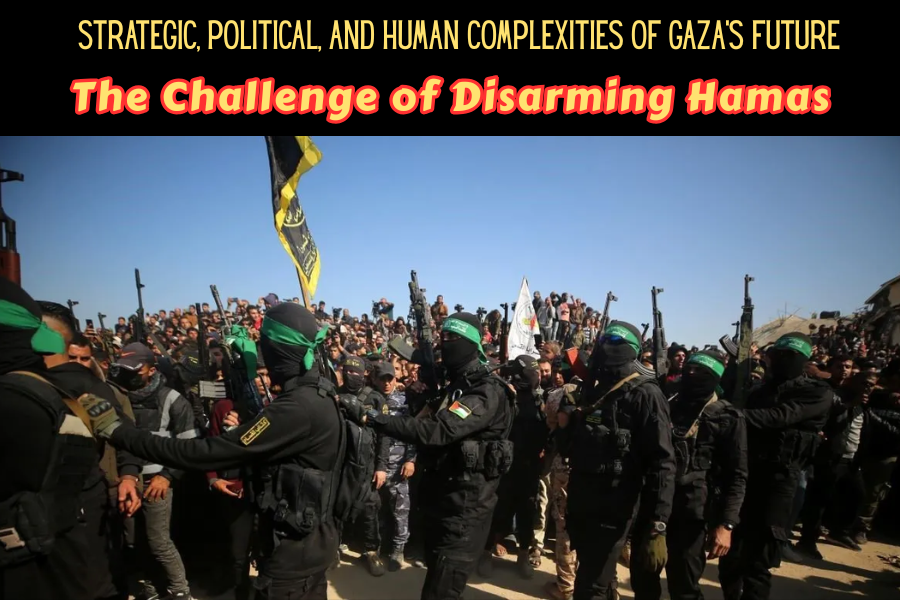
Hamas (Harakat al-Muqawama al-Islamiyya) is not a conventional military organization. It is a hybrid — part militant movement, part political authority, and part social welfare network. Its military wing, the Izz ad-Din al-Qassam Brigades, operates with a degree of autonomy that even its political leadership may not fully control. Structurally, it functions more like a decentralized insurgent network than a traditional army, organized into small, compartmentalized cells across Gaza’s dense urban landscape.
This decentralized nature means that “disarming” Hamas is not akin to collecting weapons from a standing army or negotiating surrender terms with a single leadership. Weapons are dispersed, hidden, and often locally produced. The command structure is resilient, and communication is frequently independent, making dismantlement nearly impossible without full physical and political control over Gaza — something Israel has tried and failed to achieve.
The Complexity of Gaza’s Landscape
The Gaza Strip is one of the most densely populated regions on earth. Beneath its surface lies a labyrinth of tunnels — some for smuggling, others for command, storage, and survival. These tunnels form the backbone of Hamas’s defense system and the symbol of its endurance. Even after the most destructive Israeli campaigns, Hamas has repeatedly reconstituted its arsenals and command structures.
Disarmament in such a context is not a technical task; it’s a political, logistical, and humanitarian dilemma. Every potential disarmament mechanism — whether through UN supervision, regional cooperation, or a transitional administration — runs into the same problem: Who will enforce it, and at what cost? No foreign force wishes to be drawn into an open-ended insurgency in Gaza, and no local actor has the legitimacy or power to replace Hamas overnight.
The Problem of “Loose Structure”
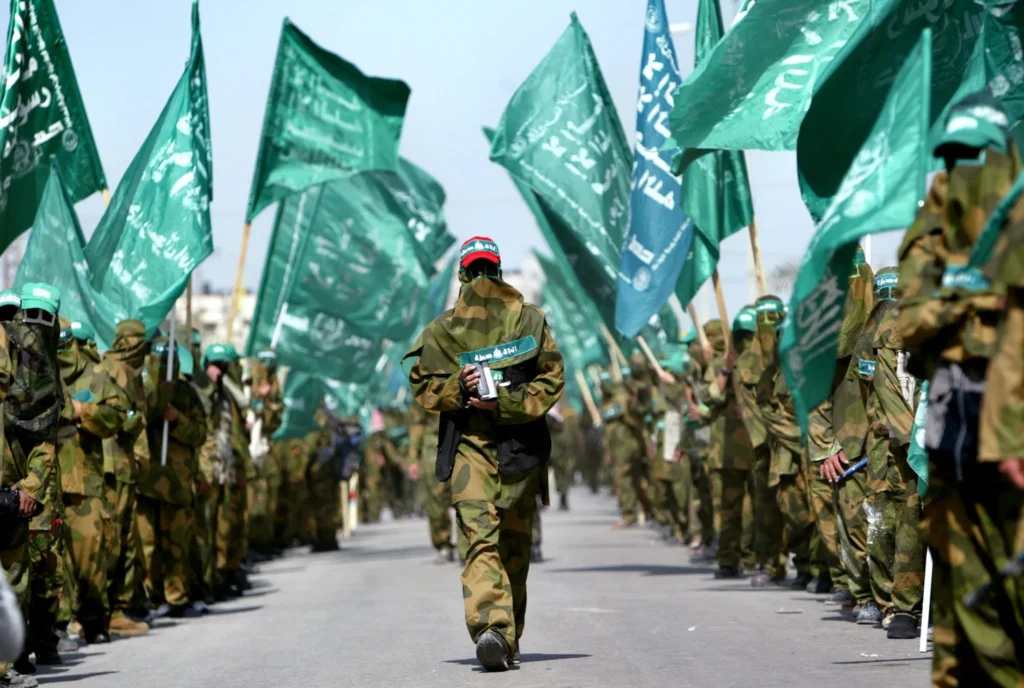
Hamas’s military structure operates in semi-autonomous clusters. Fighters, small arms, and homemade rockets are scattered across refugee camps, private homes, and underground caches. Over the years, many of these arsenals have been duplicated and diversified, ensuring continuity even after heavy Israeli bombardment.
Even if the political leadership were to agree to disarm — which is highly unlikely — its military branches, local commanders, or sympathetic factions could easily re-emerge under new banners. Historically, such disarmament efforts (as in Northern Ireland, Colombia, or post-war Lebanon) required years of negotiated confidence, political concessions, and independent verification. Gaza, however, lacks the minimal trust or governance framework to enable that process.
Post-War Disarmament Proposals
After every major escalation — 2014, 2021, and most recently in 2023–2024 — several international actors have floated “disarmament frameworks.” These typically involve:
- International peacekeeping forces or Arab coalition supervision,
- Reconstruction aid linked to demilitarization,
- The Palestinian Authority (PA) regaining control of Gaza, and
- Guarantees of future statehood discussions.
However, all such proposals collapse against ground realities. The PA lacks credibility in Gaza, Israel refuses to commit to long-term sovereignty discussions, and Hamas has little incentive to surrender the very weapons that define its survival and bargaining power.
Why Disarmament is Unrealistic in the Short Term
Several factors make disarmament virtually impossible in the near future:
- Ideological Resilience: Hamas sees resistance not just as a tactic, but as identity. To disarm would be to surrender that identity.
- Popular Dependency: Despite its authoritarian governance, Hamas still provides social services and sustenance for thousands in Gaza. Disarming would alienate its supporters and expose its fighters to retaliation.
- Hidden Arsenal: Weapons are locally manufactured (Qassam rockets, drones, mortars) or smuggled in small quantities. The supply chain is low-tech and easily rebuilt.
- Political Fragmentation: Even if Hamas dissolves, dozens of splinter factions (Islamic Jihad, Popular Resistance Committees, etc.) could carry on the armed struggle.
- Security Vacuum: Disarmament without an immediate and credible replacement force would plunge Gaza into chaos — a scenario no one desires.
A Likely Scenario
In the unlikely event that Hamas leadership consents to partial disarmament under international pressure, they will most likely present obsolete, rusted, or damaged weapons to inspectors while concealing advanced systems. This symbolic compliance would buy political time but achieve little in security terms. Within 2–3 years, new factions would emerge — perhaps under different names — to carry forward the narrative of “resistance.” This cycle mirrors many post-insurgency environments: ideology outlives the institution.
The Human and Political Dilemma
Disarmament, in theory, should open the door to peace and reconstruction. In reality, in Gaza’s current state, it could deepen despair. Without credible governance, economic stability, and political inclusion, disarming Hamas risks disarming the only organized actor capable of maintaining internal order — however imperfect that order may be.
For Israel, complete disarmament is an elusive goal. For Hamas, retaining arms is existential. For ordinary Gazans, trapped between siege and militarization, it means the continuation of a cycle that denies both peace and dignity. International actors — the UN, Egypt, Qatar, and the U.S. — face a paradox: any real solution must combine security guarantees for Israel with political legitimacy for Palestinians. That formula has never been found.
The Path Forward: What Could Work
A sustainable disarmament approach, if ever attempted, would require:
- Phased Demilitarization with Incentives: Linking each phase of disarmament to tangible reconstruction milestones, verified by a neutral international commission.
- Internal Political Reconciliation: Restoring some functional unity between Hamas and the Palestinian Authority to create a governance alternative.
- Security Guarantees: A multinational observer mission under UN or Arab League authority to prevent Israeli overreach and ensure compliance by both sides.
- Economic Resurgence: Reconstruction, employment, and trade must replace smuggling and militancy as sources of livelihood.
- Narrative Shift: Only when the idea of “armed resistance” is replaced by “political empowerment” can disarmament become sustainable.
Conclusion
Disarming Hamas is not a military operation — it’s a generational challenge. The group’s decentralized structure, ideological roots, and social entrenchment make outright disarmament implausible in the foreseeable future. Even if its arsenals were seized, its ideology would persist, ready to reincarnate under new names and faces.
True stability in Gaza will not emerge from forced disarmament, but from political reintegration, regional guarantees, and economic revival. The weapons in Gaza are not just tools of war; they are symptoms of despair, statelessness, and broken promises. Unless the underlying causes are addressed, disarmament efforts will remain symbolic gestures in a cycle of recurring violence.
Hamas may one day fade, but the idea it represents — resistance against perceived injustice — will continue to find carriers unless justice itself becomes visible. Therefore, disarming Hamas begins not with collecting weapons, but with rebuilding hope.