(By Khalid Masood)
The India AI Impact Summit 2026 (being held February 16–20 at Bharat Mandapam, New Delhi) was promoted as a landmark event to cement India’s role in the global AI landscape. With over 70,000 attendees, high-profile guests including French President Emmanuel Macron, Brazilian President Luiz Inácio Lula da Silva, Google’s Sundar Pichai, OpenAI’s Sam Altman, and NVIDIA’s Jensen Huang, plus a keynote from Prime Minister Narendra Modi highlighting ambitions for $200 billion+ in data center investments, the summit aimed to showcase indigenous innovation and attract global partnerships.
Instead, the event quickly became synonymous with disarray. Widespread attendee complaints highlighted severe logistical failures, security breakdowns leading to thefts, and a major credibility scandal involving Galgotias University that many labeled as outright fraud and misrepresentation. These issues dominated social media, news cycles, and opposition critiques, turning what was billed as a “global moment for Indian AI” into a cautionary tale of execution pitfalls and ethical lapses in tech promotion.
This article examines the key failures—mismanagement and chaos on the ground, security incidents including thefts, and the Galgotias “robodog” controversy—while exploring their broader implications for India’s AI ambitions, trust in its institutions, and lessons for hosting high-stakes tech events.
The Logistical Nightmare: Mismanagement and Organizational Failures
From Day 1 (February 16), the summit faced immediate backlash over poor planning and execution. Attendees reported arriving as early as 7 AM only to endure hours-long queues due to registration system crashes, unclear QR code/digital pass processes, and inadequate signage. Traffic gridlock around Bharat Mandapam compounded the frustration, with many international delegates and journalists left stranded or walking long distances.
An irony not lost on critics: an AI-focused event banned laptops and cameras in many areas, lacked reliable WiFi, and prohibited UPI/card payments at stalls (forcing cash-only transactions). Refreshment zones had no clear direction or provisions, leaving people without water amid the crowds. Many described the audience mix as mismatched—families and casual visitors treating it like a “timepass” outing rather than a professional B2B/tech conference, diluting meaningful networking.
The most disruptive element came from VIP security protocols. Ahead of PM Modi’s visit, the main exhibition hall was evacuated from around 12 PM to 6 PM (far longer than expected) for sanitization. Exhibitors were told to leave valuables behind, trusting security—leading to lost business hours and heightened vulnerability. Opposition leaders, including Congress figures like Mallikarjun Kharge and Rahul Gandhi, slammed it as “PR hungry” chaos that prioritized photo-ops over substance, calling it a “global embarrassment” that tarnished India’s image.
Entrepreneurs echoed this: some, like exhibitor Prakash Dadlani, vowed to skip future Indian events in favor of one-on-one meetings or overseas venues. While organizers later addressed some issues (e.g., extended hours and better crowd flow), the opening-day fiasco set a negative tone.
Chaos on the Ground: Security Lapses and Thefts
The evacuation protocol directly contributed to one of the summit’s most damaging incidents: alleged thefts from exhibitor booths in supposedly “high-security” zones.
Bengaluru-based startup NeoSapien’s CEO, Dhananjay Yadav, went public on social media, claiming patented AI wearable prototypes were stolen during the hall lockdown. He described trusting security assurances that items would be safe (even laptops were left behind), only to return and find them missing. Yadav called it “deeply disappointing” after investing in flights, logistics, and booth fees. Police filed a case, and the devices were reportedly recovered within 24 hours, but the damage to trust was done.
Other reports mentioned similar vulnerabilities, with exhibitors frustrated over lack of coordination between security teams. Critics pointed to this as symptomatic of overzealous protocols clashing with practical needs, disproportionately hurting smaller startups who could least afford losses.
Societally, the incidents highlighted inequalities in India’s tech ecosystem: established players might weather such setbacks, but emerging innovators faced real financial and reputational harm. Broader attendee hardships—crowding, denied amenities, and confusion—added to perceptions of elitism and poor inclusivity.
The Fraud Scandal: The Galgotias University “Robodog” Debacle
The summit’s most viral controversy centered on Galgotias University (Greater Noida), which announced a “Rs 350+ crore AI push” shortly before the event, touting partnerships with NVIDIA, Tata Technologies, IIT Mandi, and others.
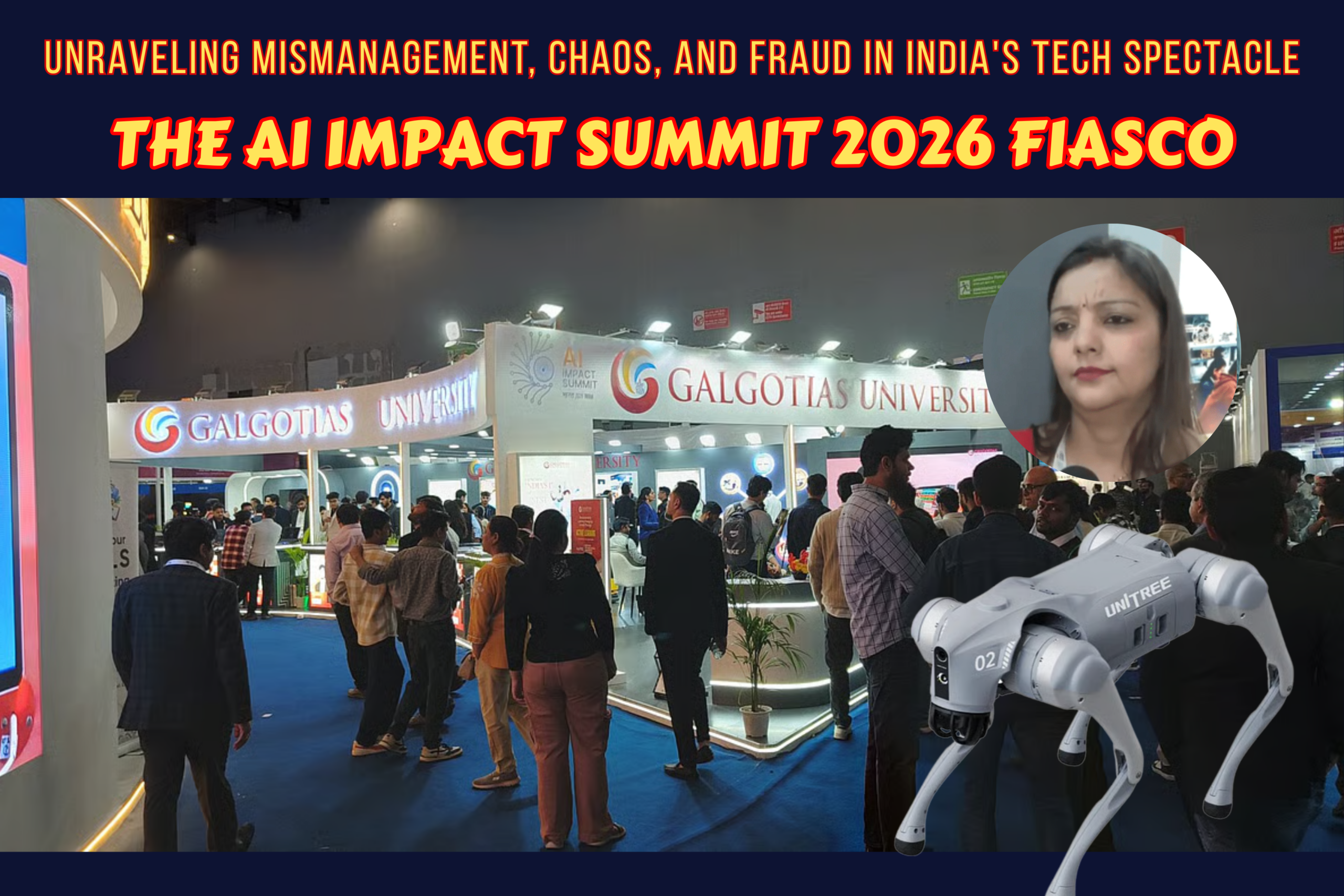
At their pavilion, they showcased a robotic dog named “Orion” (Operational Robotic Intelligence Node) and a “soccer drone.” Assistant Professor Neha Singh (Head of Communications) told DD News the robodog was “developed by the Centre of Excellence at Galgotias University” for surveillance/monitoring, and the drone was “engineered end-to-end” on campus.
Social media users quickly fact-checked: “Orion” was the commercially available Unitree Go2 from Chinese firm Unitree Robotics (priced ~$1,600–$2,800 or Rs 1.3–2.3 lakh). The soccer drone resembled South Korea’s Helsel Striker V3 ARF set (~Rs 40,000). Neither appeared indigenous.
Backlash exploded. Galgotias initially denied claims of building the robot, calling it a “propaganda campaign” harming student morale and clarifying it was a “recently acquired” learning tool. By February 18, they issued apologies blaming Singh for “factually incorrect information” due to being “ill-informed” and unauthorized to speak (despite her role). Singh took responsibility for “poor communication” but denied explicit misrepresentation. Her LinkedIn later showed “open to work,” fueling speculation about consequences.
The Ministry of Electronics and IT (MeitY) intervened: Secretary S. Krishnan ordered immediate vacation of the pavilion, stressing “genuine and actual work” without misinformation. The booth was barricaded; staff dismantled it amid reports of “national embarrassment.”
Union IT Minister Ashwini Vaishnaw had shared a video praising exhibits (including Galgotias’) as part of India’s “sovereign” AI push but deleted it amid outrage.
The scandal amplified doubts about the Rs 350 crore investment’s legitimacy, especially given Galgotias’ prior issues (e.g., unscientific papers, student protests). Critics linked it to systemic pressures for “showcasing” over substance, while defenders called it an isolated miscommunication.
Geopolitically, using Chinese tech for surveillance demos raised data privacy/dependency concerns in India’s self-reliant AI narrative.
Lessons Learned and Future Implications
Despite positives—like launches of Indian models (e.g., Sarvam AI outperforming some global benchmarks) and high-level dialogues—the summit’s mismanagement, theft allegations, and fraud scandal overshadowed achievements. It exposed gaps in event execution, ethical standards for innovation claims, and balancing security with accessibility.
For India’s AI ambitions amid US-China rivalry, the fiasco risks eroding investor confidence and global perceptions of reliability. Recommendations include: independent audits for exhibits, clearer ethical guidelines, better logistics planning, and stronger transparency mandates.
Ultimately, the event underscores that hype alone cannot substitute for substance. True leadership in AI demands not just grand stages, but credible, well-managed delivery.