(By Ayesha Mahnoor)
The principles of separation of powers and checks and balances are fundamental to modern democracy. Originating in the work of Montesquieu in The Spirit of the Laws (1748) and enshrined in the U.S. Constitution, they grant distinct authorities to the legislature, executive and judiciary so no single institution becomes absolute. In a parliamentary democracy such as Pakistan, these principles are reflected in Articles 7–50 of the Constitution of Pakistan, but in practice the system faces serious challenges.
In simple terms:
- Legislature: Parliament (the National Assembly + Senate) makes laws, approves budgets, taxes and holds the executive to account.
- Executive: The President, Prime Minister and Cabinet execute laws, run foreign affairs and defence.
- Judiciary: The Supreme Court, High Courts and other courts interpret laws and protect the constitution.
This separation aims to prevent power concentration: the legislature legislates, the executive enforces, the judiciary reviews. But constitutional evolution in Pakistan shows this framework under strain — especially via major amendments.
Constitutional Evolution & The New Reform Wave
Three recent amendments demand scrutiny: the 25th (2024), 26th (2024–25) and now the proposed 27th (2025). Each interacts with institutional balances and the architecture of Pakistan’s federal democracy.
I. The 25th Amendment (2024): Lateral Reform
Enacted in October 2024, the 25th Amendment dealt primarily with the integration of former FATA into Khyber Pakhtunkhwa (KP). Articles 59, 106 and 140A were amended. Key features included: enlarged KP Assembly seats, tribal-quotas, devolved local governance, and adjusted Senate representation.
Connotation: On the surface, it signals inclusion and national unity — bringing colonial-era excluded regions into the mainstream. But the fiscal strings and federal grants that accompany it hint at “managed federalism”, where provinces gain administrative powers but remain tethered to the centre.
Judicial dimension: The extension of KP High Court jurisdiction is efficient, but without uniform federal oversight in tribal domains, the judiciary’s coherence across provinces may weaken.
Parliamentary dimension: Senate reform appears to enhance federal representation, but if coalition-engineering drives quota changes, parliamentary oversight may become formal rather than substantive.
Overall: The 25th strengthened federal-provincial balance modestly, but left vertical separation (executive vs legislature vs judiciary) largely untouched.
II. The 26th Amendment (2024–25): Vertical Re-shaping
Passed in October 2024 amid post-election tensions and judicial scrutiny, the 26th Amendment overhauled Articles 175–191. Its features: establishment of constitutional benches (Article 191A), restricted suo motu powers (Article 184(3)), an enlarged Judicial Commission of Pakistan (JCP) with political inclusion (Article 175A), and fixed ad hoc tenures for judges. scrrjournal.com+1
Connotation: Branded as a reform to speed up justice, it conveys “judicial discipline” — but critics view it as signalling independence = interference.
Judicial dimension: The reforms allow executive/legislative actors to shape judicial appointments — a direct hit to Article 175. Historical precedents (e.g., the “Judges’ Case” of 1996) warned about such instrumentalisations.
Parliamentary dimension: Though parliamentary inclusion appears democratic, in practice coalition dominance may render the legislature an extension of the executive rather than a check.
Overall: The 26th Amendment unmistakably shifts power toward the executive, raising risks of institutional imbalance.
III. The Proposed 27th Amendment (2025): What’s Ahead?
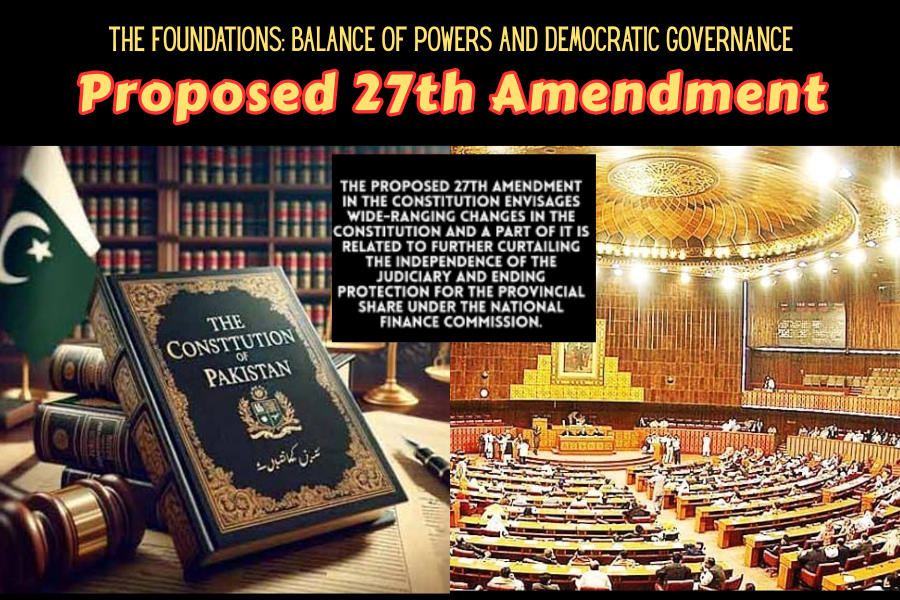
As of November 6, 2025 the 27th Amendment is under discussion. Sources indicate government plans to table it in the Senate on or around November 7. Aaj English TV+1 Provisions reportedly include: curbing post-certification review (Article 184), empowering the executive via the National Accountability Bureau (NAB), easing ordinance powers (Article 89), altering Article 243 (armed forces command), and modifying the National Finance Commission (NFC) Award. Dawn
Connotation: Marketed as stabilising reforms, the proposals instead convey regime-protection — framing independent scrutiny as destabilising and aligning Pakistan with global illiberal trends.
Judicial dimension: Removing review powers or subordinating courts undermines the “basic structure” doctrine of the constitution, fragmenting Article 175 jurisprudence.
Parliamentary dimension: Accelerated processes and broad powers risk hollowing out bicameral oversight and reducing the legislature to a rubber-stamp for the executive.
Overall: If enacted, the 27th Amendment would drive Pakistan toward executive dominance, centralising power at a time when institutional fragilities run high.
Interlinkages & Broader Implications
When seen together, the amendments form a directional pattern:
- The 25th decentralises laterally (province-state).
- The 26th and proposed 27th centralise vertically (executive vs legislature vs judiciary).
The cumulative effect: a shift from a system of shared power toward executive primacy. In a context already marked by political polarisation, media pressure, and institutional erosion, the risk is not merely theoretical. Governance, socio-economic reform and public trust may all suffer.
Consider this: the law minister recently assured Parliament that there would be no “calamity” in the name of the 27th Amendment. Dawn Yet critics warn it is disguised as reform, while delivering rollback of provincial rights (especially the 18th Amendment gains), and creeping erosion of democratic checks. Pakistan Today+1
From a governance perspective, such centralisation undermines mechanisms for accountability — where the judiciary, parliament and independent institutions must act as bulwarks. Instead, the executive emerges with fewer formal constraints.
Risks to Key Constitutional Principles
- Judicial Independence – With the 26th already lowering barriers to political control of courts, the 27th threatens to deprive the judiciary of meaningful autonomy.
- Parliamentary Oversight – Democracies rely on legislatures to check the executive; if the 27th weakens debate or reduces bicameral rigour, oversight becomes token.
- Federalism – Reversing the 18th Amendment’s decentralisation may re-ignite regional grievances in Balochistan, Sindh and KP, undermining national cohesion.
- Civil-military Balance – Any amendment tampering with Article 243 (command of armed forces) raises serious alarm about civilian supremacy and constitutional civilian control.
- Rule of Law & Basic Rights – When institutional checks erode, state power becomes less transparent and more personalised — public rights and democratic accountability suffer.
Recommendations for Restoring Constitutional Balance
- Transparent & Inclusive Process: Amendments must involve public consultation, parliamentary debate and civil-society input.
- Preserve Judiciary’s Core Mandate: Article 175 must remain inviolate; appointments and reviews should preserve merit and independence.
- Safeguard Provincial Autonomy: The spirit of the 18th Amendment — devolving powers to provinces — should be reinforced, not rolled back.
- Strengthen Parliament: Committees, hearings and inter-house checks must not be relegated to formality; parliament must reclaim oversight.
- Engage Civil Society & Media: Independent scrutiny is essential to monitor constitutional reform, protect rights and hold institutions accountable.
Conclusion
Pakistan is now at a constitutional crossroads. The proposed 27th Amendment does not merely add technical tweaks — it risks eroding the foundational architecture of separation of powers, parliamentary democracy and federalism. The earlier reforms (25th and 26th) paved the way; now the 27th threatens to tip the balance decisively toward executive dominance.
A country that aspires for stability, development and inclusion cannot afford constitutional rollback. The time to act is now — institutional safeguards must be preserved, and Pakistan’s constitutional democracy must be strengthened, not hollowed out.
The amendments before us are practical reforms, yes — but also symbolic inflection points. If Pakistan’s democracy endures, it will be because the principles that once guided it remain alive: distinct institutions, balanced powers and respect for the rights of the many, not just the few.