(By Faraz Ahmed)
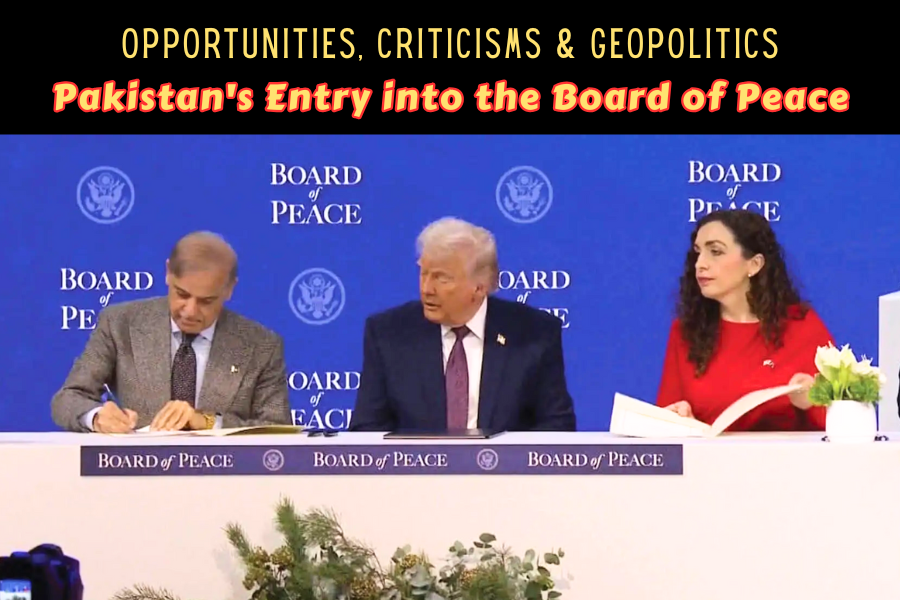
Pakistan’s formal accession to the U.S.-led Board of Peace (BoP) on Gaza—formalized at the World Economic Forum in Davos on January 22, 2026—represents one of the more intriguing foreign policy moves by Islamabad in recent years. Prime Minister Shehbaz Sharif’s signature on the charter, alongside leaders from roughly 19 other nations (including key Gulf states like Saudi Arabia, UAE, and Qatar), places Pakistan inside a Trump-initiated multilateral mechanism designed to oversee the fragile Gaza ceasefire, coordinate post-conflict stabilization, and drive ambitious reconstruction.
This is not mere symbolism. It reflects Islamabad’s realpolitik navigation of a multipolar world where U.S. influence remains decisive on economic lifelines (IMF programs, debt restructuring) while traditional alliances (China, Gulf partners) demand careful balancing. Yet the move has ignited sharp domestic criticism, accusations of inconsistency, and questions about alignment with Palestinian aspirations.
What is the ‘Board of Peace’?
Launched by President Donald Trump as part of his broader 20-point Gaza Peace Plan (floated in 2025 and forming the backbone of the late-2025 ceasefire), the Board of Peace serves as a high-level coordinating body outside traditional UN frameworks.
Its core functions include:
- Monitoring and enforcing ceasefire Phase 2 (stabilization and reconstruction).
- Mobilizing and directing international aid and investment for Gaza’s rebuilding.
- Overseeing the proposed Gaza International Stabilisation Force (ISF), reportedly U.S.-led under Gen. Jasper Jeffers.
- Facilitating long-term economic transformation—projections aim to elevate Gaza’s GDP to $10 billion by 2035 through infrastructure, tourism, free-trade zones, and modern urban development (including controversial coastal high-rises and a “seaside metropolis” vision associated with Jared Kushner).

The board is chaired indefinitely by Trump, with membership limited (62 countries invited, but only about 20 signed on). Notably absent: most European states, India (which abstained), and actors aligned against U.S. primacy. Critics label it “imperial” or a parallel structure that could sideline the UN and Palestinian agency.
Pakistan’s Official Position and Timeline
- January 21, 2026: Ministry of Foreign Affairs issues a joint statement accepting Trump’s invitation, emphasizing support for “lasting peace in Gaza” through the peace plan’s implementation.
- January 22, 2026: PM Shehbaz Sharif signs the charter in Davos.
- January 24–25, 2026: PM confirms federal cabinet authorization; Trump reportedly conveyed “well wishes” for Pakistan during interactions.
Official rationale centers on humanitarian imperatives, consistent Pakistani calls for ceasefire and a two-state solution, and a desire to contribute diplomatically (no military commitment implied). Pakistan frames participation as pragmatic support for stability in a Muslim-majority region of strategic importance.
Strategic Reasons: Why Islamabad Joined
From a statecraft perspective, several interlocking calculations are evident:
- U.S. Leverage in Economic Survival — With Pakistan reliant on IMF bailouts and facing debt maturities, closer alignment with the Trump administration offers breathing room on waivers, sanctions relief, and bilateral aid. Davos interactions likely reinforced this.
- Gulf Synchronization — Joining alongside Saudi Arabia, UAE, and Qatar positions Pakistan within the emerging Gulf-U.S. consensus on post-Gaza order, preserving economic ties (remittances, investments, energy) and military cooperation.
- Diplomatic Elevation — Participation elevates Pakistan’s voice in Middle East peacemaking, countering marginalization and signaling active global engagement amid domestic economic pressures.
- Realpolitik Flexibility — Pakistan has long balanced pro-Palestine rhetoric with pragmatic U.S./Gulf engagement. This move continues that tradition without abandoning core positions.
Criticisms and Domestic/International Backlash
The decision has provoked significant pushback:
- Domestic Opposition — PTI has rejected the move outright, labeling it inconsistent (recalling PM Shehbaz’s 2020 criticism of similar Trump plans as “unjust, biased and oppressive”). Analysts and former diplomats call it “morally incorrect and indefensible,” arguing it risks legitimizing a U.S.-centric framework that sidelines Palestinian governance and self-determination.
- Pro-Palestine Segments — Activists fear the board endorses top-down reconstruction that could prioritize external economic interests over Palestinian rights.
- Regional/International — Israel has signaled Pakistan remains unwelcome due to perceived support for “terror backers.” Some Arab commentators question whether the move undermines broader OIC/Arab League unity.
The backlash exposes classic tensions in Pakistani foreign policy: idealism vs. necessity, public sentiment vs. elite pragmatism.
Implications for Pakistan and the Region
Upsides — Enhanced U.S. relations could unlock economic/diplomatic dividends; potential reconstruction contracts/aid flows; strengthened standing among Gulf partners.
Risks — If the ceasefire collapses or reconstruction favors external visions over Palestinian agency, Pakistan could face domestic protests and credibility damage in the Muslim world. Over-reliance on Trump-era mechanisms carries volatility if U.S. policy shifts post-2028.
Long-term, this could foreshadow Pakistan’s adaptation to “Trump multilateralism”—flexible, leader-driven coalitions over rigid UN/OIC structures.
Conclusion
Pakistan’s entry into the Board of Peace is a calculated act of strategic hedging: embracing U.S.-led pragmatism to secure vital interests while preserving rhetorical commitment to Palestine. Whether it proves visionary or shortsighted depends on Gaza’s trajectory—successful stabilization would validate the gamble; renewed violence or perceived capitulation would amplify critics.
In the unforgiving arena of statecraft, survival often demands uncomfortable choices. Islamabad has made one. The coming months will reveal whether it was the right one.
What are your thoughts on this move? Does it strengthen Pakistan’s global standing, or compromise its principled stance on Palestine? Share in the comments.