(By Ayesha Mahnoor)
It is August 2025. A young woman in Lahore switches on the fan; nothing happens—another eight-hour load-shedding. In Karachi, sewage flows openly in the street outside a private school that charges Rs 90,000 a month. In Quetta, a bright Baloch engineering graduate boards a bus to the Iranian border—he has a Canadian visa in his pocket and no plan to return. In Swat, mothers hide their daughters when the Taliban knock on doors again.
This is not fate. This is the accumulated result of seven decades of decisions. And decisions can be changed.
Thirty years ago Bangladesh was poorer than Pakistan. Today its per-capita income is 70 % higher, its girls outnumber boys in secondary school, and its garment factories employ four million women. Vietnam was bombed flat in 1975. Today it exports more to the United States than Pakistan exports from the entire Pakistan. Indonesia went from military dictatorship and Asian-financial-crisis basket case in 1998 to the world’s 7th largest economy (PPP) by 2024.
They did not discover new oceans of oil. They simply stopped doing the things that keep nations poor.
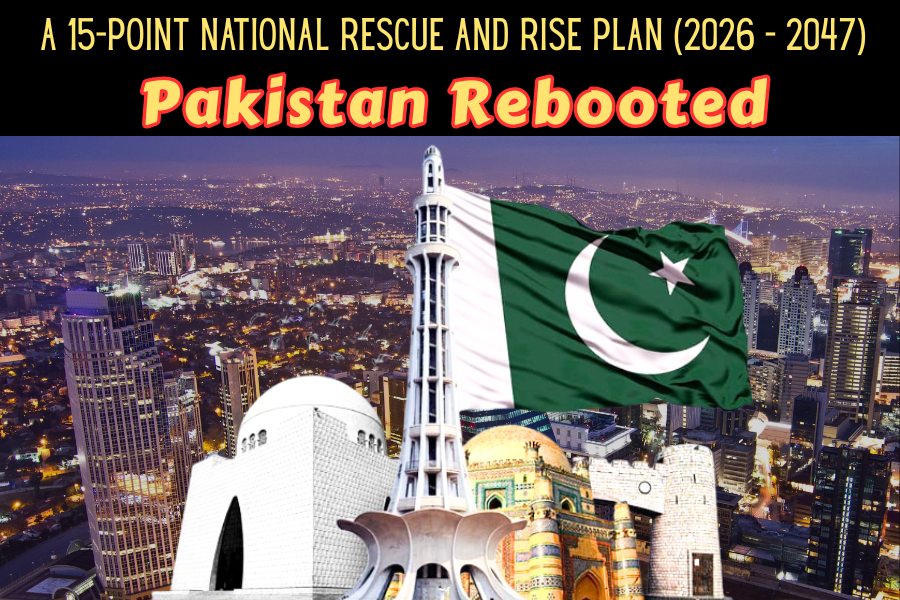
Pakistan can do the same leap. Below is the exact 15-point plan that, if executed with seriousness for two decades, will take Pakistan from perpetual crisis to sustained prosperity by 2047—the centenary of independence.
I. Why Pakistan Keeps Boiling: The Eight Chronic Failures
- Governance collapse: Power, money and money never reach below the provincial secretariat.
- Elite capture and corruption: 4–6 % of GDP is stolen every single year.
- Debt addiction: 23 IMF programmes since 1958 and still no fiscal discipline.
- Demographic bomb: 240 million today, 400 million by 2050 if nothing changes.
- Security bleed: Permanent war economy that crowds out schools and hospitals.
- Climate catastrophe in slow motion: the 2022 floods cost $30 billion; the next ones will cost more.
- Human capital disaster: 30 million children out of school, three parallel education systems producing inequality and extremism.
- Brain drain + trust deficit: every year 700,000–1 million of our best leave and never invest back.
These eight are not separate problems. They feed one another in a vicious cycle. The only way out is to attack the cycle at every joint simultaneously.
II. The 15 Levers of Transformation
Cluster A – Governance That Actually Works
- Strong, elected, financially empowered local governments: Give districts and tehsils direct control over primary education, basic health, local police, water, sanitation, and 40 % of provincial revenue. Indonesia devolved in 2001 and added 1.5–2 % to annual GDP growth almost overnight.
- Smaller administrative provinces or iron-clad provincial finance equality: Either carve 12–18 new provinces or constitutionally guarantee smaller units at least 30 % of NFC share. End the perpetual grievance that “Punjab eats everything”.
- Civil-service reform: end the generalist CSS empire Specialist tracks, fixed tenures, performance pay, and lateral entry of private-sector talent. Singapore did this in the 1960s; Rwanda did it after 1994. Both became governance superstars.
Cluster B – Money & Trust
- Ruthless war on corruption via full digital governance: Every government payment, licence, and contract on blockchain-verified platforms by 2030. Estonia did it in the 1990s and became the world’s least corrupt large state.
- Tax-to-GDP ratio from 10 % → 18 % in ten years: Tax retail, agricultural income above Rs 6 million, and real-estate capital gains at international rates. An extra Rs 12–15 trillion every year—enough to end load-shedding, build 50,000 new schools, and still have money left over.
- Diaspora bonds with 100 % repatriation guarantee: Offer 7–8 % dollar bonds to 10 million overseas Pakistanis. India raised $70 billion this way; Israel built its early economy on it. Pakistan can raise $100 billion in seven years without a single IMF condition.
Cluster C – Human Capital Revolution
- One modern national curriculum in Urdu + English-medium STEM from Class 1: End the madrasah–Urdu–elite-English apartheid. Turkey unified its curriculum in the 1930s, Malaysia in the 1970s, Vietnam in the 1990s. Within one generation inequality and extremism both collapsed.
- Crash population programme: fertility rate 3.3 → 2.1 by 2035 Scale the Lady Health Worker network to 300,000, make contraceptives free in every village, run a national campaign as aggressive as Indonesia’s 1970s “Dua Anak Cukup” (“Two children are enough”). Bangladesh did it; we can too.
- Judicial revolution: 5-year maximum case disposal guarantee Appoint 5,000 new judges, build 1,000 model courts, mandatory e-filing, sunset clause for cases older than five years. South Korea cleared its backlog in the 1980s and foreign investment exploded.
- Fund education + health to East-Asian levels (combined 10 % of GDP): Once tax and anti-corruption measures are in place, the money exists today.
Cluster D – Wealth Creation
- Transparent mining & energy contracts with 70–100 % Pakistani equity: Reko Diq, Thar coal, offshore gas, rare-earths in Balochistan. No more 100 % foreign-ownership deals that leave crumbs for Pakistan.
- 3–5 Charter Cities / autonomous SEZs with Singapore-style laws for 25 years: Gwadar New City, Rashakai-2, a brand-new federal capital territory near Fatehjang or Chakwal. Independent boards, zero income tax for 15 years, English common law, one-stop digital regulation. Shenzhen 1980 → world factory. We can do the same.
Cluster E – Sustainability & Soft Power
- Climate adaptation as national mission no. 1: 10 billion new mangroves by 2035, 500,000 check dams, mandatory drip irrigation for new tube-wells, new flood canals on the Indus. We either do this or we drown—literally.
- 12-year moratorium on major new conventional arms purchases: We already have enough tanks and jets to deter any rational adversary. The real threat to Pakistan is internal collapse, not Indian invasion.
- Islamic injunctions as rule of law, merit, and welfare—not moral policing: A state that guarantees justice, protects minorities, runs an honest zakat-based safety net, and appoints people on merit is far more “Islamic” than one that wastes billions on ribbons and protocol while children die of diarrhoea.
III. The 100-Month Roadmap (2026–2035)
Phase 1 (2026–2028) – Survival
- Local government elections with real powers
- Full digital procurement + asset declaration for all officers
- Tax amnesty + CNIC-based retail tracking
- National family-planning emergency campaign
Phase 2 (2029–2032) – Take-off
- One national curriculum rollout
- First charter city breaks ground
- Reko Diq & Thar Phase-2 under Pakistani majority companies
- Judicial overhaul legislation
Phase 3 (2033–2035) – Consolidation
- Tax-to-GDP hits 15 %
- Fertility rate falls below 2.5
- Defence budget frozen in real terms for a decade
Phase 4 (2036–2047) – Arrival
- Per-capita income crosses $6,500
- Karachi–Lahore bullet train operational
- Pakistani universities in global top 300
- Diaspora returning faster than leaving
IV. This Is Not a Dream—It Is Realpolitik
Every stakeholder actually has an incentive:
- The military wants a stable, prosperous Pakistan that does not need endless bailouts.
- Politicians want to win elections—delivering electricity, schools, and jobs wins elections.
- The judiciary wants legacy.
- The youth want a reason to stay.
- The diaspora wants a reason to invest.
All that is required is one “National Charter of Survival” signed by the army chief, the three major party leaders, the chief justices, and provincial chief ministers. Ten pages, fifteen points, twenty-year horizon. After that, any party that breaks the charter becomes politically radioactive.
V. Pakistan in 2047 – A Glimpse
- Per-capita GDP: $7,500–8,500 (upper-middle-income)
- Life expectancy: 78 years
- Literacy: 95 %
- Infant mortality: <15 per 1,000
- Karachi to Lahore: 4 hours by 300 km/h train
- Energy: 50 % renewable + indigenous coal/gas
- Exports: $150 billion (textiles + IT + minerals + food)
- A Pakistani company in global top-10 EV battery manufacturers
- Diaspora remittances replaced by diaspora investment
- Young Pakistanis saying “I want to go home and build” instead of “I want to escape”
Conclusion
Nations do not rise when they discover new oil fields or receive bigger loans. They rise when they finally decide to stop stealing from their children.
Pakistan has everything: 240 million people under 30, the world’s fifth-largest diaspora, the eighth-largest reserves of coal, copper worth trillions, rivers that can light up half of Asia, and a location at the crossroads of three of the world’s fastest-growing regions.
All we have to do is stop doing the things that have kept us poor for seventy-seven years.
The plan is ready. The examples are proven. The money is there once we stop stealing it.
Now we only need the decision.
Let 2026 be the year Pakistan chooses to reboot.
The children waiting in the dark tonight deserve nothing less.