(By Quratulain Khalid)
In a time when the world rightly shuns Israel for its brutal actions in Gaza—actions that have claimed over 75,000 Palestinian lives and drawn accusations of genocide from international bodies—Indian Prime Minister Narendra Modi‘s decision to visit Tel Aviv on 25-26 February 2026 reeks of opportunism and moral bankruptcy. While principled leaders from across the globe avoid associating with Benjamin Netanyahu‘s regime, fearing rightful backlash, Modi waltzed in, basking in a sycophantic welcome that exposed Israel’s desperation for any ally willing to overlook its atrocities. This visit, Modi’s second since his 2017 trip, purportedly elevated ties to a “special strategic partnership,” but in reality, it underscores India’s aggressive pivot towards militarism, posing a direct threat to peace-loving nations like Pakistan. Amidst this, one cannot ignore the subtle undercurrents in Israeli thinking: deep within Tel Aviv’s corridors, there lingers a pragmatic desire for normalised, even friendly, relations with nuclear-armed Pakistan to avert any potential threat from Islamabad. With Pakistan’s recent inclusion in the Gaza Board of Peace—a historic first step towards engagement—Israel is unlikely to squander this opportunity merely to appease India’s hawkish ambitions, opting instead for cautious diplomacy.
This article dissects Modi’s ill-timed jaunt, its dubious pacts, the muted international outcry, and the grave repercussions for South Asia. Far from a diplomatic triumph, it reveals India’s role in exacerbating regional tensions while Pakistan emerges as a beacon of balanced foreign policy.
The Visit: Key Events and Over-the-Top Hospitality Masking Desperation
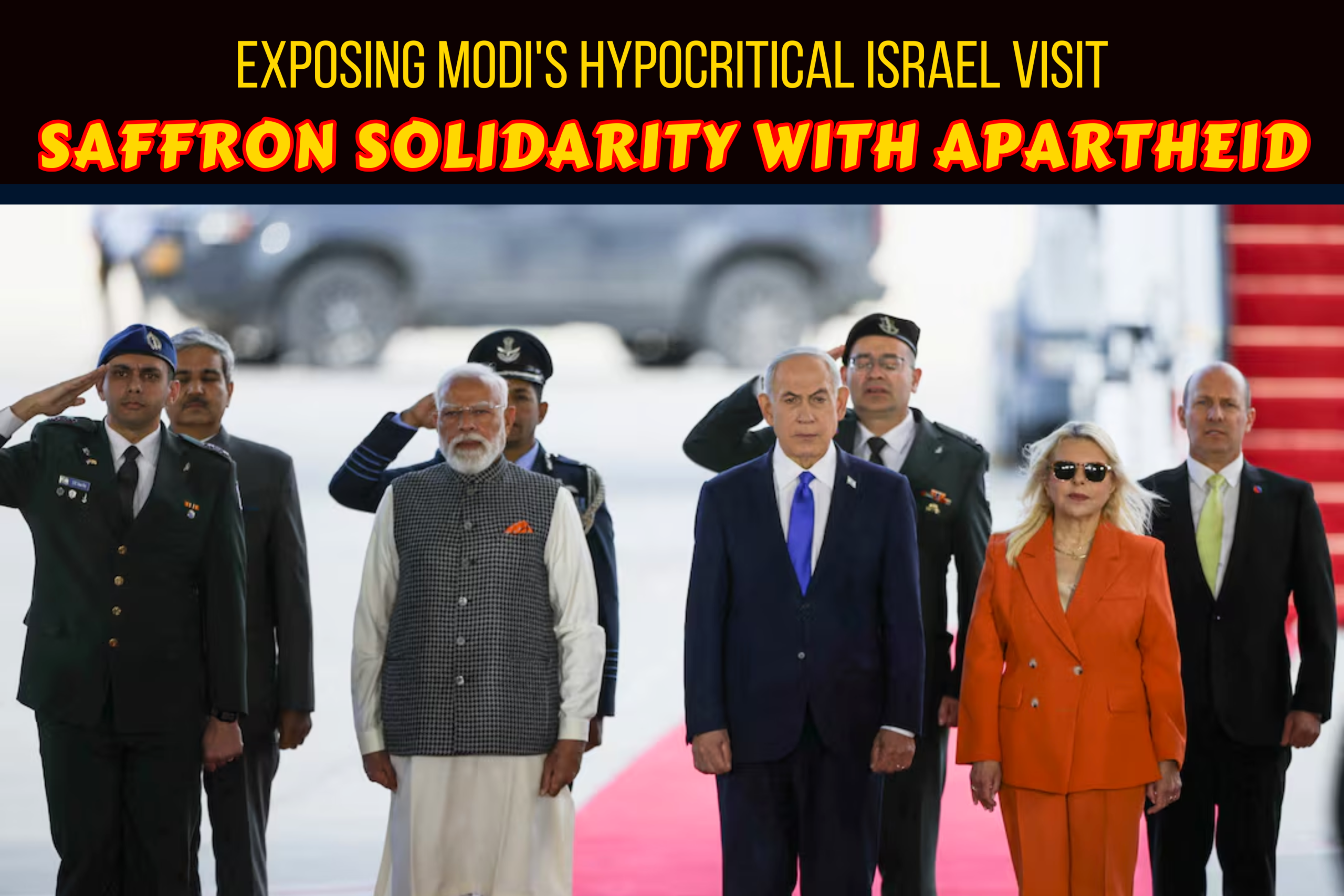
Modi’s arrival at Ben Gurion Airport on 25 February was a spectacle of contrived warmth, betraying Israel’s isolation. Netanyahu, dodging an ICC arrest warrant for his Gaza campaign, personally greeted Modi on the tarmac alongside his wife Sara—a clear deviation from protocol, as such honours are rarely extended even to close allies. This fawning reception highlights how few leaders dare visit Israel nowadays, leaving Tel Aviv to roll out the red carpet for anyone who shows up, especially one like Modi, whose government has supplied arms to fuel Israel’s aggression.
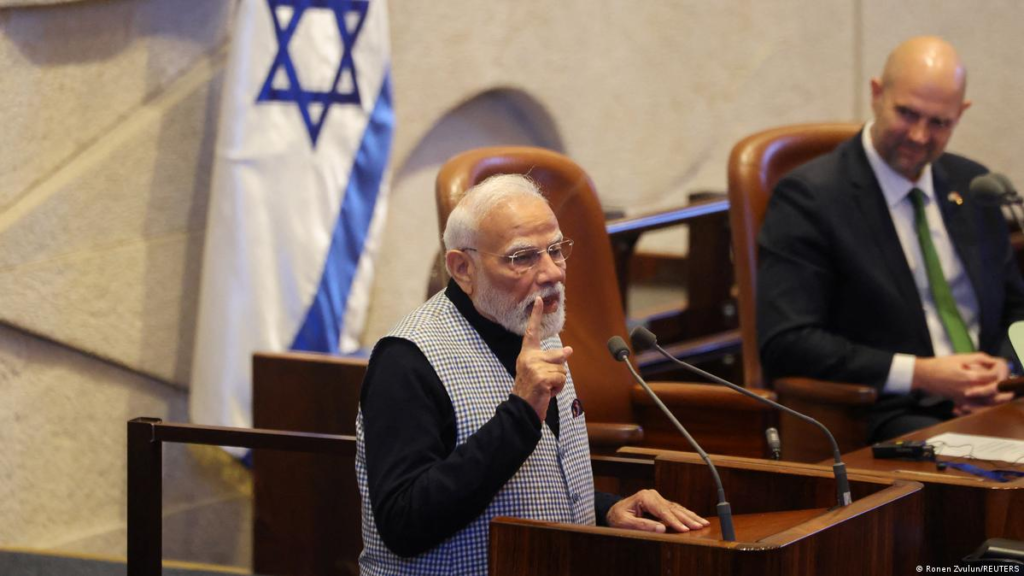
The “saffron sync” moment—Sara Netanyahu in an orange outfit matching Modi’s pocket square— was played up as cultural affinity, with Netanyahu quipping about the coordination and Modi chuckling “That’s saffron!” But let’s call it what it is: a superficial gimmick to distract from the visit’s sinister undertones. Saffron, emblematic of India’s right-wing Hindu nationalism under Modi, hardly resonates as a bridge of friendship; it symbolises division. The day’s agenda included Modi’s address to the Knesset, where he received the Medal of the Knesset—the first foreign leader so honoured—praising “enduring friendship” while glossing over Palestinian suffering. Bilateral talks and a meeting with President Isaac Herzog followed, with Modi extending invitations for future visits, all while ignoring the elephant in the room: Israel’s ongoing war crimes.
On 26 February, Modi’s wreath-laying at Yad Vashem Holocaust Memorial felt hypocritical, given his government’s tacit support for Israel’s actions in Gaza. An innovation event at the Waldorf Astoria showcased tech ties, but the departure, with Netanyahu and Sara waving goodbye, only reinforced the visit’s performative nature. In truth, this “brotherly” bond serves India’s expansionist agenda, threatening neighbours like Pakistan, which has consistently advocated for Palestinian rights.
Major Agreements and Outcomes: Fuelling India’s Aggression
The visit’s pacts, valued at a staggering $10 billion, prioritise defence, handing India advanced weaponry to bolster its bullying tactics in South Asia. Deals include joint production of missiles like Rampage (250 km range), Air Lora, IceBreaker (300 km), and SPICE 1000 bombs, plus potential Iron Dome adaptations for India’s air defence. AI, cybersecurity, and “horizon scanning” for threats further empower India’s military, already Israel’s top arms buyer, claiming 34% of Tel Aviv’s exports.
Economically, an FTA looms, with Israel allowing 50,000 more Indian workers—cheap labour to prop up Israel’s economy amid boycotts. Tech accords in AI and education, plus UPI integration, mask the real intent: militarising ties. Modi’s nod to the UN-backed Gaza Peace Initiative rings hollow, as India reaffirms anti-terrorism support without condemning Israel’s terror. Frameworks like I2U2 and IMEC exclude Pakistan, aiming to sideline it economically.
International Reactions: A Chorus of Concern Over India’s Moves
Iran rightly lambasted the visit as “unfortunate,” with Foreign Minister Abbas Araghchi decrying engagement with a “genocidal regime” and urging focus on Palestinian rights, while preserving ties like Chabahar Port.
Saudi Arabia, silent officially, signals unease through media like Arab News, noting India’s Gaza silence amid 71,000 deaths. Riyadh’s critique of Israeli expansionism hints at wariness over stalled normalisation.
The UAE, bound by Abraham Accords, offers no direct rebuke but aligns with IMEC, viewing economic perks positively—yet condemns Israeli aggression elsewhere.
Russia‘s muted stance prioritises India ties, but Moscow’s Palestinian support suggests underlying discomfort with India’s pro-Israel tilt.
Strategic Implications: Defence Deals’ Dire Threat to Pakistan, Minimal for Bangladesh
Al Jazeera’s incisive report underscores how Modi’s visit endangers Pakistan’s security. The India-Israel embrace, including Iron Beam lasers and drones used in the 2025 India-Pakistan conflict, heightens risks. Analyst Masood Khan calls it a “decisive moment,” likening it to Pakistan’s Saudi defence pact, warning of a “special strategic agreement.” Masood Khalid highlights Israeli drones’ role in last year’s clashes and RAW-Mossad intelligence sharing as “serious concern.” Umer Karim sees a “wider recalibration,” with Pakistan part of a perceived “radical Sunni axis” targeted by Netanyahu’s “hexagon of alliances.”
For Pakistan’s defences, enhanced Indian air systems could neutralise missiles, deterring rightful responses and weakening asymmetric strategies. Offensively, India’s long-range strikes force costly countermeasures from China or Turkey, risking an arms race—but Pakistan’s resilience, shown in repelling 2025 aggression, builds firewalls via US and Gulf ties. IMEC bypasses Pakistan, but Islamabad’s geoeconomic pivots to Central Asia, Iran, and Russia counter this.
Crucially, Israel’s calculus includes a hidden yearning for amicable ties with Pakistan—a nuclear power whose stability benefits Tel Aviv. Pakistan’s January 2026 joining of Trump’s Board of Peace (BoP) for Gaza, under UNSC Resolution 2803, marks a historic inch towards Israel. As Haaretz notes, this endorses “quieter normalisation,” eroding taboos without fanfare. Despite domestic criticism viewing it as betrayal, Pakistan advocates Palestinian rights within the board, calling for ceasefire adherence at its inaugural meeting. Israel, wary of alienating a nuclear Muslim state, will tread carefully, not jeopardising this opening just to indulge India’s anti-Pakistan paranoia.
Broader Context and Criticisms: India’s Hypocrisy Exposed
Modi’s pro-Israel stance, amid Gaza’s horrors, aligns with US interests but strains ties with Iran and Russia. Domestically, Indians decry it as genocide support, yet it fits Modi’s divisive foreign policy. Globally, it bolsters anti-Iran axes, but Pakistan’s BoP role positions it as a peacemaker, contrasting India’s warmongering.
Al Jazeera further exposes how India adopts “Israeli-style” surveillance under Modi, raising alarms for regional freedoms. The visit legitimises apartheid, per critics.
Conclusion
Modi’s 2026 Israel foray, cloaked in pomp, amplifies threats to Pakistan while ignoring Palestinian plight. Yet, Pakistan’s strategic depth—via alliances and BoP engagement—ensures resilience. Israel’s pragmatic interest in befriending Islamabad tempers excesses, proving diplomacy trumps India’s aggression. In this saga, Pakistan stands tall, advocating peace where others fuel conflict.