(By Khalid Masood)
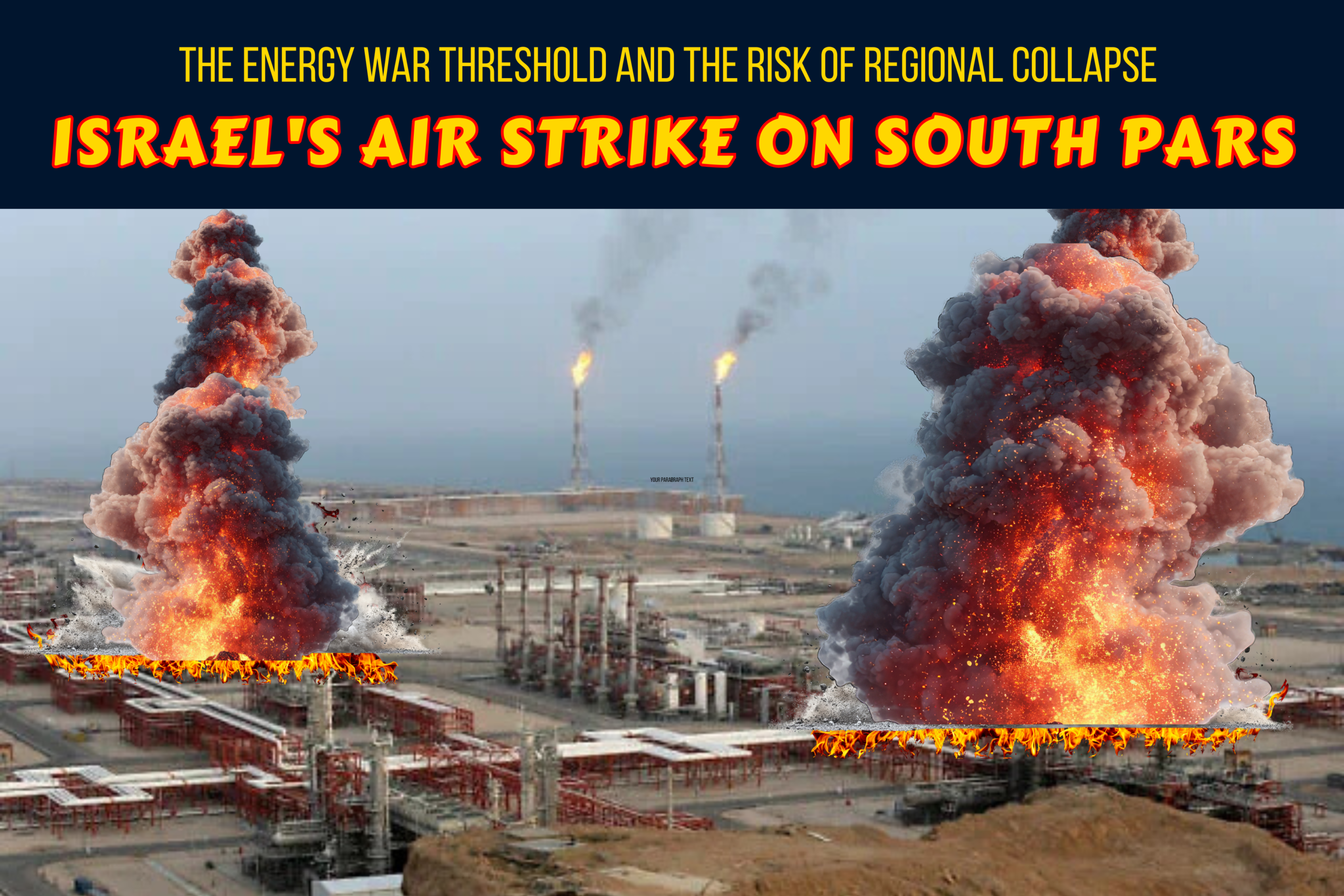
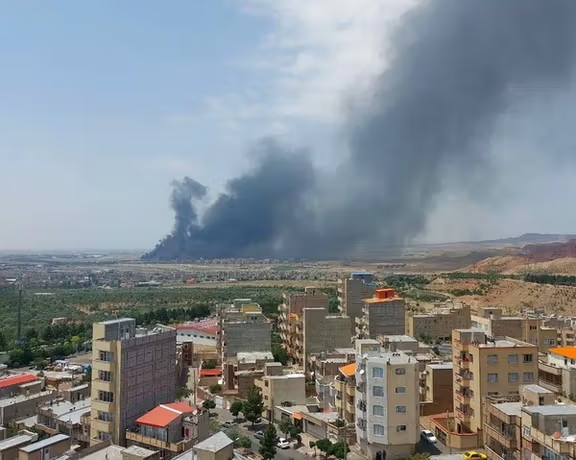
The smoke rising over Asaluyeh on the Persian Gulf coast marks more than a tactical strike; it signals a qualitative shift in the 2026 Iran-Israel conflict. For the first time, the war has moved beyond military installations, nuclear facilities, and leadership targets to strike the very engine of Iran’s economy: its energy infrastructure.
Reports emerging overnight indicate that Israeli aircraft, allegedly with U.S. logistical support, targeted the South Pars gas field—the world’s largest natural gas reserve, shared with Qatar. While neither Jerusalem nor Washington has issued an official confirmation, Iran’s Islamic Revolutionary Guard Corps (IRGC) has unequivocally blamed both nations, vowing retaliation that could engulf the entire Gulf region in flames.
This incident introduces a dangerous new dimension: economic warfare. By targeting upstream energy infrastructure, the conflict has crossed a red line that threatens not just Iran, but global energy security, regional stability, and the civilian populations dependent on Gulf gas and water supplies.
I. The Incident: What We Know
On March 18, 2026, precision airstrikes struck the South Pars gas field’s Phase processing facilities in Asaluyeh, Bushehr Province, targeting gas storage tanks and processing units at the heart of the world’s largest natural gas reserve. Satellite imagery subsequently captured visible fires at the site, and Iranian officials confirmed that production was halted at two key refineries, though no fatalities have been independently verified. Iranian state media has focused its coverage on the scale of infrastructure damage rather than human casualties, emphasizing the economic impact of the attack. Iran’s Islamic Revolutionary Guard Corps (IRGC) has formally attributed the strike to Israel with alleged U.S. logistical support; however, as of this writing, neither Jerusalem nor Washington has issued an official statement confirming or denying involvement, leaving attribution pending formal acknowledgment.
Why South Pars Matters: South Pars is not merely an industrial site; it is Iran’s economic lifeline. It accounts for approximately 40% of Iran’s natural gas production and is critical for domestic electricity, heating, and industrial use. Furthermore, the field is geologically connected to Qatar’s North Field. Any damage to the shared reservoir or processing infrastructure risks affecting Qatar’s liquefied natural gas (LNG) exports, which supply energy to Europe and Asia.
II. Strategic Shift: From Military to Economic Warfare
1. Targeting the State’s Revenue
Previous phases of this conflict focused on degrading military capabilities (IRGC bases, missile sites) or leadership (assassinations of commanders). Striking South Pars targets state revenue. Iran relies on energy exports to fund its military, proxy networks, and domestic subsidies. Disrupting this flow is an attempt to cripple Tehran’s ability to sustain a prolonged war.
Analyst View:
“This is no longer about deterrence; it is about economic strangulation. If Israel can hit South Pars, it signals that no economic asset is off-limits. This invites reciprocal targeting of economic infrastructure across the region.”
2. The Civilian Infrastructure Dilemma
Energy facilities are dual-use: they support the military but also power civilian homes, hospitals, and desalination plants. Under International Humanitarian Law (IHL), attacking such sites is permissible only if they make an “effective contribution to military action” and the attack offers a “definite military advantage” proportionate to civilian harm.
Risk:
Gas field fires can release toxic sulfur and chemicals, affecting air quality for millions. Damage to co-located desalination plants could threaten water security in Iran’s arid south. This raises the specter of environmental warfare, a taboo since the Gulf War of 1991.
3. The Qatar Factor
Qatar is a key U.S. ally and host of major American military bases (Al Udeid). It also shares the South Pars field. Striking this site risks:
- Alienating a U.S. Partner: Qatar may view this as endangering its own sovereignty and economy.
- Collateral Damage: Misguided strikes could impact Qatari infrastructure, complicating Washington’s diplomatic position.
- Diplomatic Fallout: Qatar has already expelled Iranian attaches, signaling heightened tension .
III. Regional Fallout: The GCC in the Crosshairs
Iran has explicitly threatened retaliation against Gulf energy facilities. This is not an empty threat. Iran possesses ballistic missiles and drones capable of reaching:
- Saudi Arabia: Abqaiq and Khurais oil processing facilities (targeted in 2019)
- UAE: ADNOC terminals and strategic infrastructure
- Kuwait & Bahrain: Energy and port facilities
The Dilemma for GCC States:
| State | Vulnerability | Strategic Position |
|---|---|---|
| Qatar | High (Shared gas field) | Mediator role compromised; forced to choose sides |
| Saudi Arabia | High (Oil infrastructure) | Seeking de-escalation; Vision 2030 at risk |
| UAE | Medium-High (Trade hub) | Balancing US security ties with Iran trade relations |
| Kuwait | Medium (Proximity to Iran) | Host to US forces; vulnerable to proxy fire |
Pakistan’s Concern:
As a key partner of both Saudi Arabia and China (via CPEC), Pakistan watches closely. Disruption in Gulf energy supplies affects Pakistan’s oil imports (often on deferred payment facilities). Regional instability also threatens CPEC’s western flank and Pakistan’s own energy security plans.
IV. Global Market Reaction
Immediate Impact:
- Crude Oil Futures: Surged significantly on news of the strike
- Natural Gas Prices: European and Asian LNG benchmarks spiked
- Insurance Rates: War risk premiums for Gulf shipping expected to rise sharply
Long-Term Risks:
- Supply Disruption: If South Pars production remains offline for weeks, global gas markets could tighten.
- Inflation: Energy price spikes feed into global inflation, complicating economic recovery in Europe and Asia.
- Strait of Hormuz: Any Iranian retaliation could threaten shipping lanes, through which ~20% of global oil passes.
V. Iran’s Response: The Escalation Ladder
Iran faces a critical choice: respond proportionally and risk further escalation, or respond symbolically and risk appearing weak.
| Option | Method | Risk Level |
|---|---|---|
| Direct Missile Strike | Target Israeli energy or military sites | High (Risk of all-out war) |
| Proxy Attack | Hezbollah/Houthis hit Gulf energy facilities | Medium-High (Plausible deniability, but risks GCC retaliation) |
| Strait Pressure | Harass shipping, raise insurance costs | Medium (Economic pain without direct conflict) |
| Cyber Warfare | Attack Israeli/Gulf utility grids | Medium (Deniable, disruptive) |
| Diplomatic Rally | Seek UN/OIC condemnation of “energy terrorism” | Low (Symbolic, builds political capital) |
Most Likely Scenario:
A hybrid response. Iran may launch limited direct strikes to save face while empowering proxies to pressure Gulf states, signaling that regional energy security is now hostage to the conflict.
VI. Legal and Humanitarian Implications
International Law Questions:
- Proportionality: Does the military gain of disrupting Iran’s gas revenue justify the risk to civilian energy/water supplies?
- Distinction: Can gas processing facilities be clearly distinguished from civilian infrastructure?
- Environmental Protection: ENMOD Convention and Geneva Protocols prohibit widespread, long-term environmental damage.
Humanitarian Risk:
- Air Quality: Toxic emissions from gas fires affect civilian health.
- Water Security: Desalination plants often rely on co-located power; energy disruption threatens water access.
- Economic Harm: Civilian populations suffer from inflation, job losses in energy sectors, and supply chain disruptions.
VII. The Path Forward: De-escalation or Abyss?
For the United States: Washington faces a contradiction: supporting Israel’s right to defend itself while protecting Gulf allies and global energy markets. Pressure must be applied to prevent further strikes on economic infrastructure.
For Israel: While the strike demonstrates reach and capability, it risks unifying Iran’s population behind the regime and drawing Gulf states into the conflict. Strategic gains must be weighed against regional isolation.
For Iran: Retaliation is inevitable, but targeting civilian energy infrastructure in GCC states could turn regional neighbors against Tehran. Restraint in target selection is crucial to avoid isolating itself further.
For the Region (Pakistan & GCC):
- Diplomatic Surge: Immediate high-level talks needed to prevent spillover.
- Energy Security: Diversify supply routes, increase strategic reserves.
- Defence Posture: Enhance air defence cooperation without escalating tensions.
VIII. Conclusion: The War Has Changed
The strike on South Pars is a Rubicon moment. Once energy infrastructure becomes a legitimate target, the conflict expands from a military duel to an economic war of attrition that threatens every nation in the Gulf.
For Pakistan, the message is clear: regional stability is not abstract. It is tied to energy flows, trade routes, and security partnerships. The coming days will test whether diplomatic off-ramps still exist, or whether the region is sliding into a conflict where everyone’s economy is a battlefield.
The smoke over Asaluyeh is not just burning gas. It is burning the remaining guardrails of this war.