(By Khalid Masood)
In the early hours of a March 2026 morning, as Pakistan Air Force jets returned from strikes against terrorist sanctuaries in eastern Afghanistan, a different kind of battle was already raging across social media platforms, newsrooms, and diplomatic cables worldwide. The Taliban government in Kabul claimed that Pakistani bombs had hit a “mental hospital,” killing innocent civilians. Within hours, images of grieving families and damaged buildings flooded Twitter, Facebook, and WhatsApp groups. International media outlets, scrambling for confirmation, led their bulletins with the hospital claim.
By midday, Pakistan’s Inter-Services Public Relations (ISPR) directorate had issued a detailed response: the facility was not a medical institution but a suicide bomber training camp and ammunition depot. Surveillance footage showed continuous secondary explosions consistent with weapons stockpiles. Intelligence intercepts linked the site to Tehrik-e-Taliban Pakistan (TTP) command structures. Yet, despite the evidence package ISPR assembled, the initial narrative had already taken root in many international outlets.
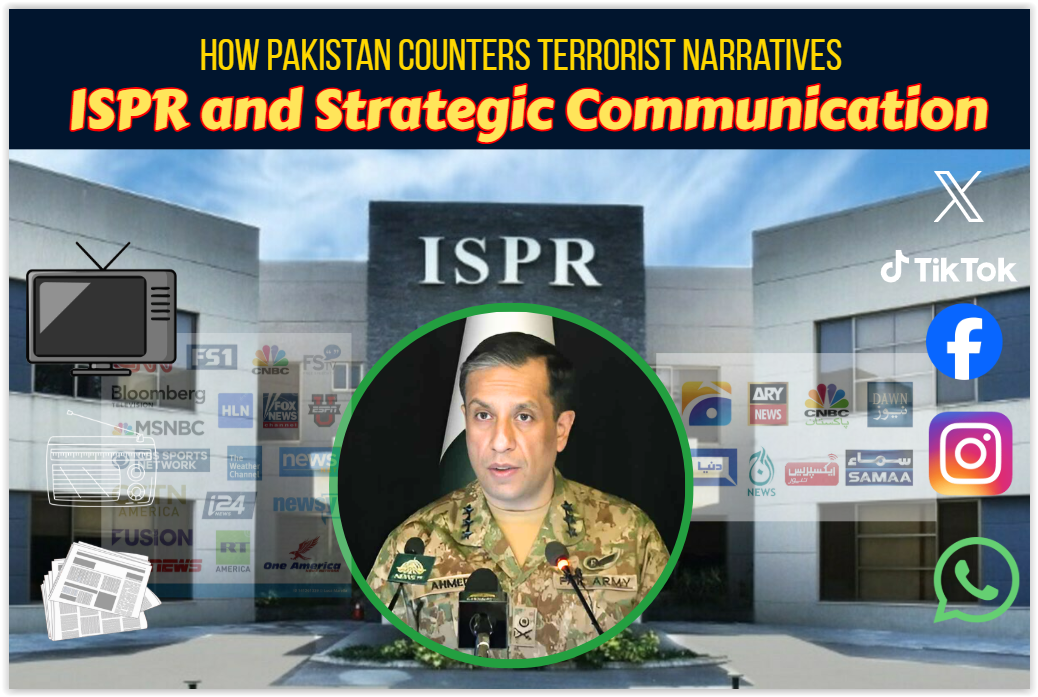
This incident encapsulates the modern reality of warfare: military operations are fought on two battlefields simultaneously—the physical and the informational. In the 21st century, victory requires success on both. For Pakistan, facing an insurgency that weaponizes information as ruthlessly as it employs violence, the Inter-Services Public Relations directorate has evolved from a traditional military media office into a sophisticated strategic communication apparatus. Its mission: to counter terrorist propaganda, provide verified information during security operations, maintain public trust, and ensure that Pakistan’s story is told accurately in an increasingly complex and hostile information environment.
This article examines ISPR’s strategic communication methods, evaluates their effectiveness against terrorist narratives, and explores the ethical challenges of military-media relations in a democracy.
I. Historical Context: From Press Releases to Strategic Communication
The Inter-Services Public Relations directorate was established in 1949, shortly after Pakistan’s independence, as the military’s official media liaison office. In its early decades, ISPR’s mandate was relatively narrow: issuing press releases, coordinating wartime censorship, and managing relationships with a small cadre of newspaper correspondents. During the 1965 and 1971 wars with India, information control was paramount, and ISPR operated under strict security protocols that prioritized operational secrecy over public transparency.
The 1999 Kargil conflict marked a turning point. Pakistan faced intense international scrutiny, and the military’s limited media engagement strategy proved inadequate in shaping global opinion. The lesson was clear: in an era of 24-hour news cycles and satellite television, information vacuums would be filled by adversaries, not allies.
The post-2001 era brought unprecedented challenges. As Pakistan became the frontline state in the Global War on Terror, the military launched major counter-terrorism operations across Khyber Pakhtunkhwa and Balochistan. Each operation required not just military success but public support, particularly as operations displaced civilians and caused economic disruption. ISPR’s mandate expanded dramatically: it now needed to explain complex security operations, justify civilian costs, counter terrorist propaganda, and maintain morale on the home front.
The digital revolution accelerated this transformation. The proliferation of smartphones, social media platforms, and citizen journalism meant that information spread faster than any official press release. Terrorist groups like the TTP and ISIS-Khorasan established sophisticated media wings, producing high-quality videos, multilingual propaganda, and viral social media campaigns. ISPR had to adapt or risk irrelevance.
Today, ISPR operates as a multi-platform strategic communication organization with distinct functions:
| Period | Development | Significance |
|---|---|---|
| 1965/1971 Wars | Traditional wartime censorship | Information control as security imperative |
| 1999 Kargil | Limited media engagement | Lessons in narrative management |
| 2001-2014 | Counter-terror operations begin | Need for public support, casualty transparency |
| 2014-2019 | Zarb-e-Azb, Radd-ul-Fasaad | Integrated media strategy, civilian harm mitigation messaging |
| 2021-Present | Afghan Taliban return, TTP resurgence | Information warfare against cross-border terrorism |
The modern ISPR mandate encompasses:
- Countering terrorist propaganda across digital platforms
- Providing verified information during security operations
- Maintaining public trust in military institutions
- Coordinating with civilian government messaging
- Engaging international media and diplomatic audiences
- Conducting strategic influence operations
II. Core Functions: How ISPR Operates
ISPR’s operational architecture is designed for speed, accuracy, and reach. Its core functions can be categorized into five interrelated domains:
A. Information Dissemination
ISPR maintains a continuous flow of information through multiple channels:
| Function | Method | Platform |
|---|---|---|
| Operational Updates | Press releases, press conferences | Traditional media, social media |
| Casualty Figures | Verified reports, ISPR statements | Official website, Twitter/X |
| Intelligence Assessments | Selective disclosure | Background briefings, attributed statements |
| Human Interest Stories | Soldier profiles, civilian impact | Video content, photo essays |
The directorate issues dozens of press releases monthly, covering everything from routine training exercises to major counter-terrorism operations. During active operations, the tempo increases dramatically, with updates issued hourly or even more frequently.
B. Counter-Narrative Operations
This is perhaps ISPR’s most critical and challenging function. Terrorist groups exploit civilian casualties, sovereignty violations, and religious framing to delegitimize Pakistani security operations. ISPR monitors these narratives continuously and responds through:
Monitoring: A dedicated team tracks terrorist propaganda on social media platforms, regional news outlets, and international media. They use advanced analytics tools to identify trending narratives, measure reach and engagement, and detect coordinated disinformation campaigns.
Rapid Response: When false claims emerge, ISPR aims to counter them within hours, not days. The goal is to prevent misinformation from crystallizing into accepted fact. This requires pre-approved messaging templates, on-call spokespersons, and direct access to operational commanders for verification.
Fact-Checking: ISPR provides evidence-based corrections using satellite imagery, blast pattern analysis, intercepted communications, and human intelligence. For example, in responding to the “mental hospital” claim, ISPR cited surveillance footage showing continuous secondary explosions—evidence inconsistent with a civilian medical facility.
Pre-bunking: Increasingly, ISPR attempts to anticipate terrorist narratives and address them proactively. Before major operations, the directorate may release background information about target areas, expected civilian presence, and measures taken to minimize harm. This reduces the information vacuum that adversaries exploit.
C. Media Relations
ISPR maintains relationships with hundreds of journalists across Pakistan and internationally:
- Embedding Programs: During major operations, select journalists are embedded with military units, providing controlled access to the battlefield. This builds credibility but requires careful management to balance transparency with operational security.
- Regular Briefings: ISPR conducts daily or weekly press briefings with senior military officers, providing updates on security situations, operational outcomes, and strategic context.
- Background Briefings: For senior editors and analysts, ISPR offers off-the-record or background briefings that provide deeper context without revealing sensitive sources or methods.
- International Engagement: ISPR maintains relationships with correspondents from BBC, CNN, Al Jazeera, Reuters, AP, and other major outlets, recognizing that international opinion shapes diplomatic and strategic outcomes.
D. Digital Strategy
ISPR’s digital presence is its most visible and rapidly evolving function:
Platforms: Twitter/X serves as the primary platform for rapid updates, with over [follower count] followers. Facebook, YouTube, and Instagram extend reach to different demographics. The official website (ispr.gov.pk) serves as an archival record of press releases and statements.
Content Mix:
- Operational updates (40%)
- Human interest stories (25%)
- Historical context and myth-busting (20%)
- Institutional promotion (15%)
Engagement: ISPR actively responds to queries, corrects misinformation, and amplifies supportive voices. During crises, the directorate operates 24/7 social media teams to monitor and respond in real-time.
Metrics: While ISPR does not publicly release detailed analytics, internal assessments track reach, engagement rates, sentiment analysis, and narrative dominance (who sets the framing of key issues).
E. Coordination Mechanisms
Strategic communication requires alignment across government:
- Ministry of Information: Coordination on broader government messaging
- Foreign Office: Alignment on international diplomacy and cross-border issues
- Civilian Government: Crisis communication coordination (though political divisions sometimes complicate this)
- Intelligence Agencies: Information sharing on terrorist propaganda and disinformation campaigns
III. Case Study: Recent Afghanistan Strikes (March 2026)
The Pakistan Air Force strikes against terrorist sanctuaries in Afghanistan in February-March 2026 provide a revealing case study of ISPR’s strategic communication in action.
The Narrative Challenge
When Pakistani jets crossed into Afghan airspace, the Taliban government faced a legitimacy crisis. Admitting that terrorists operated freely from Afghan soil would undermine their claims of control. Instead, they chose a different narrative:
Taliban Claims:
- “Pakistan violated Afghan sovereignty”
- “A mental hospital was struck, killing civilians”
- “These are unprovoked acts of aggression”
International Media Response:
- Initial reports often led with Taliban claims
- “He said/she said” framing dominated coverage
- Limited context on cross-border terrorism
Social Media Dynamics:
- Emotional images of damaged buildings spread rapidly
- Hashtags like #PakistanAggression trended
- Unverified casualty figures multiplied
Pakistani Imperative:
- Justify strikes as self-defense under Article 51 of UN Charter
- Counter civilian harm allegations
- Demonstrate TTP presence at target sites
- Maintain domestic support while managing international criticism
ISPR’s Response Strategy
ISPR executed a phased communication campaign:
| Timeline | Action | Content | Platform |
|---|---|---|---|
| Immediate (0-2 hrs) | Initial statement | Confirmation of strikes, target rationale | Twitter/X, press release |
| Short-term (2-24 hrs) | Detailed briefing | Intelligence basis, target coordinates, blast analysis | Press conference, video |
| Medium-term (1-7 days) | Evidence package | Satellite imagery, intercepts, secondary explosion analysis | Website, media briefings |
| Long-term (1-4 weeks) | Contextual narrative | Pattern of TTP attacks, diplomatic efforts exhausted | Op-eds, international media |
Phase 1: Immediate Response (0-2 hours) Within 45 minutes of strike completion, ISPR issued a brief statement on Twitter/X:
“Pakistan Air Force conducted precision strikes against confirmed TTP terrorist infrastructure in eastern Afghanistan. Targets included command nodes, ammunition depots, and training facilities. Operations were based on credible intelligence and conducted with utmost care to minimize civilian risk.”
This established the frame: defensive, precision, intelligence-based, civilian harm mitigation.
Phase 2: Detailed Briefing (2-24 hours) ISPR Director Lieutenant General Ahmed Sharif Chaudhry held a press conference with:
- Maps showing target locations
- Timeline of TTP attacks from Afghan soil
- Intelligence summaries (sanitized)
- Explanation of blast pattern analysis
Phase 3: Evidence Package (1-7 days) ISPR released:
- Satellite imagery of target sites before/after strikes
- Video footage showing secondary explosions
- Declassified intercepts linking sites to TTP command
- Testimony from defectors or captured militants
Phase 4: Contextual Narrative (1-4 weeks) Senior officers published op-eds in international media, explaining:
- The pattern of cross-border terrorism
- Diplomatic efforts that preceded strikes
- Legal basis under Article 51 self-defense
- Pakistan’s humanitarian record (1.3 million Afghan refugees hosted)
The “Mental Hospital” Controversy
The Taliban’s claim that Pakistan struck a mental hospital became the central battleground of the information war.
Taliban Narrative:
- Facility provided medical care to vulnerable civilians
- 40+ patients and staff killed
- Deliberate targeting of protected site = war crime
ISPR Counter-Narrative:
- Surveillance footage showed continuous secondary explosions over 3 hours
- Blast patterns consistent with ammunition storage, not civilian structure
- Intercepted communications referenced “training schedules” and “martyrdom operations”
- Human intelligence confirmed site housed suicide bomber indoctrination program
- No medical equipment recovered from rubble
The Verification Challenge: No independent journalists or international organizations could access the site due to ongoing security conditions. The Taliban controlled the narrative on the ground; ISPR controlled the technical evidence. International media faced a dilemma: report competing claims (risking false equivalence) or investigate independently (impossible without access).
Outcome:
- Domestic Audience: Overwhelmingly accepted ISPR version; strong support for strikes
- International Media: Mixed. Some outlets (Reuters, AP) reported both claims with appropriate caveats. Others led with Taliban allegations.
- Social Media: Emotional Taliban content spread faster than ISPR’s technical analysis
- Diplomatic Impact: Some Western governments privately expressed concern; others acknowledged Pakistan’s self-defense rights
Effectiveness Assessment
| Metric | Success | Limitation |
|---|---|---|
| Domestic Audience | Strong support; narrative resonates | Preaching to converted; limited critical scrutiny |
| International Media | Some balanced reporting | Many outlets lead with Taliban claims; “he said/she said” framing |
| Social Media | Rapid dissemination of ISPR version | Algorithm favors emotional content; terrorist propaganda spreads quickly |
| Credibility | Trusted by Pakistani public | Skepticism among international observers; “official narrative” bias |
IV. Countering Terrorist Propaganda: Methods and Challenges
Terrorist organizations like TTP, BLA, and ISIS-K employ sophisticated information operations designed to:
- Delegitimize Pakistani state authority
- Recruit new members
- Intimidate local populations
- Attract international attention
- Exploit civilian casualties for propaganda value
Terrorist Narrative Tactics
| Tactic | Example | ISPR Counter |
|---|---|---|
| Civilian Casualty Amplification | Inflated numbers, emotional imagery | Verified figures, context on militant embedding |
| Sovereignty Violation Claims | “Pakistan attacks innocent Afghanistan” | Article 51 self-defense, cross-border terrorism evidence |
| Religious Framing | “Defending Muslims against aggressor” | Distinguish terrorists from Muslims; TTP as Khwarij |
| Victimhood Narrative | “Afghanistan/Pakistan oppressed by state” | State responsibility to protect citizens from terror |
| Conspiracy Theories | “False flag operations,” “deep state” | Evidence-based disclosures; transparency where possible |
ISPR’s Counter-Strategies
1. Evidence-Based Messaging ISPR increasingly relies on technical evidence:
- Satellite imagery from commercial providers
- Blast pattern analysis by explosives experts
- Signals intelligence (selectively declassified)
- Human source testimony
- Forensic analysis of recovered materials
Challenge: Classified intelligence cannot be fully disclosed without compromising sources and methods. ISPR must walk a fine line between transparency and security.
2. Framing and Language Word choice matters profoundly:
- “Martyrdom” for Pakistani casualties (cultural and religious resonance)
- “Fitna al Khwarij” for TTP (religious delegitimization—Khwarij refers to extremists who deviate from true Islam)
- “Defensive operations” not “aggression” (legal framing)
- “Terrorist sanctuaries” not “villages” (precision targeting emphasis)
Challenge: This language resonates domestically but may alienate international audiences unfamiliar with Pakistani cultural and religious context.
3. Speed vs. Accuracy Terrorist propaganda spreads instantly; verification takes time. ISPR faces constant pressure to respond quickly, but premature statements that require correction damage credibility.
Best Practice: Use qualifying language (“initial reports indicate,” “preliminary assessments suggest”) while committing to updates as verification proceeds.
Challenge: In the court of public opinion, the first narrative often sticks, even if later corrected.
4. Multi-Platform Engagement Different audiences consume information differently:
- Twitter/X: Rapid updates, journalist engagement
- Facebook: Longer-form content, community discussion
- YouTube: Video evidence, spokesperson briefings
- Instagram: Visual storytelling, human interest
- Traditional Media: In-depth analysis, spokesperson interviews
Challenge: Resource-intensive. Requires 24/7 monitoring, multilingual content creation, and platform-specific expertise.
Persistent Challenges
Access Constraints: Independent verification is often impossible in conflict zones controlled by terrorists or hostile governments. ISPR’s claims, however well-supported, cannot be independently confirmed.
Information Asymmetry: Terrorists need one viral image to shape opinion; ISPR must prove a negative (that a site was not a hospital) or provide complex technical analysis. Emotion beats evidence in the attention economy.
Credibility Gap: International observers, particularly in Western media and human rights organizations, approach official military narratives with skepticism. This is healthy democratic practice but creates challenges when terrorists lie systematically.
Resource Disparity: Terrorist propaganda networks are often leaner, more agile, and less constrained by bureaucratic approval processes. They can produce and distribute content faster than state institutions.
Democratic Tension: Transparency strengthens democracy but can compromise operational security. Classification protects sources but fuels conspiracy theories. There is no perfect balance.
V. Comparative Perspective: How Other Nations Handle Military Communication
Pakistan is not alone in facing these challenges. Examining how other nations approach military strategic communication provides valuable lessons:
United States (Pentagon/DoD Public Affairs)
Strengths:
- Extensive resources and global media infrastructure
- Embedded media program (since 1991 Gulf War)
- Rapid response teams and 24/7 operations
- Sophisticated digital and social media capabilities
Weaknesses:
- Bureaucratic delays in declassification and approval
- Perceptions of political interference (especially post-9/11)
- Credibility challenges after Iraq WMD claims
Lesson for Pakistan: Embedding journalists builds credibility but requires careful access control and realistic expectations about what can be shown.
India (Ministry of Defence/Army Public Information)
Strengths:
- Strong domestic narrative control
- Robust social media presence
- Coordination with civilian government
Weaknesses:
- Limited international engagement
- Transparency concerns, especially after Kashmir operations
- Tendency toward information suppression
Lesson for Pakistan: Domestic support is easier to maintain than international credibility; both are necessary for strategic success.
Israel (IDF Spokesperson)
Strengths:
- Highly sophisticated digital strategy
- Rapid video production and multilingual outreach
- Proactive narrative framing
- Advanced technical evidence (satellite imagery, intercepts)
Weaknesses:
- Often perceived as propaganda in Global South
- Credibility challenges among Arab and Muslim audiences
- Aggressive tone can backfire
Lesson for Pakistan: Technical excellence and speed don’t guarantee narrative success; cultural context and audience perception matter profoundly.
United Kingdom (MoD Communications)
Strengths:
- Professional media training for spokespersons
- Strong coordination with Foreign Office
- Historical credibility built over decades
- Willingness to acknowledge errors
Weaknesses:
- Resource constraints post-Brexit
- Slower response times than digital-native actors
- Balancing transparency with classification
Lesson for Pakistan: Institutional credibility is built over decades through consistency and honesty; it can be lost quickly through deception or incompetence.
Key Takeaways for Pakistan
- Invest in digital capabilities: Speed and visual content matter
- Balance transparency with security: Acknowledge what you can; explain why you can’t share the rest
- Build long-term credibility: Consistency and accuracy over time create trust
- Engage international media proactively: Don’t wait for crises to build relationships
- Train spokespersons: Media skills are professional competencies, not innate talents
- Acknowledge errors: Correcting mistakes transparently strengthens credibility; doubling down destroys it
VI. Ethical Considerations: Transparency, Propaganda, and Democracy
ISPR’s mission raises profound ethical questions about the role of military communication in a democratic society:
The Transparency Dilemma
Public Right to Know: In a democracy, citizens have the right to information about government actions, especially those involving lethal force and public resources. Military operations affect civilian lives, displace populations, and shape national security policy. Accountability requires information.
Operational Security: Full disclosure endangers lives. Revealing sources, methods, capabilities, or future plans can compromise operations and get soldiers and intelligence assets killed. There are legitimate secrets.
The Balance: The question is not whether to classify information but what, when, and for how long. Over-classification breeds distrust; under-classification risks lives.
Propaganda vs. Strategic Communication
The line between legitimate strategic communication and propaganda can blur:
| Strategic Communication | Propaganda |
|---|---|
| Evidence-based, verifiable | Emotionally manipulative, unverified |
| Acknowledges uncertainty | Presents speculation as fact |
| Corrects errors transparently | Doubles down on false claims |
| Serves public interest | Serves narrow political/military interest |
| Respects audience intelligence | Manipulates audience emotions |
The Challenge: In practice, the distinction can be subjective. What one person sees as patriotic messaging, another sees as manipulation. Intent matters, but so does effect.
Civilian Casualty Reporting
Perhaps the most ethically fraught area is reporting on civilian harm:
Ethical Imperative: When military operations cause civilian casualties, the state has a moral obligation to:
- Acknowledge harm promptly
- Investigate circumstances independently
- Provide accountability for mistakes
- Compensate victims and families
- Change procedures to prevent recurrence
Strategic Risk: Admissions of civilian harm can be exploited by adversaries for propaganda. Terrorist groups inflate casualty figures, stage scenes for cameras, and blame all deaths on military action even when militants were present.
Best Practice:
- Prompt acknowledgment of credible reports
- Independent investigation (possibly with third-party involvement)
- Transparent findings, even when inconvenient
- Compensation for verified civilian harm
- Procedural changes to prevent recurrence
The Reality: ISPR, like most military communication organizations, faces pressure to minimize civilian casualty reports. The ethical path—full transparency—can conflict with institutional and political interests.
Media Manipulation Concerns
Several practices raise ethical questions:
Embedding: Provides journalists access but may create dependency, limit critical perspective, and expose reporters to military influence.
Selective Disclosure: Releasing favorable information while withholding unfavorable details shapes narratives but may mislead the public.
Timing: Releasing bad news on slow news days (“Friday afternoon dump”) or during major events reduces visibility but undermines transparency.
Language: Euphemisms like “collateral damage,” “enhanced interrogation,” or “kinetic action” sanitize reality and distance audiences from the human cost of war.
Democratic Accountability
In a healthy democracy, multiple institutions provide oversight:
- Parliamentary Oversight: Legislative committees should review military communication practices and classify/declassify decisions
- Independent Media: Journalists must verify official claims, seek multiple sources, and investigate discrepancies
- Civil Society: Human rights organizations, think tanks, and academic researchers provide independent analysis
- Public Media Literacy: Citizens need critical thinking skills to discern credible information from manipulation
The Pakistani Context: Pakistan’s democratic institutions are still developing. Parliamentary oversight of military affairs is limited. Media freedom faces pressures from multiple directions. Civil society is vibrant but often polarized. These realities make ethical military communication both more challenging and more essential.
VII. The Path Forward: Recommendations for ISPR and Pakistani Strategic Communication
Based on this analysis, several recommendations emerge for strengthening Pakistan’s strategic communication capabilities:
Short-Term Improvements (0-6 months)
1. Rapid Response Team: Establish a dedicated 24/7 unit for monitoring emerging narratives and countering misinformation within the critical first hours. This team should have:
- Direct access to operational commanders for verification
- Pre-approved messaging templates for common scenarios
- Authority to publish without bureaucratic delays
- Multilingual capabilities (Urdu, English, Pashto, Arabic)
2. Evidence Packages: Develop pre-prepared templates for rapid evidence release:
- Standard formats for satellite imagery analysis
- Blast pattern explanation graphics
- Timeline reconstruction tools
- Declassification protocols for urgent situations
3. International Media Engagement: Expand proactive engagement with foreign correspondents:
- Regular briefings for international press corps
- English-language content expansion
- Dedicated international media liaison officers
- Facility visits and background briefings
4. Social Media Enhancement: Upgrade digital capabilities:
- Professional video production unit
- Infographic and data visualization team
- Multi-language social media accounts
- Engagement metrics and sentiment analysis tools
Medium-Term Reforms (6-18 months)
1. Independent Verification Mechanism: Partner with neutral organizations for civilian harm assessment:
- International Committee of the Red Cross (ICRC)
- UN human rights monitors
- Reputable NGOs with access and expertise
- Joint investigation protocols for contested incidents
Benefit: Third-party verification strengthens credibility even when findings are inconvenient.
2. Media Training Program: Regular workshops for journalists on:
- Security reporting best practices
- Source verification techniques
- Understanding military operations and terminology
- Ethical coverage of terrorism and conflict
Benefit: Better-informed journalists produce more accurate reporting.
3. Digital Forensics Unit: Technical capability to:
- Verify or debunk viral images and videos
- Detect deepfakes and manipulated media
- Trace disinformation campaigns to their sources
- Provide technical evidence for public release
Benefit: Counter sophisticated information operations with technical expertise.
4. Academic Partnerships: Collaborate with universities for:
- Research on strategic communication effectiveness
- Independent evaluation of ISPR performance
- Training programs for future communication professionals
- Conferences and knowledge-sharing initiatives
Benefit: External academic scrutiny improves practice and builds credibility.
Long-Term Strategy (18+ months)
1. Credibility Building: The most valuable asset is trust, built through:
- Consistent accuracy over time
- Transparent acknowledgment of errors
- Willingness to release inconvenient information
- Resistance to political pressure for deception
Timeline: Years, not months. But essential for long-term effectiveness.
2. Institutional Independence: Insulate ISPR from political interference:
- Professional promotion criteria based on competence, not loyalty
- Statutory protections for spokespersons who report accurately
- Clear separation between military communication and political messaging
- Oversight mechanisms to prevent abuse
Challenge: Requires political will and institutional maturity.
3. Regional Cooperation: Share best practices with neighboring states:
- GCC countries facing similar terrorism challenges
- Central Asian states managing cross-border security
- South Asian neighbors with shared media ecosystems
- Joint training exercises and information sharing
Benefit: Collective strength against transnational disinformation campaigns.
4. Public Media Literacy: Support educational initiatives:
- School curricula on critical thinking and media analysis
- Public awareness campaigns on identifying misinformation
- Partnerships with civil society organizations
- Digital literacy programs for vulnerable populations
Benefit: An informed public is the best defense against manipulation.
Metrics for Success
How should ISPR measure effectiveness?
| Category | Metrics |
|---|---|
| Domestic | Public trust surveys, media sentiment analysis, social media engagement rates |
| International | Balanced reporting ratio in foreign media, diplomatic feedback, international expert assessments |
| Operational | Speed of response (time to initial statement), accuracy rate (corrections required), verification time |
| Strategic | Narrative dominance (who sets the frame?), policy impact (did communication shape outcomes?), adversary adaptation (are terrorists changing tactics?) |
VIII. Conclusion: Winning the Battle of Narratives
The Inter-Services Public Relations directorate stands at the intersection of military operations, democratic accountability, and information warfare. Its mission is neither simple nor purely technical. ISPR must:
- Inform the public without compromising security
- Counter terrorist lies without telling its own
- Maintain credibility at home while building it abroad
- Serve the military institution while serving the democratic public
- Act swiftly while acting accurately
The recent Afghanistan strikes demonstrated both the necessity and the difficulty of this mission. When Pakistani jets crossed the border to strike terrorist sanctuaries, ISPR had to justify those strikes to multiple audiences with conflicting interests and worldviews. The directorate provided evidence, explained legal rationales, and countered false claims. Yet, in the absence of independent verification and amid competing narratives, the information battle remained contested.
This is the reality of modern conflict: there is no final victory in the information domain, only continuous struggle. Terrorist groups will continue to exploit civilian casualties, weaponize sovereignty claims, and spread disinformation. Adversary states will amplify these narratives for their own purposes. International media will struggle to verify claims in inaccessible conflict zones. And domestic audiences will demand both security and transparency.
For ISPR, the path forward requires:
Professional Excellence: Investing in training, technology, and expertise to match the sophistication of adversaries.
Ethical Commitment: Resisting the temptation to deceive even when deception might provide short-term advantage. Truth is the only sustainable foundation for credibility.
Democratic Accountability: Recognizing that ISPR serves the Pakistani people, not just the military institution. Transparency, within security constraints, is a democratic imperative.
Strategic Patience: Understanding that credibility is built over years through consistent honesty and accuracy. There are no shortcuts.
For the media, the responsibility is equally weighty: verify before amplifying, seek multiple sources, understand the difference between strategic communication and propaganda, and resist the gravitational pull of sensationalism.
For the public, the task is developing media literacy: questioning all narratives, demanding evidence, recognizing emotional manipulation, and understanding that in complex security situations, certainty is often impossible.
In the 21st century, military operations are fought on two battlefields: the physical and the informational. Victory requires success on both. ISPR’s mission is not merely to report the news, but to ensure that Pakistan’s story is told accurately, credibly, and compellingly—in the face of adversaries who weaponize information as ruthlessly as they employ violence.
The battle of narratives will continue. Pakistan’s ability to wage it effectively will shape not just military outcomes, but the nation’s democratic health, international standing, and long-term security.